How to Hunt the Lockdown Phase with a Bow
Hunt lockdown by watching for roughly a 1- to 3-day window around one receptive doe, then setting up near bedding with quiet access and a plan for one close shot. Miss the setup, and you waste a stand, bump deer, and lose the brief window. This guide covers how to confirm lockdown timing, read doe movement, and choose a low-disturbance bow setup for the shot.
What is the lockdown phase?
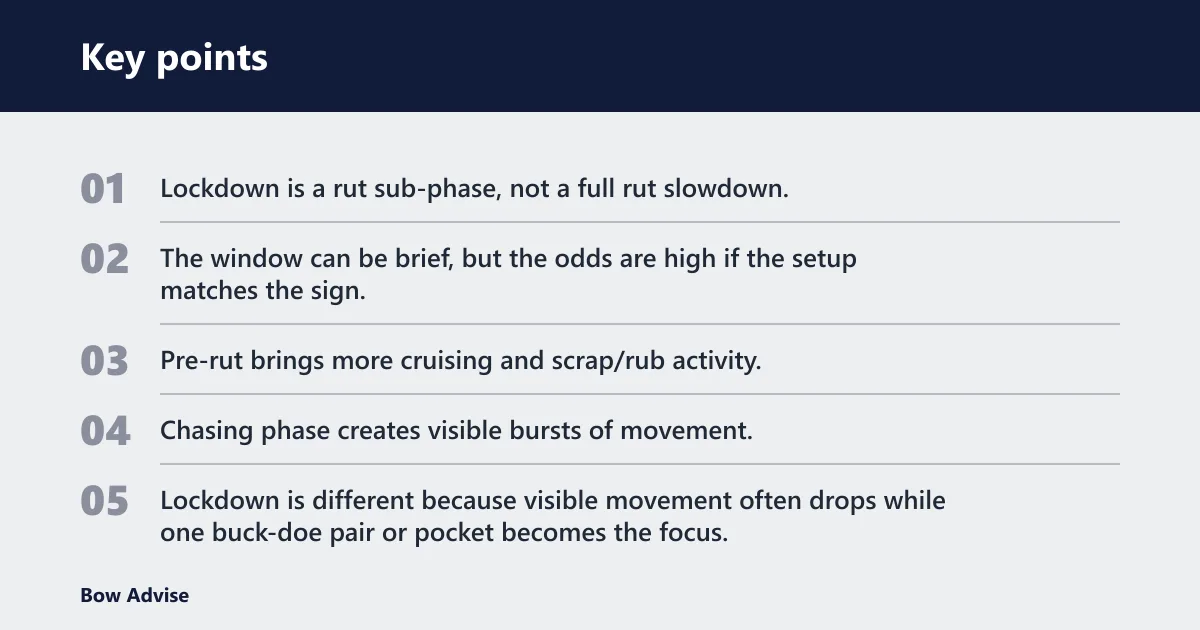

Lockdown is a rut sub-phase, not a full rut slowdown. It comes after the seeking phase and chasing phase, and before post-rut, when a mature buck may stay close to a receptive doe in or near bedding cover and show far less daylight movement.
That matters because the best target is usually one doe bedding pocket, not a random travel route. In many cases, the buck’s routine shrinks to short, cautious moves between thick cover, nearby escape cover, and the doe herself. The window can be brief, but the odds are high if the setup matches the sign.
Rut phase order and what it changes
Pre-rut brings more cruising and scrap/rub activity. Seeking phase pushes bucks to cover ground. Chasing phase creates visible bursts of movement. Lockdown is different because visible movement often drops while one buck-doe pair or pocket becomes the focus. Post-rut usually brings a return to feed-centered movement and less breeding pressure.
What lockdown sign really looks like
True lockdown sign usually appears as a cluster, not a single clue. Fresh rubs near thick cover, a doe bed pocket with recent disturbance, and very limited chase sign together suggest a buck may be holding one receptive doe. If chase sign is absent but the area still has fresh, localized sign, the buck may be bedded tighter than usual.
What you’ll need
- A bow set for close work, because bowhunting often requires closing distance to fewer than 30 yards.
- A quiet stand or blind site with a clear shot lane into bedding edge cover.
- Binoculars for checking beds, trails, and fresh sign from a distance.
- Wind check tools and a clear access plan.
- Calls carried lightly: a grunt tube and, if used at all, rattling gear.
- Quiet clothing and a silent setup routine.
- A shot plan that keeps you ready for a short-range shot opportunity.
How to hunt a lockdown pocket
The best lockdown setup starts with a doe bedding edge, then a downwind access route, then a short-range shot plan. Hunt the pocket only when the sign points to one receptive doe nearby. If the sign is vague, treat it as a false lull and keep looking instead of forcing a sit.
Find the bedding edge. Look for thick thermal cover, isolated sanctuary edges, and doe beds close to one another. The goal is a pocket where a buck can hold tight without exposing himself to open ground.
Confirm the sign cluster. Fresh rubs, fresh tracks, and limited movement in and out of one cover patch matter more than broad rut activity. If the area only shows old sign, move on and save the setup.
Plan the access route. Use a downwind entry that avoids crossing active deer trails. Keep noise low, avoid skylining yourself, and assume the deer are already close. One clumsy walk-in can end the sit before daylight.
Set for short shot distance. Position the stand for a clean opening into the pocket and be ready for a close shot. A multi-pin sight can help, but the shot lane should be built around the likely roughly 20- to 30-yard window, not long observation.
Stay ready, not active. Sit still, keep the bow within reach, and avoid repeated stand movement. Lockdown deer often move once, then disappear again.
Suppose a fresh rub shows on the downwind edge of a secluded doe bed, but there is no broad chase sign. That can still be a strong lockdown clue if the rub is new and the bedding cover is tight. The response is a quiet sit on the bedding edge, not a long walk through the center of the cover.
What stand works best?
The best stand location during lockdown is usually on the edge of bedding cover with a wind that protects the bedding area and the likely exit route. Because deer movement is reduced, stand choice matters more than during a busier rut phase. A poor wind or a noisy approach can erase the whole window.
Bedding-cover setups
Put the stand where you can cover the pocket without flooding it with scent. In tight cover, the setup should let you intercept a buck slipping between a doe bed and the nearest escape route. Do not set up so deep that your scent reaches the bed before you do.
Wind and thermal checks
Wind direction is the first filter. In hill country, morning thermals usually tend to fall downhill and afternoon or evening thermals usually rise uphill, so the same spot can change from safe to poor as the day runs on. Check both the steady wind and the thermal pattern before committing.
A common first-timer mistake is picking a stand for the trail shape instead of the bedding shape. That often leaves the hunter too far from the doe security cover. A better setup trims distance, keeps the approach quiet, and protects the side the deer are most likely to use.
Lockdown decision table
Use this table to decide whether to sit, shift, or wait. The sign has to point to a specific buck-doe pocket, not just general rut activity.
| Observable sign | What it likely means | The correct bowhunting response |
|---|---|---|
| Fresh rubs near thick bedding cover | A buck is likely working tight cover near a doe pocket, but the area may still be mobile and current | Set up on the bedding edge with quiet access, and keep the shot plan inside close range |
| Isolated doe bedding | Security cover may be holding one receptive doe and a guarding buck | Hunt the downwind edge, stay off the bed itself, and focus on one likely exit line |
| Absence of chase sign | The deer may be locked down rather than running widely through the area | Do not chase sign; sit the pocket and wait for a short move instead of switching to a travel corridor |
| Low daylight movement | Activity is compressed and may happen once, often near the bed or a nearby edge | Choose a longer sit only if the access is clean and the wind stays favorable; otherwise save the spot |
| Morning sit versus afternoon sit | Morning can catch a buck returning to or staying near bedding; afternoon often better if deer rise late from cover | Match the sit to the thermal pattern and bedding layout, not a fixed rule |
Should you sit all day during lockdown?
An all-day sit makes sense when you have strong sign, a tight bedding pocket, and access that will not disturb deer. Because movement may happen once, a morning-to-evening hunt window can be the right call. It is not a universal rule, though; a weak setup is still a weak setup at noon.
Use an all-day sit when food, water, and patience are available and the wind stays usable. If the access route is risky, or the sign is thin, a shorter sit is often better than forcing a long day that alerts the pocket. A weak sit can educate deer for the rest of the window.
When to hunt shorter windows
Choose a shorter sit if fresh sign is scattered, the bedding edge is uncertain, or the wind shifts toward the beds. A common failure case is sitting too long in bad conditions and giving away the setup before the deer ever move. Shorter windows work best when the sign is weak and the risk is high.
Do calls still work?
Calling can still work during lockdown, but restraint matters more than volume. A grunt call or a light rattling sequence may pull a responsive buck if he is still checking nearby cover, yet overcalling can push a guarded doe or her buck out of range. Use calls only when the setup and sign support it.
Grunts and rattling in lockdown
Start with minimal calling. If the deer are already close and not responsive, more noise usually adds risk. A short grunt sequence is the safer first move, and rattling should stay limited to situations where nearby deer are already active and receptive.
If that does not work, stop calling and stay silent. The next move is often to let the pocket settle and force the deer to make the mistake, not to keep adding noise. In lockdown, silence can be the better tactic after one careful try.
When to stay silent
Stay silent when you know the deer are bedded close, when visibility is low, or when the approach already carried risk. Overcalling is one of the fastest ways to blow a tight bedding setup. The less certain the pocket, the less noise belongs in it.
Common mistakes
The biggest mistake is treating lockdown like a generic rut lull. That leads to hunting the wrong travel line, overcalling, or expecting broad movement that never comes. Lockdown is usually about one receptive doe and one narrow pocket of daylight movement.
- Overcalling before confirming a responsive deer.
- Hunting the wrong bedding edge instead of the edge tied to doe security cover.
- Bumping deer on access by crossing active trails or using a loud route.
- Sitting too far from the pocket and losing the short-range shot chance.
- Ignoring wind shifts and thermal changes in tight cover.
Picture a hunter setting up on a main trail 60 yards from bedding because it “looks like rut sign.” The deer may pass nowhere near that lane during lockdown. The better move is to shrink the setup around the bedding edge and the likely short exit route.
Frequently asked questions
What is the lockdown phase of the rut?
Lockdown is the period when a buck may stay close to a receptive doe and cut daylight movement sharply. It usually matters most around the core of local rut timing, not as a post-rut cleanup phase. Hunt it as a short, high-odds ambush window near bedding cover.
When do bucks move during the lockdown phase?
Movement is often brief and close to cover, with a possible move to or from a doe bedding pocket. The best chance is usually at a bedding edge, not on a broad travel route. A close shot is more likely than a long watch session.
Should I still hunt all day during lockdown?
Yes, if the sign is tight, the access is quiet, and the wind is right. A morning-to-evening sit can make sense when a buck may move only once. If the setup is weak, a shorter sit is safer than teaching the pocket your presence.
What stand location works best when does are being bred?
A stand on the downwind edge of doe security cover usually works best. The key is to stay close enough for a short shot while keeping scent out of the bed itself. Tight cover and a clean exit lane matter more than a long view.
Do grunt calls or rattling still work during lockdown?
They can, but only when deer are responsive. Start light with a short grunt and avoid repeated rattling if nothing changes. In a tight lockdown pocket, less noise is usually safer than more, especially when the deer are already near bedding.
How do I hunt bedding cover without bumping deer during lockdown?
Use a downwind access route that avoids crossing active trails, and set up before the deer settle into the pocket. Keep noise low, stay out of the bed itself, and use the first safe edge outside the core bedding area. Tight cover punishes mistakes fast.
What wind and access conditions matter most for a lockdown hunt?
Wind direction has to protect the bedding area and the likely exit route. In hill country, morning thermals usually fall downhill and afternoon or evening thermals usually rise uphill, so the same setup can change through the day. If the access is loud or exposed, the hunt is compromised.
Can a lockdown hunt still produce a mature buck even if movement is low?
Yes. Low movement is exactly why a mature buck can become more predictable around one receptive doe and one pocket of bedding cover. The catch is that the setup has to be tight, quiet, and ready for a close shot rather than a long observation period.