How to Aim a Bow Without a Peep Sight Using Gap Shooting
Learning to shoot a bow is exciting. Sometimes, your bow might not have a peep sight. This can make aiming feel tricky.
You might wonder if you can still shoot straight. The good news is, yes, you absolutely can. It just takes a little practice and a few smart tricks.
We’ll walk through how to aim your bow accurately, even without that little peep.
It is possible to aim a bow without a peep sight by using your eye as a reference point for consistent anchor and drawing straight back. Focus on developing a solid shooting form, including a stable stance, proper grip, and a consistent draw length. Aiming techniques involve aligning your eye with the arrow and target, often by using the arrow’s shaft or the bow’s sight window as a guide. Patience and consistent practice are key to achieving accuracy.
What Is a Peep Sight and Why Do People Use It?
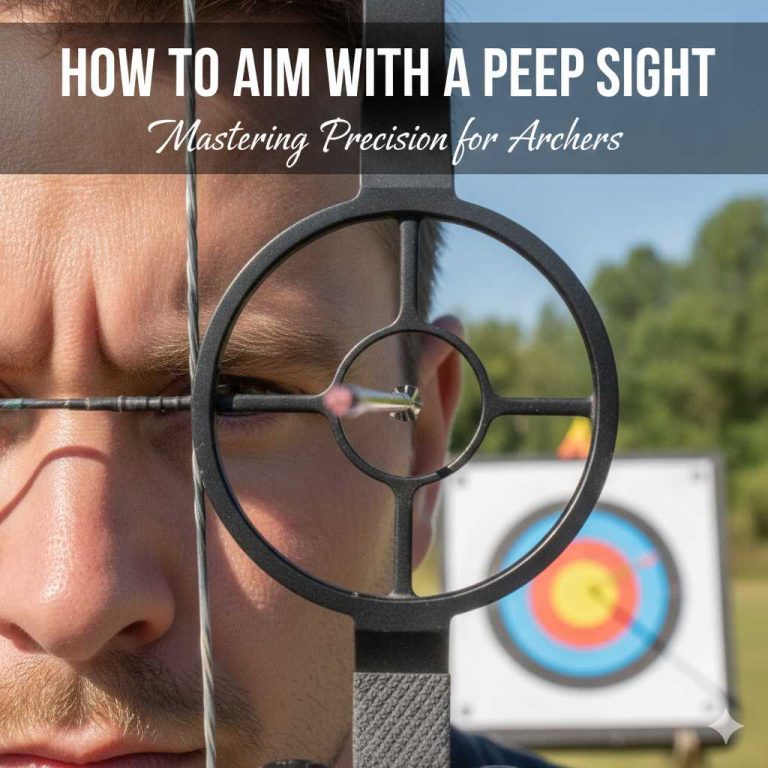
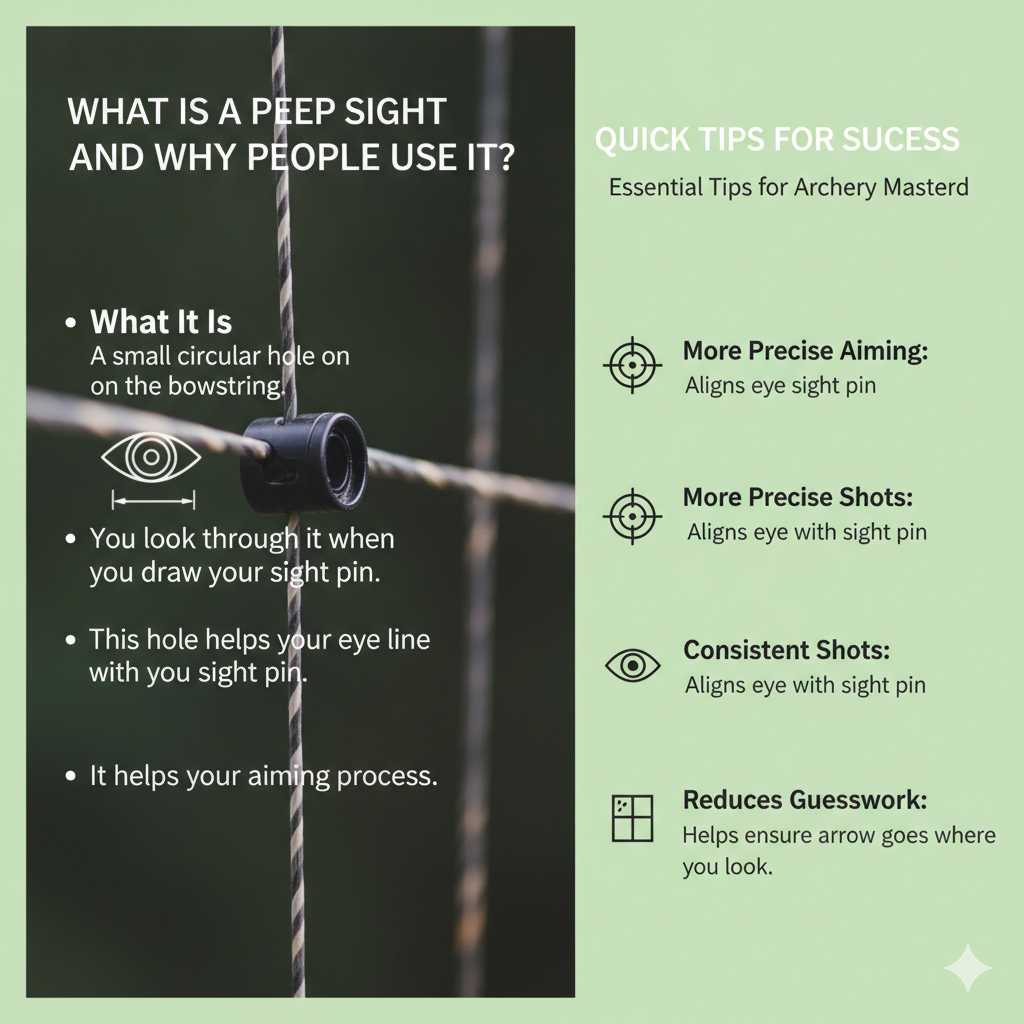
A peep sight is a small circular hole. It’s put on the bowstring. You look through it when you draw the bow.
This hole helps your eye line up with your sight pin. It makes aiming more precise. Many archers like it because it gives them a clear point of focus.
It helps keep your eye in the same spot every time. This leads to more consistent shots.
Think of it like looking through a tiny window. This window helps you aim at your target. It removes guesswork.
You don’t have to guess where your eye should be. It guides your aiming process. This is especially helpful when you’re excited or a bit nervous.
It simplifies the aiming step. It helps ensure your arrow goes where you look.
Why Might You Shoot Without a Peep Sight?
There are a few reasons you might find yourself aiming without a peep sight. Maybe your bow is new and doesn’t have one yet. Or perhaps you prefer a simpler setup.
Some archers feel a peep sight restricts their vision. They like having a wider field of view. It could also be that your peep sight broke.
You need to shoot, but can’t replace it right away.
Whatever the reason, it’s not the end of the world. Many skilled archers have shot for years without one. They rely on their own skill and a good understanding of their bow.
They learn to adapt. They find other ways to achieve the same accuracy. It’s about building a different kind of muscle memory.
It’s about trusting your own body.
Understanding Your Eye as a Sight
Your eye is a very powerful tool. When you shoot a bow, your dominant eye is your natural sight. When you don’t have a peep, your eye needs a different anchor.
This anchor helps you aim consistently. You need to know where to place your eye behind the arrow. This will be your new “peep.”
The goal is to get your eye in the exact same spot every single time you shoot. This spot should be lined up with your arrow and your target. It becomes your aiming point.
It takes practice to make this consistent. But once you do, you’ll be amazed at how accurate you can become. It’s like training your eye to be your own peep sight.
The Importance of Consistent Anchor Point
Your anchor point is where your drawing hand rests. It usually touches your face. This spot must be the same for every shot.
If your anchor moves, your aim will move too. This is crucial when you don’t have a peep. It’s your main reference for lining up your shot.
Common anchor points are the corner of your mouth or under your jawbone. Some archers touch their earlobe. Find a spot that feels natural and comfortable for you.
Practice drawing your bow to that spot. Make sure your release hand is always in the same place. This consistency is the bedrock of good shooting without a peep.
Developing a Solid Stance and Grip
Before we even talk about aiming, let’s touch on the basics. A good stance is key. Stand with your feet shoulder-width apart.
Your body should be sideways to the target. Your weight should be balanced. This creates a stable base.
You won’t wobble when you shoot.
Your grip on the bow is also important. Don’t hold the bow too tight. This can twist the bow.
It affects the arrow’s flight. A light, relaxed grip is best. Let the bow rest in your hand.
Your grip hand should be like a hinge. This prevents torque. It helps the arrow fly true.
Drawing Straight Back: The Invisible Peep
When you draw your bowstring, you want to pull straight back. Don’t pull sideways. Pulling straight back ensures your arrow stays aligned.
It’s like the string is a straight line. Your eye follows this line. This is where your “invisible peep” comes into play.
Your eye stays on that line.
Imagine your arrow is a laser beam. You want to keep that laser beam pointed at the target. Pulling straight back helps maintain that path.
It stops the arrow from veering off course before it even leaves the bow. This is a skill that takes practice. But it’s one of the most important things you can do for accuracy.
Aiming Without a Peep: Common Methods
There are a few popular ways to aim when you don’t have a peep sight. Each one uses your eye and the bow differently. Let’s explore them.
You can find what works best for you.
Aiming Method 1: Arrow Spine Alignment
This is a very common method. You draw the bow to your anchor point. Then, you align the arrow shaft with the target.
You look down the length of the arrow. Your eye should be behind the nock of the arrow. You can use the bow riser as a guide too.
See where the arrow points.
Aiming Method 2: Gap Shooting
Gap shooting involves aiming slightly above or below your target. You learn to see the “gap.” This gap is the space between your arrow’s point and the actual target. It depends on the distance.
You use your anchor point to judge this gap. It’s a feel thing that comes with practice. You adjust your aim based on the gap you see.
Aiming Method 3: String Walking
This is similar to gap shooting. But you physically move your hand up or down the bowstring. Moving your hand changes your anchor point.
A higher anchor point typically shoots lower. A lower anchor point typically shoots higher. You use this movement to adjust your aim for distance.
It’s a very precise method.
I remember my first time trying to shoot without a peep. I felt lost. I kept missing the target.
My arrows were all over the place. I tried aligning the arrow shaft. But my draw wasn’t consistent.
One day, I was watching a seasoned archer. He wasn’t using a peep either. He talked about his anchor.
He said it was his most important guide. I went home and practiced just drawing to the same spot. It felt awkward at first.
My arm got tired. But slowly, I started to feel it. My shots got closer together.
It wasn’t perfect, but it was a start. That feeling of hitting the same spot on the target was amazing. It showed me it was possible.
Fine-Tuning Your Aim: Using the Sight Window
The sight window is the opening in your bow’s riser. This is where the arrow passes through. You can use the edges of this window to help aim.
When you draw back, you can see your target through this window. You can also see the arrow. Try to keep the arrow centered in the sight window.
Your eye should be at the back of the arrow. You can then judge your aim. Is the arrow pointing at the target?
Is it aligned with your anchor? The edges of the sight window can act as a frame. This frame helps you keep everything steady.
It helps you see if you’re dropping your bow arm. Or if your draw is crooked. It’s another visual cue to help you stay on track.
How Distance Affects Your Aim
Distance is a big factor. The farther away your target is, the more you need to adjust your aim. Without a peep, this adjustment might feel harder.
Your arrow drops as it travels. This is called arrow drop. You need to compensate for it.
This is where gap shooting or string walking really come in handy.
For closer targets, you might aim right at the bullseye. For farther targets, you’ll need to aim higher. The amount you aim higher depends on your bow’s speed.
It also depends on the arrow’s weight. And the distance to the target. Practice is key here.
Shoot at different distances. See where your arrows land. Then adjust your aim for the next shot.
Distance Adjustment Quick Guide (Estimates)
This is a general idea. Your actual results will vary.
- 10 yards: Aim directly at target.
- 20 yards: Aim slightly above target.
- 30 yards: Aim more significantly above target.
- 40+ yards: Aim much higher.
Key Takeaway: Always shoot at known distances to learn your bow’s trajectory.
The Role of Your Bow’s Sight
If your bow has a sight, it’s a big help! Even without a peep, a sight pin gives you a reference point. You’ll align the sight pin with the target.
Then you’ll bring the arrow and your eye up to that pin. You essentially use your eye to frame the sight pin. It’s a bit like lining up your eye, arrow, and pin.
If you have a multi-pin sight, you can pre-set pins for different distances. This makes shooting at various ranges much easier. You just select the right pin.
The process is similar to using a peep, but your eye is just above or below the pin. You are still creating a line of sight. This line connects your eye, the pin, and the target.
What if My Bow Doesn’t Have a Sight?
That’s perfectly fine. Many archers shoot instinctively. This means they don’t use any sights.
They rely purely on feel and practice. This is where the arrow spine alignment or gap shooting methods are most useful. Your arrow becomes your sight.
Your anchor point becomes your aiming reference.
Instinctive shooting takes time to develop. It’s about trusting your body’s natural aiming ability. You focus on the target.
You draw the bow. And your body just “knows” where to point. It’s a beautiful thing when it clicks.
But it requires many repetitions. It means feeling every shot. And understanding how your body reacts.
Instinctive Shooting vs. Sighted Shooting
Instinctive Shooting: Relies on feel, anchor point, and natural aiming. Often uses arrow spine or bow riser for alignment. Requires a lot of practice to develop consistency.
Sighted Shooting (without peep): Uses the bow’s sight pin as a reference. Combines eye, arrow, and pin alignment. Still requires consistent anchor and draw.
The Importance of a Consistent Draw Length
Your draw length is how far you pull the bowstring back. This needs to be the same every time. If your draw length changes, your arrow will fly differently.
It’s like changing the sight setting. A consistent draw length helps keep your anchor point solid. It also helps your arrow shoot from the same spot on the string.
You can measure your draw length. Stand with your bow in front of you. Hold it like you’re going to shoot.
Measure from the arrow nock to your grip. Or from your string hand to the back of your bow. This is your draw length.
Make sure you can achieve this length easily and consistently. If it’s too long, you’ll strain. If it’s too short, your power will be less.
Practicing Your Aim: What to Focus On
Practice is not just about shooting arrows. It’s about practicing the right way. Focus on your form.
Focus on your anchor. Focus on drawing straight back. Don’t worry about hitting the bullseye every time at first.
Worry about making each shot feel the same. That’s how you build consistency.
Start at a short distance, like 10 or 15 yards. Shoot a few arrows. Look at where they land.
Did they group together? If they are all over, go back to basics. Check your stance.
Check your grip. Check your anchor. Are you pulling straight back?
Make small adjustments. Then shoot again. This deliberate practice is much more effective.
Practice Drills for Aiming Without a Peep
- Anchor Point Focus: Draw and hold at anchor for 5 seconds. Repeat 10 times.
- Straight Draw Drill: Draw back slowly. Feel if you are pulling straight. Don’t shoot, just feel the draw. Repeat 5 times.
- Arrow Alignment Practice: Draw to anchor and look down the arrow shaft. See how it aligns with the target. Repeat 10 times.
- Close-Range Grouping: Shoot at 10 yards. Aim for tight groups, not just bullseyes.
I once spent an entire afternoon just drawing and anchoring. No shooting. Just drawing to my anchor and holding it.
Then letting down. I did this maybe fifty times. My arm was shaking a bit.
But it felt like I was teaching my body a new habit. The next day, when I actually shot, my groups were noticeably tighter. It was a small change, but it made a huge difference.
It taught me that sometimes, the practice you don’t do that day is the most important.
Troubleshooting Common Aiming Issues
Even with practice, you might run into problems. Don’t get discouraged. Most issues have simple solutions.
Here are some common ones.
Problem: Arrows hitting consistently low.
Possible Cause: Aiming too low. Your anchor might be too low, or you’re not compensating enough for arrow drop.
Solution: Try aiming slightly higher. Ensure your anchor is consistent. If using a sight, adjust it up.
If gap shooting, widen your gap.
Problem: Arrows hitting consistently high.
Possible Cause: Aiming too high. Your anchor might be too high, or you’re overcompensating for arrow drop.
Solution: Try aiming slightly lower. Ensure your anchor is consistent. If using a sight, adjust it down.
If gap shooting, reduce your gap.
Problem: Shots are scattered.
Possible Cause: Inconsistent form. Anchor point, draw length, or draw motion is changing.
Solution: Go back to basics. Focus on one element at a time. Practice drawing to the exact same anchor.
Ensure draw length is constant. Check your grip isn’t too tight.
I had a lot of scattered shots when I started. It felt like I was doing everything right. But my arrows were dancing.
I asked a more experienced archer for help. He watched me shoot a few arrows. He noticed I was tensing up my back shoulder.
This was making my draw inconsistent. He told me to relax my shoulder. Just think about pulling with my arm.
It took a few shots to feel the difference. But soon, my shots started to group. It was a small detail that fixed a big problem.
When to Consider Adding a Peep Sight
While it’s definitely possible to shoot well without a peep, there are times you might want one. If you’re aiming for competitive shooting, a peep sight can offer an edge. It often provides more consistency.
It helps take some of the guesswork out of aiming. Especially in high-pressure situations.
If you find yourself constantly struggling with consistency. Or if you want to achieve a higher level of precision. Adding a peep sight might be the next step for you.
It’s a personal choice. There’s no single “right” way to shoot. What matters most is what works for you and helps you hit your target.
Real-World Scenarios: Hunting and Target Practice
When you’re out hunting, every shot counts. Being able to aim accurately without a peep sight is a valuable skill. You might be in a situation where adding a peep isn’t practical.
Or maybe you just prefer the simplicity. The techniques we discussed, like arrow alignment and gap shooting, can be very effective in the field.
For target practice, it’s a great way to hone your skills. You can shoot many arrows in a session. This allows for rapid improvement.
You can test different methods. See which one feels most natural. And which one gives you the best results.
The key is consistent practice in all situations.
Situational Aiming Tips
- Hunting: Focus on a stable stance and breath control. Aim for a clean, ethical shot.
- Target Practice: Experiment with different aiming methods. Focus on form and consistency.
- Low Light Conditions: Rely more on your anchor and feel. Sights may be harder to see.
- Windy Conditions: Understand how wind affects arrow flight. Aim slightly into the wind if needed.
What This Means for You
Learning to aim a bow without a peep sight is an empowering skill. It shows you the power of good form. It highlights how your own body can be your best tool.
You don’t need fancy equipment to be accurate. You need understanding and practice.
It means you can pick up almost any bow. And with some adjustment, you can shoot it well. It makes you a more versatile archer.
It builds a deeper connection with your equipment. And with the act of shooting itself. You learn to feel the shot more.
You become more in tune with the bow’s movement.
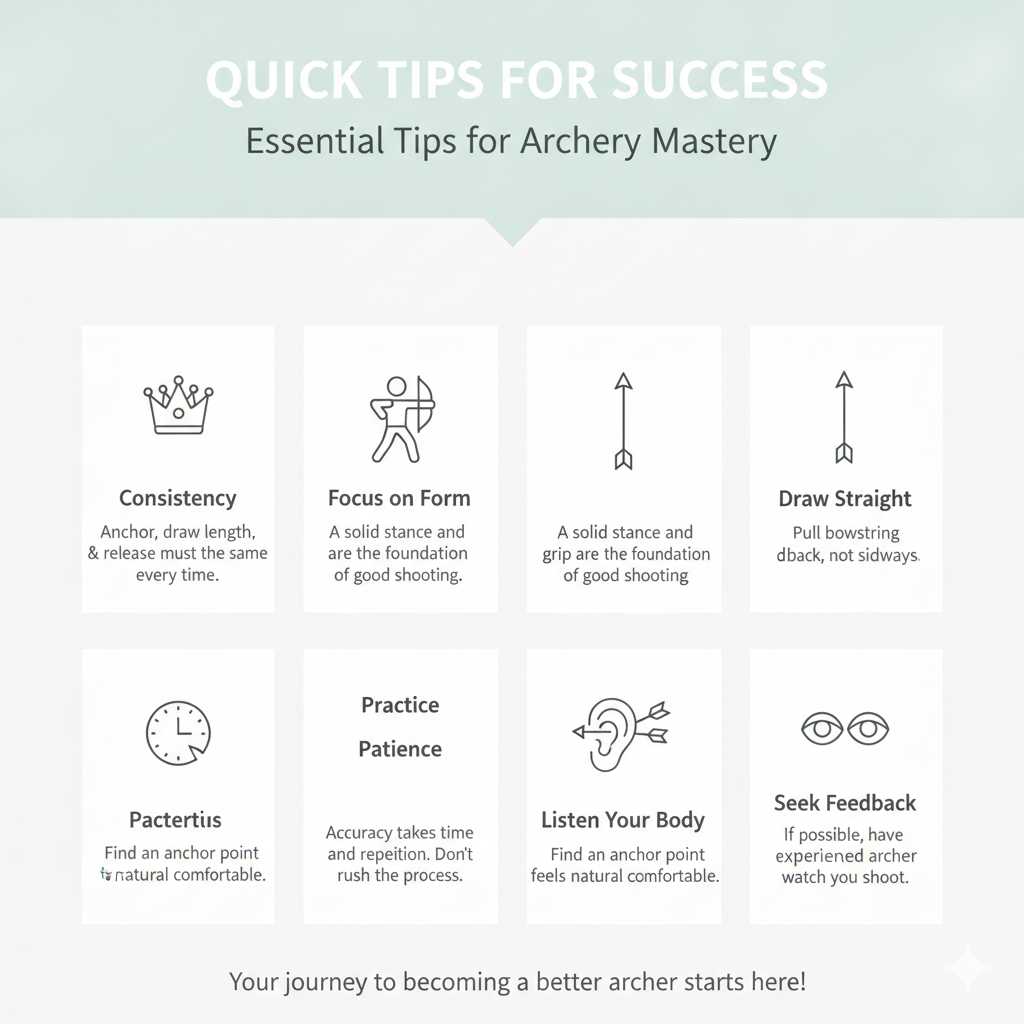
Quick Tips for Success
Here are some final quick tips to help you on your journey.
Essential Tips
- Consistency is King: Anchor, draw length, and release must be the same every time.
- Focus on Form: A solid stance and grip are the foundation of good shooting.
- Draw Straight: Pull the bowstring directly back, not sideways.
- Practice Patience: Accuracy takes time and repetition. Don’t rush the process.
- Listen to Your Body: Find an anchor point that feels natural and comfortable.
- Learn Your Trajectory: Shoot at known distances to understand your arrow’s drop.
- Seek Feedback: If possible, have an experienced archer watch you shoot.
Frequently Asked Questions
Can I really be as accurate without a peep sight?
Yes, absolutely. Many skilled archers are highly accurate without a peep sight. It often comes down to developing exceptional consistency in your form, anchor point, and draw.
While a peep sight can simplify aiming, it’s not the only path to accuracy.
What is the hardest part about aiming without a peep?
The hardest part is developing and maintaining absolute consistency. Without a peep sight, your eye needs to be in the exact same spot every time to align with the arrow and target. This requires significant practice and focus on your anchor and draw mechanics.
How do I know if my draw length is correct?
A correct draw length allows you to reach your anchor point comfortably without straining or over-extending. You should be able to pull the string back smoothly to your chosen anchor point. Measuring your draw length with a bow square or by having a coach measure you is recommended.
Is gap shooting or string walking better?
Neither is definitively “better.” Gap shooting relies more on feel and judging the space between your arrow and the target. String walking involves physically moving your hand on the string to adjust your anchor point. The best method depends on your personal preference and what feels most intuitive for you.
Can I add a peep sight later if I want to?
Yes, you can almost always add a peep sight to your bow. This usually requires a bow press to take tension off the string to install it. If you decide you want to try one, a local archery shop can help you with the installation.
How long does it take to get good at shooting without a peep?
This varies greatly from person to person. Some archers pick it up quickly, while others take months of consistent practice. Dedicate regular time to practice, focusing on form and consistency, and you will see improvement.
Don’t get discouraged by slow progress; every shot is a learning opportunity.
Conclusion
Aiming a bow without a peep sight is a rewarding challenge. It hones your fundamental archery skills. By focusing on a consistent anchor, a straight draw, and precise form, you can achieve excellent accuracy.
Embrace the practice. Trust your process. And enjoy the journey of becoming a more skilled archer.