How to Bowhunt the Rut in Big Woods Without Crop Fields
Hunt the rut in big woods by keying on terrain funnels, bedding edges, and fresh sign, then set up only when the wind and thermal direction fit your access; if a stand cannot handle both, skip it. Miss that and you bump beds, tip off mature bucks, and burn the short daylight windows that matter most. This guide covers terrain reading, rut sign, wind and thermal rules, and pressure-aware entry and exit plans for timber, mountains, and public land.
Big woods rut basics
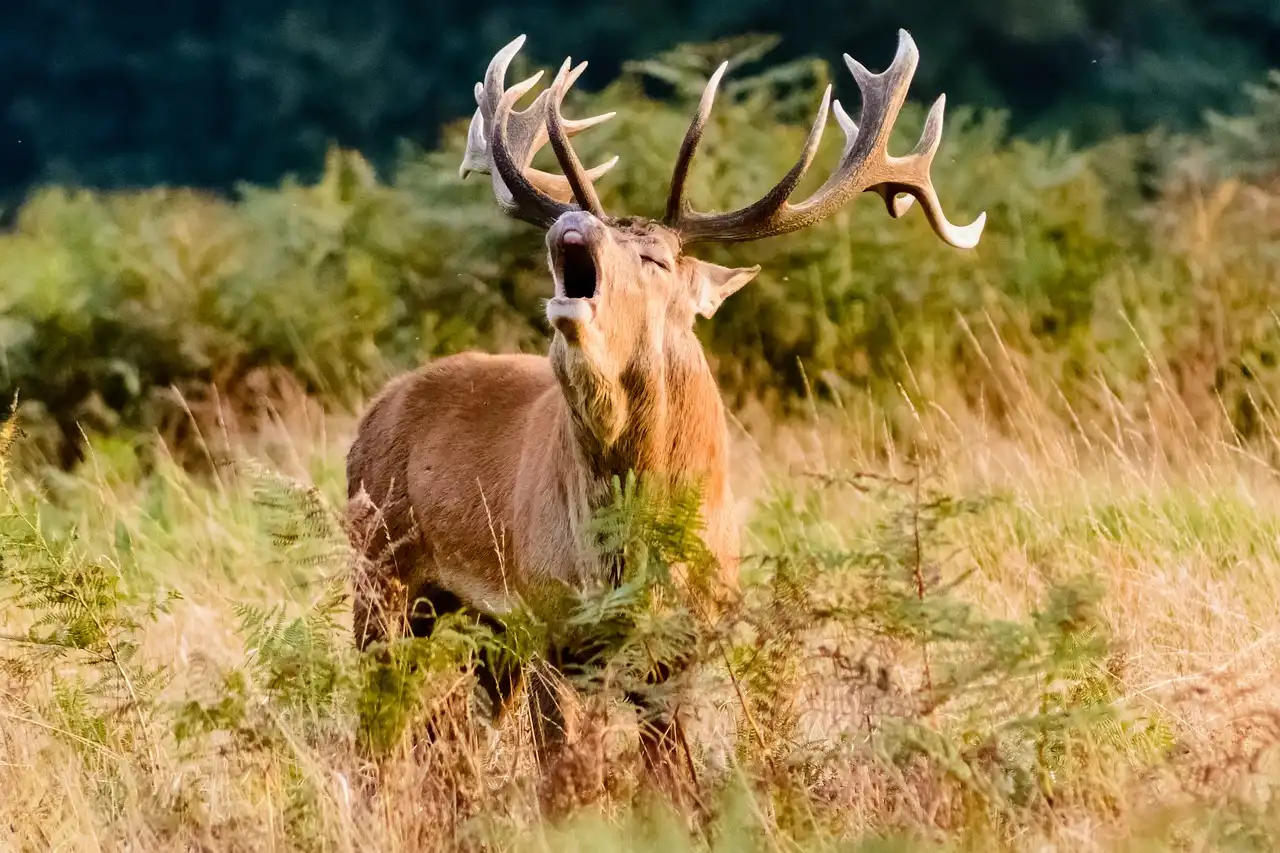


In big woods, rut success starts with bedding and movement, not crops. During the rut, mature bucks still rely on primary beds for security and secondary beds for faster repositioning, then shift between those areas while checking does, doe travel routes, and edge cover. Food sources matter less when there are no crop fields or plots to anchor the hunt.
The better target is the route between beds and the places deer are forced to cross. That often means saddles, narrow ridge fingers, creek crossings, pinch points, and the first usable cover off a bedding area. In timber, the stand that reaches the movement line without touching the bed usually beats the stand closest to where a deer was seen once.
What changes during the peak rut
Peak rut widens buck movement. Bucks cruise more often in daylight, including midday, and they use low-pressure edges between bedding areas to look for does and check fresh sign. A buck that would normally stay hidden in a primary bed may check a secondary bed, a funnel, or the downwind side of a travel corridor when the timing is right.
That shift matters because the best rut sit is often not a food sit at all. It is a terrain sit backed by fresh sign, a safe wind, and an access route that keeps pressure low.
Where should I hunt rutting bucks in big woods with no crop fields?
Start with bedding cover, then work outward to the terrain that forces deer to move in a predictable way. In big woods with no crop fields, the best rut locations are primary and secondary bedding zones, saddles, points, ridge necks, creek crossings, and pinch points that connect those areas. The goal is to intercept cruising bucks without getting into the bed itself.
Primary and secondary bedding zones
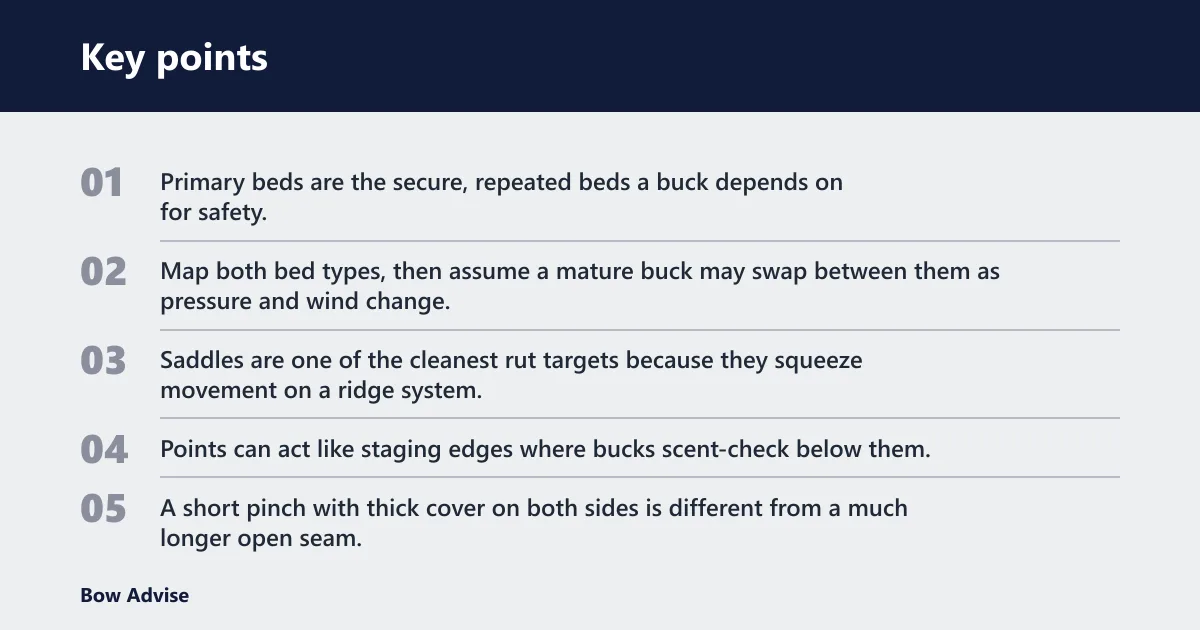
Primary beds are the secure, repeated beds a buck depends on for safety. They are often in thick cover, on remote benches, in conifers, on leeward points, or in places with a clear view and escape routes. Secondary beds are closer to travel and feeding cover, and bucks may shift there when pressure rises or when rut movement pulls them off the primary bed.
Wind and thermal use matters here. A bed that works with a west wind may be abandoned on an east wind, and a midday thermal rise in a draw can make a lower bed less usable. Map both bed types, then assume a mature buck may swap between them as pressure and wind change.
Terrain funnels that force movement
Saddles are one of the cleanest rut targets because they squeeze movement on a ridge system. Points can act like staging edges where bucks scent-check below them. Ridge necks, creek crossings, and narrow benches concentrate travel because deer prefer the easiest crossing between secure cover and doe travel.
Pinch-point width matters. A short pinch with thick cover on both sides is different from a much longer open seam. The tighter the bottleneck, the easier it is to predict where a cruising buck will pass without exposing himself.
Transition cover between beds and travel corridors
Look for the first transition cover off a bed: saplings, blowdown pockets, laurel edges, and brushy fingers that bridge bedding to a ridge or drain. Bucks often travel those edges because they can stay hidden while checking wind, scent, and movement. Those spots are better than the center of a wide trail.
Picture a steep hill with a primary bed on the upper third and a creek bottom below. The most useful stand is often on the sidehill travel line or the top of the drainage where a buck can move from one bed to another without dropping all the way into the bottom.
What sign should I key on in the big woods during the rut?
Fresh rubs, active scrapes, track size, travel direction, and the freshness of all of it are the filter. In big woods, old sign can waste time fast. Focus on sign that looks current enough to match today’s movement, then use terrain to decide whether the stand belongs on the sign line or on the approach to it.
Rubs and scrape clusters
A rub line usually matters more when it links bedding cover to a funnel or a terrain edge. Isolated rubs can still help, but a line of fresh bark shavings, pointed saplings, and repeated hits along a route is stronger. Scrape clusters near a crossing, saddle, or staging edge often signal repeated buck checks, especially when they sit under overhanging branches and near cover.
Branch height can help sort the size of the deer using the area. Low, rough sign on small stems is less useful than chest-high to head-high rubs on trees that a mature deer can reach cleanly while moving with purpose.
Track size, direction, and freshness
Track direction is often more useful than track size alone. A track entering a funnel from bedding cover and leaving toward a secondary bed or doe route is better than a random track crossing a logging edge. Fresh edges in damp soil, sharp toe marks, and clean tracks without wind-blown fill suggest recent use.
Date-stamped freshness matters. Sign found after a rain, freeze, or snowfall usually needs a fresh read the next day. If the sign is still sharp and the travel direction matches the terrain, the spot is more likely worth a sit.
- Locate bedding first. Mark primary and secondary beds before looking at trails. The bed tells the story of where a buck starts and ends his movement.
- Trace the exit route. Follow the edge from the bed to the next secure cover, funnel, or crossing. That route is often better than the bed itself.
- Check fresh sign. Confirm rubs, scrapes, and tracks that look current. If the sign does not match the last day or two of movement, keep scouting.
- Match wind and thermals. Only pick the stand if the wind protects the access and the thermal flow will not carry scent into the bedding side.
- Pick the lowest-impact entry. Use the quietest route, the shortest route that still stays downwind, and an exit that will not blow the area after dark.
A common first-timer mistake is sitting the freshest rub line without checking the wind. That can work once. Then the buck shifts beds or moves after dark, and the spot loses value for the rest of the week.
Wind and thermals in timber
Wind direction matters for stand selection in timber because the woods do not forgive sloppy scent control. In big woods, a crosswind setup often beats a straight downwind setup because it lets the hunter cover the travel line while keeping scent off the bedding side. Access route matters just as much as the stand tree.
Crosswind setup for stand selection
Set the stand so the wind carries scent away from likely deer travel, not across it. On a ridge or saddle, that often means sitting on the downwind edge of the travel line with a crosswind that pushes scent into open space or non-use cover. In creek bottoms, it may mean staying high enough that the wind does not pool around your entry trail.
If the access route requires walking through the wind cone of a bed, the setup is weak even if the sign is hot. In timber, the stand is only as good as the entry and exit.
Morning and evening thermal shifts
Morning thermals usually rise as the air warms. Evening thermals often fall as the hillside cools. In a draw, that can swing scent uphill at dawn and downhill late in the day, which changes whether a tree is safe on a given wind.
Sidehills and creek bottoms can create odd flow. Cold air pools low, funnels through drainages, and then moves with the dominant wind. A stand that works on a flat ridge may fail in a steep hollow if the thermal pull drags scent into the bedding side.
When should you hunt all day?
All-day sits matter most in the peak rut, especially when sign suggests bucks are cruising between bedding areas rather than locking onto one feeding pattern. Midday movement windows can be better than dawn or dusk on pressured public land, because bucks may move when the woods quiet down. The sit needs the right wind, enough comfort, and a low-disturbance exit plan.
Peak rut windows that justify a long sit
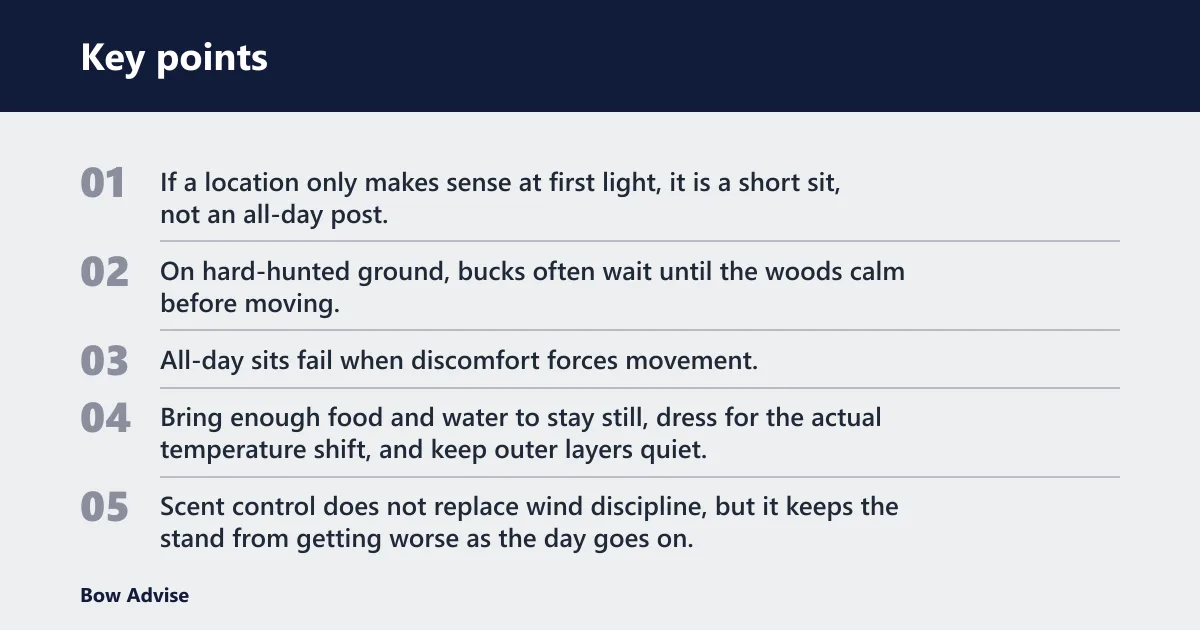
Choose an all-day sit when fresh sign sits between two likely beds, a funnel checks multiple travel routes, and the weather keeps thermals predictable enough to hold the stand until dark. If a location only makes sense at first light, it is a short sit, not an all-day post.
Deep woods pressure changes the choice. On hard-hunted ground, bucks often wait until the woods calm before moving. That makes the late morning through early afternoon window worth protecting.
Comfort, food, water, and scent control
All-day sits fail when discomfort forces movement. Bring enough food and water to stay still, dress for the actual temperature shift, and keep outer layers quiet. Scent control does not replace wind discipline, but it keeps the stand from getting worse as the day goes on.
If a long sit increases the chance of fidgeting, shivering, or climbing down early, shorten the plan. A shorter, cleaner sit can beat a long, noisy one.
Low-disturbance exit planning
Exit before the woods go dead silent if the route risks blowing the bed or crossing a likely cruise line. A clean exit can save a good location for tomorrow. If the wind shifts against the route, leave by the most hidden path even if it takes longer.
Say your best afternoon stand is above a creek crossing and the wind starts to swirl at sunset. A straight walk out past the crossing can ruin that funnel. A longer loop through thicker cover may protect the spot for the next sit.
No-plot rut scouting matrix
This matrix helps rank stand locations in big woods without relying on crop fields or food plots. Score each category from 1 to 5, then use the total and the go/no-go call to decide whether the stand deserves a sit.
| Stand factor | 1 | 3 | 5 | How to judge it |
|---|---|---|---|---|
| Bedding proximity | Far from known beds | Near a likely travel edge | Close to an exit route from primary or secondary bedding | Higher scores go to setups that can intercept movement without sitting inside the bed |
| Thermal safety | Thermals likely carry scent into bedding cover | Thermals are mixed or site-dependent | Thermals and terrain both protect the stand | Use hillside and draw flow to decide whether scent stays out of danger |
| Wind compatibility | Wind blows across the bed or access | Wind works only from one narrow direction | Wind creates a crosswind or away-from-bed setup | Do not force a stand when the wind ruins the entry or the shot lane |
| Rut sign freshness | Old sign only | Mixed old and fresh sign | Fresh rubs, scrape activity, or current tracks | Prefer sign that still looks current after weather shifts |
| Access stealth | No quiet route | Usable but noisy or long | Silent entry and exit with low disturbance | Stealthy access can make a marginal stand worth hunting |
| Go/no-go | No-go | Borderline | Go | Use a total score of 20 or more as a practical go signal; anything below that needs a better wind, fresher sign, or better access |
The matrix is simple on purpose. A stand with hot sign and bad access still ranks low. A clean access route, a safe wind, and a funnel near bedding can beat a louder, closer setup every time.
How do you stay mobile without blowing spots?
Mobile setups let a hunter adjust after finding fresh sign, which matters in timber where the best rut setup can change fast. A saddle or lightweight hang-and-hunt system keeps relocation quick, but the real advantage is quiet entry, quiet exit, and the ability to leave a dead stand without burning the area.
Saddle and hang-and-hunt use
Use a saddle or compact stand when the next sign line may be only a few hundred yards away. That lets the hunter move from bedding edge to funnel to crossing without committing to one tree too early. The setup should be easy to pack, quiet to deploy, and stable enough for a long sit.
Fast relocation after fresh sign
If a new rub line, scrape cluster, or track line appears closer to a transition edge, move. Big woods rut hunting rewards the hunter who shifts with the sign instead of waiting for a stale location to turn active. The best move is often a short one, not a long march to a different block.
Silent entry and exit routes
Plan the route before the climb. Avoid brush that snaps, steep loose rock, and trails that cross obvious deer travel. If the stand requires a noisy entry, choose a different side of the hill, a different drainage, or a different tree.
Suppose a fresh scrape cluster appears near a creek crossing at noon. A mobile setup can turn that discovery into an evening sit if the access stays quiet and the wind lines up. If either one fails, leave the spot for later rather than forcing it.
Frequently asked questions
How do you bowhunt the rut in big woods without food plots?
Focus on bedding, terrain funnels, and fresh rut sign. In big woods, deer movement is shaped more by cover, travel routes, and wind than by crops. Set up only when the stand fits the wind, thermals, and access, and treat fresh sign as the trigger for relocation.
How do I find bucks during the rut when there are no food plots?
Find the beds first, then the terrain that links them. Bucks cruise between bedding areas during the rut, often using low-pressure edges, saddles, and creek bottoms. Midday movement can be the best window on pressured ground, so don’t ignore the late morning and early afternoon.
What time of day is best for rut bowhunting in big woods?
Early morning and late afternoon still matter, but peak rut often adds a strong midday window. Bucks cruise when pressure drops and they check bedding edges, so an all-day sit can pay off when the weather, sign, and wind all line up. Short sits miss those middle-hours moves.
What is the best setup for a rut sit in thick timber?
A mobile setup with a saddle or lightweight hang-and-hunt system is usually the best fit. It lets the hunter respond to fresh sign, adjust to wind or thermal changes, and keep entry and exit quiet. The stand choice should always follow bedding, funnels, and access, not the other way around.