How to Bowhunt the Rut During an Unseasonably Warm November
Bowhunt the rut in warm November by targeting daylight movement windows around cold fronts, scrape travel, and evening doe bedding; if temperatures stay high, shorten sits and skip all-day stand time. Miss that adjustment and you burn prime locations, overhunt bedding edges, and sit through dead midday hours while deer move after dark. This guide covers when to hunt each rut phase, where to set up in warm conditions, and which classic tactics to drop when heat changes deer behavior.
How warm November changes the rut


Warm November weather often cuts daylight movement to a smaller window. It does not stop the rut. Bucks still cruise for does during the primary breeding window, yet warmer nights, unstable thermals, and heavier access pressure usually push more movement to first light, last light, and after dark.
The main change is timing. In warm conditions, deer often stay in thick bedding cover, shaded edges, and north-facing slopes longer into the morning. That puts wind and entry routes ahead of a generic “November sit.”
What you’ll need
- Tree stand, saddle, or ground setup matched to cover
- Wind checker or light powder for access checks
- Quiet outer layers and a way to store them away from house odors
- Dry spare socks and a breathable base layer
- Water bottle or hydration pack for all-day sits
- Grunt tube and rattling antlers or compact rattling kit
- Binoculars for edge watching and route checking
- Stand strap, pack, and a quiet way to carry gear in and out
How to choose the right rut sit
- Sort the rut phase. Decide whether the woods are in pre-rut, peak rut, or post-rut/lockdown. Bucks behave differently in each phase, and warm weather changes the length of the usable daylight window in all three.
- Check wind first. If the wind is unstable or swirling, move away from tight bedding edges and use a setup with more room between you and the deer’s nose. Crosswind is better than a drifting, shifting wind near warm bedding cover.
- Match the setup to access. Use a tree stand or saddle when you can approach without crossing the main travel line. Choose a ground setup only when cover hides movement and the entry and exit route stays quiet.
- Set up on the travel edge. Target funnels, scrape lines, or the downwind side of bedding-to-food movement, depending on phase. In warm weather, the best sit is often the one closest to predictable movement but far enough from the core bed to avoid blowing deer out.
- Plan the exit before the sit. Leave on a route that keeps your scent and noise off the evening line. If the exit forces a noisy walk through a food approach or bedding edge, the sit can cost more than it returns.
Do bucks still move during the rut in warm weather?
Yes, bucks still move during the rut in warm weather, but often in narrower windows. Pre-rut bucks may cruise scrapes and rub lines later in the morning. Peak-rut bucks may still check bedding edges for does. Post-rut bucks often move more cautiously and later, especially if warm nights reduce urgency.
Movement does not disappear. It shifts. The best warm-weather sits are often tied to short windows around dawn, the last hour before dark, or brief midday lulls when thermals settle and a buck leaves thick cover to check nearby travel.
Warm nights and daylight movement
Warm nights often leave less fresh sign by sunrise. That means dawn activity can be thin unless a cold front, a doe concentration, or a fresh scrape line changes the pattern. Evening can still be strong because deer that bed deep in the shade may not rise until the coolest part of the day.
Suppose the low stays near 68 degrees and the wind remains steady. A buck may still leave bedding cover late, but the odds improve more on the field edge or shaded feeding approach than on an exposed midmorning funnel.
When should you hunt bedding, funnels, or food?
Use bedding edges when bucks are cruising hard and the wind is clean. Use funnels when deer need to move between cover blocks, especially on crosswind setups. Use food when heat pushes movement later and deer wait for the coolest part of the evening to step into agriculture, food plots, or shade-adjacent feeding areas.
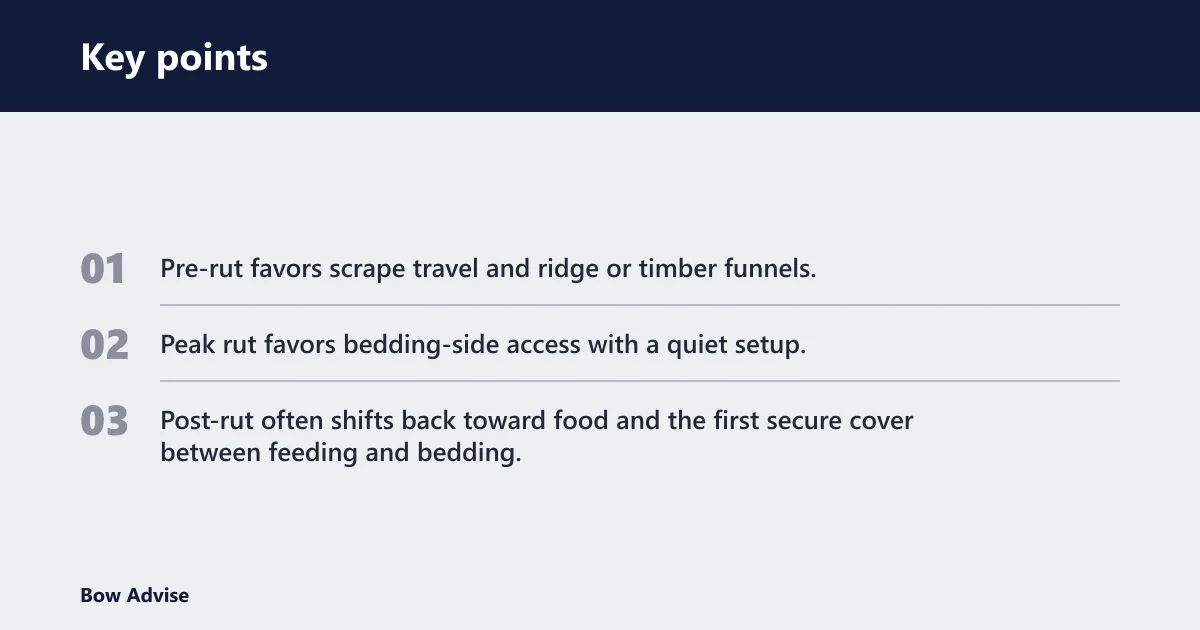
Warm weather rewards a phase-based choice. Pre-rut favors scrape travel and ridge or timber funnels. Peak rut favors bedding-side access with a quiet setup. Post-rut often shifts back toward food and the first secure cover between feeding and bedding.
Warm November rut decision matrix
| Rut phase | Temperature band | Wind stability | Hunt location | Recommended tactic |
|---|---|---|---|---|
| Pre-rut | 45-55°F | Steady | Scrape lines and funnel edges | Hunt fresh scrapes, light grunts, and watch for cruising bucks |
| Pre-rut | Above 60°F | Swirling | Skip the sit or move to a larger travel corridor | Go quiet; avoid tight bedding and avoid aggressive rattling |
| Peak rut | 45-58°F | Steady crosswind | Bedding edges and pinch points | Full-day sit if access is clean; short rattling sequence or two soft grunts |
| Peak rut | 60-70°F | Unstable | Shade-heavy cover near bedding and water | Hunt the coolest hour only; skip the sit if entry or exit sweats you in |
| Post-rut / lockdown | 40-55°F | Steady | Food sources and evening staging cover | Hunt the last two hours; minimal calling, no long rattling sequences |
| Post-rut / lockdown | Above 60°F | Changing or swirling | Skip the sit unless a cold front hits | Wait for better wind or cooler evening conditions |
What scent-control changes matter most on warm November sits?
Heat makes scent control more about the walk in than the stand. Sweat builds odor fast, and warm air can carry it farther when thermals rise and fall. The priorities are clean clothing storage, dry transport, and a route that keeps the hunter from overheating before reaching the setup.
Wind-first decision making matters more than extra sprays or gimmicks. If the route forces heavy sweating, change the setup or shorten the approach. A clean wind beats a perfect cover scent plan.
- Store clothing clean. Keep hunting layers sealed away from garage, truck, and food odors until arrival. Put them on at the truck only if the walk is short and cool enough to stay dry.
- Reduce walk-in sweat. Use lighter layers for the hike, then change at the stand if needed. A dry base layer beats carrying warm sweat into the bedding edge.
- Protect the exit path. Leave with the same wind logic used on entry. Evening thermal lift can pull scent uphill or across a field edge, so plan the walk out before dark.
- Recheck wind after heat rises. If midday thermals turn unstable, leave the setup or shift to a different side of the cover block. Warm conditions can make a once-safe stand go bad fast.
When should you call or stay quiet?
Call less when heat is high and deer are already cautious. Grunts can still work on cruising bucks in pre-rut and peak rut, and a short rattling sequence can pull a curious buck from thick cover. But aggressive calling all day often adds noise without adding movement in warm weather.
Use calling as a trigger, not a plan. If a buck has already been seen using a scrape line or funnel, a soft grunt or brief rattling sequence may help. If nothing is moving and thermals are unstable, silence is usually better.
Calling decisions by phase
- Pre-rut: Light grunts near scrape travel; use rattling only sparingly on steady wind.
- Peak rut: One short rattling sequence, then go silent for 20 to 30 minutes.
- Post-rut: Minimal calling; let food and travel routes do the work.
- Swirling wind: Skip rattling and stay quiet unless the deer is already in range.
Common mistakes
Warm November trips go wrong when hunters keep old rut habits and ignore heat. The biggest mistake is sitting a bedding edge with a bad wind and hoping a buck will still take the same path. The second is overcalling when deer already have less reason to travel in daylight.
Another common error is sweating on the way in and then blaming the spot. A hot walk, a noisy exit, or a stand placed in a swirling thermal pocket can ruin a good location faster than the temperature itself.
- Hunting tight bedding edges with unstable wind
- Using all-day sits when movement is clearly compressed to dawn and dusk
- Rattling hard in warm, pressured cover
- Ignoring shade, north-facing slopes, and water-adjacent bedding cover
- Choosing a stand before planning entry and exit routes
Picture a 66-degree afternoon with a light south wind. A hunter climbs into a tree stand near a scrape line on the edge of a cut cornfield. If the access trail crosses the field edge and the wind starts to swirl at 2 p.m., the setup is too exposed for a long sit; the better move is to wait for a steadier evening wind or shift to a deeper travel corridor.
A common first-timer mistake is hunting a fresh scrape after a warm night without checking whether it sits on a true travel line. If the scrape is isolated and the wind keeps rolling into the bed, it is a low-percentage sit. Freshness matters, but placement matters more.
Prevention
Use a wind-check on the approach, the stand, and the exit before committing to a warm sit, and shorten or skip the sit if any one of those checks fails. If any one of those three fails, shorten the hunt or skip it.
Frequently asked questions
How do you hunt the rut when November is unusually warm?
Hunt shorter windows, not longer ones. Focus on the coolest part of the day, steady wind, and locations that connect bedding to food or bedding to cruising routes. If the access route makes you sweat hard or the wind starts to swirl, skip the sit and wait for a cleaner window.
Should I still hunt scrapes and funnels if it is 70 degrees in November?
Yes, but only if the scrape or funnel sits on a real travel line and the wind stays usable. In 70-degree weather, scrapes near bedding can go stale fast unless bucks are actively cruising. Funnels can still work, but they need clean access and a setup that avoids swirling air.
Are all-day rut sits still worth it when temperatures spike?
Sometimes, but only on high-quality bedding edges with quiet access and a steady wind. If temperatures stay high and winds swing, an all-day sit usually burns energy for little gain. A better plan is to sit the highest-probability part of the day and leave before thermals turn the setup bad.
How do warm nights affect buck movement during the rut?
Warm nights often reduce the amount of fresh morning movement and push more activity into late evening. Bucks may still move, but they are more likely to wait for cooler shade, water, or the first evening feeding window. That makes evening sits stronger than they look on paper.
Should I focus more on morning or evening hunts in a warm November?
Evening usually gets the edge when temperatures spike, especially near food sources and shade-adjacent bedding. Morning can still work on fresh cruising routes, but only if the wind is steady and access is quiet. In warm stretches, both ends of the day matter more than the middle.
What rut tactics work best when deer avoid daylight because of heat?
Use quieter tactics. Hunt bedding-to-food edges, hold back on rattling, and rely on light grunts only when a buck is already nearby or cruising. The best setup is often a shaded tree stand, saddle, or ground blind with a clean crosswind and a fast exit path.