Can Rain Improve Rut Bowhunting or Shut It Down?
Light, steady rain can improve rut bowhunting by helping cover entry noise and footsteps, while harder rain often shortens effective bow range and can make tracking more difficult. Miss that split and you can waste a stand, bump deer, and lose a clean blood trail. This guide explains when rain helps rut setups, when it hurts them, and how to adjust stand choice, entry, and shot timing.
Does rain help rut bowhunting?
Rain can help rut bowhunting when it hides human noise, softens footfall, and may keep deer moving at shorter, more predictable distances. It can hurt when visibility drops too far, wind shifts with unstable thermals, or rain gets hard enough that deer stop cruising and the usable bow window shrinks.
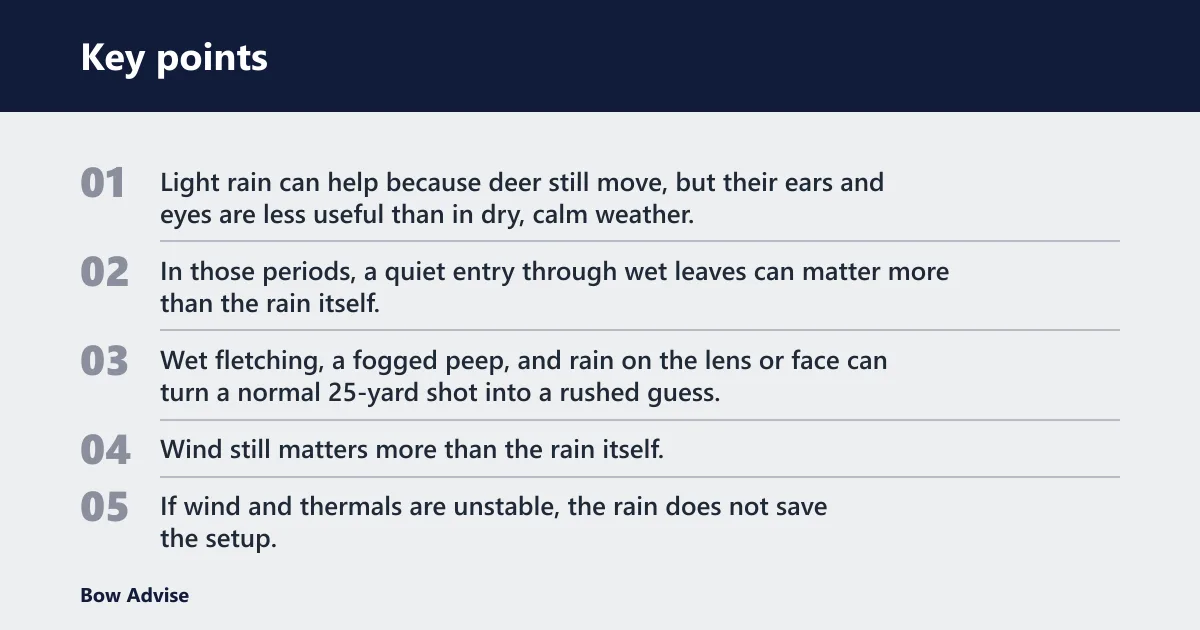
Light rain can help because deer still move, but their ears and eyes are less useful than in dry, calm weather. That matters most during the pre-rut and seeking phase, when bucks cover ground and check the first receptive does. In those periods, a quiet entry through wet leaves can matter more than the rain itself.
Heavy rain is different. It can reduce daylight movement, blur shooting lanes, and make the deer’s nose even harder to beat because hunters often get sloppy about wind when the weather already feels messy. A buck still circles downwind. Rain does not stop that habit.
Why light rain can improve movement windows
Light rain and a steady drizzle can create a usable window because they hide entry noise and reduce the chance that a deer hears a branch snap or sees movement at distance. In the rut, a buck may still travel a corridor, check a scrape, or swing past a bedding edge if the weather is quiet enough to let him move without feeling exposed.
That is especially useful on open-edge scrapes where deer already feel comfortable using a short, direct route. It also helps on evening sits, when light rain can keep deer on their feet without forcing them into thick cover too early.
Why heavy rain can shrink usable bow range
Heavy rain usually shrinks the useful bow window because deer movement becomes less consistent and the shot lane is harder to judge. Wet fletching, a fogged peep, and rain on the lens or face can turn a normal 25-yard shot into a rushed guess.
Oregon archery seasons can include sideways rain and fog, and temperatures can drop from 50 to 35 degrees in an afternoon. That changes how long a bowhunter can stay sharp, how far a clean shot remains visible, and how fast recovery must begin after arrow release.
How wind and thermals decide the real answer
Wind still matters more than the rain itself. A buck’s main defense is its nose, and in wet weather it still likes to circle downwind before committing to a scrape, trail, or suspected doe line. If wind and thermals are unstable, the rain does not save the setup.
Morning thermals often pull scent downhill early, then shift as the sun warms cover. Evening thermals can do the opposite near bedding edges. In both cases, rain may cover noise, but it does not stop scent from drifting where a deer expects it.
Light rain vs heavy rain in the rut
Light rain is usually the better rut condition for seeing a buck because it keeps some daylight movement alive while helping the hunter slip into position. Heavy rain often reduces usable movement, shortens sightlines, and makes both calling and tracking less reliable. The difference is practical, not theoretical.
Light drizzle and steady rain
Light drizzle and steady rain are the best rain types for rut stands. They can soften approach noise, keep cover sounds down, and let a hunter sit through a longer window without being heard moving in. That matters during pre-rut cruising and the chasing phase, when bucks may travel just enough to slip past a corridor or scrape line.
Use this weather for setups where the shot is likely to happen inside normal bow range, not at the outer edge of your comfort. A buck stepping into a lane at 20 to 30 yards is realistic here; a longer lane is less dependable once the rain starts cutting visibility.
Downpour conditions
A downpour usually works against rut bowhunting. Deer often tighten travel, visibility falls fast, and the sound of rain makes judging body position, antler angle, and lane clearance harder. Even when deer move, the hunter may not be able to execute a clean shot or follow the arrow path well enough to recover the animal quickly.
That is when the deer’s nose can take over. If the hunter cannot see enough to confirm a safe lane, a buck can still cut across wind and catch human odor before the bow is drawn.
Post-rain clearing
Post-rain clearing can be very good, especially when the rain stops and deer resume movement before dark or after sunrise. The air often settles, scent stays low for a while, and a buck that held tight during the rain may resume checking scrapes or cruising edges.
That window is often stronger than the rain itself. A brief clearing can turn into the best movement period of the day if wind remains steady and thermals are predictable.
Rut rain decision table
This checklist table turns rain into a stand decision, not a guess. Use it to match rain type with expected movement, setup choice, and the main no-go risks before committing to a sit.
| Rain type | Expected deer movement | Best setup | No-go risks | Scrapes | Travel corridors | Calling |
|---|---|---|---|---|---|---|
| Light drizzle | Moderate daylight movement; good cruising odds in the pre-rut and seeking phase | Quiet entry, close-range lanes, downwind stand with stable wind | Fogged peep, wet bow grip, rushed shot from low visibility | Yes | Yes | Yes, limited |
| Steady rain | Fair movement if wind stays stable; better in cover edges than wide-open terrain | Short lane setup, concealed approach, gear kept dry and quiet | Poor visibility, unstable thermals, hard-to-read body position | Yes, if close | Yes | Maybe, light use |
| Heavy rain | Reduced daylight movement; deer often tighten travel and hold cover | Only if the shot lane is short and recovery access is good | Bad blood trail conditions, weak lane visibility, compromised follow-up | No | Maybe, only known crossings | No |
| Post-rain clearing | Often strong; bucks may resume cruising, checking scrapes, and scent-checking cover edges | Stay put if wind is steady and the lane is visible | Thermal shift after rainfall ends, wet ground noise during exit | Yes | Yes | Yes, selective |
For a quick field decision, the answer is simple: light rain gets a yes on scrapes and corridors, steady rain gets a cautious yes, heavy rain gets a no on calling, and post-rain clearing gets a strong maybe-to-yes if the wind stays usable.
Where should you sit in rain?
Rain favors setups that keep the deer close and the hunter hidden. Scrapes, travel corridors, and bedding edges can all work, but the best choice depends on rut phase, wind direction, and whether the rain is light enough to preserve a shot lane.
Scrapes and downwind setup
A scrape setup is often placed about 20 to 30 yards off the scrape and positioned so the wind helps keep scent away from likely deer approach routes without leaving deer an easy downwind circle. That distance gives a shot lane while keeping movement away from the immediate scrape site.
Open-edge scrapes are stronger in light rain because bucks can reach them fast and leave the same way. Cover scrapes can be better during wetter, darker periods because they give a buck more reason to linger, but they also demand stricter wind discipline.
- Pick the wind first. Place the stand so the deer cannot cut straight downwind of your position without exposing itself. If the wind is wrong, the scrape is wrong.
- Stay 20 to 30 yards off. That spacing keeps the scent line away from the scrape and leaves room for a shot window. It also reduces the chance that a buck spots movement at the base of the tree.
- Match the sit to phase. Use morning sits near travel into bedding during the seeking phase and evening sits near scrape returns or open edges when daylight movement is more likely.
Travel corridors and crossing points
Travel corridors can be stronger than scrapes in steady rain because deer often choose the most efficient route between feeding, bedding, and doe concentrations. A crossing point where two funnels meet can produce a short, clean shot if the hunter can keep the setup quiet and hidden.
These spots matter more once the rut turns into chasing. Bucks on a hot trail often stay mobile enough to cross visible lanes without lingering, which makes the first clear opening the best chance.
Bedding edges during the seeking and chasing phases
Bedding edges are high-value rain stands when a buck is still moving in daylight. In the seeking phase, bucks may cruise just outside cover. In the chasing phase, they may swing tighter to bedding cover and show up with less warning, which makes a concealed, downwind setup essential.
Suppose a buck is using a cover scrape 25 yards off a bedding edge after a steady morning rain. A hunter set 25 yards downwind with a clear lane may get one short opportunity before the deer circles. A wider, open setup would likely fail on scent and visibility both.
Does rain change calling?
Rain changes calling by changing how far sound carries, how cautious a buck feels, and how likely it is to commit after hearing antlers or a grunt. Rattling and grunting can still work in rain, but they are strongest when used sparingly and at the right rut phase.
Rattling antlers in pre-rut and after lockdown
Rattling antlers work best during the pre-rut and again after a brief lockdown period when bucks start moving more freely. A short 30-second sequence is enough for many setups, especially if the hunter is already hidden and ready before any sound starts.
The best practice is to turn your back to the deer and use a tree for cover when rattling. That keeps the outline broken and reduces the chance that a nearby buck catches motion before he hears the sequence.
On all-day sits, a common cadence is once per hour. In rain, that frequency should stay conservative. More sound is not better if the weather already cuts visibility and the deer is close enough to spot movement.
Grunt tube volume and tone in wet air
A grunt tube works best in rain when the sound is short, controlled, and deeper in tone. Two to three grunts is enough for a response call in most rut setups. A deeper setting can suggest a dominant buck, while an adjustable pitch lets the caller match the mood of the area.
Pairing a short grunt sequence with rattling can be effective in the pre-rut and after lockdown, but only if the stand is already concealed and the wind is correct. Wet air does not excuse sloppy calling. It only changes how far the sound carries.
When silence beats noise
Silence is better during heavy rain, in low-visibility timber, and any time the deer is likely to be close enough to catch movement before sound becomes useful. A buck that is already working a downwind line does not need extra calling to find the setup.
When in doubt, let the weather carry the cover. Use calls only when they match the phase and the position are already right.
Wet-weather bow setup
Modern bow risers are machined aluminum with anodized or Cerakote finishes, so they tolerate wet conditions better than older gear. Even so, strings, peeps, arrows, and broadheads still need attention before a rainy sit because the weak points are often the small ones, not the riser.
Strings, peep sights, and serving
Strings should be waxed every 2 to 3 wet hunting days, and a wet bow should not be left in a case overnight. Moisture can soak into serving, leave the string feeling rough, and make the peep slower to clear. A peep aperture of 3/16 inch or larger is recommended for rainy conditions because it gives a better sight picture when water is on the lens line.
Keep the string dry when possible, but do not over-handle it with wet gloves. That adds grime and can make the serving wear faster over a wet season.
Arrow flight and wet fletching
Wet feathers can create about 6-inch fliers at 30 yards, which is enough to move a shot out of the kill zone if the deer is quartering or the lane is tight. Vanes are less affected, but adhesive should still have a 24-hour cure time before hunting wet conditions.
A common first-timer mistake is trusting a damp arrow that looks fine at the quiver and then drifting a shot at normal hunting distance. If the fletching is soaked, the shot plan needs to be shorter or delayed.
Fixed-blade broadheads in wet conditions
Fixed-blade broadheads are generally more reliable in wet conditions than mechanicals. They avoid some of the deployment risk that moisture can create and are easier to trust when the shot has to happen in poor light or light rain.
That does not remove the need for a sharp, true arrow. It simply lowers one variable when the weather already adds enough uncertainty.
Clothing and hand control
Quiet waterproof outerwear matters because noisy fabric can undo the benefit of light rain. A merino wool or synthetic base layer is the better choice under that shell, and a fleece mid layer helps hold warmth without the bulk of cotton. Gloves also matter because cold hands shake at full draw and make release timing worse.
- Build a quiet layer stack. Start with merino or synthetic next to skin, add fleece, then add a quiet waterproof shell. That combination keeps warmth in while reducing fabric noise in the stand.
- Protect the contact points. Keep gloves dry enough to hold the bow securely and to operate the release or fingers without fumbling. Warm hands improve control more than extra bulk.
- Dry the critical parts. Wipe the string, serving, peep, and arrow contact points before climbing down. Moisture left on the gear can affect the next shot or the storage case.
Should you stay or leave the stand?
Stay when the rain is light, the wind is steady, the lane is visible, and the recovery path is realistic. Leave when heavy rain makes the shot unsafe, the thermals are unstable, or tracking would likely turn into a long, uncertain search. The stand is only good if the whole shot cycle still works.
Visibility and shot confidence
If the deer cannot be identified cleanly, the bow range is blurred, or the lane disappears in rain and fog, the setup is failing. A 20-yard shot in steady rain can still be clear. A 20-yard shot in hard rain with fog and moving wind can be a bad decision.
The question is not whether deer can move. It is whether the hunter can execute the shot without guessing.
Tracking and recovery risk after the shot
Rain can help hide movement on the way in, but it can also hurt recovery after the shot. A soaked arrow, washed blood, and muddy leaves can make a marginal hit harder to sort out. If the trail will be thin, the shot margin needs to be wider than usual.
That is why heavy rain is often a no-go even if a buck is present. A poor recovery plan turns a good encounter into a bad result.
When a no-go decision makes sense
Call it off when the rain is hard enough to flatten movement, when wind shifts break the downwind setup, or when the bow window is too short to guarantee a clean shot. A stand that can only produce a rushed, uncertain release is not worth sitting.
Picture a buck cruising a scrape line in a steady drizzle, then a hard gust swings the scent cone across the trail. Even if the deer appears, the setup no longer protects the hunter’s nose or the recovery plan.
Frequently asked questions
Does rain improve rut bowhunting or make deer movement worse?
Both, depending on intensity. Light rain often improves rut bowhunting by masking entry noise and keeping deer comfortable enough to move. Heavy rain usually worsens movement, shortens shot windows, and makes recovery harder. The useful answer depends on whether the rain is drizzle, steady rain, or a downpour.
Is light rain better than heavy rain for seeing a buck during the rut?
Yes. Light rain is usually better because it still allows daylight movement while hiding some human noise. Heavy rain often cuts visibility, dulls lane judgment, and can make deer hold tighter. In the rut, the best sightings often come in light rain or right after it eases.
Should I still hunt a scrape or travel corridor in the rain?
Yes, but only if wind and visibility support the setup. Scrapes work best 20 to 30 yards off the source with a downwind plan that still protects scent. Travel corridors are often stronger than scrapes in steady rain because deer keep using efficient routes between bedding and feeding areas.
How does rain affect a deer’s nose and downwind approach?
Rain does not stop a deer’s nose. Bucks still circle downwind, scent-check scrapes, and test travel routes before committing. Wind direction and thermals remain the real defense and offense in wet weather. If those are wrong, rain will not save the stand.
Do bucks move more before rain, during rain, or after rain?
Often the best movement comes during light, steady rain and again after the rain clears. Before rain, some deer move early if pressure is low. During heavy rain, movement usually drops. After rain, bucks may resume cruising, especially in the seeking phase and during post-lockdown movement.
What gear matters most for bowhunting in wet conditions?
The most important gear is the quiet waterproof shell, merino or synthetic base layers, a dry peep, and arrows with secure fletching. Strings should be waxed every 2 to 3 wet hunting days, and a wet bow should not be left in a case overnight. Fixed-blade broadheads also deserve priority.
When should I stay in the stand in bad weather versus call it off?
Stay when rain is light to steady, wind is usable, and the shot lane is still clear enough for a clean release. Call it off when heavy rain, fog, or shifting thermals make the shot unsafe or the recovery unlikely. If the setup cannot produce a clean arrow path, leave it.
Does rain make rattling or grunting more effective during the rut?
Rain can help both, but only in the right phase and at close range. Rattling works best in the pre-rut and after a brief lockdown period, usually in a short 30-second sequence. Grunts are strongest when kept to two or three calls with a deeper tone and used after concealment is already secure.