All-Day Sit Strategy for Rut Bowhunters: When It Pays Off
An all-day rut sit only pays when daylight movement is likely on a funnel, a doe-to-buck transition, or a scrape line with fresh sign; if the sign is stale, pressure often costs the spot. Poor all-day sits burn energy, spook deer, and teach the area your pattern. This guide gives a simple go/no-go framework for choosing a full-day rut sit, a shorter window, or staying out.
When to cut your sit short


An all-day rut sit pays off when three things line up at once: fresh daylight sign, steady wind, and a rut phase with movement windows you can predict. The best odds come when a stand covers a bedding-to-food route, a funnel, or an interior scrape line where a mature buck can move in daylight without showing itself.
The three signals that justify staying put
Start with fresh sign, such as fresh rubs, fresh scrapes, or wider tracks. Look for fresh rubs, fresh scrapes, and tracks wider than 2 1/4 inches. Then confirm the route matters now, not last week. Finally, keep the wind steady enough that your scent does not drift through the likely travel line during the day.
When a full-day sit is more risk than reward
An all-day sit turns into a bad trade when the sign is stale, the wind is shifting, or access noise is likely to blow out the area before prime movement. That is especially true on pressured public land, where repeated entry and exit can educate deer faster than the sit itself can pay off. If you cannot stay quiet and clean, shorten the hunt.
Public pressure vs. lower-pressure ground
On public land, one bad all-day sit can ruin a small pocket of cover for days. On lower-pressure private ground, a stand can absorb more time if the route is still hot and deer are not reacting to human entry. Either way, the decision should follow current sign, not the calendar alone.
Rut phases and movement windows
The pre-rut is the best shot at a mature buck in daylight before movement gets harder to predict. Daytime buck movement rises about 30% to 50% over early October, but the useful hours shift by phase. Early pre-rut leans late in the day, mid pre-rut spreads activity into late morning and late afternoon, and late pre-rut can put midday movement on the board.
Early pre-rut
Early pre-rut movement is often strongest in the last 2 hours of daylight. That makes it a good phase for evening interception along bedding-to-food routes, especially where a mature buck stages inside cover before stepping out. Full-day sits can still work, but only if the stand covers a narrow route with fresh sign.
Mid pre-rut
Mid pre-rut hunting leans on late morning and late afternoon movement. Bucks may still show early, but the better payoff often comes from holding through the lull rather than bailing at 10 a.m. This phase rewards patience on funnels and interior scrapes near bedding cover, where a buck can swing in daylight between doe areas and secure cover.
Late pre-rut
Late pre-rut in Kentucky often falls in late October through early November. During that window, movement can center on midday travel from 11 AM to 2 PM, and a cold front can sharpen that pattern further. If fresh sign and a calm wind line up, a full-day sit is easier to justify than in earlier October.
What time of day do bucks move most during the rut?
Bucks can move at several points during the rut, but the best all-day sit setups usually protect the late morning, midday, and late afternoon windows. Early pre-rut pushes action toward the last 2 hours of daylight, mid pre-rut opens late morning and late afternoon, and late pre-rut can make 11 AM to 2 PM worth the wait.
Late morning movement
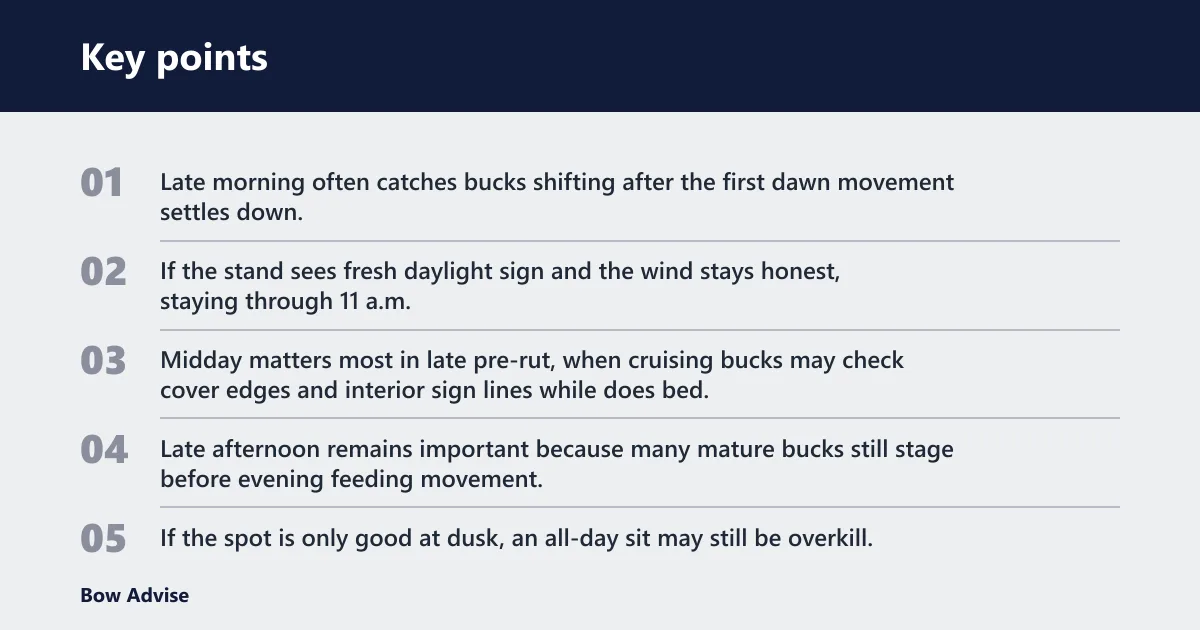
Late morning often catches bucks shifting after the first dawn movement settles down. This is a strong time on interior travel routes, especially where a buck can cruise parallel trails 20–40 yards inside the timber without stepping into open ground. If the stand sees fresh daylight sign and the wind stays honest, staying through 11 a.m. can pay.
Midday movement
Midday matters most in late pre-rut, when cruising bucks may check cover edges and interior sign lines while does bed. That does not mean every midday sit is worth it. It means the stand has to be close to the bedding side of the route, with enough cover to catch a buck before he circles downwind.
Late afternoon movement
Late afternoon remains important because many mature bucks still stage before evening feeding movement. This is the cleanest window for setups between bedding and food, especially when the stand can intercept a buck moving from cover toward a destination field or travel corridor. If the spot is only good at dusk, an all-day sit may still be overkill.
What cold fronts change
A cold front can tighten movement into stronger daylight windows and make a marginal all-day sit worth the extra time. The key is not the front alone. It is the front plus fresh sign plus a steady wind. Without those, the front may only move deer somewhere else on the property.
Bedding-to-food travel lines
The strongest all-day sits usually sit between bedding and food, not on the food edge itself. Mature bucks often stage 100–200 yards inside cover, then move toward food or doe cover as light fades. A stand on the right travel line can catch that shift without forcing a risky close approach to bedding.
Setting up between bedding and food
Place the stand where terrain, cover, or timber funnels deer between bedding and destination food. That often means a spot that gives a clean shot at a predictable crossing line while keeping the hunter out of the core bedding pocket. If the setup requires too much pressure to reach, the sit usually loses value before it starts.
Evening interception
Evening interception works best when the route is narrow enough that a buck cannot easily slip past downwind. Look for a line that catches movement after bedding has settled but before deer reach the open food source. This is one of the few times a longer sit can beat a short window, because the whole day protects the evening chance.
Mature buck staging areas
Mature bucks often stage 100–200 yards inside cover, and that staging zone is where an all-day sit can become worthwhile. A buck may pause there, scent-check, or wait for lower risk before committing to an open area. If the stand is too close to the food edge, the deer may stage out of range and never expose itself.
Funnel setups that hold daylight bucks
Funnels matter because they compress travel. Saddles, crossings, inside corners, and tight travel spots in cover all force deer into predictable lines. During the rut, a good funnel near bedding or a scrape line can turn a weak day into a high-odds sit if the wind and access are controlled.
Saddles and crossings
Saddles and crossings are high-value because they often sit on the easiest route through broken terrain or water. Bucks checking does use those points to move with less exposure. If fresh sign appears on the downwind side of a crossing, the stand may justify a full day, especially during mid to late pre-rut.
Inside corners
Inside corners of timber, cover edges, or cut fields can concentrate movement where deer feel safer than in the open. These spots are strongest when they connect bedding cover to a known route. A stand on the wrong side of an inside corner can be dead air; one on the travel side can catch multiple periods of movement.
Tight travel spots in cover
Tight travel spots in cover are often better than wide-open funnels during the rut because bucks use them to stay hidden while cruising. The tighter the route, the more important wind discipline becomes. If the wind does not stay clean, the cover that should hide the hunter can hide the buck as it slips away unseen.
Interior scrapes and mature buck sign
Interior scrapes matter more than field-edge scrapes for daylight because they sit back in cover, closer to bedding areas and the routes bucks actually use during legal light. Field-edge scrapes can still be active, but an interior scrape with a good licking branch and fresh sign is the better daylight indicator for an all-day sit.
Why interior scrapes beat field-edge scrapes for daylight
Interior scrapes are more likely to sit on the buck’s actual travel path rather than on a convenient edge that gets checked after dark. Back-in-cover scrapes near bedding areas often get daylight use because they are tied to security cover. That makes them stronger sit-length signals than a scrape that only shows nighttime traffic.
Fresh rubs, fresh scrapes, and track width
Fresh rubs, fresh scrapes, and tracks wider than about 2 1/4 inches can point to a mature buck in the area. A community scrape can be 2–4 feet wide, but width alone is not enough. Freshness and placement matter more than size, especially when deciding whether to commit to all day or only to the peak window.
Licking branch focus
The licking branch is the key part of the scrape setup because it often gets more immediate buck attention than the bare ground below it. For trail cameras, that is the best aim point. For hunting, it is the anchor that tells the hunter whether the scrape is active enough to justify a long sit.
Trail cameras and stand rotation
Trail cameras work best as low-pressure monitors, not as a reason to keep checking a dead area. Place them on scrapes and travel routes, set them downwind when possible, and keep them about 4 feet high. Then use the data to rotate stands before pressure builds and to move when sign shifts.
Place the camera quietly. Set it about 4 feet high and aim at the licking branch first, then the scrape or trail route behind it. Keep your approach clean and infrequent so the camera does not become the loudest thing in the woods.
Monitor low-pressure routes. Watch scrapes, crossings, saddles, and tight interior trails rather than high-traffic edges that deer already expect pressure on. A camera on the downwind side of the route often gives the clearest daylight picture without forcing repeated human entry.
Rotate before pressure builds. If the same stand gets repeated use and the sign begins to fade, move before the area turns stale. Stand rotation matters more on public land, where one extra sit can teach a buck the pattern faster than a private-land deer would tolerate.
Move with the sign. When fresh rubs, scrapes, or daylight tracks shift to a new route, follow them. Do not keep hunting an empty pocket just because it produced earlier in the week.
Should I Sit All Day Today?
Use a simple score before you commit. Give one point for each of these: fresh daylight sign, steady wind, rut phase in early pre-rut or mid pre-rut with a strong route, and a cold-front push that matches the area. Four points often favors all-day sits, three points often favors the best window, and two or fewer can mean staying out or scouting lightly.
| Rut phase | Recent daylight sign | Wind stability | Cold-front timing | Pressure level | Recommended sit length |
|---|---|---|---|---|---|
| Early pre-rut | Fresh rubs, fresh scrapes, or a mature track on a bedding-to-food line | Stable all day | Front arriving or just passed | Low to moderate | All day if the route is narrow; otherwise hunt the last 2 hours |
| Mid pre-rut | Interior scrape active, daylight camera hit, or track wider than 2 1/4 inches | Stable through midday | Front within the last 24 hours | Low on private, moderate on public | All day if the stand covers late morning and late afternoon |
| Late pre-rut | Fresh sign on a funnel, crossing, or staging area 100–200 yards inside cover | Stable enough for 11 AM to 2 PM | Front is helping daytime movement | Low pressure only | All day if the setup is inside cover; otherwise hunt 11 AM to 2 PM |
| Any phase | Stale sign or no daylight evidence | Shifting or swirling | No meaningful front | Heavy pressure, noisy access, or repeated stand use | Stay out or wait for a better day |
Suppose a hunter finds a fresh interior scrape, a buck track wider than 2 1/4 inches, and a steady northwest wind on a mid pre-rut day after a front. That is a strong all-day candidate. If the same hunter sees the wind swing hard by late morning, the right call is to shorten the sit before the area gets educated.
A common first-timer mistake is sitting all day because a camera showed a buck once three days ago. That is weak evidence. If the camera is dry now, the wind is uncertain, or the access route is loud, the smarter move is to save the stand for the next real window.
Frequently asked questions
When is an all-day sit worth it during the rut?
An all-day sit is worth it when fresh daylight sign, steady wind, and a rut phase with meaningful movement windows line up on the same route. That usually means a funnel, bedding-to-food line, or interior scrape with recent buck activity. If any one of those pieces fails, shorten the hunt or stay out.
Should I sit all day after a cold front during the rut?
Yes, if the front pairs with fresh sign and a route that already holds daylight movement. A cold front can boost activity, but it does not fix stale sign or poor access. If wind direction changes too often or pressure is high, the front alone is not enough to justify a full-day sit.
When should I leave a rut stand and when should I stay put?
Stay put when the wind remains steady, the sign is fresh, and the stand covers the right phase window. Leave when the wind shifts, the access path starts to get noisy, or the route no longer shows daylight use. On pressured ground, leaving early can save a stand from becoming overhunted.
How do bucks move differently in the pre-rut versus later rut?
In the pre-rut, mature bucks often key on scrape lines, doe travel, and staging areas inside cover. Later in the rut, movement becomes less predictable as bucks cover more ground searching for receptive does. That shift makes the pre-rut better for targeted all-day sits and later rut better for flexible, sign-driven moves.
How far inside cover should I hunt during the rut?
That is why many rut stands work better off the edge than on it. The goal is to stay inside the security cover without crowding the bedding pocket or blowing the wind line.
What travel routes do mature bucks use when cruising for does?
Mature bucks often use saddles, crossings, inside corners, and tight travel spots that let them move with cover nearby. They may also run parallel trails 20–40 yards inside the timber instead of the obvious edge. Those routes matter most where they connect bedding cover to doe travel or staging areas.