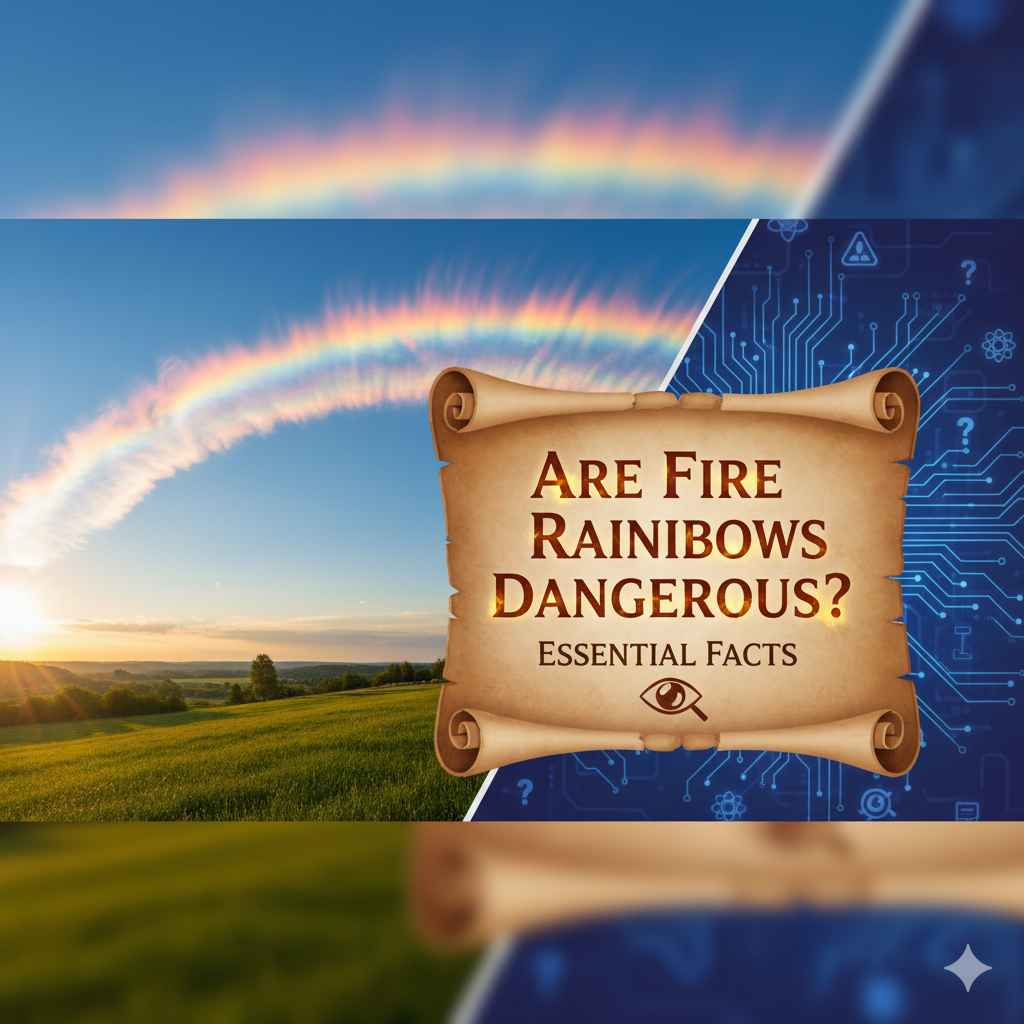
Are Fire Rainbows Dangerous? Essential Facts
Fire rainbows, also known as circumhorizontal arcs, are absolutely not dangerous. They are stunning natural optical phenomena caused by sunlight interacting with ice crystals in high-altitude clouds. There’s no risk associated with viewing them; they are entirely safe and a beautiful sight to behold. For more on this, see our guide on Is Archery Hard to Make Olympics? Tips to Qualify Faster. For more on this, see our guide on Are You Aloud to Bow Hunt in Missouri Rifle Season.
Have you ever seen a breathtaking arc of vibrant colors stretching across the sky, looking like a rainbow that’s horizontally ablaze? It’s a truly magical sight, but it often comes with a question: are fire rainbows dangerous? Many people wonder if these stunning displays are a sign of something unusual or even harmful in the atmosphere.
You’re not alone if this has crossed your mind! The good news is that these natural wonders are completely safe. They’re simply a beautiful trick of light. In this guide, we’ll break down what fire rainbows really are, how they form, and why you can enjoy them with peace of mind. Get ready to understand this amazing atmospheric event and learn what to look for next time one graces your sky!
What Exactly Is a Fire Rainbow?
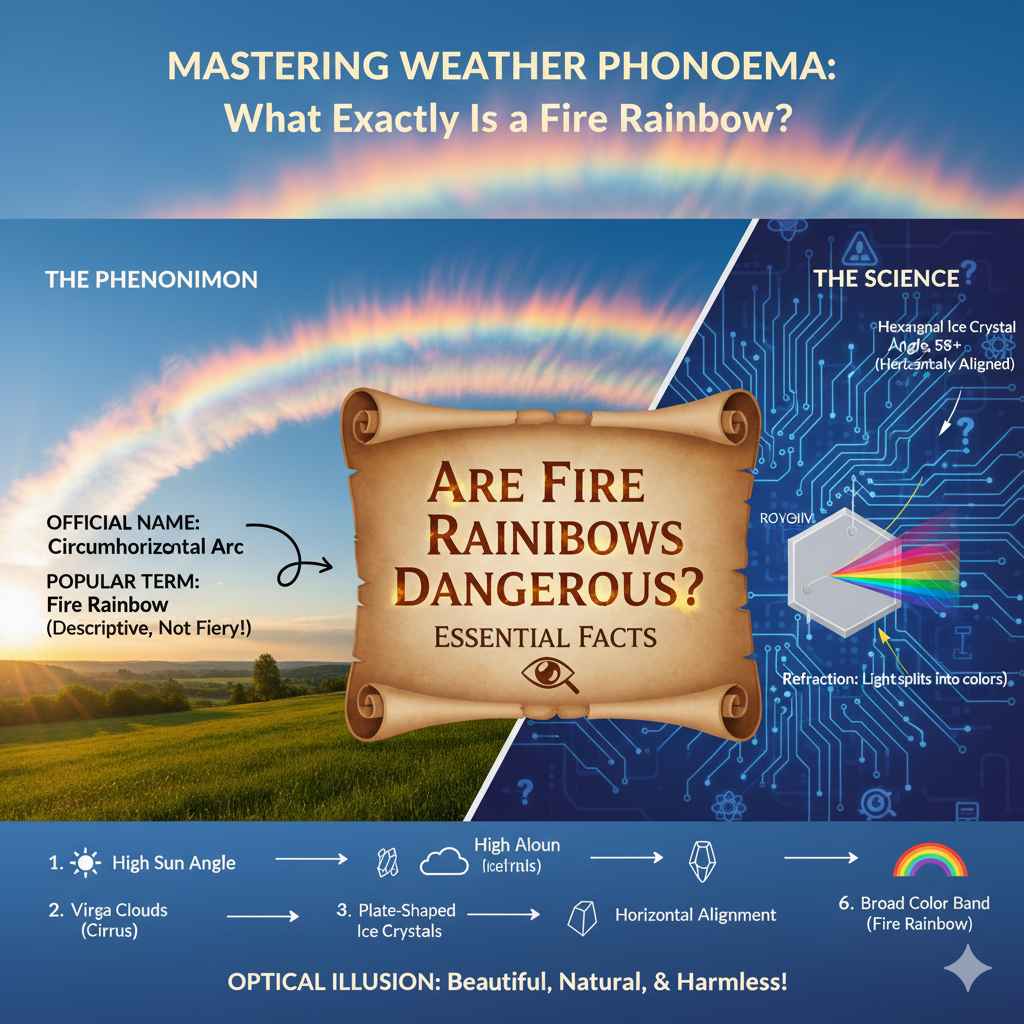
The term “fire rainbow” might sound dramatic, conjuring images of flames in the sky. However, the actual phenomenon is much more grounded in science and far less fiery. Officially, scientists call these colorful arcs “circumhorizontal arcs.” The name “fire rainbow” is a popular, more descriptive term that captures their brilliant, band-like appearance and their similarity to a rainbow’s colors.
These arcs appear as broad bands of color, resembling segments of a rainbow that run parallel to the horizon. Unlike a typical rainbow, which is caused by water droplets refracting light, fire rainbows are formed by something quite different: ice crystals in clouds.
Formation of Circumhorizontal Arcs (Fire Rainbows)
Understanding how these arcs form is key to realizing they are harmless optical illusions. The magic happens when specific conditions align perfectly:
- Sunlight Angle: The sun must be very high in the sky, at an elevation of at least 58 degrees above the horizon. This is why you typically see them during the summer months or in tropical regions where the sun reaches this height.
- Specific Clouds: The clouds involved must be “virga clouds,” which are essentially tall, thin, and flat clouds that contain hexagonal ice crystals. Cirrus or cirrostratus clouds are common culprits.
- Ice Crystal Shape: For a circumhorizontal arc to form, the ice crystals within the cloud must be plate-shaped and positioned horizontally.
When sunlight enters these horizontally aligned ice crystals, it undergoes a process called refraction. The light bends as it passes through the crystal’s flat surfaces. Because the hexagonal crystals are oriented horizontally, they act like tiny prisms. Each crystal refracts the sunlight, splitting it into its component colors, much like a raindrop does in a regular rainbow. However, the specific shape and orientation of the ice crystals cause the colors to spread out and appear as a broad, horizontal band.
Think of it like light passing through a windowpane, but with ice crystals that are perfectly shaped and aligned to split the light into brilliant bands of red, orange, yellow, green, blue, and violet.
Understanding the Science: Refraction and Ice Crystals
To truly put your mind at ease about whether fire rainbows are dangerous, it’s helpful to delve a little deeper into the science behind them. The core principle is light refraction.
Refraction: This is the bending of light as it passes from one medium to another. In the case of a fire rainbow, light moves from the air, through an ice crystal, and then back into the air. Due to the angle of incidence and the properties of ice, the light bends. Different wavelengths (colors) of light bend at slightly different angles. Red light bends the least, and violet light bends the most. This separation of colors is what creates the visible spectrum we see as a rainbow or, in this case, a fire rainbow.
Ice Crystals: For a circumhorizontal arc, the key is the specific shape and alignment of the ice crystals. They need to be hexagonal plates that are oriented horizontally. When sunlight hits these crystals at the right angle, it enters through the side face and exits through the bottom face. This specific path of light through the crystal causes the colors to be dispersed at a particular angle (around 219 degrees relative to the sun’s position), resulting in the arc appearing below the sun.
You can learn more about the science of light and atmospheric optics on NASA’s Climate Kids website: How Are Rainbows Made?
Common Misconceptions and Fears
The name “fire rainbow” itself can be a source of fear, leading some to believe there’s an actual fire involved or some sort of energetic or hazardous event occurring in the atmosphere. This fear can be amplified by sensationalized images or misunderstandings.
- “Fire” in the Name: The “fire” refers purely to the vivid, flame-like colors (especially reds and oranges) that can be seen in these arcs, not to actual combustion or heat.
- Unusual Appearance: Because they look so different from a typical rainbow, people might assume they are a sign of a dangerous weather event, UFOs, or atmospheric anomalies.
- High Altitude: Since they involve ice crystals in high clouds, some might associate them with extreme weather.
It’s important to remember that these are optical phenomena, similar to sundogs or halos, which are also caused by light interacting with ice crystals. They are beautiful displays of physics in action, not indicators of danger.
Are Fire Rainbows Dangerous? Debunking Myths
Let’s address the core question directly: Are fire rainbows dangerous? The answer is a resounding no.
There are absolutely no inherent dangers associated with witnessing a fire rainbow. They do not pose any risk to health, safety, or the environment. The science behind them confirms this:
- They are made of light.
- They form high up in the atmosphere.
- They require specific, but natural, atmospheric conditions.
The specter of danger is entirely a product of misinterpretation and the evocative nature of the name. Anyone can safely enjoy watching them form and fade.
Factors That Contribute to Their Appearance (and Why They Aren’t Dangerous)
The conditions necessary for fire rainbows are meteorological, not hazardous. Let’s look at these factors:
1. High Sun Angle
For a fire rainbow to appear, the sun must be positioned very high in the sky. This typically means the sun is at least 58 degrees above the horizon. In the Northern Hemisphere, this occurs during the late spring and summer months, around midday. In tropical regions, the sun is high enough for a longer period of the year.
Why it’s not dangerous: A high sun angle is a normal seasonal occurrence. While direct sunlight can be harmful to our eyes if stared at, the phenomenon of the fire rainbow itself doesn’t intensify any danger from the sun. The light is being refracted by ice crystals, not concentrated in a harmful way.
2. Specific Cloud Types
Circumhorizontal arcs are seen in clouds composed of plate-like hexagonal ice crystals. These are usually very thin, high-altitude clouds like cirrus, cirrostratus, or the aforementioned virga clouds.
Why it’s not dangerous: These types of clouds are common and are not associated with severe weather. They are simply the canvas upon which the light show is painted. The presence of ice crystals is normal at high altitudes.
3. Ice Crystal Orientation
This is the most crucial element. The ice crystals must be oriented horizontally, or nearly so, for the light to refract in the specific way that creates the arc. This horizontal alignment is thought to be caused by air resistance as the crystals fall, or by their shape interacting with atmospheric currents.
Why it’s not dangerous: The orientation of ice crystals is a natural physical process. It’s a matter of specific crystal geometry and atmospheric dynamics, not a sign of anything harmful.
Comparison with Other Atmospheric Optical Phenomena
Fire rainbows belong to a family of optical phenomena that are also entirely safe. Understanding these can further solidify the idea that colorful sky displays are natural and harmless.
| Phenomenon | Cause | Appearance | Safety |
|---|---|---|---|
| Rainbow | Refraction and reflection of sunlight by water droplets. | An arc of colors in the sky opposite the sun. | Safe. |
| Circumhorizontal Arc (Fire Rainbow) | Refraction of sunlight by horizontally oriented hexagonal ice crystals in high clouds. | A broad, horizontal band of brilliant colors, often appearing below the sun. | Safe. |
| Sundogs (Parhelia) | Refraction of sunlight by hexagonal ice crystals in clouds or airborne ice particles. | Bright spots of light on either side of the sun, often with colored halos. | Safe. |
| Halo (22-degree halo) | Refraction or reflection of light by hexagonal ice crystals. | A ring of light around the sun or moon, typically at a 22-degree radius. | Safe. |
| Sun Pillars | Reflection of light off the surfaces of falling ice crystals. | A vertical shaft of light extending above or below the sun. | Safe. |
As you can see, fire rainbows share commonalities with many other beautiful, scientifically explained atmospheric events. None of these phenomena are dangerous.
How to Spot a Fire Rainbow
Since they are not dangerous, you might be wondering how to witness this spectacle yourself. The opportunities are less frequent than for regular rainbows, but with a bit of knowledge, you can increase your chances.
Optimal Viewing Conditions
- Location: They are more common in temperate and tropical latitudes because these areas experience higher sun angles. However, they can be seen in higher latitudes too, during the peak of summer midday.
- Time of Day: Midday is your best bet, especially during summer. Look for when the sun is highest in the sky.
- Weather: You need a clear, bright sun and high-altitude, wispy clouds that are thin enough to allow sunlight to pass through and refract effectively. These aren’t typically storm clouds.
What to Look For
Instead of the typical arc shape of a rainbow, a fire rainbow appears as a broad, flat band of color. The colors are often very vivid, particularly reds, oranges, and yellows, which is why they get their name. It will be located high in the sky, parallel to the horizon, and generally below the sun. It won’t typically be a full circle, but rather a segment or arc.
The U.S. Geological Survey provides excellent resources on atmospheric optical phenomena: Sundog or parhelion (mock sun), which explains the science behind similar ice-crystal related optical displays.
Tips for Enjoyment
- Be Patient: These phenomena can appear and disappear as cloud conditions change.
- Don’t Stare at the Sun: Even though fire rainbows are safe, looking directly at the sun can damage your eyes. Use your peripheral vision or the arc itself as a reference point, but avoid direct solar gazing. Sunglasses are recommended for prolonged outdoor viewing when the sun is strong.
- Capture the Moment: If you’re lucky enough to see one, have your camera ready! They make for stunning photographs.
Are Fire Rainbows Dangerous for Aircraft or Weather?
Some people might worry if these optical events could affect aviation or signal unusual weather patterns. The answer remains no.
For Aircraft: Fire rainbows form at altitudes where commercial aircraft fly, but they are purely optical. They do not create any physical obstruction, electromagnetic interference, or turbulence. Pilots and passengers are in no danger from them.
For Weather: Circumhorizontal arcs are a product of existing atmospheric conditions, not a cause of any future weather changes. They are indicators that the specific atmospheric setup (high sun, ice crystals) is present. They do not predict storms, extreme heat, or any other hazardous weather event.
Factors Influencing the Fire Rainbow’s Appearance
While the core science remains consistent, certain factors can influence how a fire rainbow looks:
Cloud Thickness and Composition
The brightness and clarity of the colors depend heavily on the density and uniformity of the ice crystals within the cloud. Thinner, more uniform clouds tend to produce the most brilliant and well-defined arcs.
Table: Cloud Characteristics and Fire Rainbow Appearance
| Cloud Characteristic | Effect on Fire Rainbow | Why it Matters for Safety (or the lack thereof) |
|---|---|---|
| Thin, uniform ice crystal layer | Brilliant, sharp, well-defined colors. | Indicates ideal conditions for formation, still safe. |
| Thick or patchy ice crystal layer | Fainter colors, less defined arcs, potentially broken segments. | Less impressive visual, but still safe. |
| Presence of supercooled water droplets (in addition to ice) | May affect crystal shape, potentially altering the arc or making it fainter. | No safety impact. |
Atmospheric Clarity
Just like with a regular rainbow, the visibility of a fire rainbow can be affected by haze, pollution, or other particles in the lower atmosphere. A clearer atmosphere generally leads to a more vibrant display.
Sun’s Position
The exact angle of the sun is critical. Even a slight deviation from the necessary 58-degree elevation can prevent the arc from forming or cause it to shift position, making it harder to spot.
Debunking the Danger: Expert Opinions and Scientific Consensus
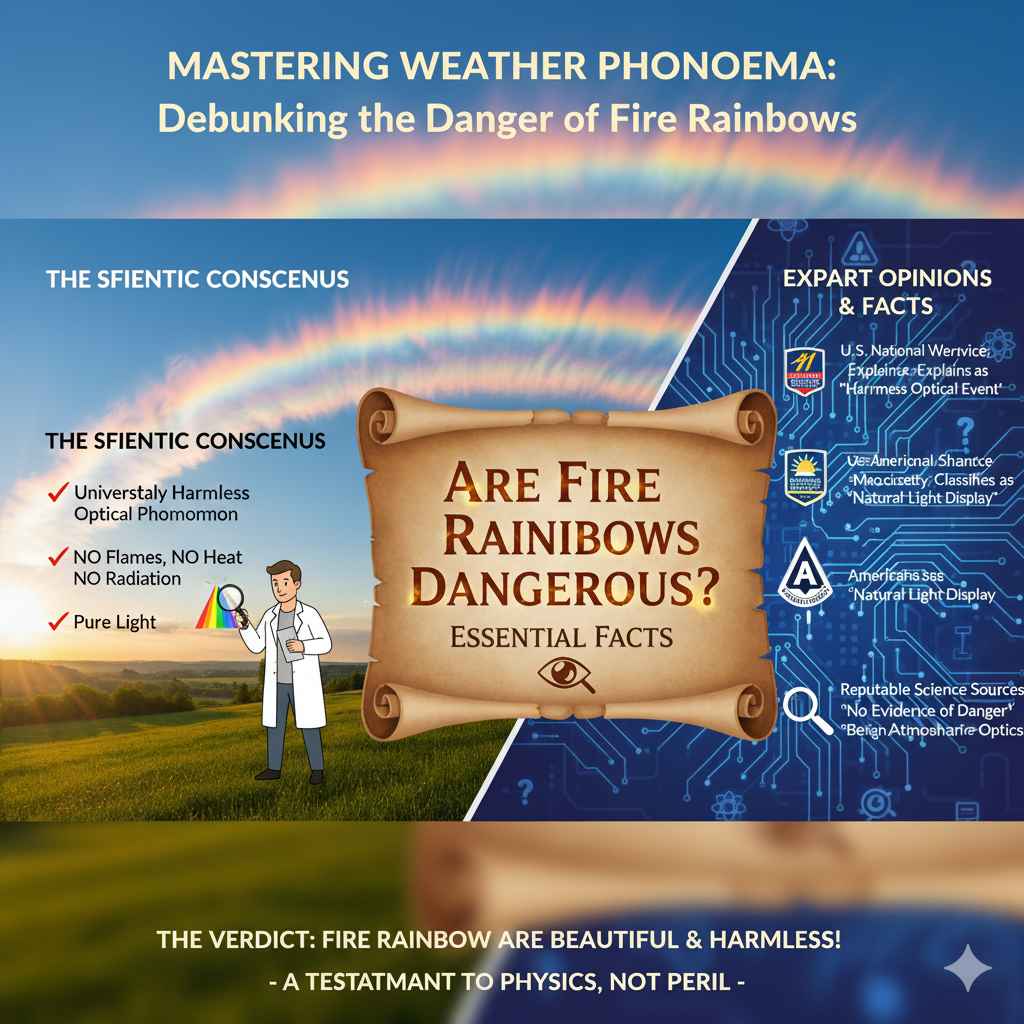
The scientific community universally agrees that fire rainbows are benign optical phenomena. Meteorologists, atmospheric physicists, and optical scientists all classify them as harmless occurrences. There is no research or evidence to suggest any danger associated with them.
The U.S. National Weather Service, for instance, frequently explains such phenomena in its resources, emphasizing their optical nature. Organizations like the American Meteorological Society also provide explanations that clearly label these as natural light displays, without any mention of hazards. Reputable sources like science museums and educational websites consistently reinforce this information.
What About Extreme Examples?
Even in cases where multiple halos, sundogs, and circumhorizontal arcs appear simultaneously, creating a very complex and colorful sky, there is no associated danger. It simply means the atmospheric conditions are particularly perfect for ice-crystal optics. Such displays are rare and breathtaking, but they are a testament to physics, not peril.
Frequently Asked Questions About Fire Rainbows
Q1: What causes the bright colors in a fire rainbow?
A1: The bright colors are caused by sunlight being refracted (bent) as it passes through uniquely shaped and horizontally oriented hexagonal ice crystals in high-altitude clouds. Different colors of light bend at slightly different angles, separating into the visible spectrum.
Q2: Can fire rainbows occur at any time of year?
A2: They are most common during the summer months in temperate regions because the sun needs to be high in the sky (at least 58 degrees above the horizon). They can also be seen year-round in tropical regions.
Q3: Is it safe to look directly at a fire rainbow?
A3: Yes, it is safe to look at a fire rainbow itself. However, you should avoid looking directly at the sun, as this can cause permanent eye damage from the sun’s intense rays. Use peripheral vision or the arc as a focus point.
Q4: Do fire rainbows mean bad weather is coming?
A4: No, fire rainbows are purely optical phenomena and do not predict future weather. They simply indicate the presence of specific cloud conditions (high ice crystals) and a high sun angle at that moment.
Q5: Are fire rainbows related to actual fire or heat?
A5: No, the name “fire rainbow” is purely descriptive, referring to the vivid, flame-like colors (especially reds and oranges) that the arc can display. There is no heat or fire involved.
Q6: How do fire rainbows differ from regular rainbows?
A6: Regular rainbows are formed by light refracting through water droplets in the air, typically appearing opposite the sun. Fire rainbows are formed by light refracting through ice crystals, and they appear parallel to the horizon, usually below the sun.