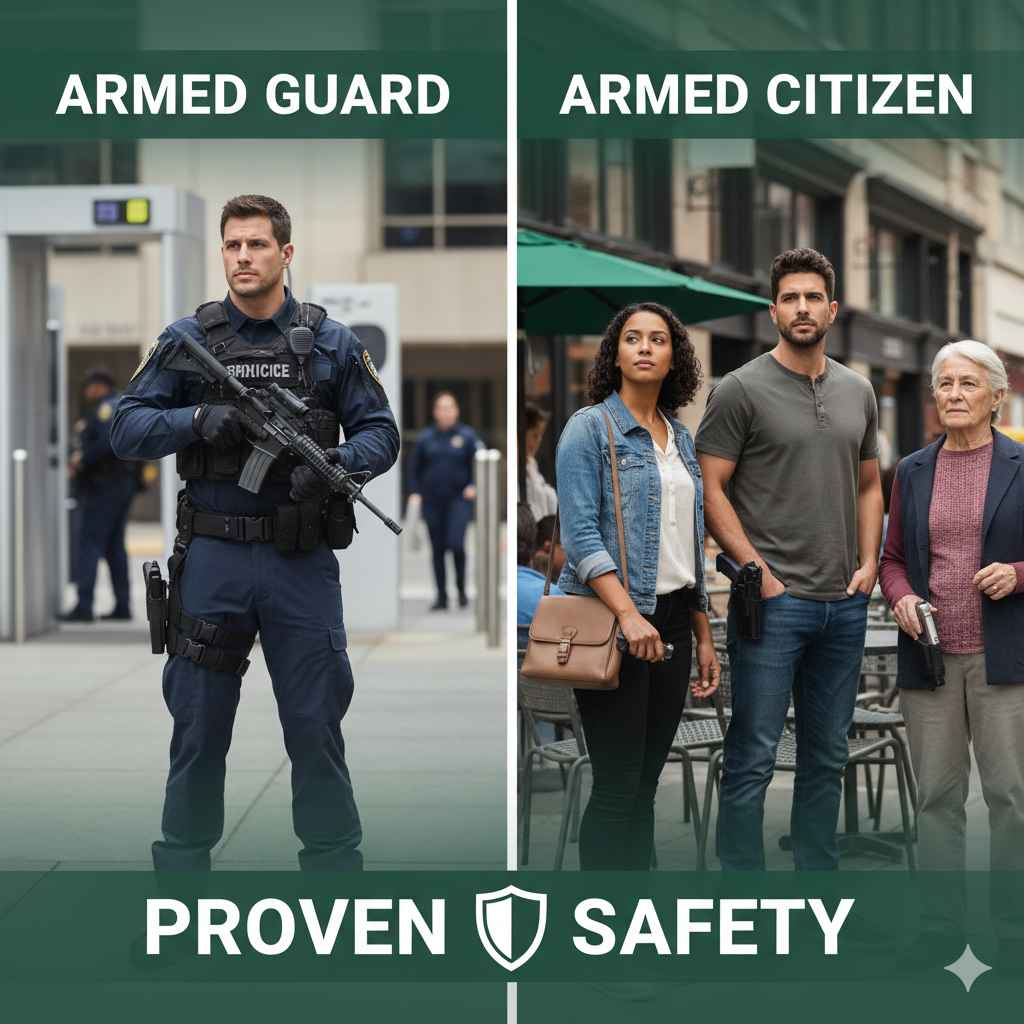
Armed Guard vs Armed Citizen: Proven Safety
Armed guard vs Armed citizen: Proven safety hinges on rigorous training, clear legal understanding, and situational awareness. While armed guards offer professional, consistent protection, armed citizens provide immediate, voluntary defense, each role having unique benefits and responsibilities.
When thinking about personal safety, the topic of who should carry a weapon—a trained professional or a responsible civilian—often comes up. It can feel confusing to know the difference between an armed guard and an armed citizen protecting themselves. Both roles aim for safety, but they operate under very different rules and levels of preparation. You want clear answers, not confusing legal talk. We will break down exactly what sets these two roles apart, focusing on training, legal boundaries, and real-world effectiveness. Getting this knowledge builds confidence in making smart safety choices for yourself and your loved ones.
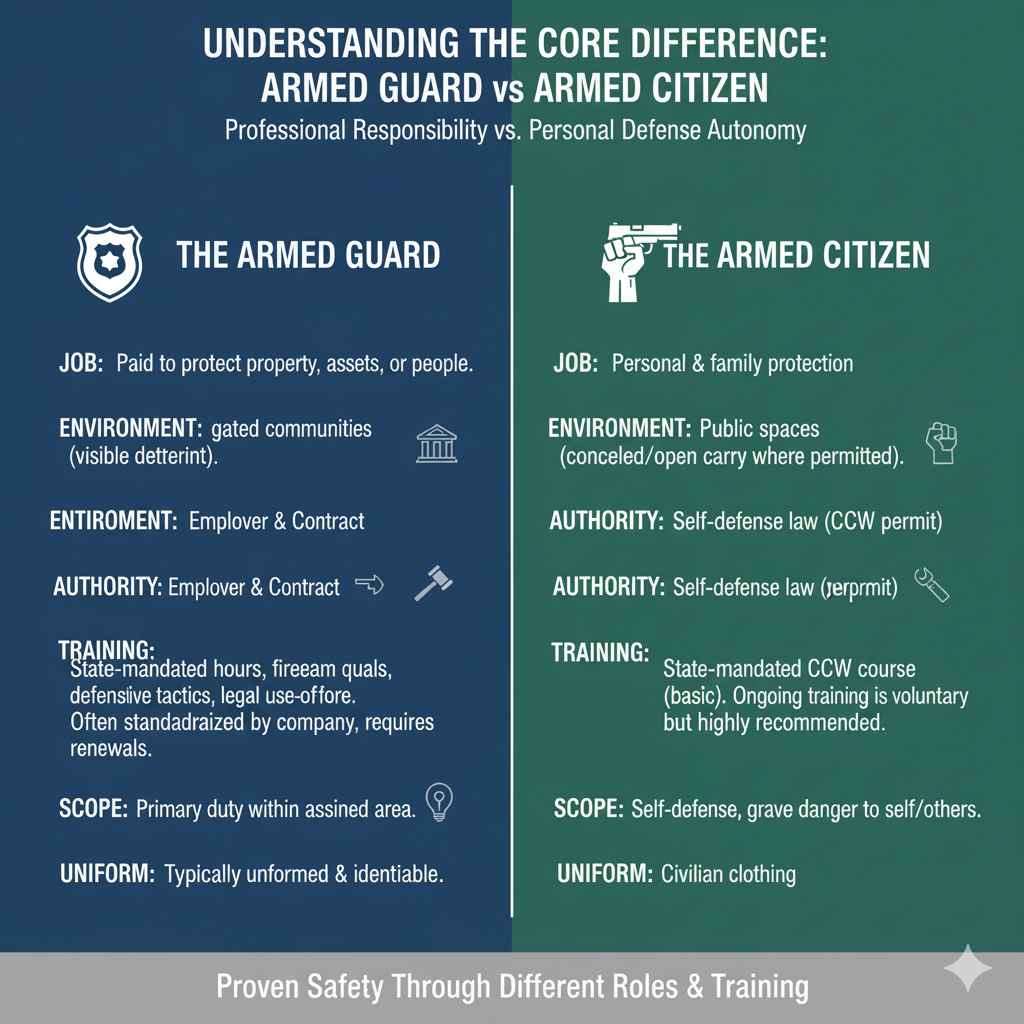
Understanding the Core Difference: Armed Guard vs Armed Citizen
The biggest difference between an armed guard and an armed citizen is their job description and the environment they operate in. Think of it like the difference between a professional baseball player and a dedicated weekend player; both know the game, but one does it for a living under specific contracts.
The Armed Guard: A Professional Responsibility
An armed guard, often called an Unarmed Guard or Security Officer, is hired to protect property, assets, or specific people. They are a visible deterrent, and their presence is usually mandated by the location they serve—like a bank, a concert venue, or a gated community. Their authority comes from their employer and the specific contract they sign.
Key Characteristics of an Armed Guard:
- Employment: They are paid employees of a security firm or directly by a business.
- Training Mandates: They must meet state-mandated training hours, which often include specific firearm qualifications, defensive tactics, and legal instruction related to use-of-force in a professional context.
- Scope of Duty: Their primary responsibility is to protect the client’s property or people within their assigned area. They rarely act outside these boundaries.
- Uniform and Equipment: They are typically uniformed, making them easily identifiable, which is part of the deterrent effect.
Their training is usually standardized across the security company, ensuring a baseline level of performance. If you check local regulations, you’ll often find that security officers must renew their permits yearly or biennially, meaning their skills are regularly checked against current standards. For instance, in many states, the requirements for private security licensing are governed by a state-level Department of Public Safety or similar agency.
The Armed Citizen: Personal Defense Autonomy
An armed citizen is a private individual who has chosen to carry a firearm for self-defense, usually after obtaining a state-issued Concealed Carry Weapon (CCW) permit, or carrying openly where permitted. Their authority is not derived from an employer but from the law granting them the right to self-defense.
Key Characteristics of an Armed Citizen:
- Motivation: Personal and family protection, not professional obligation.
- Training Standard: Varies widely. It usually requires completing a basic CCW course mandated by the state, but ongoing training is voluntary, though highly recommended.
- Scope of Duty: Their duty is self-defense. They are generally expected to intervene only when their own life or the life of another innocent person is in immediate, grave danger.
- Legal Framework: They operate under general self-defense laws applicable to all citizens.
This is where personal responsibility comes into sharp focus. While a guard’s actions are often guided by company policy, the armed citizen must instantly apply complex self-defense laws in a high-stress moment. This is why consistent personal practice, much like regularly sighting in your bow, is crucial.
Training and Qualification Differences: Rigor vs. Responsibility
When we talk about “proven safety,” training is the foundation. An armed guard has formalized, recurring training; an armed citizen’s training level is often self-directed after the initial permit requirement is met.
Armed Guard Training Depth
Armed security training programs are intensive because the margin for error is often lower due to public trust and contractual obligations. They must pass regular qualification courses to maintain their license to carry on duty.
- Initial Certification: Covers state laws regarding the use of force, detention authority, report writing, and firearms proficiency (often requiring a higher score than standard civilian qualification).
- Mandatory Recertification: Many states require guards to re-qualify with their weapon every 6 to 12 months. This ensures that skills don’t degrade over time.
- Scenario-Based Drills: Training often includes specific scenarios related to their post, such as responding to shoplifting, dealing with aggressive patrons, or securing a perimeter.
Armed Citizen Training Realities
For the armed citizen, the initial CCW class covers the bare minimum required by the state to demonstrate basic competency and legal understanding. Beyond that, it is up to the individual.
Think about the precision needed for a perfect arrow grouping; it requires consistent practice. Similarly, maintaining defensive skills requires ongoing commitment. Safety relies heavily on the citizen choosing to pursue advanced training beyond the introductory course.
Here is a comparison of typical training focuses:
| Training Aspect | Armed Guard (Professional) | Armed Citizen (Personal Defense) |
|---|---|---|
| Legal Focus | Specific laws regarding security contracts, detention, and premises liability. | General self-defense laws, duty to retreat (where applicable), and citizen’s arrest. |
| Firearm Qualification | Mandatory periodic qualification (e.g., quarterly or semi-annually) with minimum required scores. | Usually required once for the initial permit; ongoing practice is optional but crucial. |
| Equipment Requirements | Often specified by the employer (e.g., specific sidearm caliber or duty gear). | Governed by state laws regarding concealed/open carry; largely chosen by the individual. |
| De-escalation Focus | High emphasis, as job duties often involve minimizing incidents without escalation. | Important, but often secondary to immediate threat management in self-defense situations. |
Legal Boundaries: Authority vs. Personal Right
The legal framework surrounding an armed guard and an armed citizen is fundamentally different, especially when force is used. This distinction is vital for “proven safety” because legal repercussions can follow any defensive action.
The Guard’s Authority: Limited and Contractual
A security guard’s authority to detain or use force is generally narrower than a police officer’s and is often defined by state statute for private security, as well as the contract they are working under. They are not generally authorized to make arrests for offenses they did not witness, unless they have specific powers granted by the jurisdiction (sometimes called “citizen’s arrest” powers, but usually with added guard liability).
If a guard uses excessive force, they face two layers of liability: criminal charges and civil lawsuits from the injured party, often compounded by liability claims against their employing company. This structure often encourages de-escalation over confrontation.
The Citizen’s Authority: Universal Right to Self-Defense
The armed citizen acts under the universal right of self-defense. This right allows you to use necessary force, including deadly force, to protect yourself or another innocent person from an imminent threat of death or serious bodily harm. The standard applied is reasonableness under the circumstances.
It is essential for the armed citizen to know local laws regarding defense of others and property. For example, many states follow the “Stand Your Ground” principle, while others have “Duty to Retreat” laws. Ignorance of these local statutes is not a defense. Resources like state police websites or reputable legal aid organizations often provide clear summaries of these laws, for example, resources from the USA.gov portal can guide you to your specific state’s requirements.
Situational Awareness: The Unseen Shield
Whether you are a guard or a citizen, the firearm is the last resort. The best safety measure is avoiding the dangerous situation entirely. This is where situational awareness—the ability to observe and process your environment—comes into play.
Guard Awareness: Proactive Patrols
Guards are trained to maintain constant visual awareness within their patrol zones. They are often looking for anomalies—a door left ajar, an unfamiliar vehicle lingering, or a tense interaction between two people.
- Constant zone observation.
- Regularly checking in with a central dispatcher.
- Identifying potential threats before they become immediate crises.
Citizen Awareness: The OODA Loop at Home
For the armed citizen, situational awareness is about being present and practicing the OODA loop (Observe, Orient, Decide, Act). This concept, borrowed from military strategy, is crucial for making fast, sound decisions.
If you are constantly looking at your phone or wearing noise-canceling headphones while walking, you are severely limiting your ability to Observe, which halts the entire safety loop. A prepared citizen constantly scans their surroundings, noticing things that feel “off.”
A helpful tip for improving citizen awareness is adopting the “Color Code” system for alertness:
- White: Unaware, relaxed (e.g., sleeping).
- Yellow: Relaxed alertness, aware of surroundings but not tense (good for most daily activities).
- Orange: Specific threat identified, actively assessing the situation (e.g., seeing someone acting suspiciously).
- Red: Immediate fight or flight needed (threat is imminent).
The goal is to spend most of your time in Yellow, moving quickly to Orange when something seems wrong, so you don’t have to jump straight into Red, which is where drawing a weapon might become necessary.
When Protection is Needed: Engagement Protocols
If a situation forces an armed response, the procedures and expectations differ significantly between the two roles.
Armed Guard Engagement
Guards usually have strict Use-of-Force Continuum policies. They are trained to use the minimum force necessary to stop the threat, often prioritizing the safety of the public over property protection if a choice must be made.
After an incident, their protocol heavily emphasizes documentation. They must immediately secure the scene, contact law enforcement (who are the primary authority), and write detailed, objective reports. Their goal is to stabilize the situation until the police arrive.
Armed Citizen Engagement
The armed citizen’s engagement protocol is singular: stop the threat to life or severe bodily harm. There is no required reporting process to a supervisor or a detailed policy manual to follow beyond the law itself.
If a citizen uses deadly force, they must be prepared to justify their actions to responding police officers immediately, and subsequently, to prosecutors and civil courts. This high burden of proof for justification is why many self-defense experts strongly recommend extensive scenario training for armed citizens, far beyond the minimum CCW course.
Factors Influencing Proven Safety Outcomes
While training is essential, several external factors can influence the actual safety outcome whether you are a guard or a citizen.
The Role of Environment and Jurisdiction
Where the event happens drastically changes the equation. A guard working in a high-security federal building has significant protocols and backup readily available. In contrast, an armed citizen defending themselves in a remote area might be minutes away from any official response.
The legality of carrying also changes outcomes. In states with very restrictive carry laws, even a legally permitted armed citizen might face intense scrutiny simply for carrying at all. Conversely, areas with strong “Castle Doctrine” laws might offer clearer legal protection for citizens defending their homes.
The Impact of Gear and Maintenance
For both groups, equipment reliability is non-negotiable. A weapon that jams or fails to cycle is dangerous to everyone involved. This is where the parallel to archery is clear: a warped arrow or a damaged bowstring guarantees poor performance.
For the armed guard, the gear is often inspected by a supervisor or range master. For the armed citizen, maintenance is a constant, personal chore.
| Equipment Aspect | Guard Concern | Citizen Concern |
|---|---|---|
| Weapon Reliability | Must meet company standards; often requires specific duty ammunition loads. | Must function perfectly; selection based on personal comfort and legal compliance. |
| Holster Security | Often specified (e.g., Level II or III retention) to prevent unauthorized access by the public. | Must retain the weapon securely during movement but allow for a fast, safe draw. |
| Ammunition Choice | Often dictated by contract or liability concerns (e.g., avoiding over-penetration in public spaces). | Personal choice balanced against ballistic performance and local regulations. |
When Do Armed Citizens Outweigh Armed Guards in Effectiveness?
There are specific scenarios where the presence of an armed citizen, despite less formal training, offers a unique safety advantage over a uniformed guard.
Immediate, Unforeseen Threats
Guards are usually positioned in specific locations or follow predictable patrol routes. If a sudden, violent incident occurs outside a guard’s immediate post—say, in the parking lot of a store where the guard is inside—the armed citizen who happens to be in the parking lot is the first responder.
The Element of Surprise
Criminals often scout locations for security presence. If they know a location is protected by visible security, they may choose a different target or attack when the guard is distracted or away from their post. An armed citizen is an unpredictable variable; they could be anyone in the crowd.
Defense of Self vs. Defense of Property
A core difference is motivation. A guard is paid to protect property, but their ultimate liability protection often hinges on not escalating a situation involving only property crime. An armed citizen, however, faces no such conflict when their own life is threatened. If an armed citizen is attacked during a robbery, their immediate, legally justifiable response is to stop the attack, regardless of the property loss.
When Armed Guards Offer Superior Safety Assurance
Conversely, there are clear situations where the professionalism and structure of an armed guard provide a higher, more reliable level of safety.
Consistency and Accountability
A guard shows up for their shift every day, sober, rested, and ready, following procedures that are audited. An armed citizen’s readiness depends entirely on their personal discipline on any given day. If a citizen hasn’t practiced shooting or reviewed the law in a year, their competency degrades.
Command Structure and Coordination
In a mass casualty event or complex emergency, guards operate within a chain of command and are trained to coordinate with first responders (police, fire). They know who to report to and how to secure an area effectively until professional help arrives. An armed citizen is a “good guy with a gun,” but they lack the established communication protocols needed for complex scenes.
Deterrence Value
The visible presence of a uniformed, armed guard is statistically a powerful deterrent against many forms of crime, particularly organized theft or vandalism. The citizen’s presence is often hidden (concealed carry) and therefore offers no upfront deterrence.
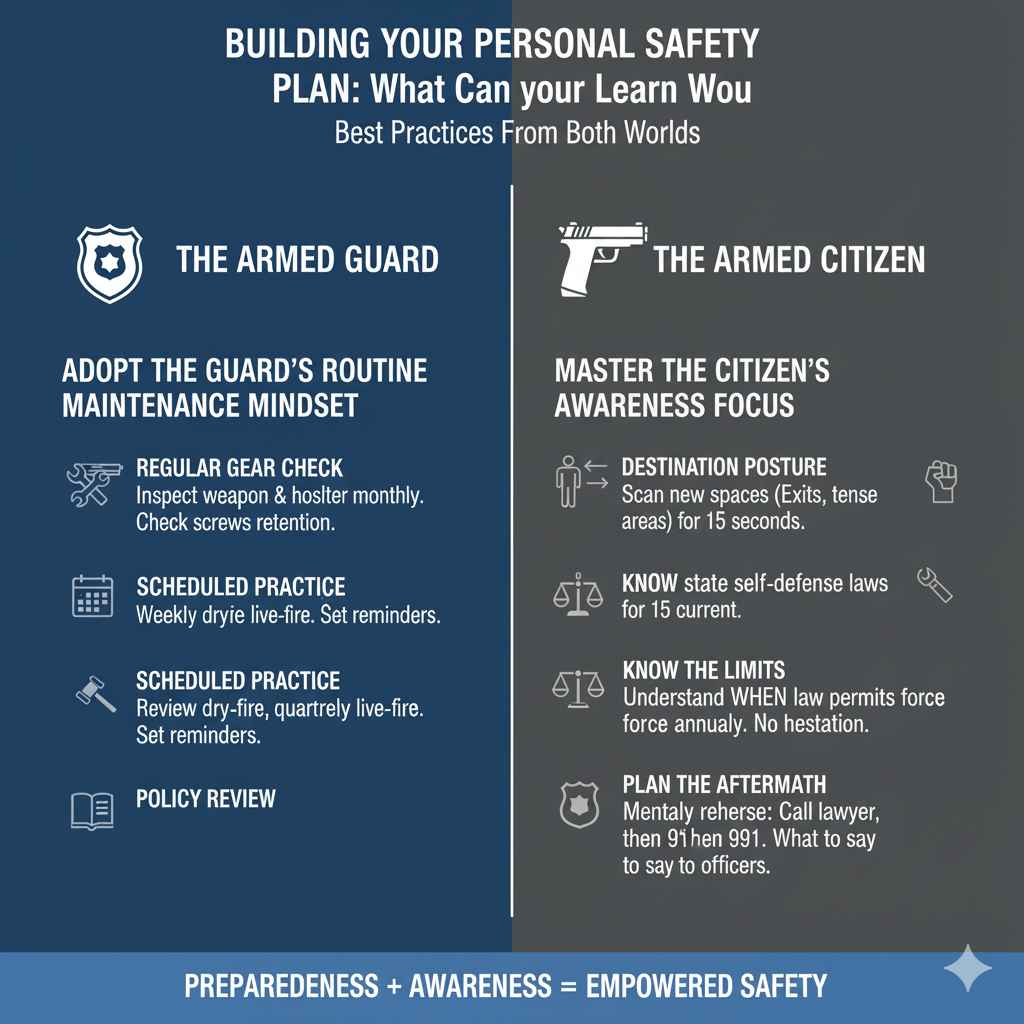
Building Your Personal Safety Plan: What Can You Learn?
Whether you admire the structure of a guard’s preparedness or prefer the autonomy of a citizen’s right to carry, you can adopt best practices from both worlds to enhance your personal safety.
Adopt the Guard’s Routine Maintenance Mindset
If you carry, treat your equipment like a job requirement. This means:
- Regular Gear Check: Inspect your carry weapon and holster monthly. Are the screws tight? Is the holster retaining the weapon correctly?
- Scheduled Practice: Do not wait until a range day is convenient. Set a calendar reminder for dry-fire practice (safe practice without live ammunition) weekly, and live-fire practice quarterly.
- Policy Review: Read up on state self-defense law changes at least once a year. Knowledge fades faster than physical skill.
Master the Citizen’s Awareness Focus
Guards focus outward on their post; you must focus outward on your immediate surroundings.
- Destination Posture: When entering any new public space (a restaurant, a mall, a parking garage), take 15 seconds to scan for exits and identify any unusually tense areas or individuals.
- Know Your Limits: Understand exactly when the law permits you to use force. If you hesitate in that moment because you are unsure of the law, you’ve already lost precious time.
- Plan the Aftermath: Before you ever leave home, mentally rehearse what you would do if you had to use your weapon—who you would call first (your lawyer, then 911), and what you would say to the first officer on scene.
Frequently Asked Questions (FAQ) About Armed Guard vs Armed Citizen
Q1: Is an armed guard allowed to arrest someone?
Generally, armed guards do not have the same arrest powers as police officers. In most places, they can only perform a citizen’s arrest, meaning they can detain someone who commits a crime in their presence until law enforcement arrives. However, the exact authority depends on local laws and the policies of the security company they work for.
Q2: Do armed guards receive more training than armed citizens?
Yes, in most cases armed guards receive more structured and mandatory training. Their training often includes firearm qualification, use-of-force policies, legal responsibilities, and regular recertification. Armed citizens usually complete a basic permit course, but additional training is optional and depends on the individual’s commitment to improving their skills.
Q3: Can an armed citizen legally defend other people?
In many jurisdictions, armed citizens can defend others if the situation meets the legal standard of immediate threat of death or serious bodily harm. However, laws vary widely by location, so it is important to understand the specific self-defense laws in your state or country before carrying a firearm.
Q4: Are armed guards responsible for protecting everyone in an area?
Not always. Armed guards are typically hired to protect a specific property, client, or designated area. Their responsibility is defined by the contract with their employer, which means their role may focus on protecting assets, monitoring access points, or deterring crime rather than acting as general law enforcement.
Q5: Is carrying a firearm as a citizen safer than relying on security guards?
Safety depends on the situation, training level, and awareness of the person carrying the weapon. Armed guards provide consistent, visible protection in specific locations, while armed citizens may offer immediate defense during unexpected threats where no professional security is present.
Q6: What is the most important skill for both armed guards and armed citizens?
The most critical skill for both groups is situational awareness. Recognizing potential threats early, avoiding dangerous situations, and using de-escalation techniques can often prevent violence entirely. A firearm should always be considered a last-resort tool for protection, not the first response.
Conclusion: Understanding Safety Through Responsibility and Training
The debate between armed guard vs armed citizen is not about determining which role is better overall, but about understanding how each contributes to safety in different ways. Armed guards provide structured, professional protection backed by training, accountability, and clear operational duties. Armed citizens, on the other hand, offer immediate personal defense, relying on individual responsibility, awareness, and knowledge of the law.
Both roles share a common goal: protecting lives and preventing harm. The key to proven safety lies not only in carrying a weapon but also in training, discipline, legal understanding, and situational awareness. A firearm alone does not guarantee safety—preparedness and responsible decision-making do.
Ultimately, whether protection comes from a professional security officer or a responsible citizen, the most effective defense begins with awareness, education, and a commitment to acting responsibly in high-risk situations. When people understand their roles and limitations, communities become safer and better prepared to handle unexpected threats.