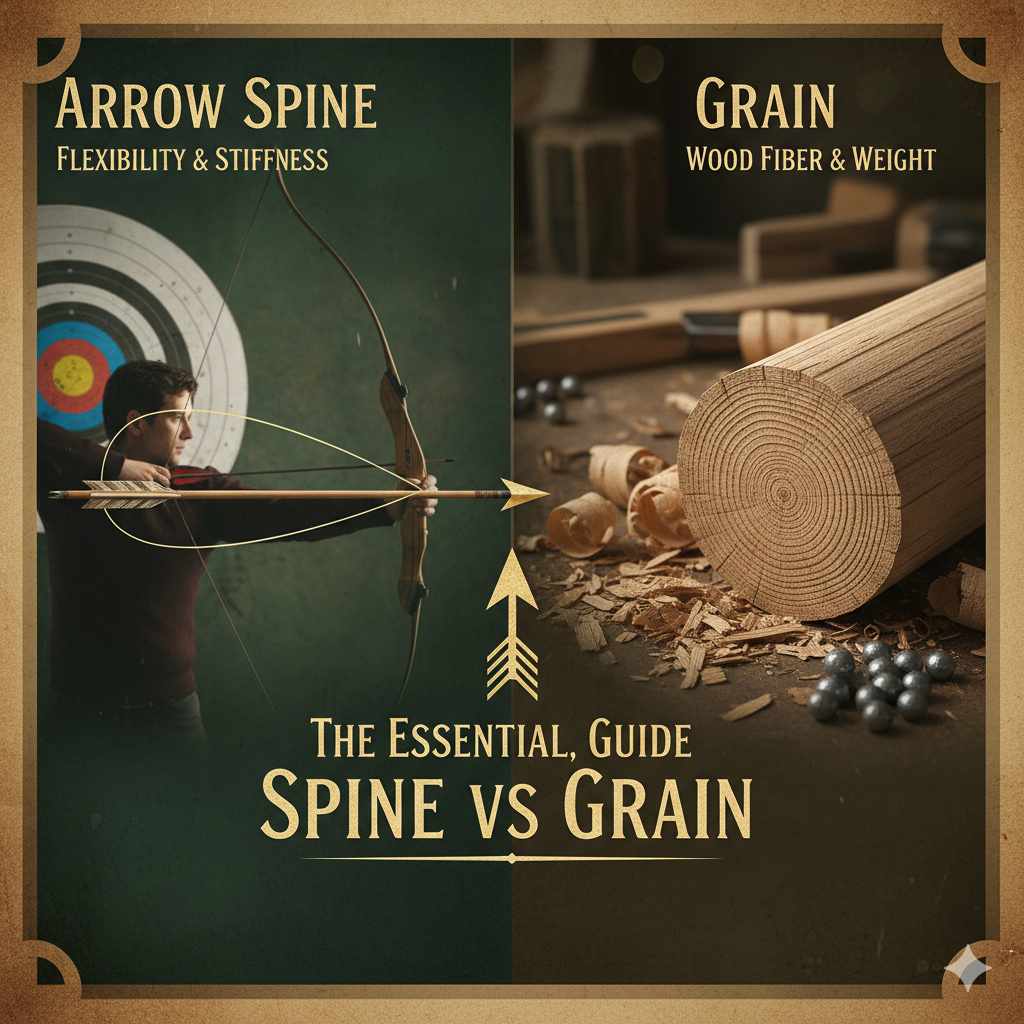
Arrow spine is the measure of an arrow’s stiffness, which determines how much it bends when shot. Arrow grain is the measure of its weight, which affects its speed and impact. Matching the correct spine (stiffness) to your bow’s power is critical for safety and accuracy, while choosing the right grain (weight) helps tune performance.
Hello archers! Salman here. If you’ve ever stood in front of a wall of arrows, you know it can feel a little overwhelming. You see numbers like “500” and “7.8 GPI” and wonder, “What does it all mean?” Two of the most confusing terms for new archers are “spine” and “grain.”
Getting these two things wrong is a common reason why shots go wide, even when your aim feels perfect. It can be frustrating! But don’t worry. Understanding the difference between arrow spine vs grain is simpler than you think, and it’s the secret to unlocking tighter groups and more consistent shots.
Today, I’m going to break it all down for you. We’ll turn confusion into confidence and get you picking the perfect arrows for your bow every single time. Let’s get started!
What is Arrow Spine? (The “Wiggle” Factor)
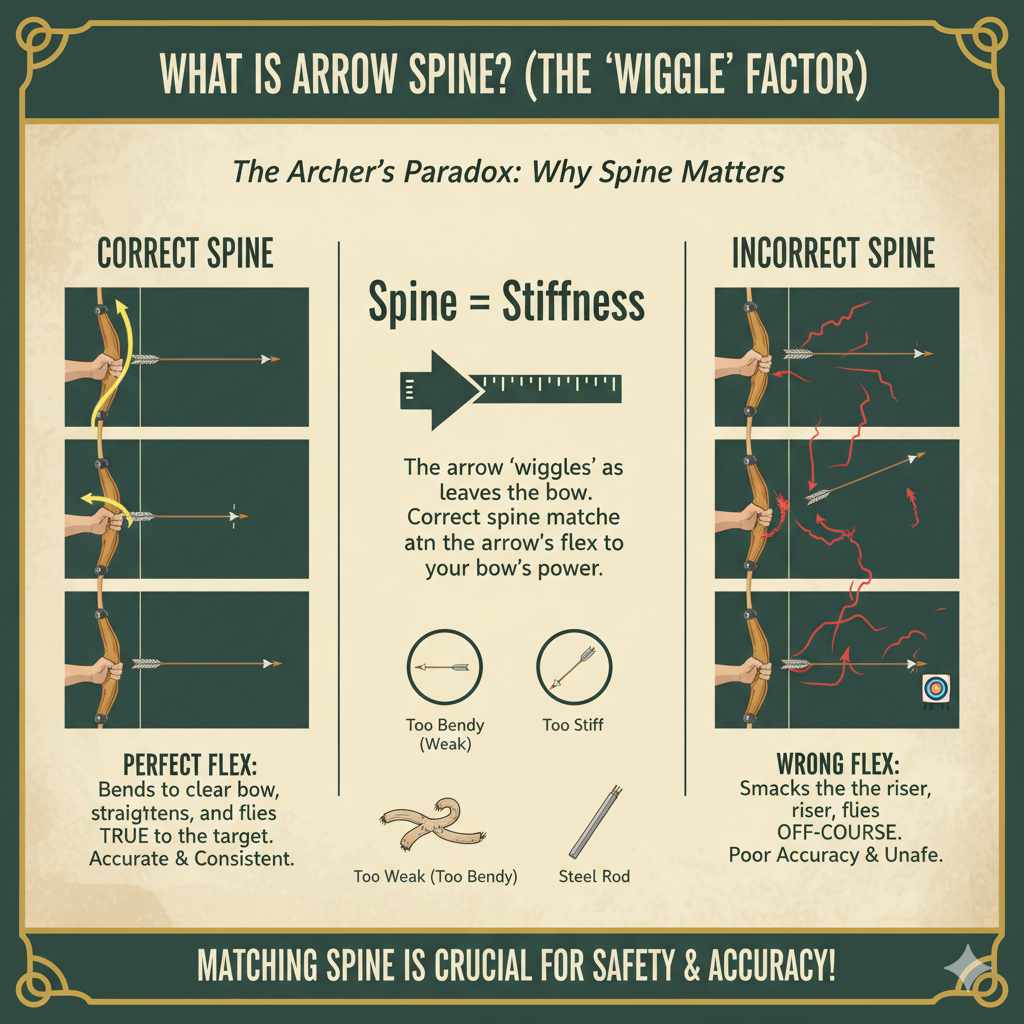
Think of arrow spine as the arrow’s stiffness. It’s a measurement of how much an arrow resists bending. When you release the bowstring, a huge amount of energy is transferred to the arrow, causing it to flex or “wiggle” as it leaves the bow. This is a normal and necessary part of every shot.
The key is to have the right amount of wiggle. If the arrow is too stiff or too floppy for your bow’s power, it won’t fly straight. This is why matching spine to your bow is the most important step for safety and accuracy.
The Archer’s Paradox: Why Spine Matters
You might think an arrow flies perfectly straight off the string, but it actually has to bend around the bow’s riser (the handle part) before straightening out. This amazing bit of physics is called the “Archer’s Paradox.”
For this to happen correctly, the arrow must have the perfect amount of flex:
- Correct Spine: The arrow bends just enough to clear the bow, then quickly straightens itself out and flies true to the target. It’s a beautiful, efficient flight.
- Incorrect Spine: The arrow either bends too much or not enough, causing it to smack against the riser on its way out. This sends it flying off-course, resulting in poor accuracy and inconsistent shots.
Imagine trying to push a wet noodle—it just flops around. That’s like an arrow with a spine that is too weak (too bendy). Now imagine trying to bend a steel rod—it won’t give. That’s like an arrow with a spine that is too stiff.
How an Incorrect Spine Affects Your Shot
Choosing the wrong spine is like wearing shoes that are two sizes too big or too small. You can still walk, but it won’t be comfortable or efficient. Here’s what happens with a mismatched arrow spine:
| Arrow Spine Issue | Effect on Arrow Flight (For a Right-Handed Archer) | What You’ll See |
|---|---|---|
| Too Weak (Too Bendy) | The arrow over-flexes and bends too much around the bow, pushing its tail to the left. This causes the arrow to impact the target to the right. | Your arrows consistently hit to the right of your aiming point. |
| Too Stiff (Not Bendy Enough) | The arrow doesn’t flex enough to get around the riser cleanly. It bounces off the riser to the left, causing it to impact the target to the left. | Your arrows consistently hit to the left of your aiming point. |
(Note: For left-handed archers, the effects are reversed—a weak spine hits left, and a stiff spine hits right.)
What is Arrow Grain? (The “Weight” Factor)
Now let’s talk about grain. Arrow grain is simply a unit of weight. It’s a very small unit, where 7,000 grains equal one pound. When we talk about arrow grain, we’re talking about the arrow’s total mass.
You’ll often see this measurement in two ways:
- Grains Per Inch (GPI): This tells you how much one inch of the arrow shaft weighs (without the nock, insert, point, or fletchings). A higher GPI means a heavier shaft.
- Total Arrow Weight: This is the combined weight of everything—the shaft, point, insert, fletchings, and nock. This is the number that truly affects performance.
Unlike spine, which has a “correct” setting for your bow, grain is more about personal preference and your archery goals. You can choose a lighter or heavier arrow to change how it performs.
How Arrow Grain Affects Performance
The weight of your arrow directly impacts its speed, momentum, and how it behaves in the wind. Think of it like throwing a baseball versus throwing a Wiffle ball. The baseball is heavier, slower, and hits harder. The Wiffle ball is lighter, faster, but gets pushed around by the wind easily.
Here’s a breakdown of how grain weight changes your shot:
| Arrow Weight | Pros | Cons | Best For |
|---|---|---|---|
| Lighter Arrow |
|
| Target archery, 3D archery, and field archery where speed and a flat trajectory are key. |
| Heavier Arrow |
|
| Bowhunting, where penetration is critical, and for archers looking for a quieter, more stable shot. |
How to Choose the Right Arrow Spine
Okay, this is the most important part. Matching your arrow’s spine to your bow is not optional—it’s essential for safety and accuracy. Luckily, it’s a straightforward process. You just need four pieces of information.
Step 1: Know Your Bow’s Draw Weight
First, you need to know the actual draw weight of your bow at your specific draw length. If you have a compound bow, this is the peak weight it’s set to. If you have a recurve or longbow, the weight is usually written on the limbs (e.g., 30# @ 28″). Remember that for traditional bows, the draw weight changes depending on how far you pull it back.
Step 2: Measure Your Draw Length
Your draw length is how far you pull the string back from its resting position. It’s a crucial part of the spine equation. An easy way to get a good estimate is to stand with your arms out to your sides, like a “T.” Have someone measure from the tip of one middle finger to the other. Take that number (in inches) and divide it by 2.5. This will give you a close approximation of your draw length. For a precise measurement, it’s always best to visit a pro shop.
Step 3: Determine Your Arrow Length
Your arrow length is also important. A longer arrow will act weaker (more bendy) than a shorter arrow of the same spine. A good rule of thumb for beginners is to have your arrow be about 1 to 2 inches longer than your draw length. This provides a safe buffer, keeping the broadhead or field point well in front of your hand.
Step 4: Use an Arrow Spine Chart
Once you have your draw weight and arrow length, you can use a spine selection chart. Every arrow manufacturer provides one. These charts cross-reference your bow’s draw weight with your arrow length to recommend a spine number.
Arrow spine is indicated by a number, like 340, 400, 500, or 600. It’s a bit counter-intuitive, but:
- A lower number (e.g., 340) means a stiffer arrow, designed for higher draw weights.
- A higher number (e.g., 600) means a weaker (more flexible) arrow, designed for lower draw weights.
Here is a simplified example of what a spine chart looks like:
| Draw Weight (lbs) | 26″-27″ Arrow | 28″-29″ Arrow | 30″-31″ Arrow |
|---|---|---|---|
| 25-30 lbs | 700 | 600 | 600 |
| 30-35 lbs | 600 | 500 | 500 |
| 40-45 lbs | 500 | 400 | 400 |
| 50-55 lbs | 400 | 340 | 340 |
Disclaimer: This is a generic example. Always consult the specific manufacturer’s chart for the arrows you plan to buy. You can find excellent resources and official charts on websites like USA Archery to ensure you’re getting safe and accurate information.
How to Choose the Right Arrow Grain
Choosing your arrow’s weight (grain) is more about tuning for performance. The main concept to understand here is Grains Per Pound (GPP).
Step 1: Understand Grains Per Pound (GPP)
GPP is a simple ratio: your total arrow weight (in grains) divided by your bow’s draw weight (in pounds). For example, if you have a 400-grain arrow and a 50-pound bow, your GPP is 8 (400 / 50 = 8).
Safety First: Most bow manufacturers recommend a minimum of 5 grains per pound of draw weight. Shooting an arrow that is too light can damage your bow, similar to dry-firing it. It’s unsafe and can void your warranty. So, for a 60-pound bow, your minimum arrow weight should be 300 grains (60 x 5). Never go below this!
Step 2: Decide Your Archery Goal
Now, think about what you want to achieve. Your goal will guide your GPP choice.
- For Speed & Target Practice (5-7 GPP): A lighter arrow in this range will give you a faster, flatter shot. This is great for 3D archery where distances are unknown and a flat trajectory helps with aiming.
- For a Good All-Around Balance (7-9 GPP): This is a great middle ground. You get a good mix of speed and kinetic energy. It’s a forgiving setup that works well for both target shooting and hunting smaller game.
- For Hunting & Maximum Penetration (9+ GPP): A heavy arrow delivers a powerful punch. It carries more momentum, penetrates deeper, and is less affected by wind. This is the preferred choice for bowhunters, especially for large game.
Step 3: Calculate Your Total Arrow Weight
To find your total weight, you need to add up all the components:
- Shaft Weight: Find the GPI of your arrow shaft and multiply it by its length in inches. (e.g., 8.4 GPI x 29 inches = 243.6 grains).
- Point Weight: Field points and broadheads typically weigh 100 or 125 grains.
- Insert Weight: The little piece that the point screws into. This is usually 10-25 grains.
- Fletching Weight: Three plastic vanes might weigh 15-20 grains total. Feathers are lighter.
- Nock Weight: The plastic piece at the back is usually around 5-10 grains.
Add them all up, and you have your total arrow weight! You can then adjust the weight by using heavier or lighter points to fine-tune your setup.
Common Mistakes Beginners Make
Navigating arrow spine vs grain can be tricky, and it’s easy to make a few common mistakes. Let’s make sure you avoid them!
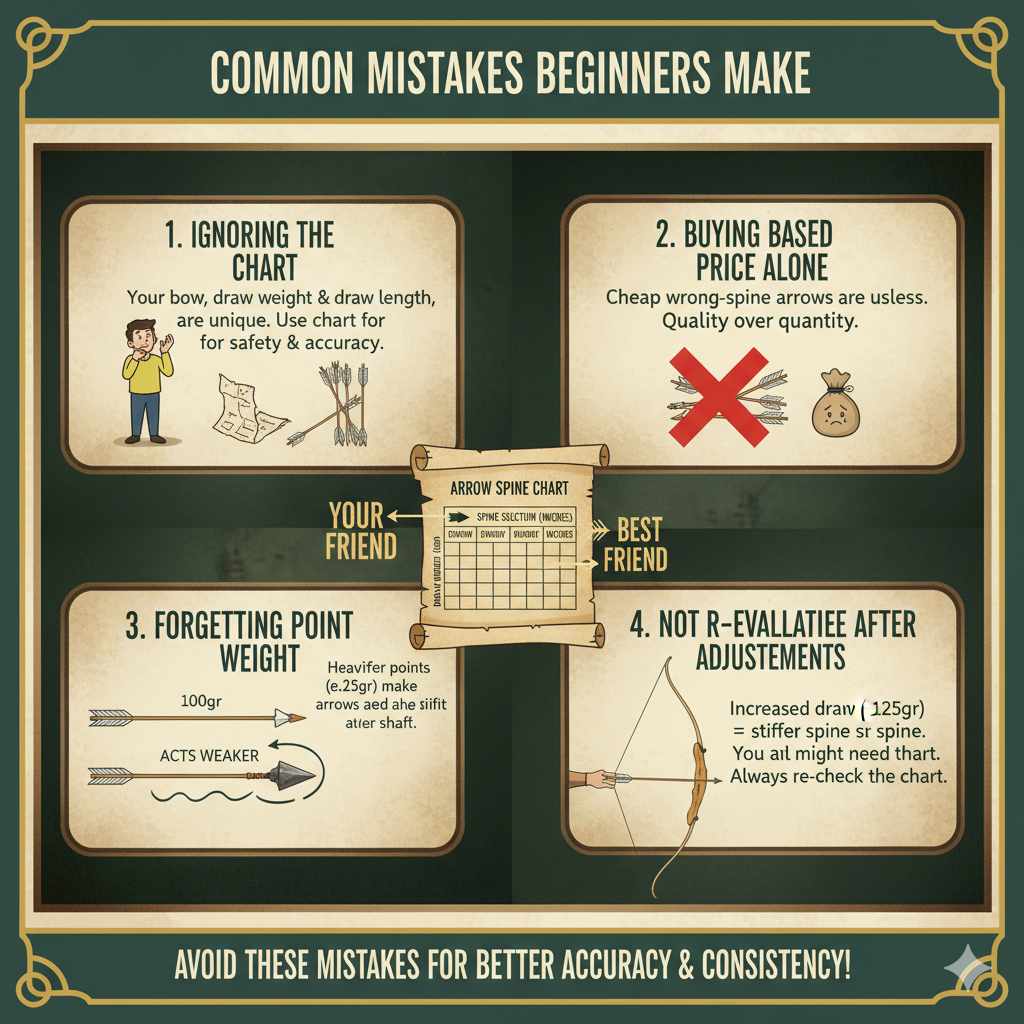
- Ignoring the Spine Chart: This is the biggest one. Don’t just guess or buy what your friend uses. Your bow, draw weight, and draw length are unique to you. The chart is your best friend.
- Buying Based on Price Alone: While budget is important, an arrow with the wrong spine is useless, no matter how cheap it was. It’s better to have six perfect arrows than a dozen that won’t fly straight.
- Forgetting About Point Weight: Changing your point weight affects the dynamic spine of your arrow. A heavier point will make the arrow act weaker (more bendy). If you switch from 100-grain points to 125-grain points, you might need a stiffer arrow shaft to compensate.
- Not Re-evaluating After Bow Adjustments: If you increase your bow’s draw weight, you might need to switch to a stiffer arrow spine. Always re-check the spine chart after making significant adjustments to your equipment.
Frequently Asked Questions (FAQ)
What happens if my arrow spine is too weak?
A weak arrow will flex too much when shot. For a right-handed archer, this often causes the arrow to fly to the right of the target. More importantly, it can be a safety hazard, as a severely weak arrow could break upon release, potentially causing injury.
What happens if my arrow spine is too stiff?
A stiff arrow will not flex enough to clear the bow’s riser cleanly. For a right-handed archer, this typically causes the arrow to fly to the left of the target. While less dangerous than a weak spine, it will still lead to poor accuracy and frustration.
Is a higher grain number better?
Not necessarily. “Better” depends on your goal. A higher grain (heavier) arrow is better for hunting because it offers more penetration and is more stable. A lower grain (lighter) arrow is better for long-distance target shooting because it’s faster and has a flatter trajectory. It’s about choosing the right tool for the job.
Can I use the same arrows for target practice and hunting?
Yes, you absolutely can! Many archers practice with the same arrow setup they hunt with. The key is to use field points that weigh the same as your broadheads. For example, if you hunt with 100-grain broadheads, practice with 100-grain field points. This ensures your arrows fly the same way in practice as they do in the field.
How do I find my draw length?
The most accurate way is to visit an archery pro shop where they can measure you with a specialized tool. A good home method is the wingspan measurement: stand straight, stretch your arms out to the sides, and have someone measure from the tip of one middle finger to the other. Divide that number by 2.5 to get a close estimate.
Does arrow material (carbon, aluminum, wood) affect spine?
Yes, but the spine measurement system is designed to be consistent across materials. A “500 spine” carbon arrow and a “500 spine” aluminum arrow should have the same static stiffness. However, different materials have different weights (GPI) and durability characteristics, which is why carbon is so popular today for its blend of strength and light weight.
What does the number on the arrow (e.g., 500) mean?
That number is the spine rating. It indicates the arrow’s stiffness. A lower number (e.g., 340) is a very stiff arrow for a high-poundage bow. A higher number (e.g., 600) is a more flexible arrow for a lower-poundage bow.
Your Next Steps to Perfect Arrow Flight
Whew, that was a lot of information! But I hope you can see that the mystery of arrow spine vs grain isn’t so mysterious after all. It really boils down to two simple ideas:
- Spine = Stiffness. You must match this to your bow’s power for safety and accuracy. Use a chart!
- Grain = Weight. You can choose this based on your goals, whether you want speed or power.
By getting these two factors right, you are building the foundation for incredible accuracy. You’re taking control of your equipment and telling your arrow exactly how to fly. It’s the difference between hoping for a good shot and knowing you’ve done everything to make one happen.
My best advice is to take your new knowledge to a local archery shop. Talk to the experts, hold a few different arrows, and ask questions. They can help you confirm your measurements and find the perfect match. With the right arrows in your quiver, you’ll feel a new level of confidence every time you step up to the shooting line.
Happy shooting!