
Best Archery Scorecards for Tournament Management
The best archery scorecards for tournament management handle four jobs well: qualification, elimination, dispute logging, and fast results publishing. Poor scorekeeping slows line flow, creates bracket errors, and can hurt a club’s standing with shooters and parents. I compare scorecard workflows and scoring software by how they work at each stage, plus the tradeoffs I’ve seen after years coaching and shooting tournaments.
Paper scorecards vs archery scorecard software: what changes on event day

The core trade-off is plain: paper is easier to set up, while software gives me tighter control over live scoring, bracket progression, and published results. In a small club shoot, paper can be enough. Once I need qualification seeding, match updates, or official results posting, digital scoring usually saves more time than it takes to set up.
Where paper usually holds up
Paper works when the event is short, the scoring lane is calm, and one person can collect sheets without chasing fixes. I still use paper for some club sessions when the goal is practice, not official progression. It falls apart when one correction has to move through seeding, brackets, and results all at once.
Where software pays off
Archery scorecard software matters when the scorecard is more than a record. It becomes the input for live score entry, results publication, bracket progression, registration workflow, and audit-ready scoring. That is where one bad total can cause real damage. I learned that the hard way after years of tuning bows and watching one wrong entry spill into a bracket problem.
| Workflow need | Paper scorecards | Archery scorecard software |
|---|---|---|
| Qualification tracking | Manual total checks | Live totals with audit trail |
| Bracket progression | Re-entry after tallying | Scorecard-driven updates |
| Dispute handling | Notes on paper, then rework | Logged corrections and review path |
| Results publication | Slow, manual posting | Fast board and export updates |
| Admin load | Low setup, higher cleanup | Higher setup, lower event-day drag |
📊 The ranking round in Olympic recurve archery uses 72 arrows. Source: Wikipedia.
What should the best archery scorecard software handle?
The best archery scorecard software has to handle live score entry, registration, bracket progression, and audit-ready scoring without slowing the event. If it cannot keep the event page, squad assignments, and official results in sync, it is not doing enough for tournament management. That matters more than a long feature list.
Live score entry and audit-ready scoring
I want score entry to be strict and traceable. That means each end or set can be checked later, corrected with a reason, and tied back to the original card. A good system should show who entered the score, when it changed, and whether that change touched the bracket or results board.
Registration, squad management, and official results posting
A tournament management platform should do more than collect names. It should handle event pages, payments, squad management, official results posting, and multi-day event workflow. If those pieces live in separate tools, I spend more time reconciling data than running the event. That is admin drag I try to avoid.
Bracket progression and multi-day workflow
For larger events, the software needs to carry scores into elimination rounds without manual retyping. It should keep the ranking round, matchplay, and final results linked. In multi-day events, that link keeps me from rebuilding the field after every stage.

How do scorecards affect qualification rounds and bracket seeding?
Scorecards decide who advances, who seeds high, and who gets the cleanest path through the bracket. In a ranking round, every missed digit matters because the total feeds seed generation. For Olympic recurve, the ranking round uses 72 arrows, so the scorecard has to be clean from the first end to the last.
Ranking round basics: 72 arrows and seed generation
The ranking round is the qualification stage used to set the bracket. I care less about how pretty the scorecard looks and more about whether it records the 72-arrow total cleanly and moves that number into seeds without a hand entry step. A hand step is where bracket errors start.
Must-have fields for clean qualification scoring
- Archer name and division
- Target or squad assignment
- End-by-end arrow values
- Running total
- Judge or verifier initials
- Time stamp for corrections
Failure points that create bad brackets
The biggest failures are late corrections, hard-to-read handwritten totals, and scores entered into the wrong division. If a corrected qualification score does not flow through seed generation, the bracket can be wrong before matchplay starts. I have seen one bad total force a full reseed, and nobody enjoys that scramble.
How should scorecards work for elimination matches and tie-breaks?
Elimination scorecards need to follow the set system exactly, because the bracket depends on it. Matches use a limited number of sets of three arrows per archer, with points typically awarded for set wins and ties, and the first archer to reach the winning total takes the match. If a match gets to 5-5, a tie-break arrow is used to decide it by nearest-to-center.
Set system rules the scorecard must reflect
The scorecard should show set-by-set scoring, not only final totals. That matters because a match can be won before all 5 sets are used. When I coach beginners, I explain that one sloppy end can still be recovered in qualification, but in matchplay every set changes the road to 6 points.
What the scorecard must capture in a tied or disputed match
For tied or disputed matches, the card needs space for set points, judge sign-off, and a reason code for the correction. If the software lets the bracket advance before the dispute is settled, the event team inherits a mess. I prefer systems that hold the result until the match is confirmed.
Tie-break arrow handling and closest-to-center decisions
When the match ends 5-5, the tie-break arrow has to be logged as its own decision point. Closest-to-center matters more than raw distance by eye, so the system should preserve the judge’s call and the final winner. Without that, bracket progression becomes a guess, and guesses do not belong in elimination rounds.
Scorecard selection matrix by event type
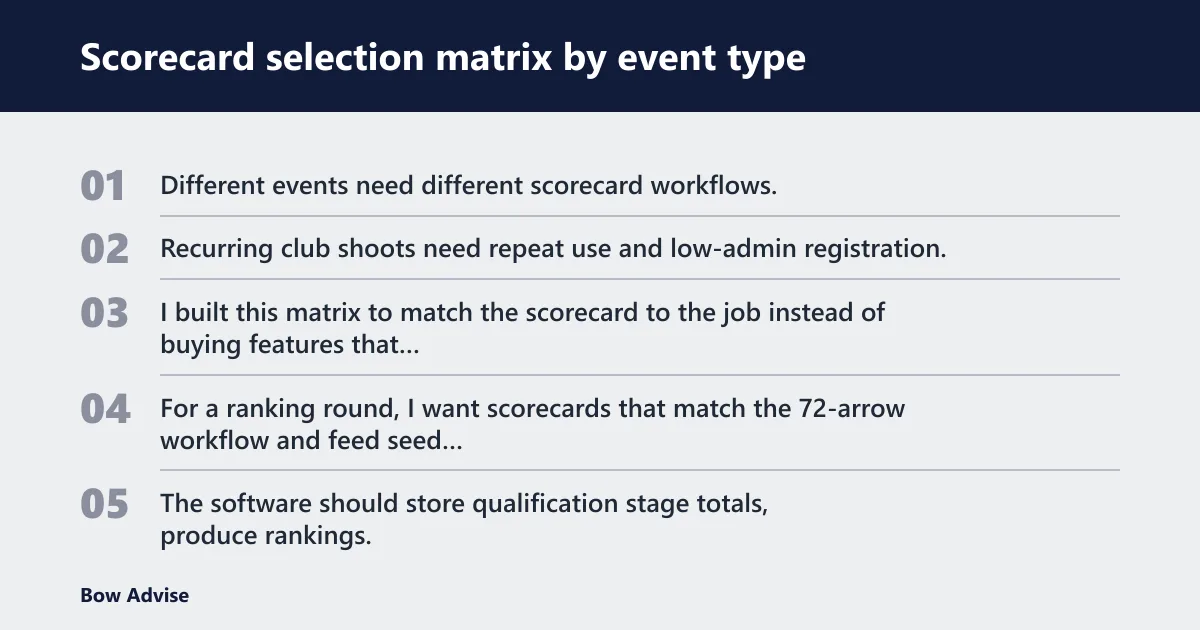
Different events need different scorecard workflows. A ranking round needs seed generation. Matchplay needs bracket updates. Team events need rotation and totals. Recurring club shoots need repeat use and low-admin registration. I built this matrix to match the scorecard to the job instead of buying features that will sit unused.
| Event type | Must-have fields | Likely failure points | Minimum software features needed |
|---|---|---|---|
| Ranking round | Archer ID, division, ends, running total, verification | Bad totals, wrong division, missed correction | Live score entry, qualification seeding, audit trail |
| Matchplay | Set scores, match points, winner, tie-break note | Bracket mismatch, premature advancement, dispute delay | Bracket progression, dispute handling, live updates |
| Team event | Team roster, archer rotation, aggregate totals, result status | Wrong rotation order, team total error, delayed posting | Team scoring, results publication, squad management |
| Recurring club shoot | Name, class, date, round total, repeat entry | High admin load, duplicate setup, messy archives | Registration workflow, repeat event support, easy results flow |
Ranking round: minimum fields and minimum software features
For a ranking round, I want scorecards that match the 72-arrow workflow and feed seed generation cleanly. The software should store qualification stage totals, produce rankings, and let me correct entries without breaking the field. Anything less creates manual cleanup before brackets even begin.
Matchplay: score entry, bracket updates, and dispute handling
Matchplay needs the fastest bracket handoff of all. The scorecard should capture each set, show who reached 6 points first, and freeze on 5-5 until the tie-break arrow is resolved. If the bracket updates before the dispute closes, the round gets hard to unwind.
Team event: rotation, totals, and results publication
Team events add another layer because rotation and totals matter at the same time. The scorecard has to show the order of archers, the team score, and the posted result. If the platform cannot publish official results clearly, coaches end up answering the same question five times after the match.
Recurring club shoot: registration, repeat use, and low-admin workflow
Club shoot management is about repeatability. I want a registration workflow that I can reuse, a scoring format that does not need rebuilding each week, and results that go out without a pile of manual edits. For recurring events, ease means low admin effort.
What breaks live scoring workflows in real tournaments?
Live scoring fails when the event team allows late corrections, when the bracket does not sync after a score change, or when the results board lags behind what happened on the line. Real-time updates only help if disciplined score entry keeps them trustworthy. Otherwise, the display creates confusion faster than paper ever did.
Late score corrections and disputed ends
A late correction is the fastest way to start trouble. If a score is fixed after the next match has already moved on, the software needs an audit trail and a controlled correction path. Without that, I have seen scoreboards and paper notes tell two different stories.
Poor bracket synchronization after a correction
Bracket updates must follow the corrected score immediately. If not, the wrong shooter advances or the wrong team stays on the board. That is especially painful in elimination rounds, where one changed number can alter the whole path to the final.
Results board lag and visibility problems
Live results only work when shooters, parents, and judges can see what changed. I want results board visibility that reflects the current state, not last hour’s totals. In a busy line, hidden updates lead to repeated questions and more admin work than the event deserved.
Choose paper scorecards if… / Choose archery scorecard software if…
Choose paper scorecards if the event is small, the results do not need instant publication, and one person can collect and verify sheets without pressure. Choose archery scorecard software if qualification, brackets, registration, and results all need to stay linked across one event or several days. I use that rule every season.
Choose paper scorecards if…
- You are running a small club shoot with low stakes.
- You do not need live updates or bracket progression.
- Results can wait until after the event.
- You want the lowest setup effort possible.
Choose archery scorecard software if…
- You run ranking rounds that feed elimination brackets.
- You need official results posting the same day.
- You manage squads, registration, and multi-day workflow.
- You want fewer scoring failures and less admin drag.
What is the best archery scorecard software for tournament management?
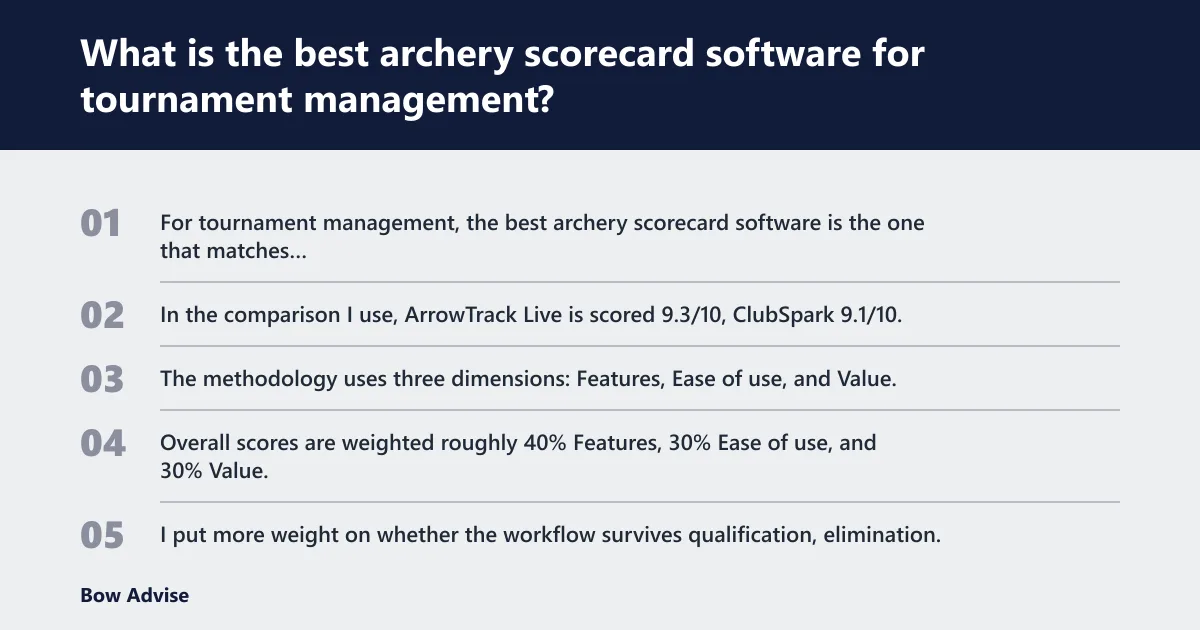
For tournament management, the best archery scorecard software is the one that matches your event flow, not the longest feature list. In the comparison I use, ArrowTrack Live is scored 9.3/10, ClubSpark 9.1/10, Sport:80 8.8/10, Ianseo 8.4/10, and ArcheryScore 8.1/10, with 10 tools compared overall.
How I judge the top picks
The methodology uses three dimensions: Features, Ease of use, and Value. Overall scores are weighted roughly 40% Features, 30% Ease of use, and 30% Value. I put more weight on whether the workflow survives qualification, elimination, and results publishing than on surface-level polish.
How do I manage archery scorecards for a live tournament?
I manage live tournament scorecards by keeping entry, verification, and publication in one controlled path. The score must be entered once, checked quickly, and pushed into bracket updates without extra retyping. That is the only way I have found to keep the line moving and avoid audit headaches later.
Practical live workflow
- Assign squads and verify divisions before shooting starts.
- Enter scores at the end or set level, not hours later.
- Hold disputed cards until a judge signs off.
- Push approved scores to brackets and results boards.
- Check the published board before starting the next round.
Which archery scoring app supports brackets and results publishing?
The app that supports brackets and results publishing best is the one that moves scorecard data directly into progression and then into official posting without duplicate work. In my view, ArrowTrack Live stands out here because it is described as a real-time tournament scoring web platform for archery organizations, and it is positioned for live scoring and fast results publication.
What to verify before buying
I always verify that bracket progression is driven directly from entered scorecards. That matters more than a plain results export. If the software cannot move clean qualification totals into match brackets and then publish final standings cleanly, it leaves the hard part for staff.
How much does archery tournament scoring software cost?
Cost depends less on the label and more on event size, support load, and how much admin time you are trying to buy back. Small club shoots usually need lighter setup and simpler registration. Multi-day events and governing-body use need more workflow control, which usually means more admin overhead and a higher price structure.
How I think about cost
I look at software cost in two buckets: money out and time out. If a platform saves me from retyping scores, fixing bracket errors, and rebuilding results, the real cost can be lower even if the sticker price is higher. For a one-day club shoot, that math often flips the other way.
Is there archery software for club shoots and recurring events?
Yes. Club shoot management is one of the clearest use cases for archery software, especially when the event repeats on a weekly or monthly schedule. The software should make registration easy, keep results workflow simple, and avoid forcing me to rebuild the same event structure every time.
What recurring shoots need most
Recurring events need speed, consistency, and low-friction setup. I do not want a system that is powerful on paper but painful to repeat. If a club can open the event, register archers, post results, and close out the night without a pile of edits, it is doing the job.
What is the easiest archery scoring system to use?
The easiest archery scoring system is the one your staff can run under pressure without missing entries or losing the bracket. Ease of use is not just clean screens. It is whether the person on the tablet can keep score, the judge can verify it, and the results board stays current.
My ease-of-use test
I test software on my own range before I trust it at an event. If I cannot move from score entry to published result without hunting through menus, I know the line crew will struggle too. I learned to be ruthless after setting my first compound 10 lb too heavy and spending a month flinching until I backed the limb bolts out.
How do scorecards affect archery bracket progression?
Scorecards affect bracket progression because they are the source record for who advances, who drops, and who needs a tiebreak. If the scorecard is wrong, the bracket is wrong. Once a wrong name moves forward, fixing it takes more time than the original match.
Where progression fails
Progression fails when the scorecard is entered late, corrected without audit detail, or posted before review. It also fails when qualification totals do not match the seeding logic. I have seen that turn a clean bracket into a scramble that takes longer than the shooting did.
Which archery software supports registration and live updates?
Any serious tournament management platform should support registration and live updates together, because they are two sides of the same event. If the event page, payment record, squad list, and live scoring board do not stay connected, staff end up reconciling details by hand while shooters wait.
What to ask before you commit
Ask whether the platform can keep registration linked to the scoring workflow from start to finish. Ask how it handles official results posting after corrections. Then ask how it behaves on a multi-day event, because that is where weak systems show their limits fast.
Frequently asked questions
What is the best archery scorecard software for tournament management?
The best choice is the one that fits your event flow with the least admin drag and the fewest scoring failures. For live scoring and fast results publication, I would put ArrowTrack Live near the top because it is built as a real-time tournament scoring web platform and is scored 9.3/10 in the comparison table.
How do I manage archery scorecards for a live tournament?
Use one workflow for entry, verification, and publication. Keep score entry disciplined, hold disputes until they are reviewed, and make sure bracket updates follow the confirmed score. If your board and your paper notes disagree, stop and fix the source before the next line starts.
Can archery scorecards handle elimination rounds and tie-breaks?
Yes, if the scorecard is built for matchplay. It must track set scores, show the path to first to 6 points, and record the tie-break arrow when a match ends 5-5. Closest-to-center decisions need a clear audit trail so bracket progression stays clean.
What features should archery tournament scorecards have?
At minimum, they should handle live score entry, registration workflow, bracket progression, results publication, and audit-ready scoring. For bigger events, I also want squad management, event setup, official results posting, and multi-day workflow support. Those features matter more than a pretty interface.
How much does archery tournament scoring software cost?
Price depends on event size, workflow depth, and how much manual admin the system removes. A small club shoot may not need a full platform, while a multi-day event often does. I judge cost by the time saved on corrections, posting, and bracket cleanup, not just the invoice.
Is there archery software for club shoots and recurring events?
Yes. Recurring club shoots are a strong fit for software that keeps registration, scoring, and results in a repeatable flow. The best systems make weekly setup simple and avoid forcing staff to rebuild the event each time. That low-friction repeat use is the real win.