Best Archery Scorecards for Tournament Management Guide
The best archery scorecards for tournament management are the ones that record two synced scores, two signatures, and a clear tie-break path; for most events, paper cards with digital entry at the scorer’s table are the safest choice. Bad scorecards create disputes, slow brackets, and force retyping that can change podium places. I compare paper, tablet, and hybrid systems by score capture, dispute control, and results workflow.
Paper vs digital scorecards: what tournament jobs each one handles best

The core trade-off is simple: paper gives you a stable record when rain, mud, or dead batteries hit, while digital moves scores into brackets faster. I want both when I can get them. A clean paper card protects the field; a digital scorer protects the backend.
| Job | Paper scorecard | Digital scorecard |
|---|---|---|
| Arrow-by-arrow entry | Strong if the line is clear and the scorer writes after each end | Strong if the device and app stay synced during the round |
| Dispute handling | Good when both archers sign and corrections are logged on paper | Good when the app stores edit history and keeps timestamps |
| Offline use | Excellent | Varies by app and device caching |
| Bracket handoff | Needs manual data entry or later transcription | Can pass results straight into tournament management software |
| Risk of rework | Low for field use, higher at the results desk | Low if the device is stable, higher if data is entered badly on screen |
Where paper still wins at club shoots and low-connectivity venues
Paper still wins when you need a plain checkout sheet, no-device backup, or a field that cannot trust signal. I have shot club rounds where everyone stared at one weak hotspot, and paper kept the line moving. A pencil never needs pairing.
Where digital wins for live results, registration sync, and elimination updates
Digital wins when the event needs live scoring, registration workflow, published results, and downstream bracket updates. ArrowTrack Live is described as the best overall pick, and its strength is the path from registration into event setup and then from scorecard entry into published results. That matters when one corrected score can move a seed.
What a tournament-ready archery scorecard must capture
A tournament-ready scorecard should capture who shot, what they shot, how many arrows or sets were completed, and how the final card was verified. If a card cannot survive a dispute, it is not tournament-ready. It is just paper.
Archer details, division, and distance
At minimum, I want archer name, target assignment, division, bow style, and distance. Recurve at 70 meters is not the same job as a compound line with different scoring pressure. If the card mixes divisions, the results desk will pay for it later.
Ends or sets, arrow-by-arrow entry, score, 10s, and X-counts
The card should record arrow-by-arrow entry or clear end totals, plus 10s and X-counts where the format uses them. For compound, X-counts often decide rank and ties. For recurve, the set result matters more than raw total in matchplay. I keep both on the card if the event may seed into brackets.
Signature, correction log, and shoot-off or tie-break fields
Two signatures matter because a score without countersignature can lead to disputes. A correction log matters because late submissions and manual re-checking happen more often than staff want to admit. The card also needs a box for a shoot-off arrow or 5-5 tie-break arrow so the bracket does not stall on a verbal memory.

How scorecards feed tournament management software
Scorecards are the input layer, not the finish line. Good tournament management software connects registration, live scoring, results publishing, and bracket progression without forcing staff to retype a clean field sheet. The handoff is where many events lose time.
Registration workflow and event setup
ArrowTrack Live emphasizes real-time tournament scoring and links registration into event setup. That matters because a wrong division or missing archer detail at sign-in will show up again in scoring. I want the registration record to travel with the scorecard, not live in a separate pile.
Live scoring and results publishing
Live scoring helps when spectators, coaches, and field staff need to see rank, score, 10s, and Xs as the event progresses. It only works if the scorecard feeds the system cleanly. I care less about the screen and more about whether the result on that screen matches the signed card.
Bracket progression for single-elimination and matchplay
For single-elimination brackets, the scorecard must pass a reliable winner into the next match. In recurve matchplay, that means set points, not just total arrows. A bad handoff forces manual edits, and manual edits are where disputes and delays grow.
What should a scorecard include for ranking rounds and recurve matchplay?

A ranking-round scorecard should capture 72 arrows, total score, 10s, Xs, and rank-ready data that can seed brackets. For recurve matchplay, it should also capture set points, the 70-meter distance, and a clean tie-break field. Without those pieces, the bracket desk will be guessing.
Ranking round: 72-arrow seeding and competition data fields
The Olympic-style ranking round uses 72 arrows. That score is not just a total; it becomes the seed that shapes the bracket. I want rank, score, 10s, and Xs recorded in a way that can be checked against the signed card without doing math twice.
Recurve rules: 70-meter distance, 3-arrow ends, and set scoring
Recurve archery at World Archery-approved events is typically shot at 70 meters, with matchplay often built around set-based ends of three arrows per archer. A match is won by the first archer to reach six points. The scorecard has to show set by set progress, not only total arrows, or the result can look wrong at first glance. (en.wikipedia.org)
Elimination bracket handoff and 5-5 tie-break capture
When a set match reaches 5-5, the tie-break arrow must be captured cleanly. That detail affects the next slot in the elimination bracket. If the card does not record the shoot-off result, the bracket update becomes a manual judgment call, and I do not want judgment calls where a score should speak for itself.
Use the requirements matrix before you approve a system
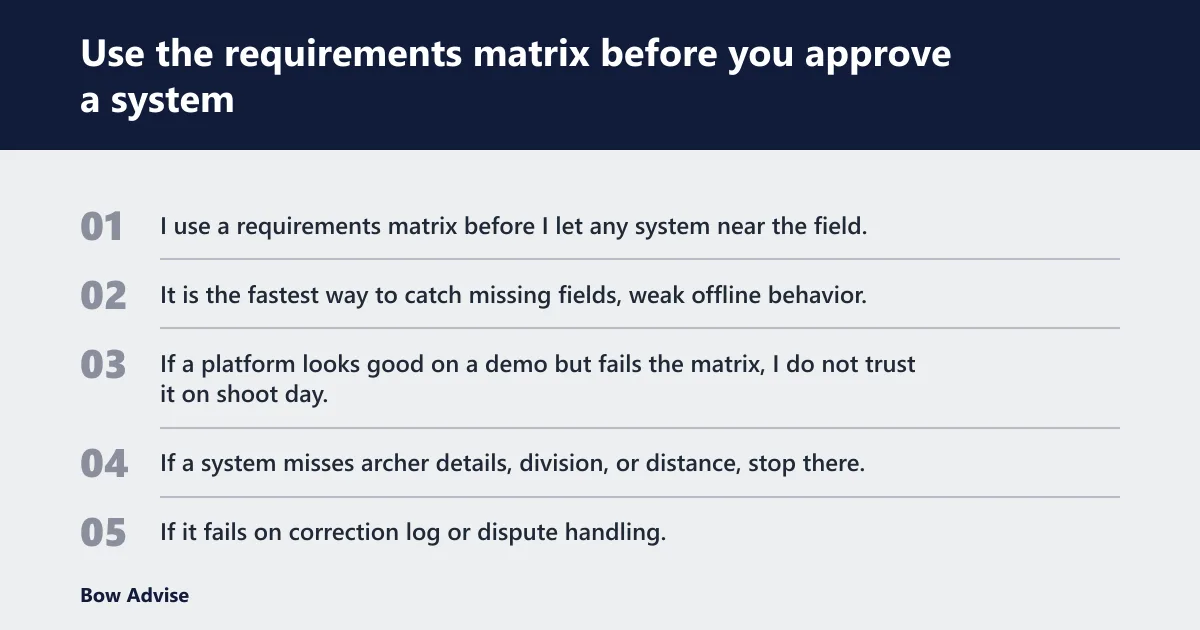
I use a requirements matrix before I let any system near the field. It is the fastest way to catch missing fields, weak offline behavior, and sloppy bracket handoff. If a platform looks good on a demo but fails the matrix, I do not trust it on shoot day.
| Field | Paper scorecard | Digital scorecard |
|---|---|---|
| Archer details | Yes, if printed clearly | Yes, usually from registration sync |
| Division | Yes | Yes |
| Distance | Yes | Yes |
| Ends/sets | Yes | Yes |
| X-counts | Yes | Yes |
| Signature | Yes | Yes, if the workflow supports it |
| Correction log | Manual | Usually timestamped |
| Bracket handoff | Manual re-entry | Direct export or sync |
| Offline use | Yes | Only if cached locally |
| Mobile support | No | Yes, if the app is built for it |
| Results export | Manual transcription | Usually built in |
| Dispute handling | Strong if signed and legible | Strong if edits are tracked |
How to read the 12-field matrix
If a system misses archer details, division, or distance, stop there. If it fails on correction log or dispute handling, it will create work after shooting ends. The matrix is not about features on a sales page. It is about whether the card can survive real tournament pressure.
Paper vs digital scoring decision points
Paper is the safer first choice when the venue is rough, the staff is small, or the club wants a low-cost backup. Digital is stronger when the event needs live results, exported rankings, and fast bracket updates. I like hybrid setups because they reduce both field risk and desk risk.
Which fields matter most for small clubs, multi-division shoots, and poor connectivity
Small clubs care most about signatures, division, and correction log because they often run lean staff. Multi-division shoots care most about clean separation of distances and bow types. Poor-connectivity venues care most about offline use and later export. One weak field can waste an entire results sheet.
Choose paper scorecards if… / Choose digital scorecards if…
Choose paper if you need low cost, simple checkout, and a no-device backup that any scorer can use under pressure. Choose digital if you need live results, bracket updates, and a cleaner audit trail from registration through elimination.
Choose paper scorecards if you need simple checkout, low cost, and no-device backup
Paper fits short club shoots, casual recurring events, and venues where devices would only add friction. It also fits staff who are comfortable with manual checking and later entry. If I know the internet may fail, I want paper in my bag.
Choose digital scorecards if you need live results, bracket updates, and cleaner audit trails
Digital fits larger events, matchplay weekends, and shoots where results must move quickly into brackets. It also helps when corrections must be traced later. ClubSpark is described as the best value pick, and Sport:80 is described as the easiest to use. Those labels matter only if the workflow matches the event.
How do you prevent scoring errors during a tournament?
Prevent errors by checking archer details before the first end, making both scorers verify division and target assignment, and forcing every correction through a visible log. The biggest problems I see are late submissions, missing signatures, and disputed X-counts. Most of them start with rushed admin, not bad archers.
Pre-shoot checks for signatures, division, and target assignment
Before shooting starts, I confirm target number, archer name, division, and distance. Then I check that both scorekeepers know whether the event is ranking round or set play. A five-minute check can save an hour at the results table.
Correction workflow for late submissions and manual re-checking
Late submissions need one owner and one log. If a paper card changes, I want the old mark visible and the correction initialed. If a digital card changes, I want the edit history intact. Manual re-checking is fine; hidden edits are not.
Dispute handling for X-counts, ties, and missing entries
Disputed X-counts should be settled from the signed card before results move forward. Missing entries should stop bracket progression until they are fixed. I would rather hold one line for ten minutes than rebuild an elimination tree after the fact.
Frequently asked questions
What is the best archery scorecard app for tournament management?
The best app is the one that matches your event flow from registration through results. ArrowTrack Live is described as the best overall pick because it ties real-time scoring to event setup and published results. If your club values cost or ease of use more, ClubSpark or Sport:80 may fit better.
Which archery scoring software supports live results and brackets?
Look for software that accepts scorecard entry, publishes results, and updates brackets without retyping. That matters most in elimination brackets where one corrected score changes the next match. I want the software to move a verified result forward, not ask staff to rebuild it by hand.
Can I use a mobile scorecard for archery tournaments?
Yes, if the mobile setup still supports offline use, edit history, and a clear signature workflow. Mobile is useful at larger events and in live scoring, but it can fail if the venue has weak connectivity or if staff are slow with device entry. Paper still helps as backup.
What features should an archery scorecard have for competitions?
A competition scorecard should include archer details, division, distance, ends or sets, X-counts, signatures, and a correction log. It should also support shoot-off or tie-break recording. If the scorecard cannot feed rank, score, 10s, and Xs into results, it is incomplete.
Does archery tournament software handle eliminations and tie-breaks, including shoot-off situations where needed?
Good tournament software should handle single-elimination progression, matchplay scoring, and tie-break results. For recurve, that means set scoring to six points and a clean 5-5 shoot-off path. If the system cannot record the tie-break arrow cleanly, a staff member will end up fixing it manually.
Which scorecard system is easiest for recurring club shoots?
For recurring club shoots, I usually favor the system that is easiest to repeat with the same staff and the same form. Paper is often quickest to deploy. Digital becomes easier only if the club wants recurring registration, results export, and less retyping at the end of each session.