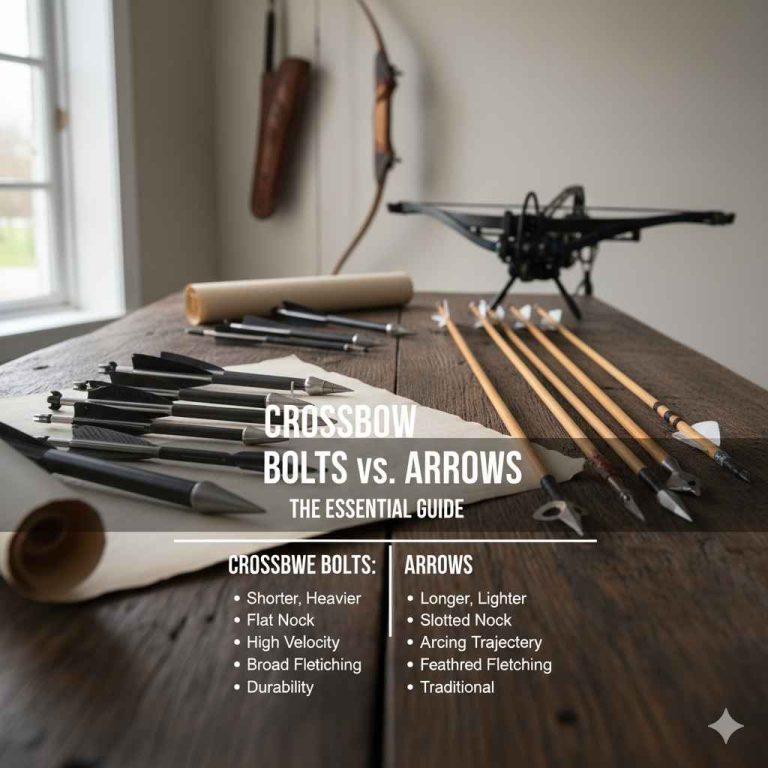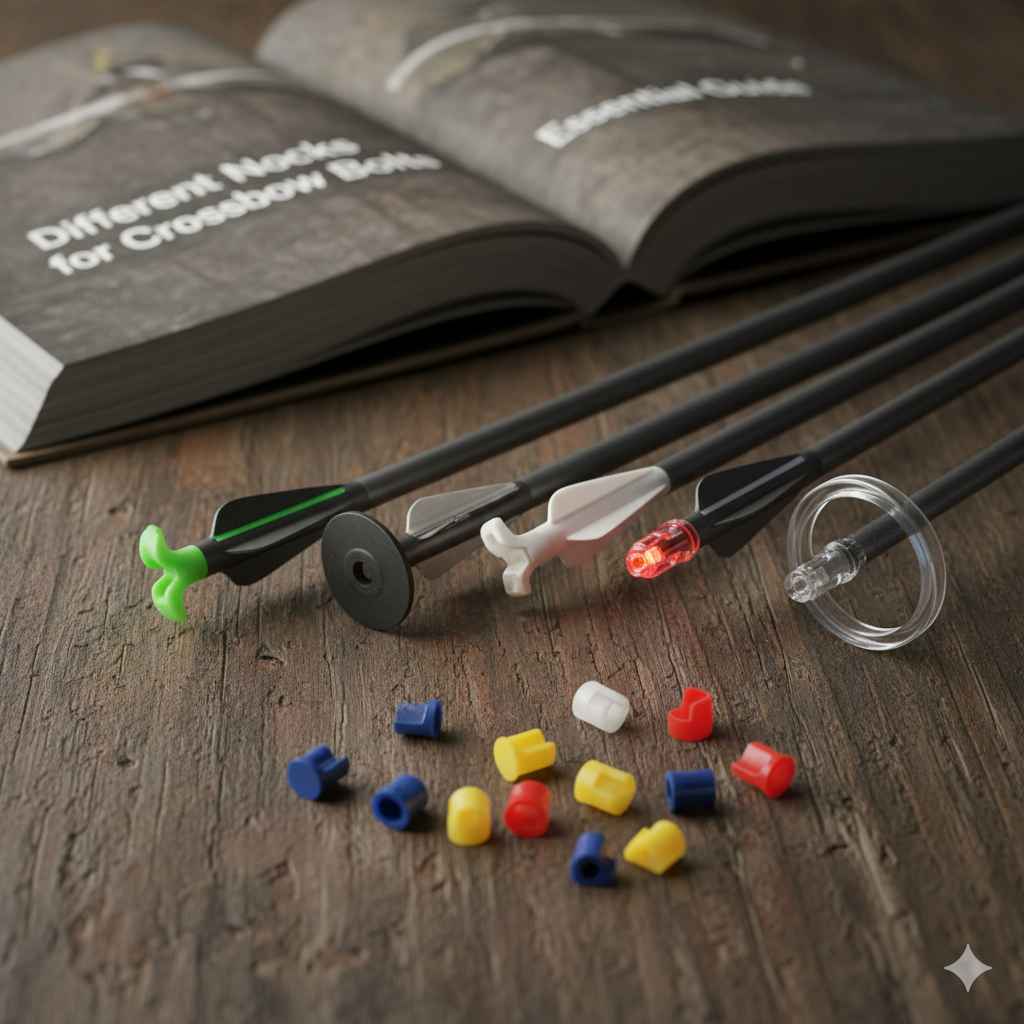
Different Nocks for Crossbow Bolts and When to Use Them
Understanding the different nocks for crossbow bolts is crucial for safety, proper arrow flight, and consistent accuracy. Beginner crossbow hunters often confuse them; this guide simplifies the three main types—flat, moon, and hybrid—explaining how to choose the right one for your specific crossbow setup to ensure reliable shooting every time.
Welcome to the world of crossbow shooting! If you’ve just picked up your first crossbow, you’ve likely noticed that the back end of the bolt—the part that snaps onto the string—comes in different shapes. It can feel a bit confusing, right? You just want to hit the target!
Figuring out which nock works best for your specific crossbow is an important step. Using the wrong one can lead to poor performance or, worse, unsafe shooting. Don’t worry; we are going to break down the different nocks for crossbow bolts simply. Think of me as your friendly guide helping you get set up correctly. By the end of this, you will know exactly what you need and why. Let’s make sure every shot counts!
Why the Nock Matters: The Unsung Hero of Accuracy
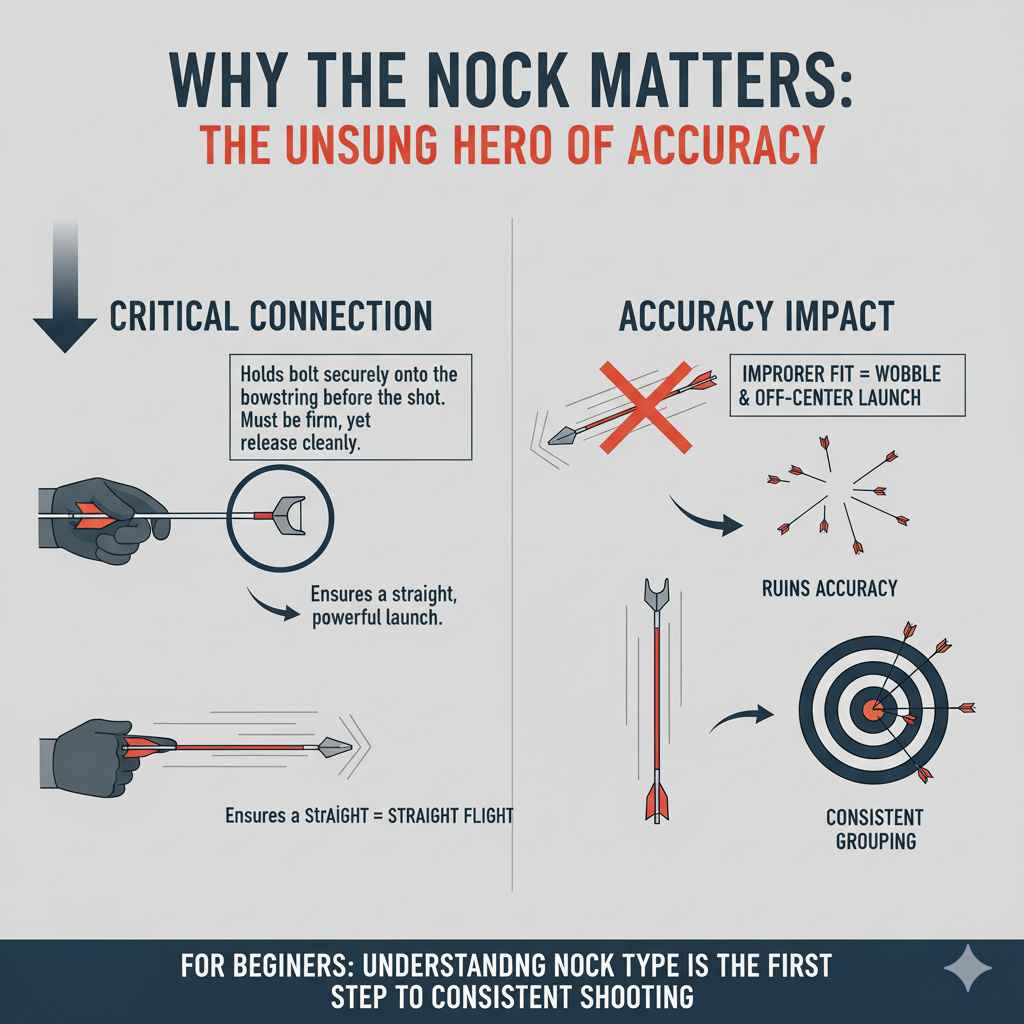
The nock is often overlooked, but it is one of the most vital parts of the bolt system. It is the small piece at the rear of the arrow or bolt that holds it securely onto the bowstring before the shot. Its job is critical: it must hold the bolt firmly enough so it doesn’t slip off accidentally, yet release cleanly the instant the trigger is pulled.
If the nock doesn’t fit the string perfectly, or if it doesn’t release evenly, the bolt will wobble or be pushed off-center when leaving the bow. This ruins your accuracy immediately. For beginners, understanding the nock type is the first step toward consistent grouping.
The Three Main Types of Crossbow Nocks
While there are many small variations, nearly all crossbow bolts use one of three primary nock styles. Your crossbow manufacturer will almost always specify which type you must use for safety and optimal performance.
1. Flat Nocks (or Straight-Cut Nocks)
The flat nock is the simplest design. It looks like the back of a standard wooden arrow, often with a flat surface or a very slight concave curve.
What They Are:
Flat nocks are universally compatible with many types of bowstrings. They are usually less expensive and sometimes come standard with entry-level crossbow packages.
The Pros and Cons:
- Pros: Simple, widely available, and cost-effective.
- Cons: They can sometimes sit looser on a string, increasing the chance of premature release or inconsistent seating compared to other types. They might not align perfectly with modern, narrow crossbow strings designed for specific nocks.
When to Use Them:
Flat nocks are typically best suited for older, traditional crossbows or entry-level models that use thicker, rounder strings. Always check your crossbow’s manual before committing to flat nocks.
2. Moon Nocks (or Half-Moon Nocks)
The moon nock is the most common type found on modern crossbows, especially hunting models. It gets its name because the seating groove looks like a tiny crescent moon.
What They Are:
This nock features a distinct concave curve that perfectly cradles the crossbow string. This shape ensures the bolt sits consistently in the exact same spot on the string every single time it is loaded.
The Pros and Cons:
- Pros: Excellent consistency, as the string fits snugly into the curved groove. This leads to better, more predictable launches and improved accuracy. They often seat securely.
- Cons: They are specific. If you use a moon nock on a crossbow designed for a flat nock, it might not sit correctly, or vice versa.
When to Use Them:
If your crossbow came with bolts featuring this style, or if your manual recommends it, stick with the moon nock. They are the standard for high-performance and modern crossbows today.
3. Hybrid Nocks (or Capture Nocks)
The hybrid nock is an evolution designed to offer the best features of both the flat and moon styles, often found on very high-end or speed-focused crossbows.
What They Are:
A hybrid nock usually has a slight curve like the moon nock, but the string channel is shallower or more open, sometimes resembling a letter “U” more than a deep “C” (moon). Some variations are designed to “capture” the string slightly, offering a very positive lock.
The Pros and Cons:
- Pros: Offers extremely secure seating and excellent alignment, often used to enhance the performance of very fast bows where string alignment is paramount.
- Cons: These are the most specialized and are usually proprietary to certain manufacturers (like TenPoint or Ravin). Using the wrong hybrid style can cause serious issues.
When to Use Them:
Only use a hybrid nock if your specific crossbow model explicitly requires it. These are usually found when shooting extremely high-speed crossbows, as the design helps manage the immense energy transfer without stripping the string or misaligning the bolt.
Understanding Nock Fit and Compatibility
The biggest source of confusion for new crossbow shooters is compatibility. You cannot just mix and match nocks. Compatibility depends on two main factors: the bolt shaft diameter and the crossbow string itself.
The Crossbow String Factor
Modern crossbow strings are often thinner and use different materials (like BCY Dynaflight or Fast Flight) compared to older strings.
1. String Thickness: A moon nock requires a string of a specific diameter to seat properly. If the string is too thin, the nock will rattle; if it’s too thick, the nock won’t snap on all the way, which is dangerous.
2. String Material: Some high-speed crossbows feature strings that require very specific nock interfaces to handle the stress of the shot without damaging the string.
The Importance of Manufacturer Recommendations
This is the most important rule for safety and accuracy. Always check the owner’s manual for your crossbow.
The manual will clearly state which nock style is required (e.g., “Use only Moon Nocks”). Ignoring this recommendation can void warranties and, more importantly, put you at risk. Misfires or partial releases can cause catastrophic failure in the bow limb or result in the bolt flying off target immediately upon release.
For reference on general archery safety standards, organizations like the National Archery in the Schools Program often share guidance that emphasizes equipment compatibility. You can find general safety guidelines that support checking manufacturer specs on resources related to established shooting organizations.
How to Choose the Right Nock for Your Bolt
Selecting the correct nock isn’t about preference; it’s about matching the equipment provided by your manufacturer. Here is a simple decision process:
- Check Your Crossbow: Look at the crossbow itself. Some crossbows have a physical retention system in the track that physically forces the bolt to seat a certain way.
- Examine Your Current Bolts: What style of nock came with the crossbow? If you bought a complete package, use that style.
- Consult the Manual: Find the section on recommended accessories or bolt specifications. It will definitively state “Flat,” “Moon,” or a specific proprietary type.
- Inspect the String: If you replaced your string, did the string manufacturer state that it is compatible with Flat, Moon, or Hybrid nocks? Sometimes, a new string requires a different nock than the old one.
Nock Types Comparison Table
This table summarizes the key features to help you quickly distinguish between the three main types of different nocks for crossbow bolts.
| Nock Type | Appearance | Best For | Key Benefit |
|---|---|---|---|
| Flat Nock | Straight or slightly rounded back edge. | Older or entry-level crossbows with thicker strings. | Simplicity and wide availability. |
| Moon Nock | Distinct, deep crescent-shaped groove. | Most modern crossbows (the industry standard). | Consistent seating and reliable release. |
| Hybrid Nock | Shallow curve or specialized locking mechanism. | High-speed or specialized proprietary systems. | Maximum alignment security under high tension. |
The Anatomy of a Good Nock Fit: Testing Consistency
Once you think you have the right nock, you need to verify the fit. A good fit feels secure but releases smoothly.
The “Finger Test”
After loading the bolt onto the string, perform this simple safety check before engaging the safety or aiming:
1. Grip: Hold the crossbow firmly, keeping your fingers well away from the trigger mechanism.
2. Seat Check: Gently push the bolt forward slightly, just enough to feel if it’s seated properly.
3. Test Release: Apply very light forward pressure on the bolt (as if you were about to push it off the string), but do not pull the trigger.
If the nock slips off easily with very light pressure, it might be too loose. This is dangerous, as the bolt could accidentally fire if the safety is bumped.
If the nock feels stubbornly stuck, it might be too tight, potentially causing a partial release or excessive wear on your string.
The ideal fit is secure enough that you have to actively pull it off the string with slight effort, but it releases cleanly when the trigger is pulled.
Checking for Wear and Tear
Nocks take a beating every time they are shot. They rub against the string, the rail, and the trigger mechanism.
Inspect for Cracks: Always visually check the nock before shooting. Look for any hairline cracks, chips, or flattening where the string rides. A cracked nock can shatter upon release, causing a severe misfire.
Check for Groove Widening: Over time, the groove of a moon or hybrid nock can widen due to friction. If the string looks loose inside the groove, the nock needs replacing.
Replacing Nocks: Nocks are consumable items. Most manufacturers recommend replacing them after a set number of shots (sometimes as few as 20–50 shots on very fast bows) or immediately if any damage is observed. Replacement nocks are inexpensive insurance for accuracy and safety.
What About Illuminated Nocks? A Beginner’s Look
Many hunters use illuminated nocks (often called “lighted nocks”) for better visibility, especially during dawn, dusk, or low-light conditions. These are an excellent addition, but they only come in one shape: the shape required by your bow.
Key Considerations for Lighted Nocks:
- Compatibility First: A lighted nock must match the shape of the standard nock your crossbow requires (e.g., if your bow needs a moon nock, you must buy a lighted moon nock).
- Weight Matters: Adding a lighted component adds weight to the back of the bolt. High-performance crossbows are incredibly sensitive to balance. Using a lighted nock that is significantly heavier than the standard nock can throw off your point of impact. Always test-fire new lighted nocks at a target to see if your impact point has shifted.
- Activation: Most lighted nocks activate upon release or impact. Ensure the switch mechanism doesn’t interfere with a clean release from the string.
If you are focusing strictly on target practice during the day, save your money and stick to standard, matching nocks until you feel completely confident in your shooting mechanics.
Troubleshooting Common Nock Issues
When things go wrong, the nock is often the culprit. Here are common beginner struggles and how the nock type plays a role.
Issue 1: The Bolt Drops Off the String Before Firing
This is often called “string jumping” or premature release.
Likely Cause: The nock is too loose on the string (inconsistent seating).
Nock Solution: If you are using a flat nock, try switching to a moon nock if your crossbow allows it, as the moon shape offers better grip. If you are already using the correct type, the string might be too old or thin. You may need a string replacement or perhaps a string wax that slightly thickens the string fibers temporarily.
Issue 2: Bolts are Grouping Poorly (Inconsistent Shots)
Your shots are scattered all over the target, even when you repeat your form perfectly.
Likely Cause: Inconsistent release angle or seating depth.
Nock Solution: This strongly suggests the nock is not fitting the string uniformly across shots. Switch to the most positive retention style possible—usually the moon nock, as it centers the bolt perfectly on the string for every shot. If you are using a low-quality or damaged nock, replace the whole set immediately.
Issue 3: The Bolt Slams into the Rail or Riser
The bolt seems to contact the crossbow frame on its way out, leading to major accuracy loss.
Likely Cause: The bolt is entering the “rest” or track at the wrong angle, often caused by a nock that is too tall or too short.
Nock Solution: The height of the nock determines the trajectory off the rail. If your crossbow is designed for a shallow moon nock, using a tall, poorly fitting flat nock might lift the rear of the bolt too high, causing it to “climb” upon release. Always use the manufacturer-specified height and shape.
Maintaining Your Crossbow String and Nock Interface
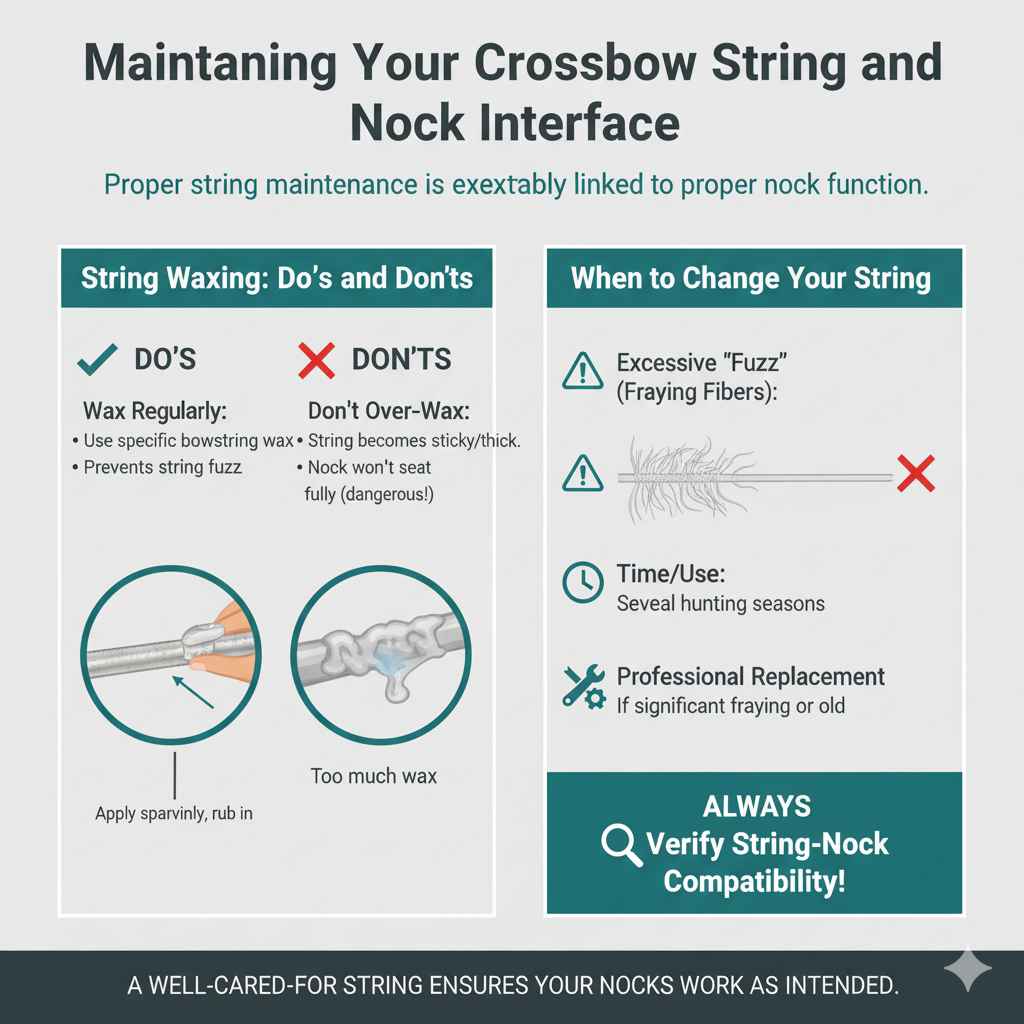
Proper string maintenance is inextricably linked to proper nock function. A well-cared-for string ensures your nocks work as intended.
String Waxing: Do’s and Don’ts
Waxing your string protects it from fraying and helps it grip the nock correctly.
Do Wax Regularly: Use wax specifically made for synthetic bowstrings (like those recommended for Fast Flight or Dynaflight materials). Waxing prevents string fuzz, which can create an inconsistent surface for the nock to sit on.
* Don’t Over-Wax: Too much wax makes the string sticky and thick. A thick string will prevent your moon or hybrid nock from seating fully, leading to dangerous looseness. Apply wax sparingly, rubbing it in until the string looks slightly shiny but not gooey. You should still be able to see the string texture faintly.
When to Change Your String
A string that is too loose or has excessive “fuzz” (fraying fibers) will cause nock problems. If you see significant fraying, or if the string has been on the bow for several hunting seasons, it is time for a professional replacement. When you replace the string, always verify with the string supplier that it is compatible with the specific nock style your crossbow demands.
Frequently Asked Questions (FAQ) for Beginner Crossbow Owners
Q1: Can I use a flat nock if my manual says moon nock?
A: No, you should not. Using the wrong nock type is unsafe and will severely impact accuracy. A flat nock may not seat securely on a string designed for a moon nock, leading to inconsistent shooting or accidental release.
Q2: How often should I check my crossbow nocks?
A: Check them before every single shooting session, especially before hunting. Look for cracks, chips, or signs that the string groove is widening. Replace any damaged nock immediately.
Q3: Do all bolts of the same diameter use the same nock?
A: Not necessarily. While bolt diameter (like .204 or .308) relates to the shaft size, the nock style (flat, moon, hybrid) is determined by the crossbow’s string setup and the release mechanism, not just the shaft size.
Q4: What is the difference between a standard nock and an illuminated nock?
A: The primary difference is weight and function. Standard nocks are just hard plastic for retention. Illuminated nocks contain a small light activated on firing, helping you see where the bolt lands in low light, but they must match the required shape (flat/moon).
Q5: If I change my crossbow string, do I need to change my nocks?
A: Maybe. New string materials can have different diameters or tensions than older strings. Always confirm with the string manufacturer or your crossbow manual if the new string is compatible with your existing nocks
Conclusion: Choosing the Right Crossbow Nock for Safe and Accurate Shooting
Understanding the different nocks for crossbow bolts is a key step for any beginner or experienced shooter who wants consistent accuracy and safe performance. While the differences between flat, moon, and hybrid nocks may seem small at first glance, each design plays a critical role in how the bolt connects to the string and launches from the crossbow.
Flat nocks offer simplicity and wide compatibility, making them common on older or entry-level crossbows. Moon nocks have become the modern standard, providing secure seating and improved shot consistency for most contemporary crossbows. Hybrid nocks, meanwhile, are designed for high-performance and specialized systems, offering enhanced alignment and stability for faster bows.
The most important takeaway is that nock selection should never be based on guesswork. Always follow the specifications listed in your crossbow’s manual and match the nock type to your bowstring and bolt design. Using the correct nock ensures that every shot releases cleanly, reduces unnecessary wear on your equipment, and most importantly, keeps your shooting experience safe.
Regular inspection, proper string maintenance, and replacing worn nocks will help maintain reliable performance over time. With the right nock installed and your equipment properly maintained, you can focus on improving your shooting skills and enjoying the precision and excitement that crossbow shooting offers.
In the end, the small piece at the back of the bolt—the nock—is actually one of the most important components in the entire system. When it fits correctly and functions as intended, every shot becomes smoother, more predictable, and far more accurate.