Can Extreme Cold Drain Your Rangefinder Battery?
Yes, extreme cold can make a rangefinder or sight light act dead before the battery is truly empty. A weak lithium cell can lose usable voltage fast below freezing. Missed ranges and dark pins cost shots. This guide explains why that happens, how to tell cold sag from real depletion, and what to do before and during a bowhunt.
Cold-induced voltage sag versus true battery depletion
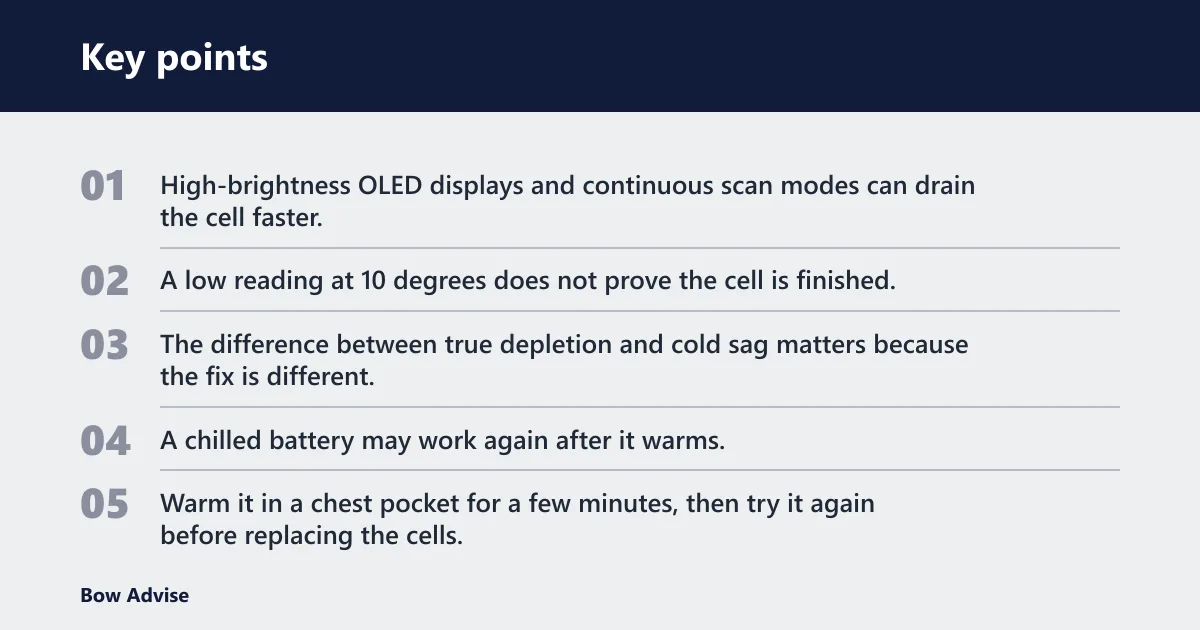


Cold weather can make a rangefinder battery look weak because lithium cells deliver less voltage under load when they are chilled. That is often temporary. A warning in the field may reflect cold battery behavior, not a fully empty cell, so the next move is to warm the unit and check it again before swapping batteries.
What a low-battery warning can mean in freezing weather
Most modern tactical rangefinders use a single CR2 3-volt lithium battery, and some use CR123A lithium batteries instead. The guide says a standard CR2 can provide 2,000 to 5,000 measurements, but that number assumes normal conditions and sensible use. High-brightness OLED displays and continuous scan modes can drain the cell faster.
In the cold, the chemical reaction slows. That is the key field problem. The battery may still have usable charge, but the device sees less delivered voltage and may flash a low-battery indicator sooner than expected. A low reading at 10 degrees does not prove the cell is finished.
Why temporary voltage sag matters for field decisions
The difference between true depletion and cold sag matters because the fix is different. A dead battery needs replacement. A chilled battery may work again after it warms. Forum users also note that battery placement close to the body can help because body heat keeps the cell and housing above ambient cold longer.
Say your rangefinder shows a low battery icon after it has sat in a bino pouch side pocket for an hour in single-digit weather. Warm it in a chest pocket for a few minutes, then try it again before replacing the cells. If the warning clears, the first alert was likely cold-related voltage drop.
Why lithium cells behave differently in cold
Lithium battery chemistry handles winter better than alkaline, which is why lithium is the standard choice for hunting optics. Lithium batteries are described as operating from -40°F to 140°F. That does not mean performance stays flat across that span. It means the chemistry is built for wider temperature use than alkaline cells.
Alkaline batteries fall behind in cold because their output drops more sharply when temperature falls. Lithium cells still lose performance, but they usually keep enough delivery for field use longer. That is why winter hunters should start with lithium and still plan for body heat, insulation, and spares.
CR2 and CR123A battery use
CR2 and CR123A batteries are not interchangeable. They may sound similar, but they differ in size and fit. A rangefinder that calls for CR2 needs the exact cell type listed by the maker, while some hard-use optics and a few rangefinders use CR123A lithium batteries instead.
CR2 has a compact form factor and strong energy density, which fits the small battery bay in many rangefinders. CR123A can appear in higher-output devices, but it is not a drop-in substitute for CR2. Check the battery label on the housing or the manual before packing a spare.
Can a sight light battery also slow down in the cold?
Yes. A sight light battery can show the same winter symptoms as a rangefinder battery: dim output, slower startup, or a brief failure to power on. Cold does not care whether the device is measuring distance or lighting pins. If the battery is chilled, output can fall enough to change what you see on the bow.
Dim output and delayed startup
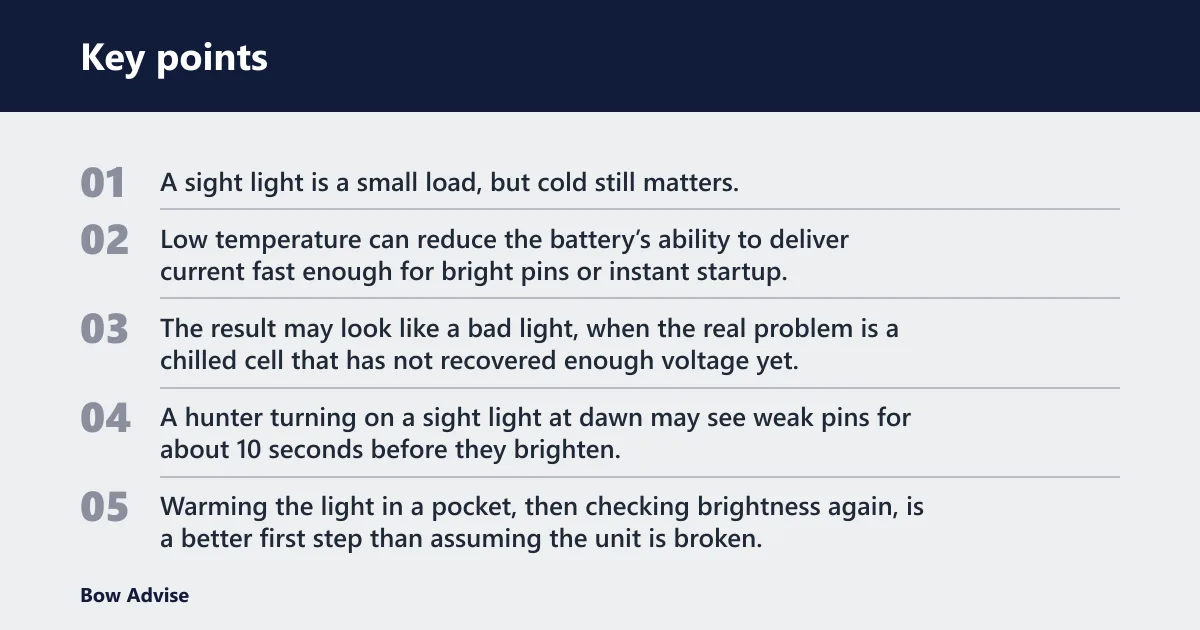
A sight light is a small load, but cold still matters. Low temperature can reduce the battery’s ability to deliver current fast enough for bright pins or instant startup. The result may look like a bad light, when the real problem is a chilled cell that has not recovered enough voltage yet.
A hunter turning on a sight light at dawn may see weak pins for about 10 seconds before they brighten. That delay often points to cold battery response rather than total failure. Warming the light in a pocket, then checking brightness again, is a better first step than assuming the unit is broken.
When warming the light fixes the problem
If the sight light works normally after warming, treat the issue as a cold-handling problem. Keep the spare battery in a warmer location, and do not store the light in an exposed outer pouch for long sits. If dimness remains after the device has warmed, then the battery may truly be near empty.
How do you keep your rangefinder warm on a bowhunt?
Keep the rangefinder close to body heat, inside insulation, and away from long exposure to moving air. A chest pocket is often warmer than a bino pouch side pocket, and a jacket pocket can work well if the device stays protected. A neoprene cover or insulated pouch can help retain warmth around the housing and battery.
Chest pocket versus bino pouch side pocket
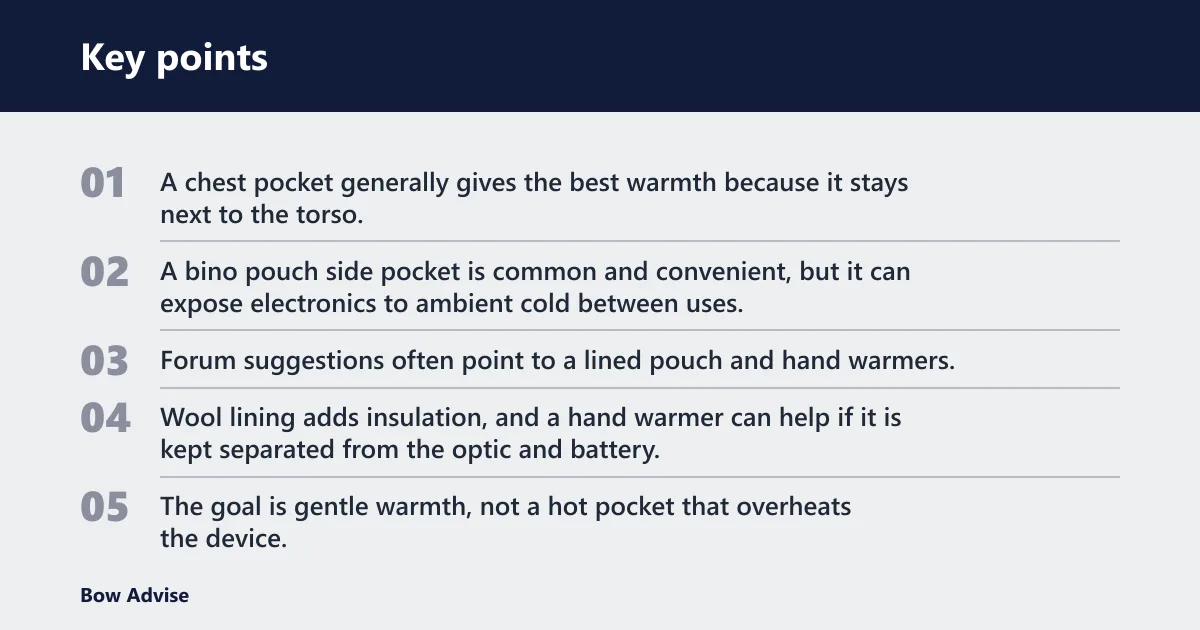
A chest pocket generally gives the best warmth because it stays next to the torso. A bino pouch side pocket is common and convenient, but it can expose electronics to ambient cold between uses. That makes it a better short-term carry spot than a place to leave the rangefinder all morning.
Forum suggestions often point to a lined pouch and hand warmers. Wool lining adds insulation, and a hand warmer can help if it is kept separated from the optic and battery. The goal is gentle warmth, not a hot pocket that overheats the device.
Jacket pocket storage
A jacket pocket can be a good middle ground if the pocket stays zipped and the rangefinder does not tumble loose. The device should sit inside a soft sleeve or cover so it does not rattle against zippers or buttons. Sudden cold exposure after repeated opening and closing is what shortens usable warmth.
Should you keep your rangefinder inside your jacket in the cold? Usually yes, if it stays easy to reach and does not overheat. That is a better choice than an outer pouch when temperatures are low, because the jacket pocket reduces the temperature swing that triggers false-low warnings.
Neoprene covers and insulated pouches
A neoprene cover helps keep warmth in the housing and battery area. It also slows the rate at which the device cools after a reading. A model-specific cover is best, but a simple insulated pouch can help as long as the buttons and lens are still accessible when you need them.
Do hand warmers help rangefinder batteries on a bowhunt? Yes, when they are used with insulation and placed correctly. Keep them next to the outside of the pouch or separated by fabric. Do not press a hot warmer directly against the optic housing for long periods.
Battery carry locations in cold weather
Carry location changes how much cold a battery sees. The same CR2 cell can behave differently in a chest pocket, a bino pouch side pocket, or an outer pouch because each spot has a different temperature exposure and different airflow. That is why field handling matters as much as battery chemistry.
| Symptom | Likely cause | Fix |
|---|---|---|
| Low-battery warning on a rangefinder after time in the cold | Temporary voltage sag from chilled lithium battery chemistry | Warm the unit in a chest pocket for a few minutes, then retest before replacing the cell |
| Dim sight lights or delayed startup | Cold battery output is too low for full brightness on first power-up | Keep the light in insulated storage and verify brightness again after warming |
| Slow startup on a rangefinder or sight light | The battery is cold and the reaction rate is slower | Hold the device closer to the body, then retry once the housing has warmed |
| Battery works again after warming | Cold sag, not full depletion | Continue using the battery if it passes a second check; keep a spare ready |
| Chest pocket carry | Best body heat retention, least ambient exposure | Use for the rangefinder or spare batteries when access still stays fast |
| Bino pouch side pocket | Convenient, but more exposed to cold air | Add a neoprene sleeve or place a hand warmer near the pouch exterior |
| Outer pouch | Highest cold exposure and widest temperature swings | Use only for short carry if needed; move the device closer to the body for long sits |
Carry at least two spare CR2 batteries, and keep them warm in a separate pocket or insulated compartment. If the rangefinder uses CR123A instead, pack the correct spare for that model. Do not assume the sizes can substitute for each other just because both are lithium cells.
-
Check the warning first.
If the device shows low power in freezing weather, do not replace the battery immediately. Move it to a warm pocket or insulated pouch and give it a few minutes to recover.
-
Retest under normal handling.
Turn the unit back on after warming and take a reading or light check. If it works again, the cell likely had temporary voltage sag rather than true depletion.
-
Swap only after a second failure.
If the warning returns after warming, replace the battery with the correct model. That is especially important with CR2 and CR123A cells, since they are not interchangeable.
-
Insulate the carry spot.
Use a neoprene cover, lined pouch, or jacket pocket to reduce exposure. A binos pouch side pocket is fine for convenience, but it needs extra insulation in hard cold.
-
Position hand warmers carefully.
Place a hand warmer near the pouch, not directly on the optic. Gentle warmth helps, but direct heat can overdo it and create a new problem.
-
Keep one spare accessible.
Carry at least two spare CR2 batteries when the optic uses that cell. Store them where body heat can help, so a backup is not also chilled when needed.
A common first-timer mistake is leaving the rangefinder in an exposed outer pouch all morning, then assuming the low-battery icon means the cell is bad. In cold weather, that warning may clear after warming. The practical fix is to verify the warning before you discard a battery that still has usable charge.
Frequently asked questions
Can cold weather drain a rangefinder battery faster?
Yes. Cold reduces the battery’s ability to deliver voltage under load, so the rangefinder can appear to drain faster. High-brightness OLED displays and continuous scan modes make the effect more obvious. A warning in freezing weather may still clear after the device warms.
Will my rangefinder battery die in freezing temperatures?
Not always. Lithium batteries can still work in freezing temperatures, but they may deliver less power until they warm. A low-battery alert in the field can be a temporary voltage drop rather than a dead cell. Retest the unit after warming before you decide the battery has failed.
How do I keep my rangefinder warm while bowhunting?
Carry it close to body heat in a chest pocket or insulated pouch, and limit exposure in open air. A neoprene cover helps retain warmth around the housing and battery. A bino pouch side pocket can work, but it usually needs extra insulation in colder weather.
Should I keep my rangefinder inside my jacket in the cold?
Usually yes, if the pocket is easy to reach and the device is protected from hard impacts. A jacket pocket keeps the battery warmer than an exposed pouch. It also reduces the temperature swing that can trigger false-low readings before the hunt is over.
Are lithium rangefinder batteries better in winter?
Yes. Lithium battery chemistry handles cold better than alkaline, which is why it is the standard choice for hunting optics. Lithium still slows in the cold, but it usually keeps more usable output. That makes it the better starting point for winter bowhunts.
Can a sight light battery also be affected by extreme cold?
Yes. A sight light battery can dim, start slowly, or flash weakly in low temperatures. The cause is the same as with a rangefinder: cold reduces delivered voltage. Warming the light often restores normal output if the battery still has usable charge.