Cold Weather Archery for Kids: Safety and Layers
Keep youth winter sessions to about 30–45 minutes in the cold, with frequent glove checks and an immediate stop if fingers go numb, string feel changes, or form breaks. Poor cold-weather setup raises the chance of sloppy shots, missed cues, and cold-related injury. Local range closures, icy footing, and supervision level can also determine whether a session should happen outdoors at all. This guide covers safe layers, bow-hand protection, warm-up timing, session length, and clear stop rules for parents and coaches.
How the cold turns the shot cycle into a setup problem

- 100% merino wool regulates temperature naturally
- Flatlock seams minimize chafing during activity
- Absorbs moisture vapor to keep kids dry
Cold weather archery is mostly a form and clothing problem. It changes comfort, grip, and shot consistency more than it changes the bow itself, and the cold costs only a little arrow speed. For kids, the bigger issue is that cold hands, bulky layers, and shorter attention spans can stack up fast.
Youth shooters usually feel the effects sooner than adults. Their fingers cool faster, they tolerate discomfort less well, and they are more likely to rush when they want the session to end. That makes early checks on fit, warmth, and string path more useful than a long block of shooting.
A parent-first winter plan should focus on the shot cycle, not only the thermometer. If the bow hand, release hand, collar, or sleeve changes the draw path, the session has already become a setup problem.
How should kids dress for winter archery?
Kids should wear layers that keep the torso warm without sending fabric into the string path. The best setup starts with a close base layer, adds a midlayer that does not bulk at the shoulders, and finishes with a wind-blocking outer layer that stays clear at full draw. Practice in the exact layers and gloves they will wear.
Base layer fit and moisture control
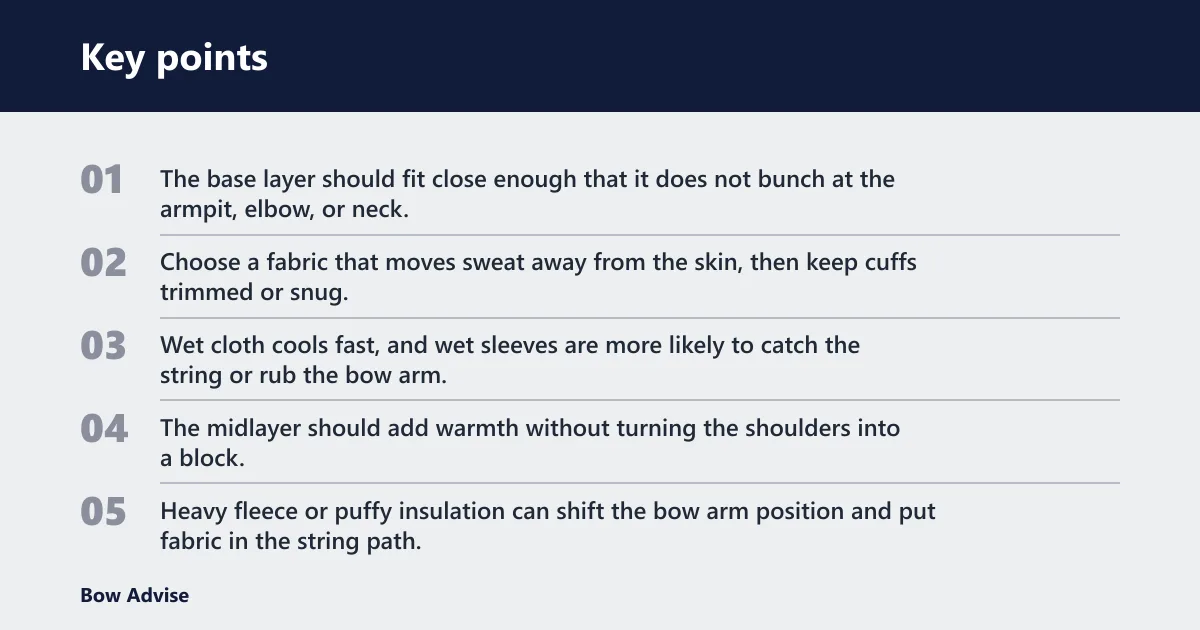
The base layer should fit close enough that it does not bunch at the armpit, elbow, or neck. That matters because a loose shirt can change sleeve clearance and make anchor contact less repeatable.
Choose a fabric that moves sweat away from the skin, then keep cuffs trimmed or snug. Wet cloth cools fast, and wet sleeves are more likely to catch the string or rub the bow arm.
Midlayer bulk and arm clearance
The midlayer should add warmth without turning the shoulders into a block. Heavy fleece or puffy insulation can shift the bow arm position and put fabric in the string path.
Check the arm at full draw. The sleeve should not press into the chest, pinch under the armpit, or force the bow arm to rotate outward just to clear cloth.
Outer layer wind protection without string contact
The outer layer should block wind, but it cannot be so loose that it drags across the bowstring. A heavy jacket can put fabric in the string path, so sleeve clearance should be checked past the sleeve at full draw.
Look for a jacket that closes the front well and stays quiet at the shoulder. If the cuff, collar, or pocket flap enters the shot lane, the jacket is too bulky for shooting.
Say your child wears a thick winter coat and the bowstring brushes the left sleeve at anchor. The fix is not to force the shot. Switch to a thinner wind shell over better base layers and recheck clearance before the next arrow.
How long should a youth winter session last?
Youth winter sessions should stay short enough that form stays clean from the first arrow to the last. A good range is 30–45 minutes in the cold, with breaks built in before fingers go numb or focus slips. Wind chill matters as much as the air temperature because exposed hands and faces cool much faster.
Short practice blocks and break timing
Use short practice blocks instead of one long run. For many kids, 10 to 15 minutes of shooting followed by a warm break keeps attention better than a long stretch that ends in shivering and rushed form.
During breaks, get the hands warm, check the bow-hand side, and look at the next round of clothing. The session should restart only when fingers move normally and the archer can hold the bow without fidgeting.
Stop signs for wind, numb hands, and fatigue
Stop the session if the child cannot feel the string cleanly, keeps dropping the bow hand, or starts freezing at the face and fingers. Numb hands are a safety issue, not a training nuisance.
Other stop signs include repeated stinging in the face from the cold, a shaky anchor, and shots that drift because the child is hurrying through the draw. A session that keeps going after form breaks usually teaches bad habits.
Warm up first. Get the child moving for a few minutes before the first arrow. Simple arm circles, shoulder rolls, and hand opening drills help more than starting stiff and cold.
Run one short block. Keep the first block to about 10 to 15 minutes of actual shooting. That gives a quick read on hands, sleeves, and anchor before the child gets too cold.
Check hands and face. Ask whether the fingers still feel normal and whether the string hand and bow hand still feel precise. If the answer is no, pause the session.
End on clean form. Stop before fatigue changes posture or release. Ending early on good shots builds better habits than forcing a cold child to finish a full round.
Suppose a teen starts fine at 38 degrees, then after 20 minutes begins squeezing the grip harder and missing anchor on the next two shots. That is the point to stop, warm up, and resume later if the hands and shoulders return to normal.
Cold-weather session checklist
This checklist gives a parent-friendly way to match temperature, clothing, and session length. It is not a fixed rule for every child. Use it with wind, glove choice, and how fast the shooter cools down.
| Temperature / wind | Clothing setup | Maximum session block | Break length | Stop signs | Reduce draw weight? |
|---|---|---|---|---|---|
| 32–40°F, light wind | Base layer, light midlayer, thin wind shell; sleeve clear at full draw | 15 minutes | 5–10 minutes | Cold fingers, sleeve rub, anchor drift | Usually no |
| 20–31°F, steady wind | Close base layer, controlled midlayer bulk, wind protection over torso; check collar height | 10–12 minutes | 10 minutes | Numb hands, shivering, slower draw | Maybe, if draw control slips |
| Below 20°F, wind chill rising | Minimal bulk, wind shell, hand muff on bow-hand side, face covering checked for anchor fit | 5–10 minutes | Warm-up until hands recover | Loss of feel, shaky aim, facial sting, string contact | Often yes, if needed for control |
| Kids, any cold wind day | Same layers they will shoot in; keep sleeves, cuffs, and collar from entering the string path | Short blocks only | Frequent, before fatigue | Loss of attention, rushed shots, form breakdown | Consider 2 to 4 lb back-off if needed |
| Teens, moderate cold | Layered torso warmth with clear arm clearance; practice with gloves if they will use them | 15–20 minutes | 5–10 minutes | Grip squeeze, anchor shift, peep misalignment | Only if draw speed and control drop |
Can kids shoot with gloves on?
Yes, but gloves can change trigger feel and grip. A thin glove is usually easier to manage than a bulky glove, and a release set up for bare finger may need more trigger travel with gloves. The exact cold setup should be used in practice, not guessed on the line.
Thin glove vs bulky glove
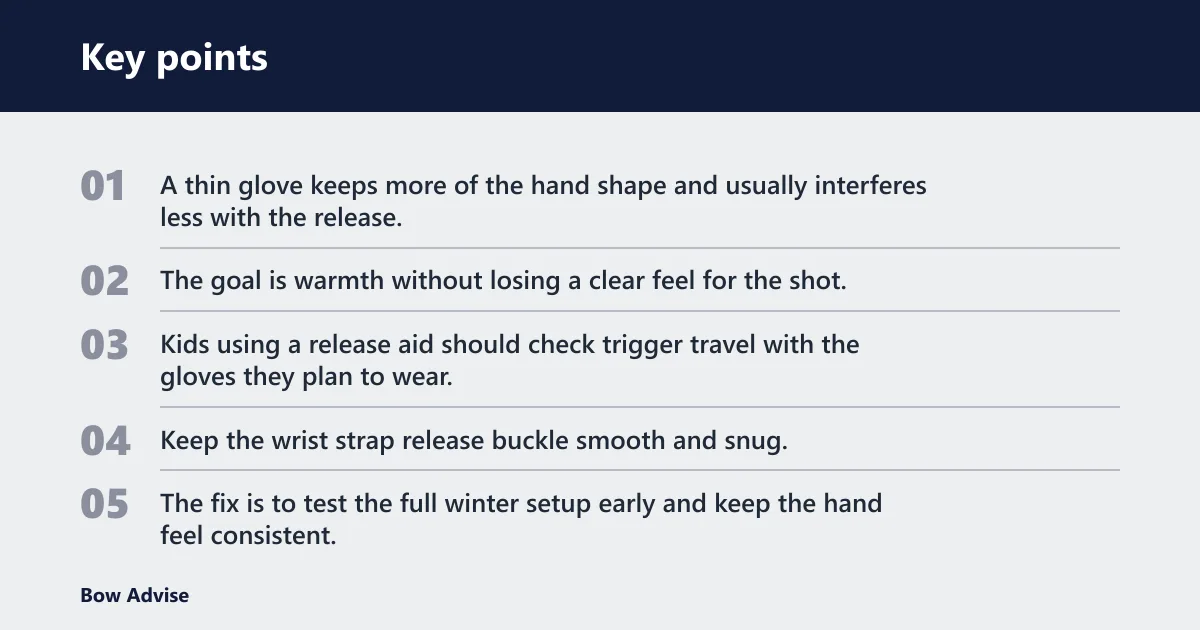
A thin glove keeps more of the hand shape and usually interferes less with the release. A bulky glove can dull the trigger feel, change grip pressure, and make the child clench harder to keep the release steady.
If the bow hand needs extra warmth, a hand muff on the bow-hand side helps more than a thick glove that ruins finger control. The goal is warmth without losing a clear feel for the shot.
Release aid fit and trigger feel
Kids using a release aid should check trigger travel with the gloves they plan to wear. A release set up for bare finger may need more trigger travel with gloves, especially if the glove adds thickness across the first finger or palm.
Keep the wrist strap release buckle smooth and snug. If the buckle rubs or the glove blocks the trigger, the archer may start punching the shot or opening the hand too early.
Practice with the exact cold setup
Practice should match the field setup. If gloves, hand muff, or winter sleeves will be worn outside, the same setup should be used before the first cold day, because the feel changes more than most kids expect.
A common first-timer mistake is switching to thicker gloves on the day of practice and then blaming the bow for poor release timing. The fix is to test the full winter setup early and keep the hand feel consistent.
Does winter clothing change anchor point?
Yes. Winter clothing can move the face, neck, and string contact points. Collar height, face mask fit, and shoulder bulk can all shift where the string lands and how the peep lines up.
Collar height and face covering fit
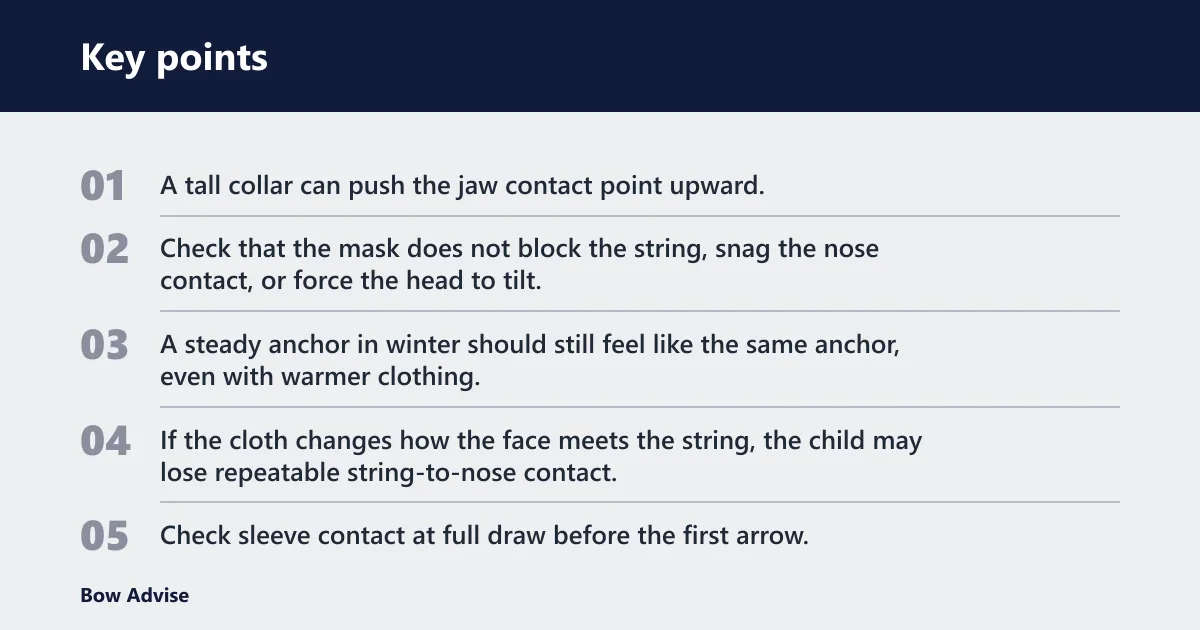
A tall collar can push the jaw contact point upward. A face mask or gaiter can do the same if it sits under the jaw or across the mouth in a way that changes the line to the nose and corner of the mouth.
Check that the mask does not block the string, snag the nose contact, or force the head to tilt. A steady anchor in winter should still feel like the same anchor, even with warmer clothing.
String-to-nose contact and peep alignment
If the cloth changes how the face meets the string, the child may lose repeatable string-to-nose contact. That can also shift peep alignment enough to make the sight picture look different even when the stance is unchanged.
Keep the head position simple. If the archer has to hunt for the string every shot, the clothing is too intrusive or the anchor point needs to be reset for winter layers.
Armguard use and sleeve contact
Check sleeve contact at full draw before the first arrow. Use an armguard if the sleeve edge, coat cuff, or bow arm position puts fabric near the string line.
String clearance past your sleeve at full draw is the test that matters. If the sleeve touches during the draw or near the release, shorten the layer, adjust the cuff, or change the outer layer.
Should youth archers lower draw weight?
They may need to. The guide suggests backing draw weight off a few pounds, and a 2 to 4 lb reduction can make sense when cold hands, thick layers, or winter fatigue reduce control. The aim is a clean, controlled draw rather than forcing the same number year-round.
When a 2 to 4 lb reduction makes sense
Lower draw weight is worth considering if the child starts raising the bow shoulder, collapsing the draw, or losing steady anchor after only a few arrows. Cold muscles and extra clothing can make the current setting too hard to control.
That adjustment should be small. A drop of 2 to 4 lb is enough to make the draw smoother without changing the whole setup.
Keeping the draw controlled
The draw should stay smooth, with no jerking or lean-back. If the child has to fight the bow just to reach anchor, the session is no longer about skill work.
Form matters more in winter than raw holding effort. A controlled draw protects the shoulder, keeps the release cleaner, and reduces the chance of a rushed shot.
Recheck zero at 20 yards and arrow weight
If you change draw weight, recheck zero at 20 yards. Even a small adjustment can move the impact enough to matter for practice and for any fixed sight setting.
How do you keep a young archer safe in freezing temperatures?
Keep sessions short, keep the clothing simple, and stop early when the body starts to fail the shot. Cold safety for youth archers is mostly about watching hands, face, and form before those problems become a habit or a hazard.
Use the same layers used in practice, check sleeve clearance at full draw, and watch for numb fingers, shivering, and slower release control. Gear care matters too, because warm-to-cold cycling can bring condensation into strings and accessories.
Equipment care in freezing conditions
Try to avoid unnecessary warm-to-cold cycling, and dry gear before storage so moisture does not collect on strings, sights, and metal parts. That keeps condensation from becoming a maintenance problem.
String wax applies poorly in the cold, so any waxing should be done when the string is clean and dry, not when it is stiff and chilled. Cold-stiffened dampeners transmit more vibration and noise, so they should be checked for stiffness and stored dry.
Picture a bow that spends 20 minutes in the snow and then gets packed into a warm car without drying. The next outing can start with damp string servings or fogged parts, which is a good reason to dry the bow before storage.
Frequently asked questions
How cold is too cold for kids to shoot archery?
There is no single number that fits every child, but the practical limit is when hands go numb, the face stings enough to break focus, or form starts to fail. Wind chill matters more than the thermometer alone. If the child cannot feel a clean string release, stop.
What should a child wear for archery in cold weather?
Start with a close base layer, add a midlayer that does not crowd the shoulders, and finish with a wind-blocking outer layer that stays clear of the string path. The collar, cuffs, and sleeves should not change anchor point or touch the string at full draw.
How long should youth archery sessions be in winter?
Keep the session short enough that form stays clean, with pauses as needed for warmth. End it sooner if hands go numb, attention fades, or shots get sloppy.
Can kids shoot bows with gloves on in winter?
Yes, but gloves can change trigger feel and grip. Thin gloves are easier to manage than bulky ones, and a release aid may need more trigger travel with gloves on. Practice with the exact cold setup before a real session so the child knows how it feels.
Does bulky winter clothing change a child’s anchor point?
Yes. Tall collars, face coverings, and heavy layers can shift string-to-nose contact and peep alignment. If the child has to force the head position or hunt for the string, the clothing is changing the anchor. Refit the layers before the next arrow.
Should youth archers lower draw weight in the cold?
They may need to. Backing draw weight off a few pounds can help when cold hands and thick clothing reduce control. A 2 to 4 lb reduction is a reasonable adjustment if the archer starts collapsing, rushing, or losing a controlled draw. Recheck zero at 20 yards afterward.