Late Season Bowhunting Setup: Quiet Clothing and Warmth
Pick a winter kit that keeps your draw length, anchor, and release hand position unchanged: thin base layer, quiet midlayer, and outer layer with low-crinkle fabric, plus gloves that leave string hand feel intact. Too much bulk or noisy cloth ruins anchor repeatability, string clearance, and shot timing. This guide covers layer selection, glove choice, bow-side adjustments, and a mobility-first setup for cold-weather stands and still hunting.

Must-have setup
Late-season bowhunting clothing should be chosen for what it does to the shot, not only for how warm it feels in camp. A base layer should move sweat off the skin, fit snugly, stay low-bulk, and stack cleanly under other layers. Mid layers should add insulation without trapping the arms in thick sleeves. The outer shell should cut wind, resist water, stay quiet when rubbed, and keep enough range of motion for a full draw.
Warmth matters because cold hands, stiff shoulders, and a shivering torso make holding at anchor harder. But the wrong insulation can move the bow hand, catch a string, or change where the face lands on the string and the release aid. The goal is repeatable shooting under cold-weather clothing, not maximum loft at any cost.
 Upgrade pickLichenland · Base Layer · Merino Wool · Camo
- 100% 260gram 18.5 micron extra fine merino wool
- Ergonomic cuff with thumb loops and breathable fabric
- Silent, thermo-regulating, and odor-free material
Drawback: Check the size and fit against your project before buying.$72.99Price as of 25 Nov 2026View on Amazon →As an Amazon Associate we earn from qualifying purchases. Prices and availability are accurate as of the date shown and are subject to change.

- 100% 260gram 18.5 micron extra fine merino wool
- Ergonomic cuff with thumb loops and breathable fabric
- Silent, thermo-regulating, and odor-free material
Lichenland merino wool hunting base layer top
Based on the listed specs, this is the base layer type to look for: 100% 260 gram 18.5 micron merino wool, silent fabric, and thumb-loop cuffs that help keep sleeves in place. Merino is useful here because it handles moisture and stays low-bulk under a mid layer.
The drawback is cost. At $72.99, it is pricier than basic synthetic base layers, and merino also needs more care than simple wash-and-wear fabric.
Our pickNEW VIEW · X-Large · Warm Fleece Lined · Tree Camo- Exclusive tree, leaf, and reed camouflage designs
- Durable polyester with water-resistant softshell and fleece lining
- Ultra-silent fabric and noiseless zippers for stealth
Drawback: Check the size and fit against your project before buying.$50.99Price as of 25 Nov 2026View on Amazon →As an Amazon Associate we earn from qualifying purchases. Prices and availability are accurate as of the date shown and are subject to change.
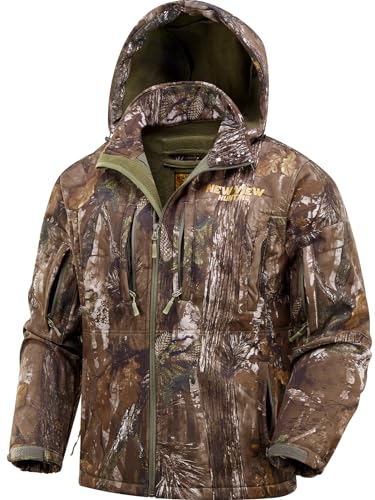
- Exclusive tree, leaf, and reed camouflage designs
- Durable polyester with water-resistant softshell and fleece lining
- Ultra-silent fabric and noiseless zippers for stealth
NEW VIEW camo hunting jacket
This jacket fits the outer-shell role better than a heavy parka. The published details point to a fleece-lined, water-resistant softshell with noiseless zippers and a quiet fabric face, which matters when a sleeve brushes a bow riser or brush in a tree stand.
The drawback is bulk management. A lined jacket can be warm, but if it is worn over too many layers it can crowd the shoulders, affect anchor repeatability, and limit full-draw freedom.
Pair with itPinals · 30 Inch · 300 Spine · Carbon Arrows- Straightness of +/- 0.003 for consistent accuracy
- Shaft weight and spine examined and sorted by machine
- Made by pure precision carbon with removable field points
Drawback: Check the size and fit against your project before buying.$59.98Price as of 25 Nov 2026View on Amazon →As an Amazon Associate we earn from qualifying purchases. Prices and availability are accurate as of the date shown and are subject to change.

- Straightness of +/- 0.003 for consistent accuracy
- Shaft weight and spine examined and sorted by machine
- Made by pure precision carbon with removable field points
Pinals carbon hunting arrows
These arrows are not clothing, but they belong in the setup because clothing changes shot execution only if the rest of the system is already tuned. A 30 inch shaft, 300 spine, and stated +/- 0.003 straightness are the details that fit a cold-weather bow setup where repeatability matters.
The drawback is that spine choice still has to match the bow. A well-made shaft does not fix an arrow that is too stiff or too weak for the final hunting setup.
Late-season clothing checklist
Use this checklist before a hunt, with the base layer, mid layer, outer shell, gloves, face covering, and boots on together. The point is to catch problems that only appear when everything is stacked at once. A jacket can feel fine in a bedroom mirror and still fail at full draw.
-
Check anchor repeatability.
Draw to anchor three times with the face covering and collar you plan to wear. The contact point at the corner of the mouth, jawline, or nose should land in the same place each time.
-
Check string clearance.
Raise the bow arm and draw slowly while watching sleeves, hood edges, and cuff material. Nothing should drift into the string path near the forearm, nose, or release hand path.
-
Check hood and collar noise.
Turn your head, raise and lower the bow arm, and rub the collar against the outer shell. Any hiss, scrape, or zipper click is a problem in close-range hunting.
-
Check pocket access.
Reach for a rangefinder, face mask, and spare glove with both hands on and with the bow slung or held. Pockets that cannot be opened silently are a liability in cold weather.
-
Check full-draw mobility.
Draw from standing, kneeling, and seated positions. Shoulder and elbow articulation should still allow the string hand to settle without strain or jacket pull across the back.
-
Check walk-and-sit layering.
Walk five to ten minutes in the full kit, then sit and cool down. If sweat builds on the walk, remove a layer before it chills the torso and hands later.
Say your outer shell has a stiff hood edge. The draw may still feel fine indoors, but the first turn of the head in a stand can shift the anchor point enough to make the shot feel different. That is a clothing problem, not a bow problem.
A common first-timer mistake is treating the jacket as the warmest item and forgetting the sleeves. A cuff that rubs the string path can be silent at rest and loud only at release, which is the worst time to discover it.
What is the best layering system for late season bowhunting?
The best system is the one that keeps the shot unchanged while matching the pace of the hunt. Start with a moisture-moving base layer, add a mid layer that insulates without swallowing arm movement, and finish with a shell that blocks wind and stays quiet. If the hunt involves long stands, add warmth in removable pieces; if it involves walking or climbing, keep the stack lighter and easier to vent.
Base layer fit and moisture control
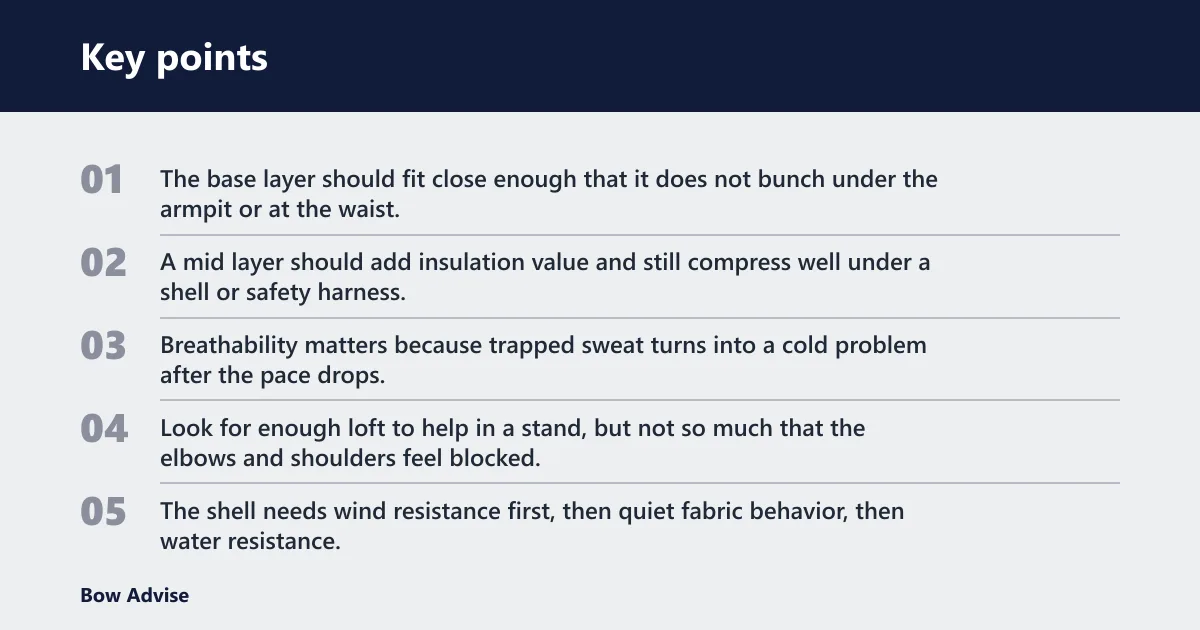
The base layer should fit close enough that it does not bunch under the armpit or at the waist. That close fit helps moisture move away from the skin and keeps the first layer from adding bulk where the string arm and bow arm need clean motion.
Mid layer loft without bulk
A mid layer should add insulation value and still compress well under a shell or safety harness. Breathability matters because trapped sweat turns into a cold problem after the pace drops. Look for enough loft to help in a stand, but not so much that the elbows and shoulders feel blocked.
Outer shell cut, noise, and weather protection
The shell needs wind resistance first, then quiet fabric behavior, then water resistance. A range-of-motion cut in the shoulders and back matters more than a stiff, heavy jacket that feels warm but fights the draw cycle. Noise also matters in the zipper, cuffs, hood, and pocket openings.
How do you keep anchor repeatable?
Anchor repeatability depends on where the collar sits, how the face covering sits, and whether sleeves or hood edges creep into the bowstring path. Cold-weather clothing should preserve the same reference points you use in milder weather. If the collar or gaiter changes where the release hand lands, the whole shot changes with it.
Collar height and facemask contact points
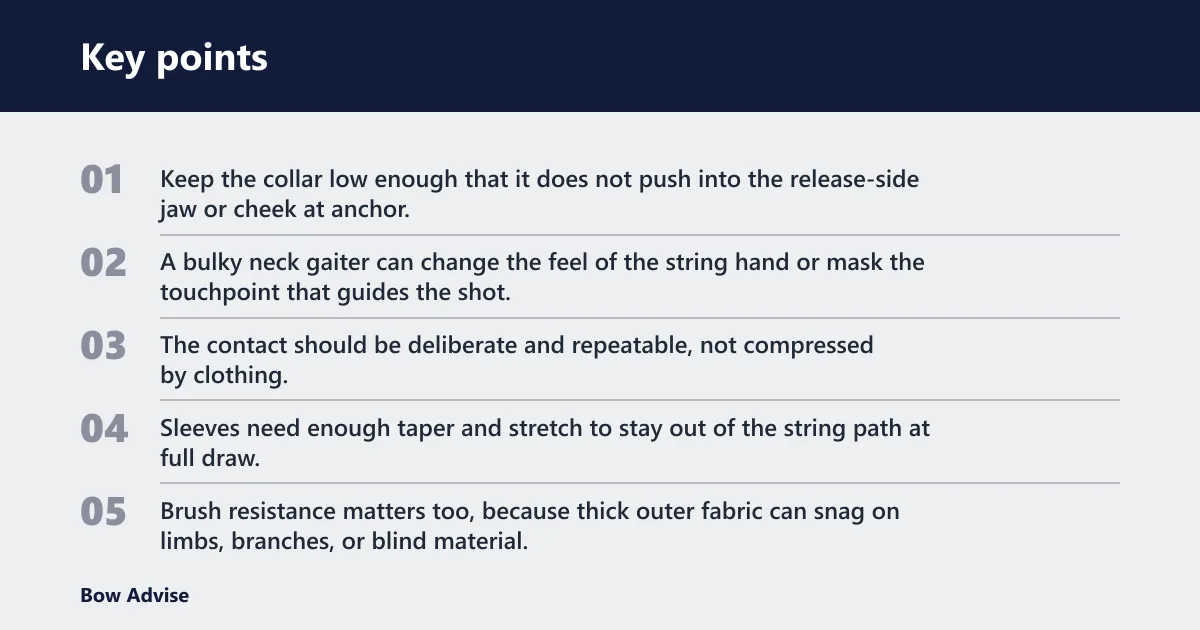
Keep the collar low enough that it does not push into the release-side jaw or cheek at anchor. A bulky neck gaiter can change the feel of the string hand or mask the touchpoint that guides the shot. The contact should be deliberate and repeatable, not compressed by clothing.
String path clearance around sleeves and hoods
Sleeves need enough taper and stretch to stay out of the string path at full draw. Hoods are useful in wind, but loose hood fabric often creates more trouble than it solves if it bunches near the nock line. Brush resistance matters too, because thick outer fabric can snag on limbs, branches, or blind material.
Cold-weather consistency from nock to release
Cold hands and stiff cloth both change timing. If a glove makes the release hand feel uncertain, or if the collar nudges the face covering every time the head turns, consistency drops. A clean setup keeps the same anchor, the same release pressure, and the same follow-through.
How can you stay mobile in cold weather while hunting in a stand or on foot?
Mobility comes from articulation, not only from sizing up the jacket. The shoulders, elbows, knees, and hips need enough room for climbing, kneeling, sitting, and drawing without the clothing binding up. On-foot hunts need better packability and venting; stand hunts can carry more insulation if the layers can be shed or opened quietly.
Shoulder and knee articulation
Look for cut lines that follow the shoulder and knee instead of fighting them. If the jacket pulls hard when reaching overhead or the pant leg tightens when kneeling, the hunter will feel it during the shot. That tension can also make it harder to settle into a stable stance.
Layer choices for climbing, kneeling, and sitting
Climbing calls for less bulk in the torso and thighs. Kneeling needs fabric that does not pinch at the back of the leg. Sitting in a stand needs a mid layer that stays warm after movement stops, because the body cools quickly when the wind rises and the pace drops.
Packability when you need to shed insulation
A removable layer is useful when the walk in raises body heat but the stand turn or glassing session turns cold. Compressible insulation is easier to carry and easier to add back later. If a layer cannot be stowed quietly, it is less useful than it looks.
How do you keep your bow setup quiet when layering for cold weather?
Quietness starts with fabric that does not rub loudly, zipper pulls that do not click, and cuffs that do not scrape the string or riser. The bow itself may be tuned well, but a noisy sleeve, stiff hood, or clattering pocket can still betray the shot. Silence should be checked at movement speed, not only while standing still.
Noise from rubbing fabric and zippers
Choose outer layers with soft surface fabric and covered or quiet zippers. Hard zipper teeth and dangling pulls are common noise points, especially when shoulders twist or a pocket is opened with gloves on. Cuffs that rasp against each other can be just as obvious as a loud zipper.
Brush resistance and edge control
Cold-weather clothing should slide past brush instead of catching on it. That matters when climbing into a stand, easing through saplings, or settling into cover. Hood edges, strap loops, and stiff seams are common snag points that slow movement and create noise.
Gloves and hand access
Hand protection needs to preserve enough feel for the release hand while keeping the fingers warm during long waits. Silent access is important; if the glove must be peeled off with two hands, it can cost time and make noise. Keep the draw hand compatible with the release style you use.
What gear should you prioritize for late season bowhunting in freezing temperatures?
Prioritize the clothing item that most affects the shot first, then the item that keeps the body warm enough to stay still. After that, add the small pieces that prevent noise and loss of dexterity. Boot insulation, hand warmth, and face coverage matter, but none should force the anchor or draw to change.
Hand warmer placement and silent access
Hand warmers work best when they are easy to reach without bright movement or loud pocket handling. Placement should support the bow hand and the non-draw hand without blocking access to a release aid, rangefinder, or call. If a warmer interferes with the draw hand, it is in the wrong spot.
Boot insulation and sock compatibility
Boot insulation should match the hunt tempo. A hunter who sits still for long periods needs more insulation than one who walks often, but too much volume can reduce circulation and make the feet colder. Sock choice matters too, because the boot should fit the insulation stack without cutting off blood flow.
Quiet pocket layouts and cuff finishes
Quiet pockets let the hunter reach for a face mask or hand warmer without a loud flap. Soft cuff finishes reduce scraping and help sleeves stay put when drawing. Bib suspenders can also interfere with shoulder movement, so that area should be checked with the full layer stack on.
Late-season clothing checklist asset
| Check | Yes / No | Why it matters |
|---|---|---|
| Anchor repeatability | Confirms the collar, mask, and face touch points stay the same. | |
| String clearance | Shows whether sleeves, hood, or cuff fabric enter the string path. | |
| Hood and collar noise | Finds hissing, scraping, and zipper clicks before the hunt. | |
| Cuff noise | Reveals fabric that rubs at the wrist or forearm during draw. | |
| Pocket access | Checks that face masks, warmers, and small items can be reached silently. | |
| Full-draw mobility | Shows whether shoulders and elbows still move freely at anchor. | |
| Kneeling comfort | Tests whether knees and hips stay comfortable in a shot-ready position. | |
| Stand-sit comfort | Checks how the stack feels after long stillness in a stand. | |
| Breathability | Helps prevent sweat buildup that chills the body later. | |
| Wind blocking | Protects the torso and arms from steady wind exposure. | |
| Hand access | Makes sure gloves, warmers, and release gear stay easy to reach. | |
| Walk-vs-sit layering adjustments | Confirms the stack can be vented on the move and closed up when still. |
Nice-to-have upgrades
These upgrades help once the basic stack already works. They are useful because they remove friction from the hunt, but they should not be bought before the core fit, anchor, and noise issues are solved. Small gains matter most after the shot is already reliable.
Hand warmer system
A good hand warmer system is about placement and quiet access. It should warm the fingers between holds without forcing loud pocket openings or interfering with the draw hand. Heat output should be enough to keep dexterity, not so bulky that it crowds the waist or chest strap.
Boot insulation for stillness and walking
Boot insulation should be chosen by how much standing versus walking the hunt requires. More insulation helps during long still hunts, while less bulk can be better for moving hunts where circulation stays active. Sock compatibility and boot volume matter because a tight fit can reduce warmth instead of helping it.
Backup face covering
A spare face covering is useful when the first one gets damp or icy. It should fit with the collar and hood without changing the anchor point. If the face covering traps moisture or shifts under the nose, it can become a shot problem as well as a comfort problem.
Consumables and spares
Late-season hunts run better when small items are easy to swap. A dry pair of socks, a spare liner, and a backup warm layer can solve a lot of cold-weather problems without changing the whole kit. Small repair items are worth carrying because a broken zipper pull or strap can end the usefulness of a good layer.
- Extra socks for a dry foot at camp or after a long sit.
- Thin liners that preserve feel under gloves.
- Hand warmers for the coldest glassing or stand sessions.
- Small repair items for zippers, snaps, and straps.
- Dry layer swaps for sweat management after the walk in.
Budget setups
Budget planning should protect the shot first. Save money on pattern variety or extra features before cutting into fit, silence, or mobility. If a lower-cost layer keeps the anchor point stable and stays quiet near the string, it is doing the job that matters.
| Setup | Priority | Best buy from this list | Price |
|---|---|---|---|
| Starter | Quiet base layer and dry layering | Lichenland merino wool base layer top | $72.99 |
| Mid | Base layer plus quiet outer shell | Lichenland merino wool base layer top + NEW VIEW hunting jacket | $123.98 |
| Serious | Clothing plus cold-weather field durability | Lichenland base layer + NEW VIEW jacket + TIDEWE boots + Pinals arrows | $249.94 |
For freezing hunts, the starter setup should go to the base layer first. The mid setup adds the shell that quiets wind and brush contact. The serious setup is for hunters who need the clothing system, foot insulation, and arrow consistency all working together in late season.
Frequently asked questions
What should I wear for late season bowhunting so I stay warm without getting bulky?
Start with a moisture-moving, snug base layer, then add a mid layer that insulates without trapping your arms. Finish with a quiet shell that blocks wind and still allows full draw. The goal is warmth that does not change anchor point, string clearance, or release hand position.
How do I keep my bow setup quiet when layering for cold weather?
Choose soft fabrics, quiet zippers, and cuffs that do not scrape when the bow arm moves. Check hood edges, collar material, and pocket flaps in full kit before the hunt. Noise often appears only when twisting, drawing, or reaching under cold-weather layers.
What clothing works best for bowhunting in late season without hurting anchor point?
A low-bulk base layer, a controlled mid layer, and an outer shell with a cut that does not crowd the neck or shoulders work best. Anchor problems usually come from collars, facemasks, or sleeves that change where the string hand and face meet.
How do bulky jackets affect bow draw and release in cold weather?
Bulky jackets can push the anchor point off target, crowd the string path, and make the release hand feel less precise. They also create more chance for hood, cuff, or collar noise. A warmer jacket is only useful if it still lets the bow move cleanly through the shot.