Do Broadheads Fly Differently in Cold Dense Air?
Yes, but usually only a little: colder, denser air can raise drag slightly and move impact point, while broadhead errors of more than about 2 inches at hunting distance usually point to tuning, setup, or form. Miss that call, and you can end up chasing weather instead of fixing the bow. This guide shows how cold air changes flight, how to separate it from setup problems, and what to check before hunting.
How broadheads handle denser winter air
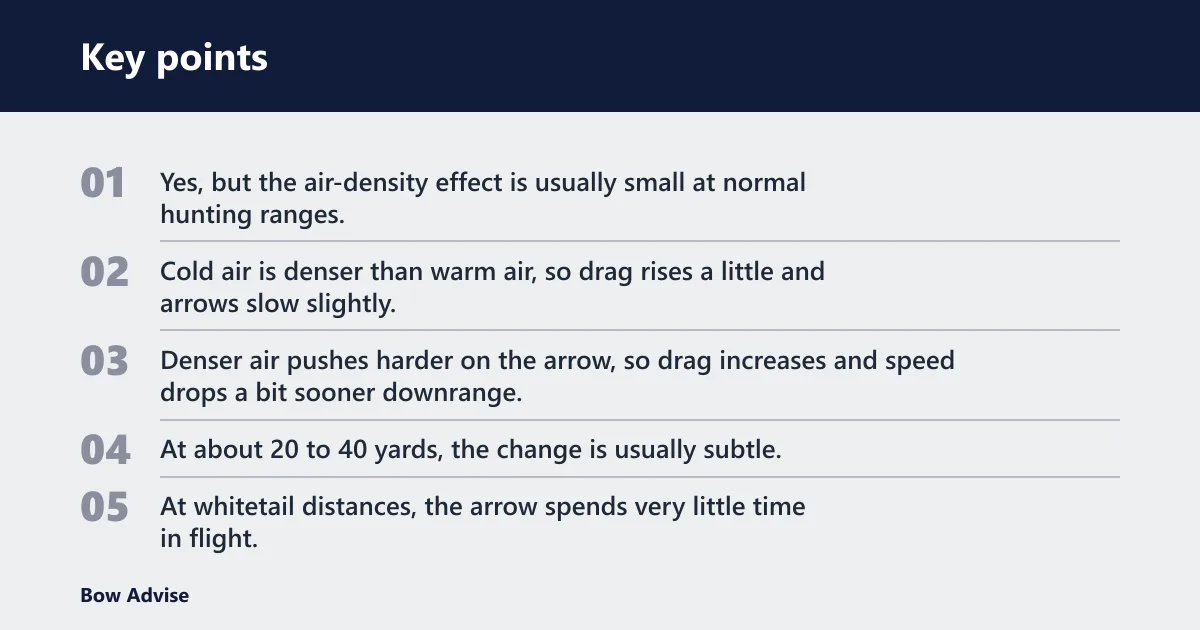

Yes, but the air-density effect is usually small at normal hunting ranges. Cold air is denser than warm air, so drag rises a little and arrows slow slightly. Broadheads can reveal that change more than field points, especially fixed blades, but most winter misses come from setup or shooter changes, not temperature alone.
Why colder air adds a little drag
Air density rises as temperature falls. Denser air pushes harder on the arrow, so drag increases and speed drops a bit sooner downrange. That means the arrow can strike slightly lower, especially at longer practice distances or with slower setups. At about 20 to 40 yards, the change is usually subtle.
Why the change is usually small at hunting distances
At whitetail distances, the arrow spends very little time in flight. That limits how much drag can act on it. A broadhead that shifts several inches in winter is more likely reacting to nock fit, spine, string condition, or anchor change than to air density alone.
Why broadheads react more than field points
Field points are streamlined, so they show less steering in flight. Broadheads have more exposed surface area, and fixed blades act like small fins. That gives them more chance to plane if tune is off. A clean field-point group can hide a broadhead issue until the broadhead test exposes it.
Fixed blades versus mechanicals
Fixed-blade heads are usually more sensitive to tuning errors because the blades are already in the wind. Mechanical broadheads often fly closer to field points when the bow is tuned well, but they still depend on arrow speed, correct blade deployment, and a clean release. Air temperature is rarely the main difference between the two.
Broadhead winter checklist
This checklist separates the likely cause before gear changes start. If the group shift is small and consistent, air density may be part of it. If the shift grows, scatters, or changes with clothing, the issue is more likely setup or shooter related.
| Likely air-density issue | Likely setup/tuning issue | Likely shooter-gear issue |
|---|---|---|
| Small, repeatable lower impact in cold weather | Broadheads hit much lower or left/right than field points | Group changes only when winter layers are worn |
| Effect is modest at 20 to 30 yards | Impact shift grows at 30 to 40 yards | Anchor feels cramped or inconsistent in bulky clothing |
| Same bow setup, same arrow, same release, different temperature | Paper tune, walk-back tune, or bare shaft shows mismatch | Gloves change trigger pressure or release timing |
| Field points and broadheads both move a little lower | Broadheads plane more than field points | Peep alignment changes because hood, collar, or layers shift head position |
Short test sequence at 20, 30, and 40 yards
Confirm the baseline at 20 yards. Shoot three field points and three broadheads from the same hunting setup. If the broadheads land within about 1 to 2 inches of the field points, the setup is probably sound and any cold-air effect is likely minor.
Repeat at 30 yards. Keep the same clothing, anchor, and release hand. A small, consistent lower hit that grows slightly with distance can fit air density plus normal trajectory loss. A side shift or scattered group points more toward tune or form.
Check again at 40 yards. This distance shows whether the pattern is stable. If the gap between field points and broadheads keeps widening, move to tuning checks. If the pattern stays tight and only drops a little, leave the setup alone and adjust sight marks.
Say a compound bow groups field points and fixed blades together at 20 yards in mild weather, then the broadheads land about 2.5 inches low at 40 yards in colder weather. That pattern can fit colder, denser air, but it also fits a slower arrow, a sight mark that was never confirmed in winter layers, or a small tune change.
How much can cold air change impact?
The air-density effect is real, but it is usually modest at bowhunting ranges. Inside 20 yards, many hunters will not see enough change to matter. Between 30 and 40 yards, the effect becomes easier to notice, especially if the arrow is slower or the broadhead is less forgiving.
Short-range hunting versus longer practice distances
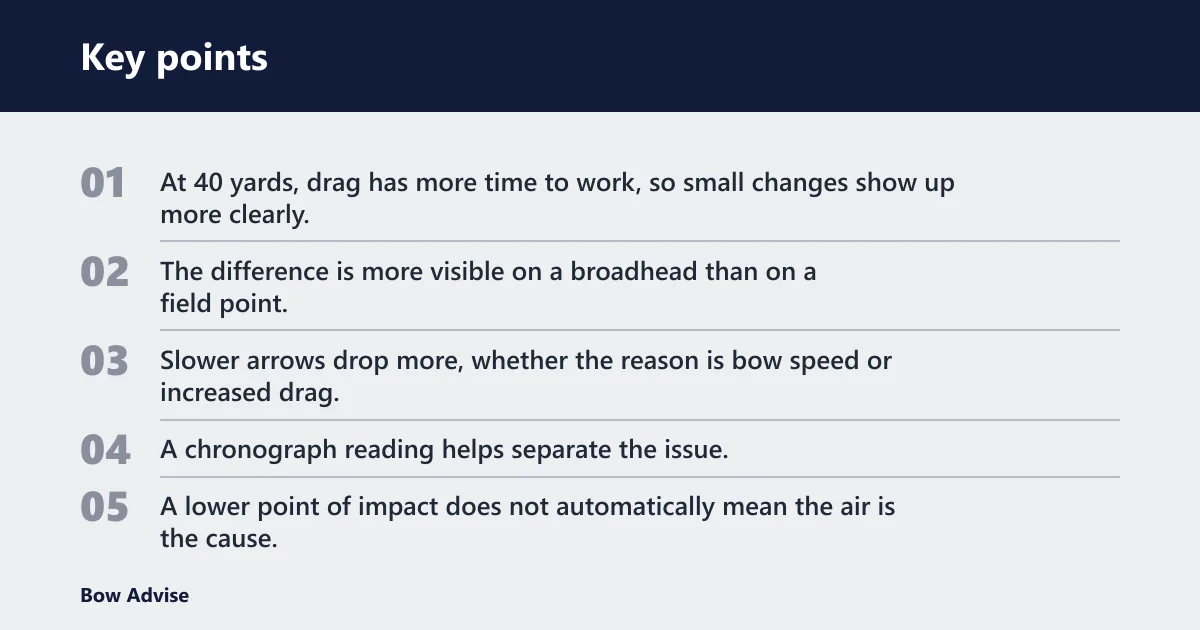
At 20 yards, arrow flight time is short. At 40 yards, drag has more time to work, so small changes show up more clearly. That is why a bow that looks dead-on at 20 can show a slight low impact farther out. The difference is more visible on a broadhead than on a field point.
How arrow speed changes the picture
Slower arrows drop more, whether the reason is bow speed or increased drag. A chronograph reading helps separate the issue. If a setup is already on the slow side, a temperature-related speed loss can show up as a slightly lower impact point, especially when broadheads are used past 30 yards.
What a lower impact point can mean
A lower point of impact does not automatically mean the air is the cause. It can also mean the bow is shooting slower, the sight was set in warmer conditions, the string has changed, or the shooter’s anchor moved. The size of the shift matters more than the fact that it is lower.
What else changes broadhead flight in winter?
Temperature often gets blamed first, but winter gear and bow condition are bigger causes of broadhead shift. Paper tune, walk-back tune, broadhead tune, bare shaft comparison, string fit, and anchor consistency all matter more than air density when the miss is larger than a small seasonal drift.
Bow tuning checks
A winter setup should still pass basic tune checks. Paper tune can reveal tear direction. Walk-back tune shows whether the arrow leaves the bow square to the target line. Broadhead tune confirms real hunting heads, not just points. Bare shaft comparison helps show whether the arrow is leaving cleanly before fletching hides the error.
Check paper first. Shoot a bare shaft or a field-point arrow through paper at close range, often around 6 feet. A clean bullet hole or a very small tear gives a useful baseline before broadhead testing begins.
Confirm walk-back alignment. Shoot at the same vertical aim point from 20, 30, and 40 yards. If the arrows drift off line as distance grows, the bow may need rest or nock-height adjustment rather than a sight change.
Compare broadheads directly. Group field points and broadheads at the same distances. If broadheads hit off line while field points stay tight, the issue is often tune, arrow spine, or head design sensitivity, not cold air alone.
Arrow spine and broadhead forgiveness
Arrow spine is the stiffness match between the arrow and the bow’s launch. A marginal spine can show up more clearly in winter because the broadhead gives less forgiveness. Carbon arrow behavior can also change with setup details, so a shaft that looked acceptable indoors may act differently once hunting clothing and colder conditions are added.
A common first-timer mistake is blaming cold weather for a broadhead spread of about 4 inches at 30 yards when the real issue may be weak spine or inconsistent dynamic spine behavior. That size of error is too large for air density alone in most hunting setups.
String, cable, and nock fit changes
String material contracts in the cold. That can change brace height slightly and affect nock fit. If the string or serving is worn, serving diameter may not grip the nock the same way from one season to the next. Wax and serving condition also matter because a dry or frayed string can behave less consistently.
Clothing, anchor, and release consistency
Bulky jackets can move the bow arm, pinch the drawing elbow, or force a different anchor point. Gloves can change how the release is held and activated. Peep alignment may also shift if a hood, collar, or face covering changes head position. These are common winter errors that look like an air-density problem.
Suppose a hunter adds a thick jacket and wool gloves, then sees broadheads strike 3 inches right at 30 yards while field points stay centered. That is more consistent with anchor or release change than with temperature alone. If the same setup is shot with the exact hunting layers, the pattern often changes again.
Should you re-sight your bow for winter?
Yes, but only after confirming the sight marks with the same clothing and setup used for hunting. Cold air can move impact a little, and winter gear can move it more. If the bow was sighted in light clothing, the winter sight mark should be checked before the season or before a late-season hunt.
When to confirm sight marks again
Recheck sight marks whenever the temperature drops enough to change clothing, string feel, or shooting posture. A summer pin setting is not guaranteed to match a late-season setup. If broadhead impact is off by a small, consistent amount at 30 or 40 yards, a sight adjustment may be all that is needed.
Why the hunting setup must match the sight-in setup
Winter sight marks should be confirmed in the same clothing, with the same release, peep, D-loop, and arrow setup used in the field. A sight-in session done in a T-shirt does not fully represent a late-season hunt. The goal is matching conditions, not chasing a perfect indoor group.
How to test broadhead impact at 20, 30, and 40 yards
Use the same arrow, the same broadheads, and the same clothing you will hunt in. Compare field points and broadheads at each distance before changing gear. A stable pattern that shifts only slightly lower can usually be handled with sight marks. A widening gap points to tuning or setup work.
Start at 20 yards. Shoot one group of field points and one group of broadheads. Match the shooting form you will use in the field. If the arrows are already far apart here, do not blame cold air first.
Move to 30 yards. Keep the same anchor and release. Watch whether the broadheads stay together, drift low, or drift sideways. A low but tight group can fit a minor density effect plus normal drop; a sideways drift usually points elsewhere.
Finish at 40 yards. Look for pattern shape, not one bad shot. If the broadheads only land a little lower and remain grouped, re-sight for winter. If the gap becomes large or erratic, tune the bow before hunting.
Use this decision rule: if the shift is small, repeatable, and similar at all three distances, confirm sight marks and hunt. If the shift grows with distance, or if broadheads and field points separate by more than about 2 inches at hunting distance, retune before relying on the setup.
Frequently asked questions
Do broadheads fly differently in cold dense air?
Yes, but usually only a little. Cold air is denser, so drag increases and arrows slow slightly. Broadheads can show that change more clearly than field points, especially fixed blades, but a large shift usually means something in the setup, string condition, or shooting form changed too.
How much does cold air change broadhead trajectory?
At 20 yards, the change is often too small to matter. At 30 to 40 yards, it can become visible as a slight lower impact, especially with slower arrows. Bigger errors are more often caused by tune, spine, anchor shift, or clothing than by air density.
Will broadheads hit lower in winter?
They can, but not always for the reason hunters assume. Denser air can nudge impact lower at distance, yet a winter sight shift is often caused by colder strings, a change in brace height, different clothing, or a changed anchor point. Confirm the full setup before adjusting the sight.
Do fixed broadheads react more to cold air than field points?
Yes. Fixed blades have more surface area in the air, so they are less forgiving and can show small changes more clearly. Field points usually hide minor setup errors better. If the broadhead group moves while field points stay tight, tune and spine should be checked first.
Should I re-sight my bow for winter hunting?
Yes, recheck sight marks in the same clothing and setup used for hunting. Winter layers can change anchor point, peep alignment, and release feel. If the broadhead group is only slightly lower and consistent, a small sight adjustment may solve it without any gear change.
What else in cold weather affects broadhead accuracy besides air density?
Clothing, gloves, string contraction, serving wear, nock fit, and anchor shift all matter. A bow that was tuned in warm weather may act differently when the string is stiffer and the shooter’s posture changes. Broadheads reveal those problems more clearly than field points do.