Can a Crossbow Scope Fog or Frost Over in Winter?
Yes. A crossbow scope can fog, frost over, or collect lens condensation in winter, and the fix can depend on whether the problem is internal moisture, outside frost, or warm-air condensation. Guess wrong, and you lose a clear aiming point at the worst moment. This guide shows how to tell each cause apart and the exact field fix for each.
How to tell internal fog from external frost


Yes. Winter can fog a crossbow scope inside the tube, frost the outer lens, or leave a thin film of condensation after a warm-to-cold move. Fogproof and waterproof construction help, but they do not stop every visibility problem, especially after a sudden temperature shift or when moisture rides in on breath, snow, or wet clothing.
Why winter causes scope fog and frost
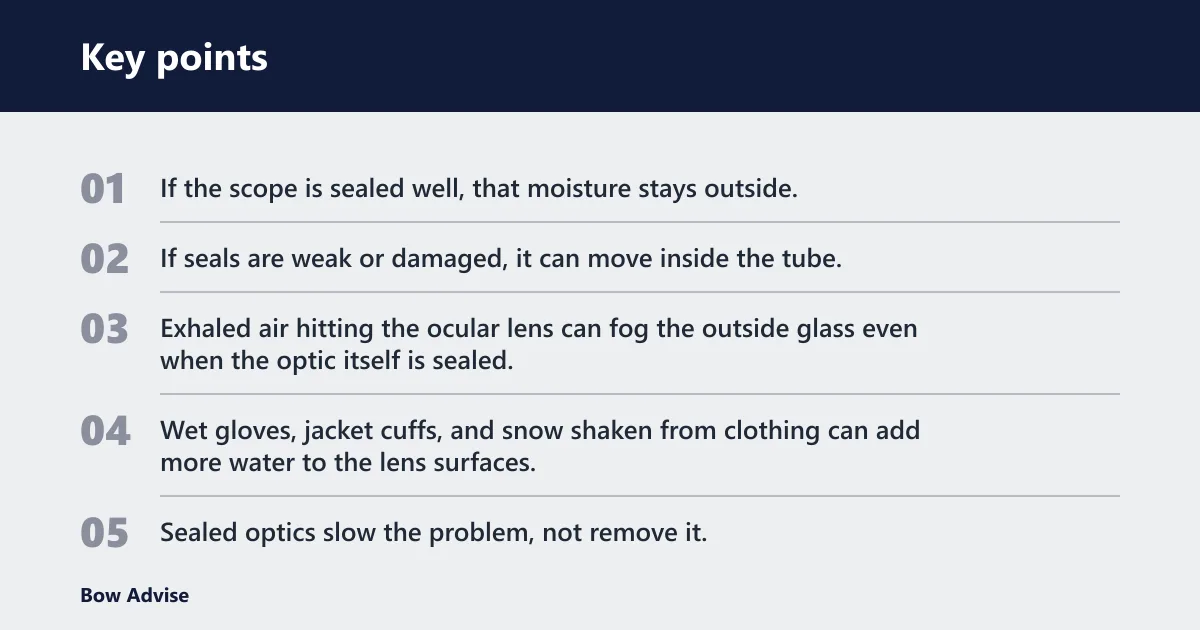
Cold air holds less moisture than warm air, so a scope that is warm in a truck cab can cool fast enough to make water condense on the first cold surface it meets. If the scope is sealed well, that moisture stays outside. If seals are weak or damaged, it can move inside the tube.
Moisture from breath matters too. Exhaled air hitting the ocular lens can fog the outside glass even when the optic itself is sealed. Wet gloves, jacket cuffs, and snow shaken from clothing can add more water to the lens surfaces.
Sealed optics slow the problem, not remove it. Nitrogen purging supports fog resistance in some scopes, and O-ring sealing helps prevent moisture ingress. Those features lower internal fogging risk, but they do not cancel out a warm-to-cold transfer, a loose cap, or wet lens handling.
Fog inside the tube, frost on the outside lens, and condensation after a temperature change look similar at first glance, but they fail in different places. The fastest diagnosis is to check where the blur sits, whether it wipes away, and whether the reticle is clear even when the glass is not.
What the three failures look like
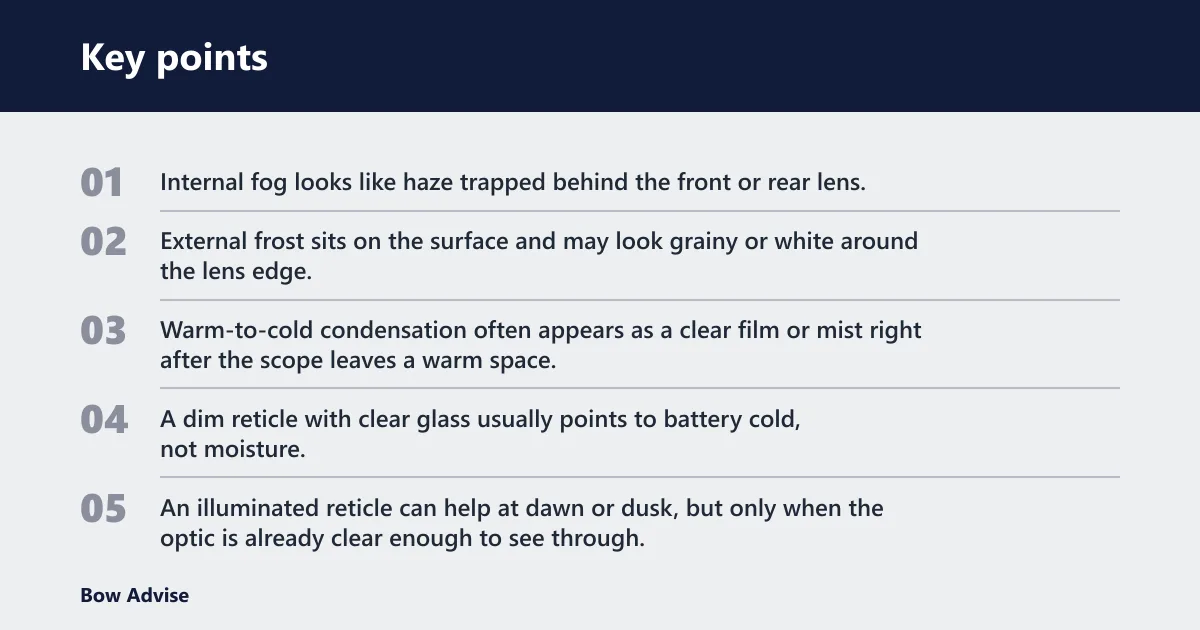
Internal fog looks like haze trapped behind the front or rear lens. It does not wipe off, and it often persists across the full view. External frost sits on the surface and may look grainy or white around the lens edge. Warm-to-cold condensation often appears as a clear film or mist right after the scope leaves a warm space.
A dim reticle with clear glass usually points to battery cold, not moisture. That matters because the fix is electrical, not drying. An illuminated reticle can help at dawn or dusk, but only when the optic is already clear enough to see through.
Say your crossbow scope is clear in the truck, then blurs as soon as it enters about 10°F air. If the blur is on the outside lens and a glove can wipe it away, that is surface moisture or frost. If it stays cloudy behind the glass, treat it as internal fog or trapped condensation and warm the optic gradually.
Crossbow scope troubleshooting table
| Symptom | Likely cause | Immediate fix | Prevention |
|---|---|---|---|
| Fog inside the tube | Internal moisture, weak sealing, or a damaged O-ring path | Stop using the scope for the shot. Move it to a dry, warm place for a gradual thaw, leave the caps off, and let trapped moisture escape before rechecking the view. | Use a sealed optic with nitrogen purging and O-ring sealing, keep caps on during transport, and avoid opening the scope to warm moist air before it cools again. |
| Frost on the exterior lens | Surface moisture from snow, breath, or a cold lens exposed to wet air | Brush off loose snow, then use a clean lens cloth or lens tissue. If frost remains, warm the optic slowly under a coat or in a pocket until it clears, then dry the lens. | Keep lens covers closed until ready to shoot, avoid breathing across the ocular lens, and store the scope where it can stay dry between setups. |
| Condensation after warm-to-cold transfer | Rapid temperature shock when a warm optic meets cold air | Do not wipe blindly. Let the scope acclimate for several minutes, then inspect the lenses and reticle again. If the film is outside, wipe it dry; if it is inside, warm and dry the optic before use. | Bring the crossbow and scope into cold air earlier, keep them in a case until near shooting time, and open caps only after the optic has cooled closer to ambient temperature. |
| Reticle looks dim | Battery cold, low battery power, or brightness set too low | Increase brightness one level at a time, then replace the battery if the reticle still fades. Keep a spare battery warm in an inner pocket. | Use an illuminated reticle with working red or green settings, test the battery before the hunt, and store spare cells where body heat can help them stay usable. |
How do you keep a crossbow scope clear in winter?
Keep the scope dry, let it match outdoor temperature, and open the lens covers only when you are ready to shoot. That is the practical winter routine. A fogproof and waterproof scope still needs clean glass, stable temperature, and careful handling because snow, breath, and rapid warming can still cloud the view.
Use lens covers the right way
Lens covers keep the optic shielded from snow, sleet, brush, and grit. Flip-up or spring-loaded caps are useful because they keep the lenses closed in transit and open fast at the shot. Open them before aiming, not after the bolt is already on the string and the animal is in view.
A common first-timer mistake is leaving the front cap shut until the last second, then trying to clear it while the target moves. That wastes time and may smear moisture across the lens at the exact moment the image needs to stay clean.
Let the optic acclimate before shooting
-
Move the gear outside.
Bring the crossbow and scope into the hunting temperature early enough for the metal and glass to cool closer to ambient air. This reduces the temperature shock that creates condensation on the first cold surface. -
Keep caps closed.
Leave lens covers shut during the cooling period so warm, moist air does not rush across the glass. Open them only after the optic has settled. -
Inspect before aiming.
Check both lenses and the reticle under the actual light you will hunt in. If the glass is still hazy, delay the shot rather than force a poor sight picture.
Dry and warm the scope without rushing it
If frost or condensation appears, warm the optic gradually. Put it under a coat, in a dry pocket, or in a sheltered area rather than blasting it with sudden heat. Fast warming can leave more moisture on the glass or inside the tube, which prolongs the problem.
Suppose the scope comes out of a 65°F truck into 15°F air and the outer lens mists immediately. Let it settle in the cold air for a few minutes, then wipe the outside with a dry lens cloth. That works better than aggressive wiping while the lens is still cooling. The goal is a dry surface, not a hot optic.
What scope features matter in cold weather?
Cold-weather scope choice is about moisture control, usable brightness, and comfortable head position under winter clothing. Nitrogen purging and O-ring sealing help with moisture resistance. Illumination helps in low light. Objective size, eye relief, and speed-ring calibration affect whether the optic remains practical in real hunting conditions.
Nitrogen purging and O-ring sealing
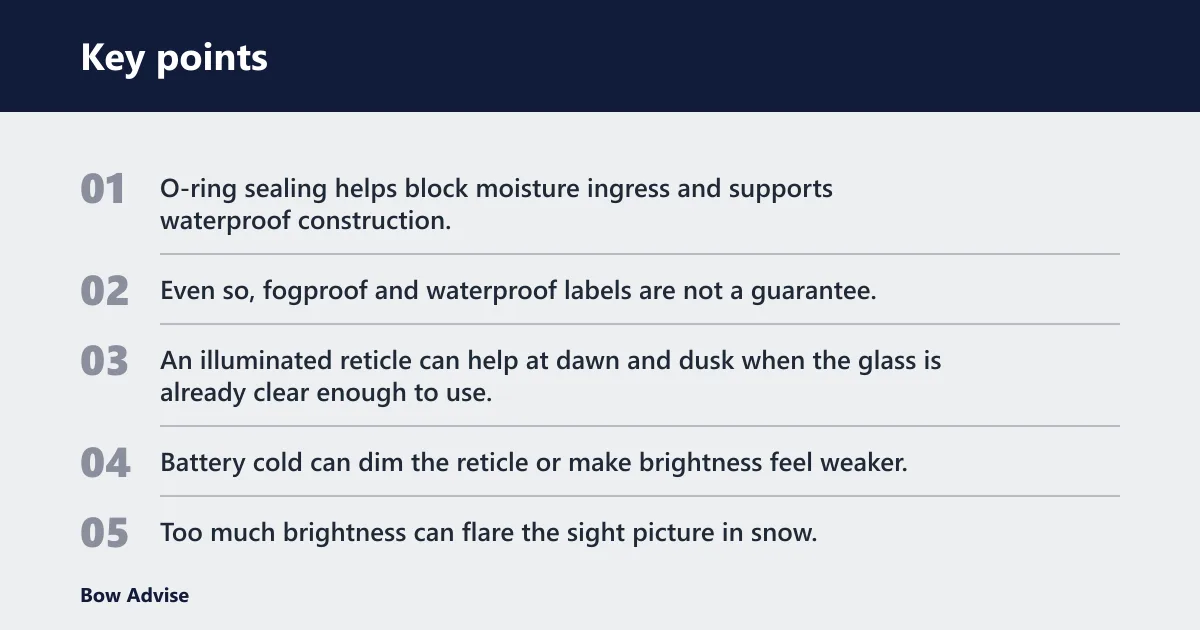
Nitrogen purging is used in some scopes to support fog resistance by reducing internal moisture and limiting water vapor inside the optic. O-ring sealing helps block moisture ingress and supports waterproof construction. Those features matter most when the weather shifts fast or the optic sees snow and freezing rain.
Even so, fogproof and waterproof labels are not a guarantee. If a seal is damaged, or if the scope is exposed to repeated warm-to-cold swings, moisture can still show up on or in the optic.
Illuminated reticles and battery cold
An illuminated reticle can help at dawn and dusk when the glass is already clear enough to use. Red or green options are common. That light does not cure fog or frost, but it can make the aiming point easier to see in dim conditions once the lens itself is clean.
Battery cold can dim the reticle or make brightness feel weaker. Keep a spare battery warm, test illumination before the walk-in, and use only as much brightness as the light level requires. Too much brightness can flare the sight picture in snow.
Objective lens size, eye relief, and speed rings
Objective lens diameter affects brightness and bulk. A 32mm objective lens is commonly used on crossbow scopes and is often described as a useful balance of light and size. A 20mm lens can keep the optic smaller, but the sight picture may feel less forgiving in low light.
Eye relief matters more in winter because heavy jackets and high collars can change head position. A scope that is comfortable with bare layers may feel cramped once cold-weather clothing is on.
Speed ring or fps ring calibration must match the crossbow’s bolt speed after setup or any major change. A variable crossbow scope may include a ring that sets the reticle to the correct fps. If the setting is wrong, holdovers will be off even if the glass is perfectly clear.
The CVLIFE scope is adjustable between 300 to 460 fps, uses a 20-100 yards ballistic reticle, is nitrogen-purged, and is O-ring sealed. The Vortex Crossfire II is a 2-7×32 Crossbow Scope, the Vortex XBR-2 reticle offers holdovers from 20 to 100 yards, the Vortex scope includes red or green illumination, and the package includes 30 mm rings. A Killer Instinct scope is listed at 1.5-5x with a 32mm objective lens.
What should you check before hunting in freezing temperatures?
Check zero, lens condition, battery status, and clothing clearance before the hunt starts. A crossbow scope should be rechecked after mounting and after any major temperature or setup change. Cold can shift handling, sight picture, and in some cases point of impact, so a quick check saves trouble later.
Pre-hunt winter check
-
Confirm the zero.
Check sight-in after mounting and again after a major change in temperature or setup. A scope that was correct indoors may not point the same way once the crossbow and optic settle into winter air. -
Test the reticle.
Turn on illumination, cycle brightness, and look for a steady aim point. Replace a weak battery before leaving the truck, because cold can expose a battery that seemed fine at room temperature. -
Check lens covers.
Open and close the caps once so they move cleanly, then leave them shut until needed. This keeps snow out and avoids last-second fumbling. -
Verify clothing clearance.
Shoulder the crossbow with gloves, coat, and collar in place. Make sure the eye relief still gives a full sight picture without crowding the scope or forcing the head too far back.
Keep hunting, warm it up, or stop?
If the glass is clear after a brief wipe, the reticle is bright, and the zero is known, the scope is ready. If the blur stays inside the tube or returns quickly after wiping, warm and dry it before shooting. If the optic will not clear or the reticle remains unreliable, stop using it until the problem is fixed.
That decision point matters in snow. A little surface frost can be managed. Internal fog or a dead reticle cannot be trusted for a shot.
Frequently asked questions
Can a crossbow scope fog up in freezing weather?
Yes. A crossbow scope can fog when warm moisture meets cold glass, and freezing weather makes that change happen fast. The biggest trigger is temperature shock after leaving a warm truck or blind. Sealed construction helps, but it does not stop every condensation problem.
Will frost form inside or outside a crossbow scope?
Frost is usually an outside-lens problem. If moisture gets past weak seals or a damaged O-ring path, the inside can haze or fog, but exterior frost is more common and easier to wipe off. The location of the haze tells you whether to dry the lens or warm the optic.
Are fogproof and waterproof scopes enough for snow and cold?
They are a strong start, but not a full cure. Fogproof and waterproof construction helps reduce internal moisture problems, especially when paired with nitrogen purging and O-ring sealing. Still, a rapid warm-to-cold move, snow on the lens, or wet handling can create visibility trouble.
Does moving from a warm truck to cold air cause scope fog?
Yes. That move is one of the most common causes of lens condensation. Warm air trapped in or around the optic cools fast, moisture condenses, and the view blurs. The best fix is to let the scope acclimate before opening the caps or taking the shot.
Should I use lens covers or scope caps in winter?
Yes. Lens covers protect the glass from snow, sleet, and brush, and they keep moisture off the lenses during transport. Flip-up or spring-loaded caps are especially useful because they open quickly before the shot. Open them before aiming, not during the shot process.