How Cold Weather Changes Arrow Penetration on Game and Targets
Cold weather can trim arrow penetration a little, but temperature alone rarely drives the result. The bigger causes are stiffer target media, thicker clothing, dull broadheads, or a tune that was already close to the edge. If you blame temperature alone, you can miss the real setup problem and lose penetration on game or waste arrows in frozen targets. This guide separates arrow physics, bow tune, target material, and game tissue so you can find the real cause.
How temperature affects speed and targets


Yes, but usually in small and indirect ways. Cold air can reduce arrow speed a bit, and colder materials can change how a bow, arrow, target, or animal tissue reacts. The biggest difference often shows up as a change in impact feel or group shape, not a dramatic loss of penetration by itself.
What changes are real and what is just target feel
Arrow speed is measured in feet per second, or fps, and that speed affects trajectory, kinetic energy, and how much of the arrow’s motion carries into the target. When speed drops a little, kinetic energy also drops. But on a hunting arrow, the larger penetration change often comes from broadhead design, tune, or target resistance rather than air temperature alone.
A colder target can feel “harder” because foam, layered bags, wet media, or frozen outer layers resist entry more than they do in mild weather. That does not mean the arrow suddenly changed. It usually means the medium did.
Why the same arrow can act differently in game tissue and target media
Game tissue is not foam. Hide, hair, fat, and muscle react differently from layered target material, and that difference matters even more in winter. A deer with a thick winter coat, tight hide, and a steep quartering angle can stop an arrow more effectively than a broadside shot on thin tissue, even if the bow setup is unchanged.
That is why a shot that drives well into a bag target in the yard may not tell the full story about penetration on game. The arrow, the broadhead, and the impact angle all matter.
Arrow speed, energy, and momentum
Arrow speed matters because it helps determine trajectory and kinetic energy, and both shape how an arrow performs downrange. Still, speed is only part of the picture. For hunting arrows, momentum often tracks penetration better than speed alone because heavier arrows keep moving through resistant tissue more consistently.
Why speed matters in fps
Most winter speed loss is modest, but even a small drop can show up more clearly on lighter arrows or marginal bow setups. When speed falls, the arrow’s arc grows a little and impact energy drops. That can matter at longer ranges and on less forgiving targets.
Cold can also change bow performance indirectly. String behavior, nock fit, and brace-related reaction can shift enough to move impact point or flight quality. If broadheads start planing more in cold weather, the issue is often tune, not air temperature.
Why momentum often matters more for hunting arrows
Momentum depends on mass and velocity, so a heavier arrow can keep driving through hide, fat, and muscle even if speed changes a bit. That is why many hunters care about momentum for penetration on game. The goal is not the fastest arrow on paper; it is a setup that carries through real tissue.
Kinetic energy still matters, especially for impact and trajectory, but momentum often gives a better hint about how a hunting arrow will continue after first contact. If a fixed-blade head is getting through but a mechanical is stopping short, the difference may be design and resistance more than raw speed.
How arrow mass changes winter performance
Arrow mass is usually measured in grains. Lighter arrows show small speed changes more clearly because their flight changes faster when velocity drops. Heavier arrows often keep penetration more stable because they retain momentum better, even when winter conditions nudge speed downward.
That does not mean heavier is always better. A very heavy arrow can still fail if tune is off, the broadhead is dull, or the impact angle is poor. Mass helps, but it does not cancel setup errors.
How winter changes bow tune
Winter can shift bow tune enough to change broadhead flight and penetration, especially on setups that were already close to the edge. Draw weight, draw length, brace height, and broadhead-to-field-point tune all matter. Small changes in any one of them can show up as a flight change when the air turns cold and clothing gets bulkier.
Draw weight, draw length, and brace height effects
Cold hands and heavy clothing can change anchor point and release consistency. A jacket sleeve or glove cuff can also interfere with the string or face contact. That can alter actual draw length or let-off timing enough to move impact point.
Brace height and string reaction can also feel different in cold conditions. If the bow seems louder, harsher, or less forgiving, the underlying issue may be setup consistency rather than temperature itself.
Broadhead and field-point tune drift
Broadhead-to-field-point tune is where winter problems often appear first. A setup that groups well with field points can still drift with broadheads if nock point, rest position, or paper tune is marginal. In cold weather, that gap may become easier to see.
Suppose a 430-grain hunting arrow groups about an inch left with field points but around three inches left with fixed blades at 30 yards after a clothing change. The broadhead is not the whole problem. The added bulk may have altered anchor or string path enough to expose a tune issue.
Arrow spine and broadhead flight in cold conditions
Arrow spine can seem more sensitive in winter because a marginal setup leaves less room for error. Dynamic spine changes with string reaction, point weight, and actual launch conditions. If the arrow is already borderline stiff or weak, cold-weather changes can make broadhead flight look worse.
Fixed-blade heads usually reveal this sooner than field points. Mechanical heads can hide some of it in flight, but that does not mean the setup is tuned correctly.
Do broadheads penetrate differently in winter?
Yes, broadheads can behave differently in winter, but the difference usually comes from design, sharpness, and tune sensitivity, not from cold air alone. Fixed blades tend to show tune issues sooner. Mechanical heads often fly easier, but their opening system can add resistance and reduce penetration on tough tissue.
Fixed-blade broadheads
Fixed-blade broadheads put more side force into the arrow and therefore punish poor tune more visibly. In cold weather, that matters because a small setup change can already be present from clothing or grip changes. Once the arrow is entering at a slight angle, penetration drops faster.
Blade profile and cut size matter too. A wide cut needs more energy to pass through tissue. If the head is dull or the arrow is under-tuned, the loss shows up quickly in winter testing.
Mechanical broadheads
Mechanical broadheads often fly like field points, which can help if the bow is tuned well but the shooter expects a broadhead-friendly flight path. Their drawback is that opening blades can use energy on impact, and cold conditions do not remove that cost.
That means a mechanical may group well yet still penetrate less than a comparable fixed-blade head on dense tissue. The difference is most visible on heavy hide, shoulder edge, or quartering shots.
Blade sharpness, cut size, and angle of impact
Broadhead sharpness always matters. A sharp head slips through tissue more cleanly than a dull one. That is true in summer and winter, but cold weather can make everything feel harder and hide a dull edge.
Angle of impact matters just as much. A broadside hit on a deer is far easier to drive through than a steep quartering shot. Species and shot angle often change penetration more than temperature does.
Cold target media penetration
Target penetration can change a lot more in winter than game penetration, because target media is more sensitive to temperature and moisture. Foam, layered bag targets, and wet or frozen media can all resist arrows differently. A colder target can feel much harder even if the arrow, bow, and broadhead are unchanged.
Foam targets and layered bag targets
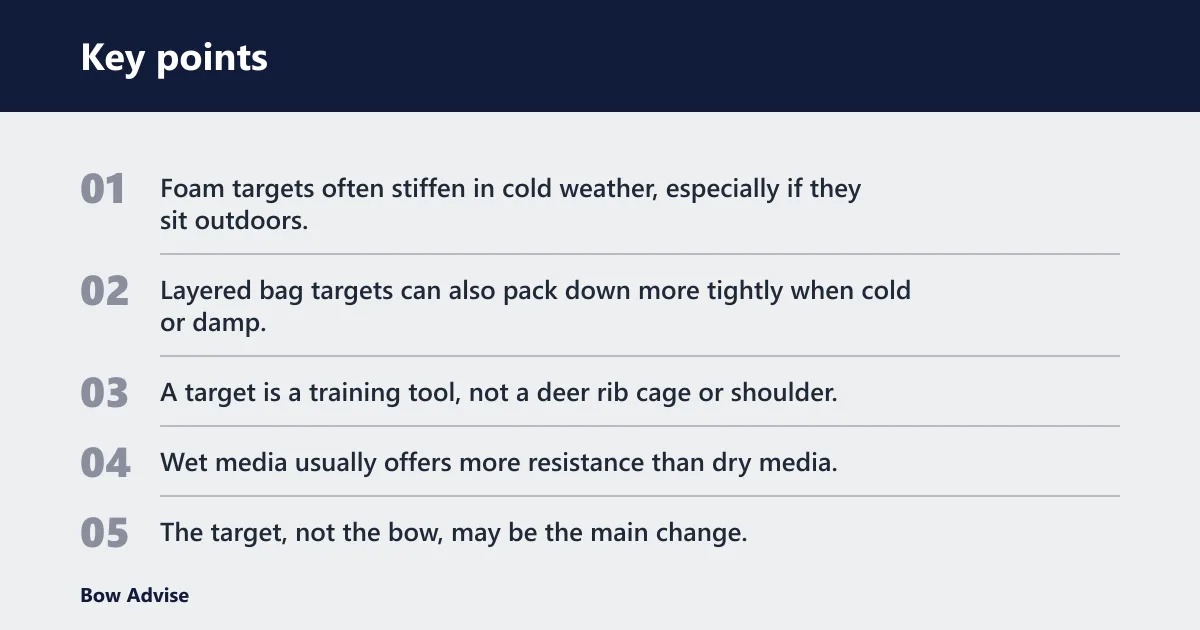
Foam targets often stiffen in cold weather, especially if they sit outdoors. Layered bag targets can also pack down more tightly when cold or damp. That can make arrows stop sooner, bend differently on entry, or pull harder on withdrawal.
This is one reason target depth is a poor stand-in for game penetration. A target is a training tool, not a deer rib cage or shoulder.
Wet versus frozen media
Wet media usually offers more resistance than dry media. Frozen outer layers can be even harder. If the target face has iced over, the first inch can feel dramatically stiffer, and the arrow may lose more visible depth before the rest of the target takes over.
That effect can make winter practice misleading if the same arrow would penetrate better into warm or dry media. The target, not the bow, may be the main change.
Why a colder target can feel harder
Cold makes many target materials less compliant. That does not prove arrow speed fell off by a large amount. It only shows the target changed enough to resist entry more strongly.
| Ambient temperature | Arrow setup | Broadhead type | Observed impact depth | Group shift | Likely cause |
|---|---|---|---|---|---|
| 38°F | 420 grains, field-tuned | Fixed blade | Full pass-through on foam; 10 inches in dry bag target | No shift | Normal target variation |
| 18°F | 420 grains, same setup, heavier jacket | Fixed blade | 8 inches in the same bag target; no pass-through on frozen face | 2 inches left | Clothing interference or tune drift; target medium is stiffer |
| 18°F | 500 grains, same bow, same anchor | Mechanical | Pass-through on deer-sized gel; shallow entry in frozen foam | No shift | Target resistance, not major speed loss |
| 10°F | 400 grains, marginal tune | Fixed blade | Reduced penetration on foam and broadside game practice medium | 4 inches high | Speed loss plus broadhead tune issue |
Use the table as a diagnosis tool, not a rule. If penetration drops only in a frozen target but not in a consistent setup, the medium is the first suspect. If penetration drops on both target and broadhead flight shifts, look at tune, anchor, or clothing first.
How should you test in winter?
Test your setup at the temperature you expect to hunt in, because that is the only way to separate real penetration change from winter noise. A safe winter check should verify zero, broadhead flight, and actual penetration on the medium you plan to face. If groups shift after clothing changes, re-check tune before hunting.
A safe field check before hunting
- Warm up the bow. Shoot a few arrows at the hunting temperature or as close to it as possible. Use the same jacket, gloves, release, and anchor position you plan to wear in the field so the result reflects real use.
- Check field-point groups. Shoot at 20 and 30 yards, then note any left-right or vertical shift. A small shift can come from clothing interference or grip change, while larger shifts often point to tune drift or anchor change.
- Confirm broadhead impact. Shoot the same distance with your hunting broadheads. If fixed blades print away from field points, correct tune before blaming the weather.
- Compare penetration depth. Use the same target type in the same cold conditions, then compare depth and recovery effort. If the target is wet or frozen, note that separately so you do not treat it like game tissue.
- Record the result. Write down temperature, arrow mass, broadhead type, impact depth, and any group shift. That makes it easier to spot whether the change followed temperature, clothing, or target resistance.
When to re-sight or re-tune
Re-sight if the bow groups consistently in a new spot after clothing changes, even if penetration looks normal. Re-tune if broadheads and field points separate, or if fixed blades begin to plane more in cold weather. A sight pin change alone should not hide a tune issue.
A common first-timer mistake is to re-sight after a bad cold-weather group, then carry the same marginal tune into hunting season. That fixes the symptom, not the cause.
What to do if groups shift after clothing changes
If a heavier jacket changes the anchor, shorten or adjust the clothing before moving the sight. If sleeves contact the string, rest, or forearm, solve that first. Then check tune again at the same temperature.
Picture a 70-pound compound that groups tightly in a T-shirt but opens about two inches left in a thick parka. That is not proof that winter air is the problem. It is proof that body position changed.
Frequently asked questions
Does cold weather change arrow penetration?
Yes, but usually a little and often for indirect reasons. Cold can reduce arrow speed slightly and change how targets or tissue react, yet most noticeable penetration changes come from clothing interference, tune drift, broadhead design, or a frozen target medium rather than temperature alone.
Why do arrows hit harder or softer in winter?
They can seem harder or softer because speed, tune, and target resistance all change together. A small fps drop can matter, but a marginal broadhead tune or a stiffer target surface usually creates the bigger shift in how an arrow feels on impact.
Do arrows lose speed in cold temperatures?
Often they lose a little speed, though the amount is usually modest. Cold can affect string behavior, nock fit, and bow reaction, which can shave some fps. The visible effect is clearer on lighter arrows and marginal setups than on well-tuned hunting rigs.
Do carbon arrows and aluminum arrows behave differently in the cold?
In practice, material matters less than mass, spine choice, and tune. Carbon and aluminum both work in cold weather if the setup is correct. The bigger issue is whether the arrow spine matches the bow and whether broadheads fly the same as field points at hunting temperature.
Does cold air affect broadhead penetration on game?
Cold air has a small effect compared with shot angle, hide thickness, and broadhead design. Fixed blades and mechanicals can behave differently, but species, impact angle, and sharpness usually matter more than the air temperature itself when the arrow meets game tissue.
Should I re-sight my bow for cold weather?
Only if your point of impact shifts when you wear hunting clothes or when broadheads and field points no longer match. A sight change can help with a new impact point, but it should follow a check for anchor change, clothing contact, and tune drift.