How Much Do Bow Cases Cost? Prices by Type and Use
Bow cases often fall into a few price bands: roughly $25–$70 for basic soft storage, about $80–$180 for truck-ready soft cases, and around $150–$400+ for hard travel cases. Skimping on protection can bend cams, crack sights, or turn airline handling into expensive damage. This article breaks down case prices by storage, truck transport, and travel, then shows which features are worth paying for.
How much do bow cases cost?
Bow case prices usually fall into three bands: basic soft cases for storage, mid-range soft cases for transport, and hard cases for travel or shipping. Price tracks protection, fit, and durability more than the number on the tag.
Typical price ranges by use case
| Bow case type | Typical use case | Common price range | Protection level | What usually pushes the price up |
|---|---|---|---|---|
| Soft bow case | Home storage, short trips, careful truck transport | $25–$70 | Basic to moderate | Thicker padding, better stitching, more pockets, stronger zipper |
| Truck-ready soft case | Range trips, woods transport, daily carry in a vehicle | $80–$180 | Moderate | Heavier padding, backpack straps, reinforced handles, weather-resistant fabric |
| Hard bow case | Travel, airline check-in, shipping, maximum impact protection | $150–$400+ | High | Rigid shell, foam cutouts, lock points, wheels, latches, airline-friendly build |
What those prices usually buy
A lower-priced soft bow case usually gives you basic padding, a simple zipper, and enough protection for dust, scratches, and gentle handling. Mid-range cases often add thicker foam, better closures, and pockets for rests, quivers, or arrows. Hard cases cost more because the shell and hardware do the heavy lifting.
For a beginner, the best buy is often the lowest-cost case that matches the actual risk. A case for closet storage does not need airline-grade hardware. A case for baggage handling does.
Soft case vs hard case: what changes the price?
Soft bow cases cost less because they use fabric, foam, and zippers instead of a rigid shell and latches. Hard bow cases cost more because they resist crushing, impact, and rough handling much better. The price gap is really a protection gap.
Soft bow cases for storage and short transport
A soft bow case is the lower-cost option. It is lighter, easier to carry, and usually has basic padding that keeps dust, scratches, and minor bumps off the bow. It fits home storage and short trips where the case stays in a vehicle and is not stacked under heavy gear.
Soft cases are common for recurve bows and compact compound bows. They can also work for longer compound bows, but only if the internal length and pocket layout match the setup. If the bow stays assembled with a sight, rest, or quiver attached, the case must have enough room for those parts or the parts must be removed.
Hard bow cases for impact protection and travel
A hard bow case uses a rigid exterior, often with dense foam inside. That construction raises the price, but it also makes the case better for airline travel, shipping, and any situation where other bags may press against the bow. A hard case is the safer choice when the bow may be dropped, stacked, or tossed during transit.
Travel cases are usually hard-sided and often cost more than standard storage cases because they add stronger shells, secure latches, and lock points. Some include wheels or pressure relief features. Those additions matter when the bow is checked with luggage or shipped separately.
What features make a bow case more expensive?
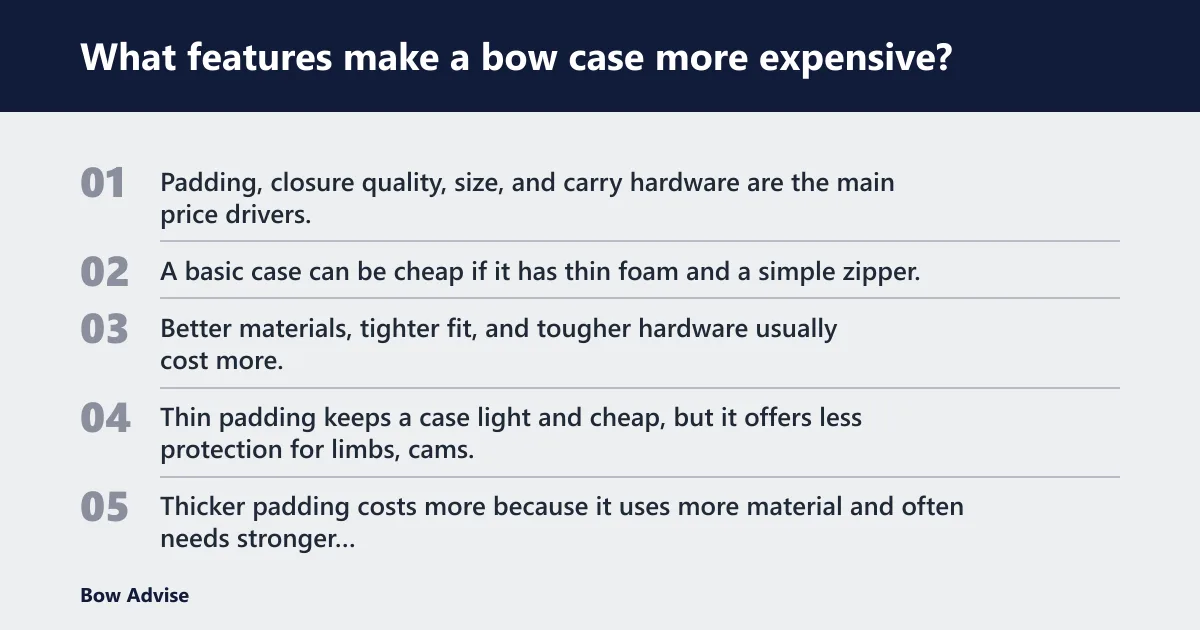
Padding, closure quality, size, and carry hardware are the main price drivers. A basic case can be cheap if it has thin foam and a simple zipper, but those same parts are often the first to fail. Better materials, tighter fit, and tougher hardware usually cost more.
Padding thickness and interior layout
Padding affects both price and protection. Thin padding keeps a case light and cheap, but it offers less protection for limbs, cams, sights, and arrow rests. Thicker padding costs more because it uses more material and often needs stronger stitching to hold its shape.
Interior layout matters too. Separate sleeves, tie-down straps, and molded foam inserts add cost, but they also keep parts from shifting. That matters most for compound bows, where cams and accessories can take damage if the bow moves inside the case.
Zippers, closures, and weather resistance
Zippers and closure systems are a common failure point in low-cost cases. A cheap zipper can split under load or snag on padding. Better cases may use heavier zippers, dual pulls, storm flaps, or lockable closure points. Weather-resistant fabric or sealed seams also raise the price.
For a bow that rides in a truck bed, sees wet grass, or gets carried through light rain, those closure details matter. A case that lets moisture into the interior can cause rust on metal parts and swelling in some foam or fabric layers.
Extra pockets, straps, wheels, and lock points
Accessory pockets are useful, but they add cost. So do backpack straps, padded handles, MOLLE-style webbing, wheels, and reinforced corners. On hard cases, latches and lock points also push the price up, especially if the case is designed for airline travel.
These features are not cosmetic. They change how the case is used. A pocket for an Allen wrench or release aid is useful. A wheel set matters if the case is heavy. Lock points matter if the case leaves your hands at an airport counter.
Suppose a compound bow with a 34-inch axle-to-axle length is being carried with a sight and quiver attached. A bargain soft case that is only long enough for the bare bow may force the owner to remove parts every time, or worse, squeeze the rig into a tight fit. That usually costs more in lost convenience and possible damage than a better-sized case would have cost upfront.
What size bow case do I need?
Bow case size should match the bow’s internal length and width, not just the category listed on the package. Compound bows and recurve bows have different fit needs, and accessories can change the required space. A case that is too short or too narrow can press on cams, limbs, or string accessories.
How to match internal dimensions to bow length and width
Most manufacturers list internal dimensions. Those numbers matter more than outside size. Measure the bow at its longest point, then compare that length to the case interior with a little room left for foam, straps, or protective spacing. Width matters too, especially when limb pockets or sight guards are involved.
Stabilizers, quivers, and some sights may need extra room. If the case is built for a bare bow only, expect to remove accessories before storage or transport. That is common with many compact soft cases and many travel cases with molded interiors.
Why compound bows and recurve bows need different fit checks
Compound bows are often longer axle-to-axle and have cam systems that need clearance. Cam protection matters because hard contact can damage the wheels or cables. Many compound owners store the bow with accessories removed or secured so the case can close without pressure on the rig.
Recurve bows are often shorter and may fit slimmer cases, but limb protection is a key concern. A recurve case may not need the same width as a compound case, yet it still needs enough room so limbs do not rub hard against the shell or zipper line.
Allow room for stabilizers, sights, and quivers
Case size decisions should account for the full setup. A bow that fits naked on a bench may not fit with a quiver attached. If the case has external pockets only, the main compartment still needs enough clearance for the bow itself.
- Measure the bow at its longest point.
- Check the case’s internal length, not the outside size.
- Confirm width at the widest part, including cams or limbs.
- Account for sights, stabilizers, and quivers.
- Choose extra room only when the bow needs it; do not buy oversized protection for a compact setup.
Which bow case is right for your use case?
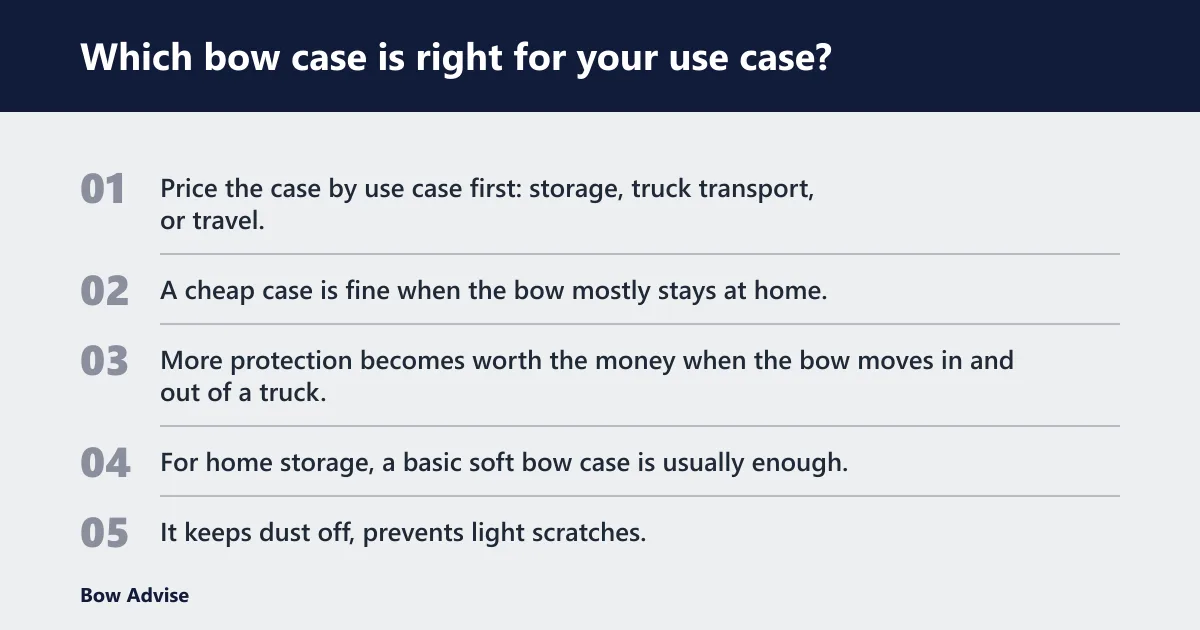
Price the case by use case first: storage, truck transport, or travel. A cheap case is fine when the bow mostly stays at home. More protection becomes worth the money when the bow moves in and out of a truck, rides with heavy gear, or leaves home on a plane.
Storage at home
For home storage, a basic soft bow case is usually enough. It keeps dust off, prevents light scratches, and gives a clean place to store the bow and small parts. This is where low cost makes sense, because the main risk is handling damage, not impact or crushing.
A common first-timer mistake is buying a hard travel case for a bow that never leaves the house or the local range. That extra cost often sits unused while the bow still needs a separate place for arrows, a release, and tools.
Truck transport to the range or woods
For truck transport, a mid-range soft case is often the best value. It should have decent padding, a dependable zipper, and enough length for the bow and its attachments. If the case rides behind the seat or in a covered bed, the goal is protecting against bumps, gear contact, and weather changes.
For hunters, this is usually the price band that makes sense. It protects better than a bare-bones sleeve without jumping to travel-case pricing that may never be used in the field.
Airline or shipping travel
For airline travel or shipping, a hard bow case is often worth the extra cost. The bow may be dropped, stacked, or exposed to rough handling that soft padding cannot stop. A hard shell with secure latches and good interior fit is the better risk match.
Can a soft bow case work for travel? Only in very limited situations, and it should not be the default choice for checked baggage. Soft cases may be acceptable for careful vehicle travel or protected carry, but airline check-in is a different level of risk.
Use this buyer matrix before you spend money
This matrix ties price to use case, protection, and the features that actually move the cost. It helps separate what is worth paying for from what is only nice to have. The goal is to avoid overbuying a travel case for storage, or underbuying a soft case for a rough trip.
| Case type | Use case | Protection level | Features that push the price up | When a budget case is enough |
|---|---|---|---|---|
| Basic soft bow case | Home storage, short careful trips | Low to moderate | Padding thickness, better zipper, extra pocket | Bow stays in a closet, safe room, or low-risk vehicle trip |
| Truck-ready soft case | Range days, woods transport, regular vehicle use | Moderate | Heavier padding, reinforced handles, weather resistance, straps | Bow rides in a controlled vehicle space with no airline risk |
| Hard travel bow case | Airline travel, shipping, high-impact handling | High | Rigid shell, lockable latches, wheels, foam insert, reinforced corners | Rarely a budget choice if the bow will be checked or shipped |
The main rule is simple: buy for the worst handling the bow is likely to face. If that means a quiet storage shelf, a soft case is enough. If that means a baggage carousel, a hard case is the safer buy.
Frequently asked questions
how much does a bow case cost
Most bow cases run from about $25 to $70 for basic soft storage, $80 to $180 for better soft transport cases, and $150 to $400+ for hard travel cases. The price moves with padding, shell strength, closure quality, and added features such as wheels, locks, and weather resistance.
how much do bows cost
Bow prices vary far more than case prices. Entry-level bows can start under a few hundred dollars, while higher-end hunting or target setups can run much higher once sights, rests, and releases are added. That is why it makes sense to match the case to the actual bow value and travel risk.
how much do good bow cost
A good bow can mean different things for beginners, hunters, and target archers. In general, the bow itself often costs more than the case by a wide margin, especially once accessories are included. The case should protect that investment, but it does not need to cost as much as the bow.
What is the difference between a soft bow case and a hard bow case?
A soft bow case is lighter, cheaper, and better for storage or short transport. A hard bow case uses a rigid shell and usually more secure closures, so it protects better against crushing and impact. That makes hard cases better for airline travel, shipping, and rough handling.
How much should I spend on a bow case for hunting?
For hunting, many archers seem to do well with a mid-range soft case, often in roughly the $80 to $180 range. That range usually gives better padding, stronger zippers, and enough space for common accessories without paying for travel-grade features that may never be used in the field.
Do bow cases fit compound bows and recurves?
Many do, but fit is not universal. Compound bows often need more internal length and cam clearance, while recurve bows often need slimmer storage with good limb protection. Always check the case’s internal dimensions and confirm room for sights, stabilizers, or quivers before buying.
Is a hard bow case worth the extra money?
Yes, when the bow may be checked on a flight, shipped, or exposed to rough handling. A hard bow case costs more because it protects more. If the bow only rides in a truck or stays at home, a soft case may be the better value.
Can I travel with a soft bow case?
Sometimes, but it is usually a poor choice for airline travel. A soft case can work for careful vehicle travel or low-risk carry, but it does not stop crushing forces the way a hard shell does. For checked baggage, a hard case is the safer standard.
What size bow case do I need?
Choose by internal dimensions, not the outside label. The case should match the bow’s length and width with room for accessories if they stay attached. Compound bows often need more clearance than recurves, especially if cams, sights, stabilizers, or quivers stay on the bow.