How to Fix a Peep Sight That Sits Too High or Too Low
At full draw, a peep that sits too high or too low is usually adjusted by changing string length, adding or removing twists, or moving the peep after the bow’s axle-to-axle and brace height are confirmed. Ignore it, and you will start tilting your head, blur the peep, and miss center. This guide shows how to diagnose the cause first, then fix the height problem in the least disruptive order.
Peep diagnosis table


| Symptom at full draw | Likely cause | First adjustment to make | What to re-check afterward |
|---|---|---|---|
| Peep sits too high; you duck your head | Anchor is higher than repeatable, draw length is short, or the peep was set before the D-loop | Confirm anchor, then verify draw length and D-loop before moving the peep | Sight housing centering, head posture, and where the peep lands at full draw |
| Peep sits too low; you raise your chin | Anchor is lower than repeatable, draw length is long, or the peep moved after string creep | Check anchor first, then inspect for draw-length or string changes | Sight housing alignment, chin position, and whether the peep returns to the same spot |
| Peep looks off-center on different draws | Inconsistent anchor, face pressure, glasses, or a release aid change | Repeat the anchor with eyes closed, then open at full draw | Whether the sight housing centers the same way on every draw cycle |
| Peep changed after a draw-length change | Draw length was altered, which shifts anchor and peep position | Reset draw length before touching the peep again | Full-draw posture and peep-to-sight alignment |
| Peep changed after adding a D-loop | The D-loop changed effective draw length | Recheck full-draw anchor before moving the peep | Where the peep sits with the new loop length |
| Peep drifts after setup | String creep or rotation settled after the string set was installed | Correct rotation with twists, then re-serve the peep if its location changes | Rotation at full draw, tune, and sight-in |
What you’ll need
- Bow press
- Serving thread
- Serving tool
- Hex wrench set
- Marker or tape for reference marks
- Sight housing for alignment checks
- The correct peep aperture for the light you shoot in
Why is my peep sight too high or too low?
The height problem usually starts with the archer, not the part. The peep sight is a rear aperture in the string, and its correct spot is judged at full draw. If the anchor changes, the sight picture changes with it.
A peep that sits too high makes you duck your head. A peep that sits too low can make you raise your chin. Those compensations hide the real cause, so the first check is always the same: draw the bow, settle the anchor naturally, then open your eyes and see whether the sight housing centers cleanly in the peep.
Separate anchor error from peep error
Use the same facial reference every time. A firm jawline point, corner-of-mouth contact, or nose-to-string reference only helps if it repeats. If the peep is off on one draw and right on the next, the setup is less likely to be wrong than the anchor.
Glasses can change head angle. A release aid change can do the same if the hand position shifts. Left/right facial asymmetry can also make one side feel “natural” while the other side drifts. In those cases, the fix is often a repeatable anchor, not a moved peep.
Say your peep sits a touch high only when you anchor with a new wrist-strap release. If the same bow and D-loop were fine before, the release changed the anchor height. Move the hand reference back before moving string hardware.
How do I fix a peep sight that sits too high?
Start by confirming that the draw length is correct and the D-loop is already installed. If the peep sits too high at full draw, the fastest wrong move is to slide it immediately. Fix the anchor and length chain first, then move the peep lower only if the problem follows the bow setup.
Use the least disruptive order
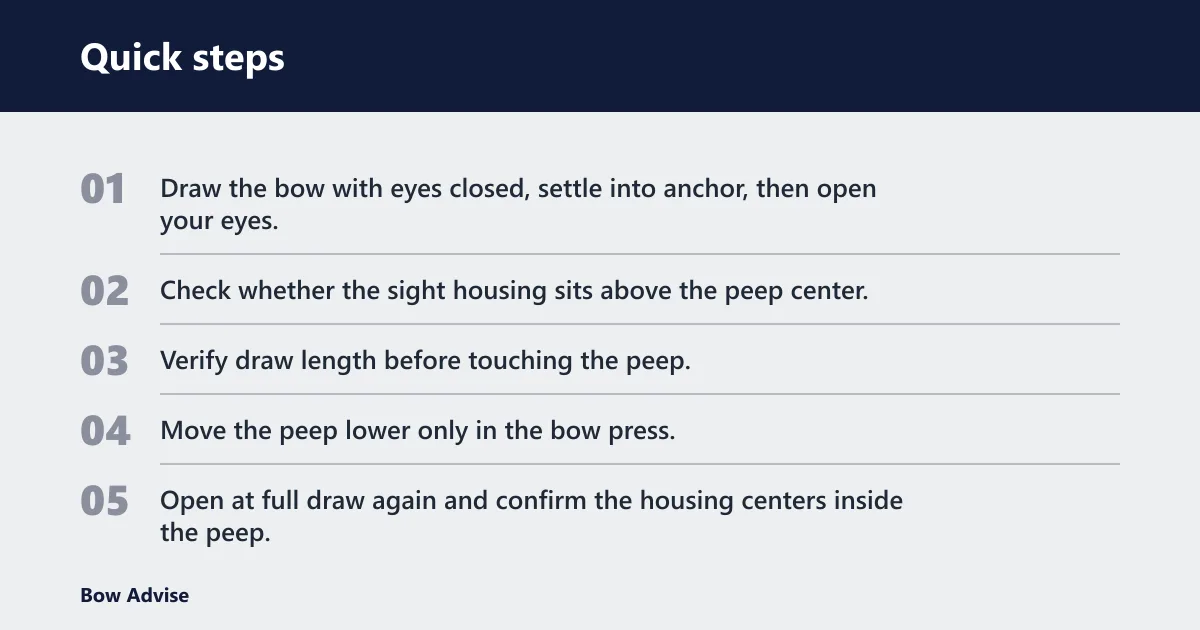
- Draw the bow with eyes closed, settle into anchor, then open your eyes.
- Check whether the sight housing sits above the peep center, which means the peep is effectively too high for that anchor.
- Verify draw length before touching the peep; a short draw can pull the anchor higher and make the peep look high.
- Move the peep lower only in the bow press, then re-serve it above and below so it cannot move.
- Open at full draw again and confirm the housing centers inside the peep.
If the peep still sits high after those checks, inspect string rotation. Twists can change where the peep squares up at full draw, but they should be used to correct orientation and restore tune, not as the first height fix.
If that didn’t work, check the loop length
A longer D-loop can change effective draw length and shift where the peep lands. Keep the loop installed before the final peep check, then compare the full-draw view with the old loop. If the peep moved after the loop change, adjust the peep after the loop length is finalized.
How do I fix a peep sight that sits too low?
Confirm anchor consistency before moving hardware. A peep that sits too low can come from a lower head position, a draw length that is too long, or a D-loop that changed the draw. Move the peep higher only if the same full-draw symptom follows the bow setup and not the archer.
Raise the peep only after diagnosis
- Draw to anchor with eyes closed, then open at full draw and note where the sight housing sits in the peep.
- Repeat the draw three times; if the peep varies, fix anchor consistency before changing hardware.
- Check whether the D-loop length or string twist changed since the last good setup.
- Move the peep higher only in a bow press, then lock it in place with serving above and below the peep.
- Recheck the view at full draw and sight the bow in again.
A common first-timer mistake is to chase the low peep by moving it upward twice in a row without checking the draw length. That can turn a small setup issue into a bigger one, because each change affects the next reference point.
If string creep is the reason, do not keep raising the peep blindly. Correct the rotation first, then verify whether the peep still sits low. New strings can settle, and that settlement can move the peep position even when the serving is still tight.
Do I need a bow press to move a peep sight?
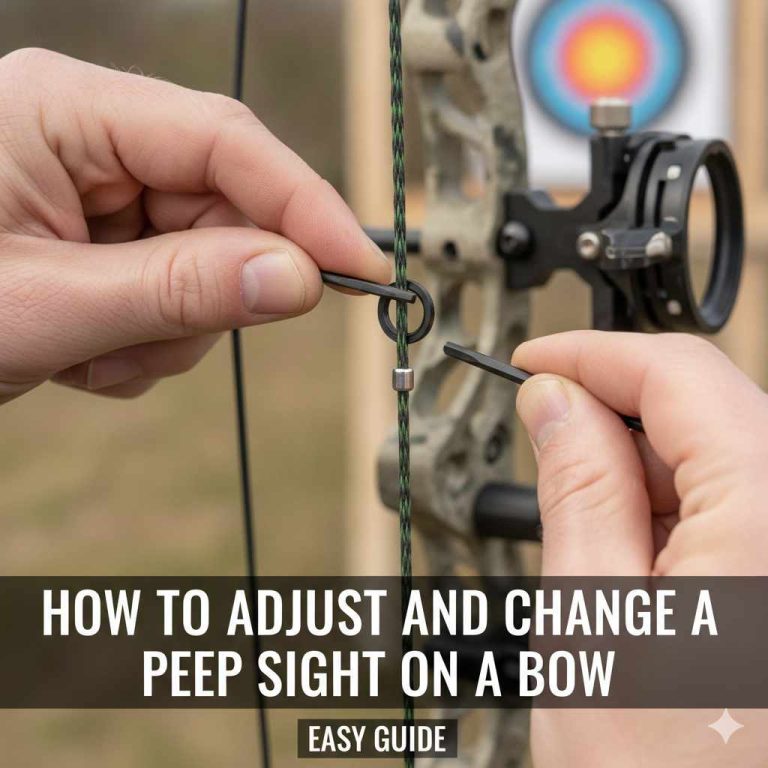
Yes. A bow press is the safety-critical tool for relieving string tension before splitting the string strands and repositioning the peep. The peep sits between the string strands, so moving it without a press risks damage to the string and the part.
Move it the safe way
- Place the bow in a press and relieve string tension according to the manufacturer’s listing for your model.
- Open the string strands enough to free the peep.
- Reposition the peep to the new spot.
- Serve the peep above and below it so it cannot move.
- Release the press, then verify the alignment at full draw.
The serving on each side is what locks the peep in place. The common guidance is at least 0.5 inches of serving on each side of the peep. That keeps the peep from walking under use.
Can draw length change make my peep sit wrong?
Yes. Draw length must be set correctly before final peep height, because a wrong draw length shifts anchor position and changes where the peep lands at full draw. Even a small adjustment can move the sight picture enough to matter.
That is why peep height should be verified after the draw length and D-loop are final. A D-loop can also change effective draw length, so it belongs in the setup before the last peep check. If the loop changes, the peep position may need to change with it.
Check the chain in order
- Set draw length to the correct starting point for the bow.
- Install the D-loop before the final peep check.
- Draw to anchor and inspect whether the sight housing centers in the peep.
- Only then move the peep if the view is still off.
Say the bow is a 33-inch ATA hunting setup and the peep has been roughly 5.5 to 6.0 inches above the nocking point in a working arrangement. If a longer D-loop is added, the same anchor can land lower on the string path, so the old peep spot may no longer center the sight housing.
Should I adjust the peep or the D-loop first?
Adjust the D-loop first if it is not final, then judge the peep. The loop changes effective draw length, so a peep set before the loop is finished can end up in the wrong place. Once the loop is final, use peep movement only for the remaining correction.
The reason is simple: the D-loop changes where the hand stops and where the anchor lands. That changes the peep’s position at full draw even if the string itself did not change. After the loop is set, the peep can be moved and served to stay fixed.
What to check after the loop change
- Full-draw anchor consistency
- Sight housing centering inside the peep
- Peep rotation at full draw
- Any change in head tilt or chin height
How do I know if my peep height is correct at full draw?
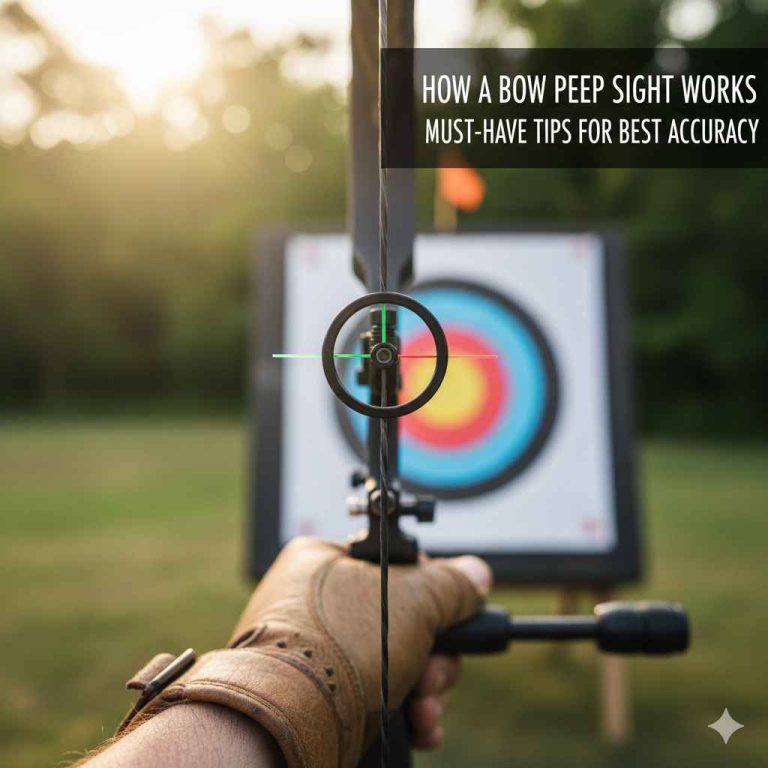
The peep height is correct when the sight housing centers cleanly inside the peep at full draw without forcing the head up or down. The eyes-closed method is the cleanest check: draw, anchor, open the eyes, and see whether the housing lands naturally in the center.
Use the sight housing as the reference
The housing is the alignment reference. If the peep is right, the housing appears centered without a chin lift or head duck. A larger aperture can help when first light is the problem, while a smaller aperture gives a tighter view in bright conditions.
For aperture choice, common setup ranges include about 3/32 in for indoor target or bright conditions, 1/8 in for general daylight and 3D, 3/16 in for all-round hunting, and 1/4 in for low-light hunting. A bigger peep can make the sight easier to see at dawn or dusk.
Common mistakes
- Moving the peep before confirming draw length. Check the draw first, because a wrong length changes anchor height and peep location.
- Using string twists as a height shortcut. Twists are mainly for rotation and tune, not the first height correction.
- Skipping the bow press. That risks string damage and poor peep installation.
- Failing to serve the peep after the move. The peep should be locked above and below so it cannot move.
- Not rechecking zero and alignment afterward. Any peep move means the bow needs a fresh sight-in.
After the peep is moved, recheck the bow at distance and confirm the sight housing still centers at full draw. If twist changes were made, the bow should also be checked for clean tune, since string rotation can affect timing and alignment.
Prevention is simple: keep the anchor repeatable, finalize the D-loop before the last peep check, and mark the string before changing anything. That makes later diagnosis much faster.
Frequently asked questions
How much should a peep move before I re-sight my bow?
Any move that changes the full-draw sight picture deserves a fresh sight-in. A quarter inch genuinely matters on a peep, so even a small shift can change point of impact. Recheck alignment and zero any time the peep position is altered.