How to Replace a Cracked Peep Sight on a Bowstring
Replace a cracked peep sight by removing the old peep from the serving, installing the correct peep size, and tying it back at the same nock height; then tune until it centers at full draw. Ignore the crack, or install it wrong, and you can get peep rotation, serving wear, poor alignment, and another split peep. This guide covers replacement steps, twist checks, serving setup, and the fixes for repeat cracking.
What a cracked peep means
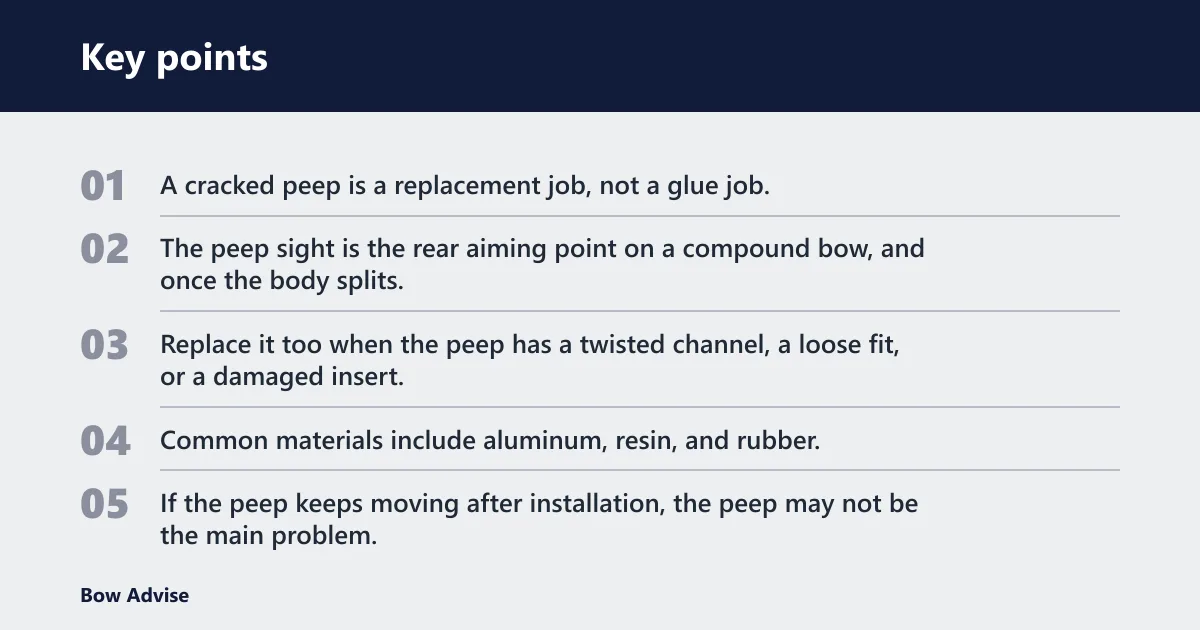


A cracked peep is a replacement job, not a glue job. The peep sight is the rear aiming point on a compound bow, and once the body splits, deforms, or opens under tension, it can throw off alignment or fail again under draw force.
Replace it too when the peep has a twisted channel, a loose fit, or a damaged insert. Common materials include aluminum, resin, and rubber, and all of them can crack if the channel size does not match the string well or the bow keeps rotating the peep out of line.
When the problem is actually the string
If the peep keeps moving after installation, the peep may not be the main problem. Worn bowstring serving, uneven string twist, poor timing, or a draw-length change can shift where the peep wants to sit at full draw. In that case, the repair has to include the string condition, not only the peep body.
What you’ll need
- Bow press for safely opening string tension on most compound bows
- Replacement peep sight in the correct tube or tubeless style
- Serving thread for tying the peep into position
- Serving tool to apply tight, even wraps
- Bow square for checking setup context and nocking-point alignment
- Sharp cutter or scissors for clean serving removal
- Marker or tape for marking the original peep height before removal
Pick the right replacement first
Choose a peep that matches string diameter, sight housing size, anchor style, and low-light needs. A larger aperture lets in more light, which can help in low-light setups and with larger sight housings. Smaller apertures are better when you want a tighter aiming reference and a smaller sight picture. If the channel is too large for the string, the peep can wander or pinch the serving poorly.
Can I replace it without a bow press?
Most compound bows need a bow press for peep replacement because the string tension has to come off before the old peep is removed and the new one is tied in. Without a press, the string can spring, the twist can change, and the repair can become unsafe or inaccurate. A press is usually part of the job.
When a simple adjustment is not enough
A peep that is only slightly off at rest may still be fine if the string and timing are correct. But a cracked body, split channel, or frayed serving around the peep needs a full replacement and inspection. If the bow is out of tune, a simple twist correction at the peep rarely solves the root cause.
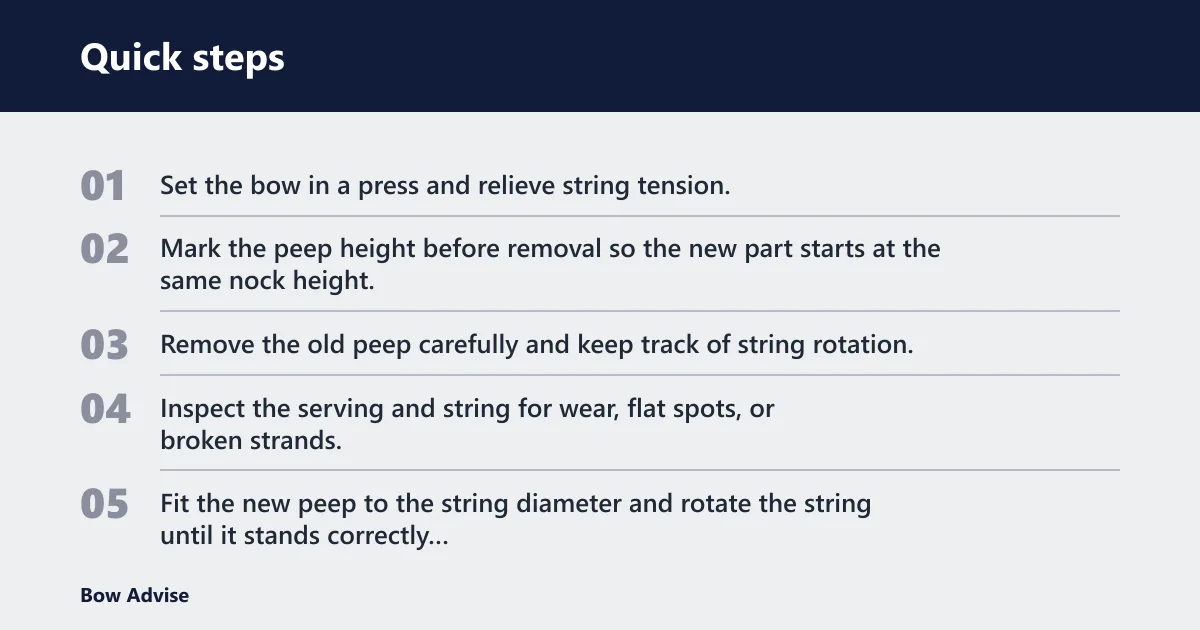
- Set the bow in a press and relieve string tension.
- Mark the peep height before removal so the new part starts at the same nock height.
- Remove the old peep carefully and keep track of string rotation.
- Inspect the serving and string for wear, flat spots, or broken strands.
- Fit the new peep to the string diameter and rotate the string until it stands correctly at full draw.
- Serve the peep in with tight, even wraps that hold it without pinching the string.
- Check alignment at full draw and add only the rotation needed, then recheck after each change.
- Before regular use, shoot a few arrows and confirm the peep stays centered.
Remove the old peep cleanly
Open the bow in the press, then cut or unwind the serving only as much as needed to free the peep. Do not slice deep into the string bundles. If the serving is frayed or flattened around the old peep, that damage matters as much as the cracked body because it can let the new peep move later.
Look for twist patterns and channel damage
Check whether the old peep sat crooked because the string had uneven twist or because the peep channel was oversized. A peep that is too large for the string can rock side to side. A damaged channel can catch the serving and create repeat rotation.
A 1/4-inch peep may crack after a draw-length change and can sit about 10 degrees off at full draw. That points to setup drift, not only a bad part. The fix is to reset peep position after the draw-length change and verify the string twists before locking anything in.
Set the new peep at full draw
Rotate the string so the new peep faces the sight housing at full draw before you tie it in. That is where alignment matters, not just at rest. Match the peep size to the housing opening and your anchor style so your eye lands naturally behind the aperture without forcing your head position.
Use the right size for the job
For low-light hunting, a larger aperture can help admit more light. For target shooting, a larger aperture often gives a wider field of view, while a smaller one can give a tighter sight picture. If the sight housing looks crowded or the peep blocks too much of the target, the size is wrong for that setup.
Suppose a hunter replaces a cracked small peep with a much larger one because it is available. The bow may still shoot, but the larger opening can make dawn and dusk aiming less precise and change anchor feel. The better fix is the correct size, not the nearest spare.
Lock the peep in place
Use serving thread to tie the peep in so it cannot slide or rotate. The serving should be tight enough to hold, but not so tight that it pinches the string bundles or distorts the peep channel. A serving tool makes the wraps cleaner and more repeatable than hand wrapping alone.
Serve the peep evenly
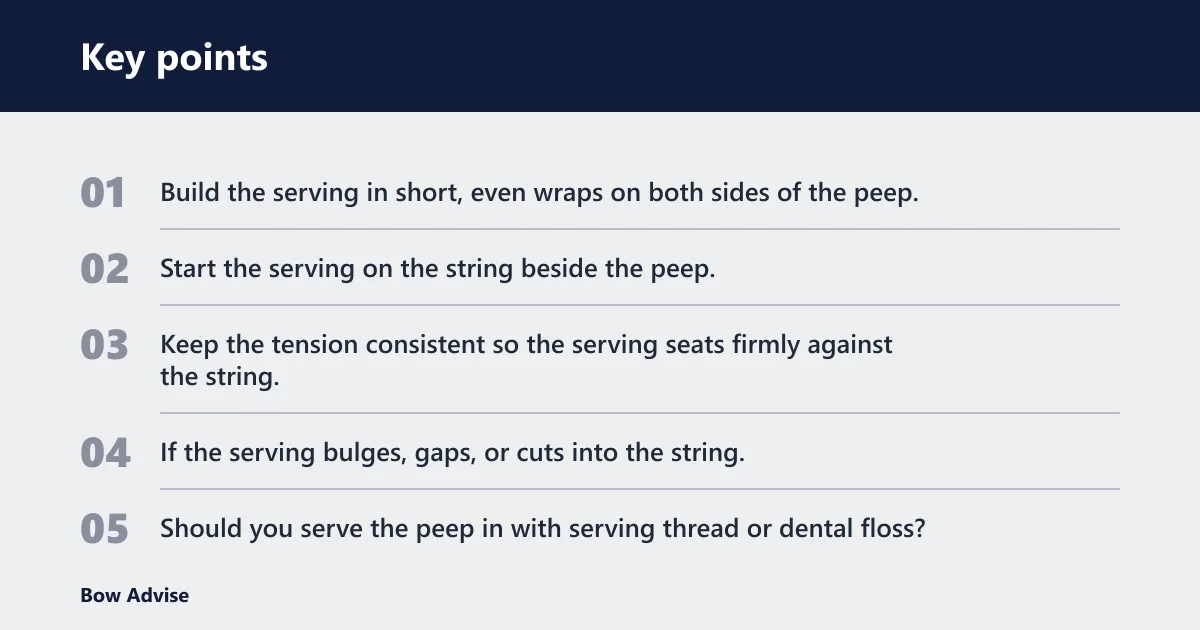
Build the serving in short, even wraps on both sides of the peep. Start the serving on the string beside the peep, wrap tightly around the string and across the peep area, then finish by locking the tag end under the final wraps before trimming it flush. Keep the tension consistent so the serving seats firmly against the string. If the serving bulges, gaps, or cuts into the string, back up and redo that section before shooting.
Should you serve the peep in with serving thread or dental floss? Use serving thread made for bowstrings. Dental floss is not a normal substitute because it does not hold the same way and can leave a repair that slips under repeated draw cycles.
How do you keep a new peep from twisting?
Keep a new peep from twisting by checking string twist, draw length, and bow timing after installation. If the string wants to rotate the peep out of line, the problem may be in the cable timing or the bow’s current draw-length setting. A good peep can still drift if the setup is off.
Check the setup before adding more twist
Use a bow square to confirm the nocking-point context and compare it with the marked peep height. If the draw length changed, the peep position may need a reset. Add twist in small increments, then return to full draw and recheck before adding more. A single extra half-turn can change alignment enough to matter.
If that didn’t work, try this next
- Check whether the string is old, dry, or stretched and replace it if wear is obvious.
- Inspect cable timing on the compound bow and correct timing before chasing peep rotation.
- Recheck draw length and return the peep to the proper height.
- Replace oversized or damaged peep hardware that cannot sit centered in the string.
Peep replacement checklist
| Symptom | Likely cause | Fix | Pass or fail safety check |
|---|---|---|---|
| Cracked peep body | Material fatigue, impact damage, or channel stress | Replace the peep; do not glue the split | Pass only if the new peep is intact and seated cleanly |
| Frayed serving | Old serving worn by repeated peep movement | Strip the damaged section and re-serve with proper thread | Fail if strands show through or the wrap feels loose |
| Repeated twist | String twist, timing issue, or draw-length change | Reset string rotation, verify timing, then recheck at full draw | Pass only when the peep returns to center on repeat draws |
| Off-center full-draw alignment | Mismatched peep size or incorrect anchor position | Change peep size or reset the height and rotate the string | Fail if the sight housing is only centered with head tilt |
| String wear | Serving wear, exposed strands, or pinched bundles | Repair the serving and replace the string if damage is severe | Pass only if the string surface is smooth and stable |
Common mistakes
The biggest mistake is treating a cracked peep as a minor repair. It is a replacement part. Another common error is ignoring worn serving, because a fresh peep can still move if the serving lets it walk after a few draws.
Another mistake is tuning only for rest position. Full-draw alignment is the standard that matters. If the peep centers only when the shooter changes head position, the size, height, or bow timing is still wrong.
Another issue is using the wrong style. Tube and tubeless peeps use different setups, so the replacement should match the string and sight setup. The replacement peep must match the string diameter and sight housing size, or the repair will not stay consistent.
Final safety check before shooting
Before any test shots, verify that the peep cannot slide, the serving is tight, and the string shows no fresh abrasion. Draw the bow several times and confirm the peep centers the same way each time. Then shoot about three to five arrows at a safe target and recheck the serving after the first group.
Prevent the next failure by inspecting serving and string wear whenever the peep is serviced, and revisit the setup after any draw-length or timing change. That keeps the next peep from following the same failure path.
Frequently asked questions
Can I replace a cracked peep sight without a bow press?
Most compound bows should not be serviced that way. A press removes tension so the old peep can come out and the new one can be set safely. Without it, the string can move unpredictably and the repair can be unsafe. A press is the normal tool for this job.
What tools do I need to replace a peep sight on a bowstring?
Use a bow press, replacement peep, serving thread, serving tool, and a cutter for the old wrap. A bow square helps confirm setup context before you lock the peep. For a clean repair, the serving thread must be the correct type and pulled tight enough to hold without squeezing the string.
How do I know if my peep sight should be replaced instead of repaired?
If the body is cracked, split, deformed, or the channel is damaged, replace it. If the serving is frayed or the peep keeps rotating, inspect the string and timing too. Glue is not a proper fix for a cracked peep body because it can fail under draw tension.
What size peep sight should I choose when replacing a cracked one?
Choose a size that matches string diameter, sight housing size, anchor style, and light conditions. Hunters often prefer a smaller low-light aperture, while target shooters often use a larger opening for visibility. If the peep does not sit centered at full draw, size and setup both need review.