
Lighted Nocks vs Standard Nocks: Which to Use for Bow
I buy lighted nocks only when I expect low-light shots, long-range hits, or hard arrow recovery. If I want the simplest, most consistent setup, I stay with standard nocks. Wrong nock choice can shift fit, add failure points, or make a tuned bow act strange. I’ll compare brightness, battery life, tuning, fit, and hunting use so you can pick the right setup for your arrows and bow.
This guide is part of our Bow hunting laws and regulations series.
Lighted nocks vs standard nocks: the real trade-off
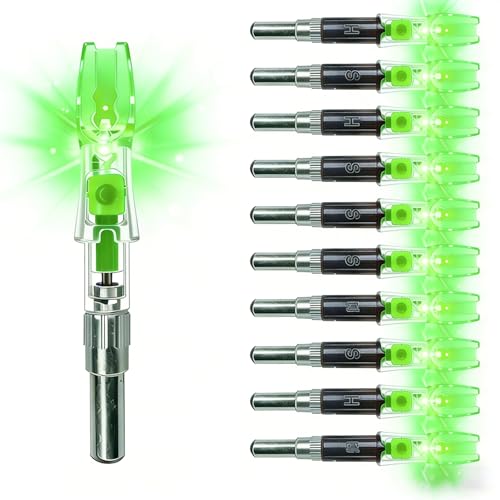

The trade-off is plain. Lighted nocks help me see arrow impact and recover arrows. Standard nocks are simpler, lighter, and easier to keep consistent. I treat that as a field-use decision first, not a gear-flex decision.
For bowhunters, the right answer changes with distance, light, and how picky your bow is about setup changes. My own rule is blunt: if the nock has to earn its spot by helping me read a hit or find an arrow, I consider lighted. If not, I keep the standard nock and skip extra variables.
According to outdoorlife.com — The Halo nock weighs 14.6 grains.
Lighted nocks vs standard nocks at a glance
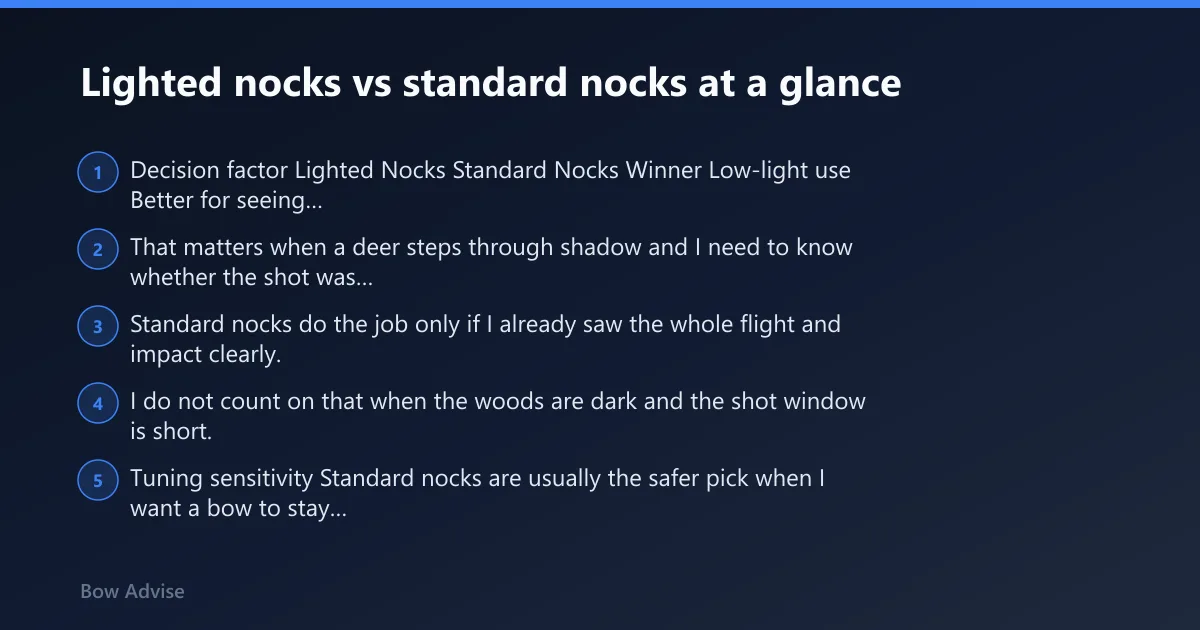
| Decision factor | Lighted Nocks | Standard Nocks | Winner |
|---|---|---|---|
| Low-light use | Better for seeing arrow impact in dim woods | No built-in visibility aid | Lighted Nocks |
| Tuning sensitivity | More sensitive because fit and width can change | Usually simpler to tune and repeat | Standard Nocks |
| Arrow ID | Easier to track one arrow after the shot | Harder to spot once it is buried or passed through | Lighted Nocks |
| Recovery priority | Useful when finding the arrow matters | No visual aid for recovery | Lighted Nocks |
| Setup complexity | Can need shaft matching, string fit checks, and d-loop adjustment | Baseline setup for most hunting arrows | Standard Nocks |
| Cost | Higher purchase cost and possible battery replacement burden | Lower cost and no battery component | Standard Nocks |
| Weight | Usually heavier than standard nocks | Usually lighter | Standard Nocks |
Low-light use
Lighted nocks win here because they make arrow impact easier to read at dusk or in cover. That matters when a deer steps through shadow and I need to know whether the shot was high, low, or a pass-through.
Standard nocks do the job only if I already saw the whole flight and impact clearly. I do not count on that when the woods are dark and the shot window is short.
Tuning sensitivity
Standard nocks are usually the safer pick when I want a bow to stay boring. Lighted nocks are heavier than standard nocks, and some models add width at the d-loop, so the same setup can act differently after a swap.
I have seen bows that were fine with one nock type get a little fussy with another. That does not mean lighted nocks are bad. It means they are part of the tune, not outside it.
Recovery priority
Lighted nocks help when finding an arrow matters more than saving the simplest setup. If I am hunting a thick creek bottom or a cut corn field where arrows disappear fast, that visible point of light can save time and money.
Standard nocks win when recovery is not the main issue and I value fewer moving parts. They are the baseline because nothing has to turn on, pair, or stay lit.
Do lighted nocks affect accuracy and bow tuning?
They can affect accuracy if the added weight, width, or fit changes how the arrow leaves the bow. The nock itself is small, but the bow cares about consistency at the string, d-loop, and rest.
On my own bows, I treat any nock change like a setup change. I do not assume point of impact stays the same just because the arrow still flies.
Why extra weight and width matter
Lighted nocks are heavier than standard nocks, and that extra mass can change the balance of the back end of the arrow. Some models also add width at the d-loop, which can create a different release feel than the nock you tuned with.
If your bow is already picky, that extra change may show up in paper tune, bare shaft flight, or broadhead groups. If your bow is forgiving, you may never notice much beyond a slight retune check.
Why nock fit matters more than brand claims
Nock fit should usually click onto the string with light resistance. Too tight, and it can move the string or drag the arrow as you draw. Too loose, and the arrow can fall off the rest or jump off the string before you want it to.
That fit changes tuning consistency. A bad setup can hide in plain sight.
How the arrow rest and nock point have to stay consistent
The arrow rest is one of the two bow contact points that matter most, and it has to stay consistent when the nock changes. If a wider lighted nock changes where the arrow sits at full draw, the rest may no longer support the same launch path.
That is why I retest after any nock swap. I am looking for the same hold, the same draw feel, and the same arrow launch every time.
What nock fit and nock pinch mean for your setup
Nock fit is the feel of the arrow snapping onto the string with light resistance. Nock pinch is when the string or d-loop squeezes the nock area hard enough during the draw that the arrow may lift off the rest or shift position before release.
Lighted nocks can create both problems sooner than standard nocks if their extra width affects fit. That does not make them unusable. It means your d-loop spacing and string fit matter more.
What a correct nock fit feels like
A correct fit feels secure without fighting you. The arrow should stay on the string when you point the bow down, but it should not need a hard tug to seat.
If it takes too much force to clip on, I treat that as a warning. If it barely hangs there, I treat that as a problem. Both can hurt consistency.
Why wider lighted nocks can create nock pinch
Wider lighted nocks can get pinched between the d-loop strands during the draw. When that happens, the arrow may lift off the rest or change angle just enough to matter at longer range.
This is one of the main reasons I do not recommend lighted nocks for every bowhunter by default. If your setup already runs close to the edge, the extra width can make the problem show up fast.
How d-loop spacing can reduce or worsen pinch
D-loop spacing changes how much room the nock has as the string loads. If the loop is cramped, a wider lighted nock has less space and more chance to pinch.
When I test a new nock, I watch the arrow through the draw cycle. If it lifts, shifts, or binds, I adjust the loop before I judge the nock itself.
Which arrow shafts and nocks actually fit together?
Lighted nocks must match the shaft inside diameter before you buy. Common shaft inside diameters are .165, .204, .233, .244, and .246, and the wrong match can ruin the whole plan before you ever shoot.
That is why I check compatibility first, then brightness, then battery life. Fit comes before features.
Matching common shaft inside diameters
- .165: often used with smaller-diameter arrow systems; Halo offers a fit option here.
- .204: common in several hunting arrows; Halo offers a fit option here.
- .233: a common fit size; Halo offers a fit option here.
- .244: a common fit size; Halo offers a fit option here.
- .246: a common fit size; Halo offers a fit option here.
Notes on Halo, CosiComu, Nockturnal Shift FIT, and Lumenok
Halo is listed as best overall, and it offers options for .233, .244, .246, .204, and .166/.165 shafts. The Halo nock weighs 14.6 grains, and its battery life is 20+ hours.
CosiComu is listed as best value. Its weight was measured at 18.4 grains, its battery life is more than 24 hours, and a six-pack costs $19. Nockturnal Shift FIT is listed as easiest to turn off, which matters if you like a simple shutoff after the shot. Lumenok remains a familiar name for hunters who want a straightforward lighted nock without chasing every feature claim.
When are lighted nocks worth it for bowhunters?
Lighted nocks are worth it when seeing the hit and finding the arrow changes what you do next. That matters most in low light, in thick cover, or on shots where you need to know whether to wait, track, or back out.
They are less useful when you shoot in bright conditions, keep shots short, and already recover every arrow easily. In that case, the extra cost and setup work buy little.
Low-light hunting and seeing arrow impact
This is the strongest case for lighted nocks. If the shot happens at dusk, under timber, or through brush, a lit nock can tell you where the arrow went and whether the shot path matched your aim.
That information is worth more than brightness for brightness’ sake. I want a clear read on impact, not just a glowing arrow for a photo.
Arrow recovery after the shot
Lighted nocks can help you find an arrow that passed through or buried in leaves, grass, or snow. That saves time in the field and can protect expensive shafts.
They do not guarantee recovery. If the arrow is buried deep, broken, or kicked off by an animal, the glow may not save it.
When filming shots or tracking hits matters
Filming shots is one of the few times where lighted nocks can earn their keep even on a range or backyard setup. They help you see impact on video and confirm arrow path when the camera angle is limited.
For pure practice, though, standard nocks still make sense if you just want to repeat your tune. I do most of my normal shooting with standard nocks and save the lighted ones for hunts or shot review.
When standard nocks are the smarter choice
Standard nocks are the smarter choice when you want the fewest variables. They are the baseline setup for most hunting arrows, usually lighter, and they avoid battery or switch concerns.
If your bow is already tuned, your arrows are matched, and you do not need extra shot visibility, standard nocks are hard to beat.
Decision matrix: choose lighted nocks or standard nocks
This is the quick filter I would use before buying. If the answer is yes to visibility and recovery, lighted nocks move up fast. If the answer is yes to consistency and low setup effort, standard nocks stay ahead.
| Decision factor | Lighted Nocks | Standard Nocks | Best pick |
|---|---|---|---|
| Hunting distance | Better when longer shots make impact harder to read | Fine when shots are short and easy to track | Lighted Nocks for longer or harder-to-read shots |
| Low-light use | Strong advantage | No visibility aid | Lighted Nocks |
| Tuning sensitivity | More sensitive to fit and width changes | Less likely to change a stable tune | Standard Nocks |
| Arrow ID | Easier to spot after the shot | Harder to spot at distance or in cover | Lighted Nocks |
| Recovery priority | Useful if finding the arrow matters | No added help | Lighted Nocks |
Setup checklist for avoiding nock pinch before season
- Match the nock to your arrow shaft inside diameter: .165, .204, .233, .244, or .246.
- Check that the nock clicks on the string with light resistance.
- Inspect d-loop spacing and make sure the loop is not crowding the nock.
- Draw the bow slowly and watch for the arrow lifting off the rest.
- Shoot a few arrows and confirm the rest contact and group shape stay the same.
- Retest after any d-loop or nock change before hunting.
Choose Lighted Nocks if… / Choose Standard Nocks if…
Choose Lighted Nocks if… you hunt in low light, need help seeing impact, care about arrow recovery, or film shots often. I would also choose them when the arrow shaft match is clear and I can verify nock fit and d-loop spacing without forcing the setup.
Choose Standard Nocks if… you want the lightest, simplest, most consistent hunting setup, or your bow is already sensitive to fit changes. If you do not need a glowing impact point, standard nocks stay my default pick.
Frequently asked questions
lighted nocks vs regular nocks
Lighted nocks are the better choice when visibility and recovery matter, while regular nocks are the safer choice when simplicity and repeatable tuning matter most. I think of it as a field-use decision, not a status upgrade. If the shot is easy to see, regular nocks are usually enough.
lighted nocks vs regular
Lighted nocks vs regular comes down to whether you want extra feedback after the shot. Lighted versions help you read impact and find arrows, but they add fit checks, possible width issues, and battery dependence. Regular nocks keep the setup clean and predictable.
are lighted nocks worth it
They are worth it when low-light hunting, arrow recovery, or shot confirmation changes your follow-up. They are not worth it for every bowhunter, especially if the bow already tunes well and you do not lose arrows often. I only buy them when they solve a real problem.
do lighted nocks affect accuracy
They can affect accuracy if their extra weight, width, or fit changes how the arrow leaves the bow. That effect is usually about setup, not the glow itself. If your nock fit is wrong or the d-loop is cramped, accuracy can suffer fast.
how do lighted nocks affect bow tuning
Lighted nocks can change tuning because they are often heavier than standard nocks and may fit differently on the string. That can alter rest contact, arrow launch, or nock pinch. I always check paper tune and field points again after switching.
do lighted nocks help recover arrows and deer
They help with arrow recovery more reliably than deer recovery. Seeing the glowing nock can tell you where the arrow landed and where to start looking. They do not replace good shot judgment, blood-trail reading, or patience after the shot.
which lighted nocks fit my arrow shaft
Start with your arrow shaft inside diameter. Common sizes are .165, .204, .233, .244, and .246, and the nock has to match that size. Halo offers options for .233, .244, .246, .204, and .166/.165 shafts, so compatibility is the first filter before brightness or battery claims.