Can You Wear a Watch While Shooting Archery?
Yes, sometimes, but a watch should come off when possible. If the case rides low or sits in the string path at full draw, remove it. A watch that catches string contact can bruise the wrist, change the shot, or damage the band and bowstring. The issue is bowstring clearance, not style.
Watch clearance and risk checklist
Use this checklist before nocking an arrow. At full draw, the watch should stay outside the string path with room to spare. If the watch head, crown, or band can touch the string, riser, or arm guard during draw, hold, anchor, or follow-through, it is a poor fit for shooting.
| Watch type | Case thickness | Band material | Wrist location | Bow type | Risk rating |
|---|---|---|---|---|---|
| Thin analog dress watch | 6-8 mm | Leather or fabric | Above wrist bone, tight fit | Compound | Low if clearance stays open |
| Thin analog sports watch | 8-10 mm | Silicone | Bow arm, high on forearm side | Recurve | Low to moderate |
| Metal bracelet watch | 9-12 mm | Metal bracelet | String arm or bow arm | Recurve | Moderate |
| Smartwatch | 10-15 mm | Silicone or fabric | Bow arm, below sleeve cuff | Compound | Moderate to high |
| Fitness tracker | 8-13 mm | Silicone or NATO-style | Low on wrist, loose fit | Any | Moderate |
| Large watch with crown guards | 12-16 mm | Stiff leather or metal | Near wrist bone | Recurve | High |
That table is a guide, not a promise. Case diameter matters because a wide watch head can sit farther from the wrist than the strap suggests. Case thickness and crown height matter even more when the string runs close to the back of the hand. A slim case with a tall crown can still snag.
Band material changes fit and snag risk. Leather can be stable if it is snug, but thick stitching or a stiff buckle can add bulk. Metal bracelets can shift and rattle. Silicone bands are usually easier to keep close to the wrist. Fabric and NATO-style bands can feel secure, yet extra layers may add thickness under a sleeve or arm guard.
Can you wear a watch while shooting archery?
Yes, if the watch sits above the wrist bone and stays clear of the string path at full draw; no, if it rides low, shifts on the draw arm, or crowds the release side. Removal is the safer default because clearance changes with bow type, anchor, draw length, and arm position. Range rules may be stricter than general advice.
The bowstring does not care whether the object on your wrist is a watch, bracelet, or tracker. If it sits in the path, it is a hazard. If it stays well outside that path through draw, anchor, and follow-through, it may be acceptable.
Why the real issue is string clearance
Bow string clearance means the distance between the watch and the string path through the shot. That distance is not fixed. It changes with draw length, anchor position, brace height, and the angle of the bow arm. A watch can be harmless at rest and still become a problem when the string arm rotates or the bow arm collapses.
String slap is the direct contact risk. Deflection is the less obvious one: the string or a wrist accessory may nudge each other and change the release path, the follow-through, or the arrow’s flight. That is why a watch is a clearance question, not a fashion question.
Why the bow arm matters most
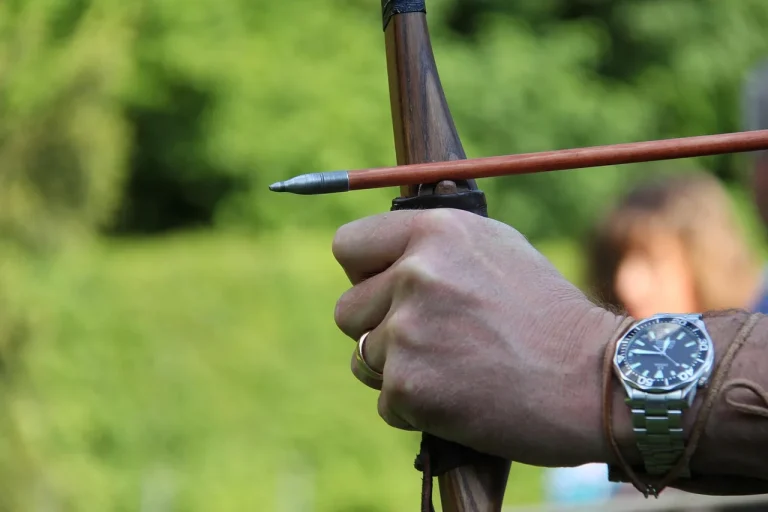
The bow arm matters most because it is closest to the string path on many shots. A watch on the bow arm can be exposed to the string during draw and release, especially on recurves with a shorter brace height. The string arm is usually farther away, but it still needs a clearance check on compound bows and during follow-through.
Bow arm versus string arm clearance
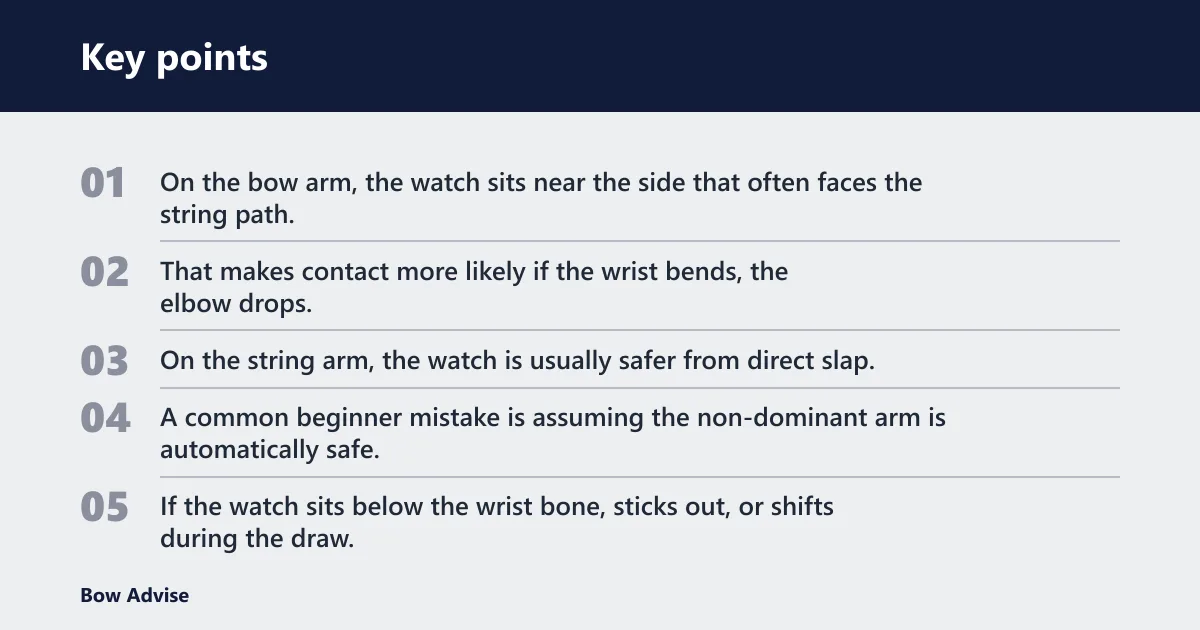
On the bow arm, the watch sits near the side that often faces the string path. That makes contact more likely if the wrist bends, the elbow drops, or the watch rides low. On the string arm, the watch is usually safer from direct slap, but it can still interfere with clothing, anchor position, or a release aid setup.
A common beginner mistake is assuming the non-dominant arm is automatically safe. It is not. If the watch sits below the wrist bone, sticks out, or shifts during the draw, it can still enter the clearance zone.
How anchor, draw length, and limb travel change risk
Anchor point changes the wrist angle. A deeper anchor can bring the string closer to the forearm or wrist, especially if the draw length is long for the archer’s setup. Limb travel matters too, because a bow that stores and releases more energy can move the string path sharply near the end of the shot. That leaves less room for bulky accessories.
Brace height also matters. A shorter brace height generally leaves less room between the string and the bow’s front end at rest, so small position changes matter more. That is one reason the same watch can feel fine on one bow and crowded on another.
When a watch becomes a string hazard
A watch becomes a string hazard when it can touch the string at full draw, during release, or during follow-through. The danger rises if the band is loose, the case is thick, the crown sticks out, or the wrist bends inward. Any of those can turn a minor accessory into a contact point.
Suppose a 12 mm smartwatch sits low on the bow arm of a beginner recurve shooter. The first draw may seem fine at rest, but at anchor the wrist rolls inward and the crown faces the string. That is enough reason to remove it before the next shot.
Does a watch fit with recurve and compound bows?
Yes, but the answer changes by bow type. Recurve bows often demand tighter wrist clearance because the string path and brace height leave less tolerance for bulky wristwear. Compound bows often give more room near the grip, yet the string path, cable movement, and release-side motion still make some watches risky.
Recurve clearance concerns
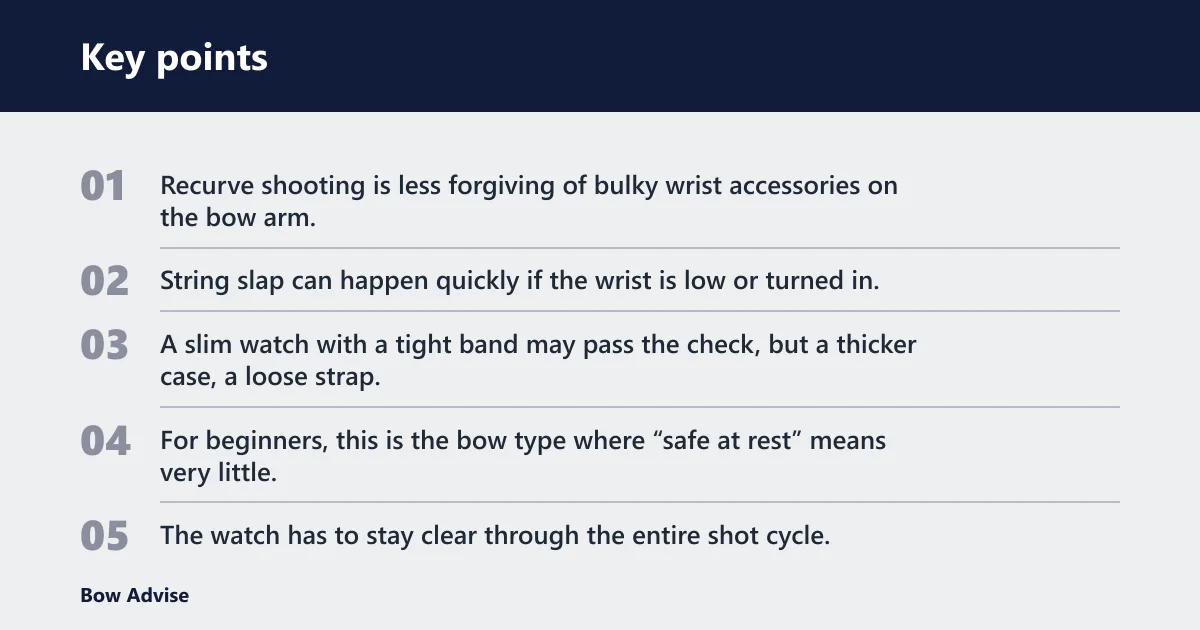
Recurve shooting is less forgiving of bulky wrist accessories on the bow arm. String slap can happen quickly if the wrist is low or turned in. A slim watch with a tight band may pass the check, but a thicker case, a loose strap, or a protruding crown often creates a problem fast.
For beginners, this is the bow type where “safe at rest” means very little. The watch has to stay clear through the entire shot cycle, not only while standing relaxed at the line.
Compound clearance concerns
Compound bows often give better clearance at the forearm, but the watch still needs a full-draw check. Some setups place the wrist closer to cables, release aids, or the string path during expansion. A smartwatch can also interfere with a wrist sling, release strap, or glove fit.
Compound archers should pay close attention to the draw length setting. A longer draw can change the arm angle enough to move the watch into the danger zone, even if the same watch seemed harmless on a shorter setup.
Brace height and follow-through effects
Brace height affects how close the string sits to the bow at rest, which changes the margin for error. Follow-through matters because the wrist can move after release. Even if the watch does not touch at the instant of release, it can still scrape or tap during the end of the shot cycle.
That is why a watch check should happen with the bow fully drawn, not while the archer is relaxed between ends.
Which watch types are safer?
Thin analog watches are usually safer than thick smartwatches, but only if the case stays low and the band fits snugly. Large cases, tall crowns, guards around buttons, and bulky sensors raise the contact risk. A safe watch for archery is the one that stays flat, low, and stable.
Analog watch vs smartwatch
An analog watch often has a simpler shape and fewer protrusions. A smartwatch or fitness tracker can be riskier because it usually adds sensors on the underside, buttons or crowns on the side, and more bulk on the wrist. That bulk matters most on the bow arm, where space near the string is limited.
Smartwatches also face a different damage risk. A string strike can scratch a touchscreen, crack a bezel, or loosen a strap. A low-profile analog watch may take less abuse if something does brush the wrist.
Case thickness, crown height, and protrusions
Case thickness is the first number to look at. A thicker case stands farther off the wrist, and a tall crown can stick out even more than the case itself. Pushers, sensors, and raised bezels can catch on a sleeve, arm guard, or string during the shot.
If a watch has a screw-down crown, knurled crown, or side buttons, treat those as clearance features, not decoration. They create edges that can snag when the wrist rotates.
Safest band materials for archery
Silicone and snug fabric bands are usually the easiest to keep stable. Leather can work if it fits close and does not flare. NATO-style bands can be secure, but the extra layer under the watch head can add thickness. Metal bracelets are the least predictable for clearance because they can shift and reflect movement.
The safest band is the one that does not move around during draw and does not add unnecessary bulk under the sleeve or arm guard.
What if you cannot remove the watch?
If the watch cannot come off quickly because of work, medical needs, or fit issues, keep it high on the wrist, tighten the band so it does not slide, and check clearance at full draw before shooting. If the watch still sits near the string path, stop and move it, cover it, or skip the shot.
Low-profile placement and fit checks
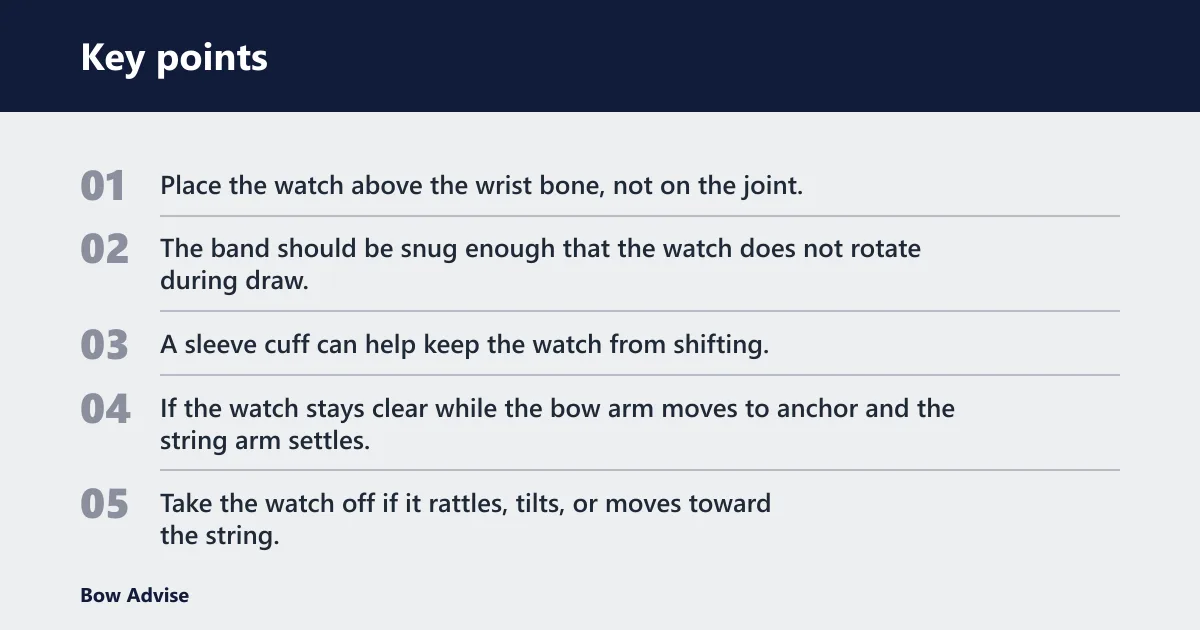
Place the watch above the wrist bone, not on the joint, and keep it on the side that stays farthest from the string path. The band should be snug enough that the watch does not rotate during draw. A sleeve cuff can help keep the watch from shifting, but it should not be relied on as protection.
Run a dry draw with no arrow first. If the watch stays clear while the bow arm moves to anchor and the string arm settles, that is a better sign than checking it only while standing upright.
When to stop and take it off anyway
Take the watch off if it rattles, tilts, or moves toward the string. Remove it if the crown or case edge is close enough to brush clothing or the string. Stop if the watch affects your grip, release, or confidence at the line. A watch that keeps distracting the archer is a poor fit even before contact risk appears.
Safety comes before convenience. If the choice is between a watch and a clean shot, the watch loses.
Range rules and coach guidance
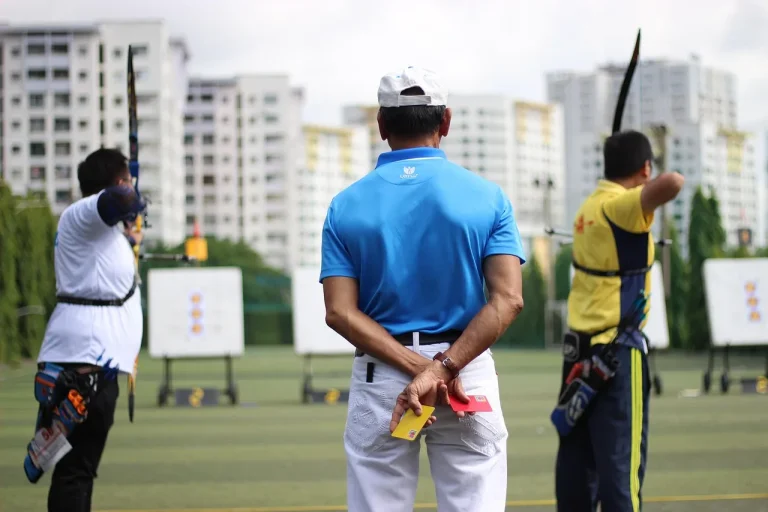
Local range rules may ban jewelry or accessories, and coach guidance can be stricter than general advice. That is normal. A coach may see a clearance issue that is hard to feel from the shooter’s side. If the rule says no wrist accessories, follow it without debate.
For beginners, this is often the simplest answer: if the range limits wrist items, remove the watch before stepping to the line.
Do arm guards make a watch safe?
No. An arm guard protects the forearm from string slap, but it does not protect the wrist itself. A watch can still sit outside the bracer, or the bracer can push the watch into a tighter, awkward position. If the watch touches the string path, the arm guard does not cancel that risk.
Why a bracer is not wrist protection
A bracer covers a different area than a watch. The wrist joint is often left exposed, especially near the hand side. That means a watch can still be struck, even if the forearm has a full guard in place.
Do not assume that more gear equals more clearance. Sometimes it creates the opposite effect.
Problems when a watch and arm guard stack together
Stacking a watch under or beside a bracer can make the fit uneven. The band may press into the wrist, the watch may tilt, and the guard may shift during draw. That stack can also reduce circulation or distract the archer while aiming.
If both items are needed, check that the watch is still flat and that the guard does not push it into the clearance zone.
Frequently asked questions
Will a watch hit the string when I shoot?
It can, especially on the bow arm and especially with recurves. A thick case, tall crown, loose strap, or bent wrist can put the watch into the string path. The only reliable check is to draw fully and confirm that the watch stays well clear through anchor and release.
Should I take my watch off before archery practice?
Yes, if you can remove it easily. That is the simplest way to avoid string slap, distraction, and accidental damage. If you cannot remove it, keep it high, tight, and low profile, then verify clearance at full draw before shooting any arrows.
What kind of watch band is safest for archery?
Silicone and snug fabric bands are usually the safest because they stay close to the wrist and add less bulk. Leather can work if it fits tightly. Metal bracelets and stiff, layered bands are more likely to shift, catch, or add height that reduces clearance near the string.
Can a smartwatch interfere with bow string clearance?
Yes. Smartwatches often have thicker cases, side buttons, sensors on the back, and more overall bulk than simple analog watches. That makes them more likely to crowd the string path or snag on a sleeve or guard. They also scratch and dent more easily if the string touches them.
Is it safer to wear a watch on the bow arm or string arm?
The string arm is usually less risky for direct string contact, but that does not make it automatically safe. The bow arm is the main concern because it often sits closer to the string path. Either arm still needs a full-draw clearance check before shooting.