How Do Rainbows Form: Essential Guide
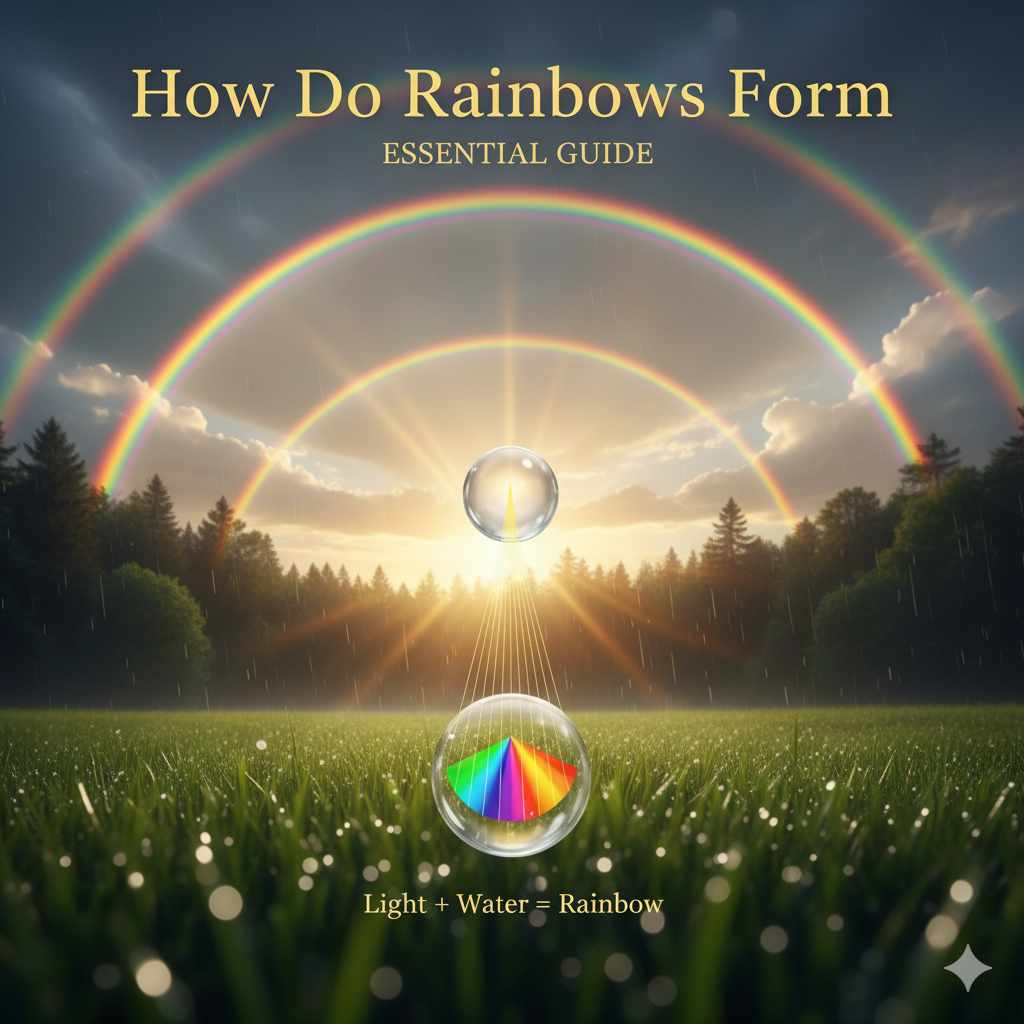
Rainbows form when sunlight shines through raindrops. The water droplets act like tiny prisms, bending and separating sunlight into its different colors. This process, called refraction, is what creates the beautiful arc of colors we see in the sky after rain. For more on this, see our guide on How Do You Score Archery.
Have you ever been caught in a sudden rain shower and then, as the sun peeked through, a spectacular rainbow painted the sky? It’s a sight that always feels like a little bit of magic. But how does this colorful arch actually appear? It’s not magic, but a fascinating display of light and water working together. Understanding how rainbows form can make that next sighting even more special. Don’t worry, it’s simpler than you might think, and by the end of this guide, you’ll be able to explain it as clearly as a sunny sky after a storm.
The Science Behind the Colors: A Beginner’s Peek
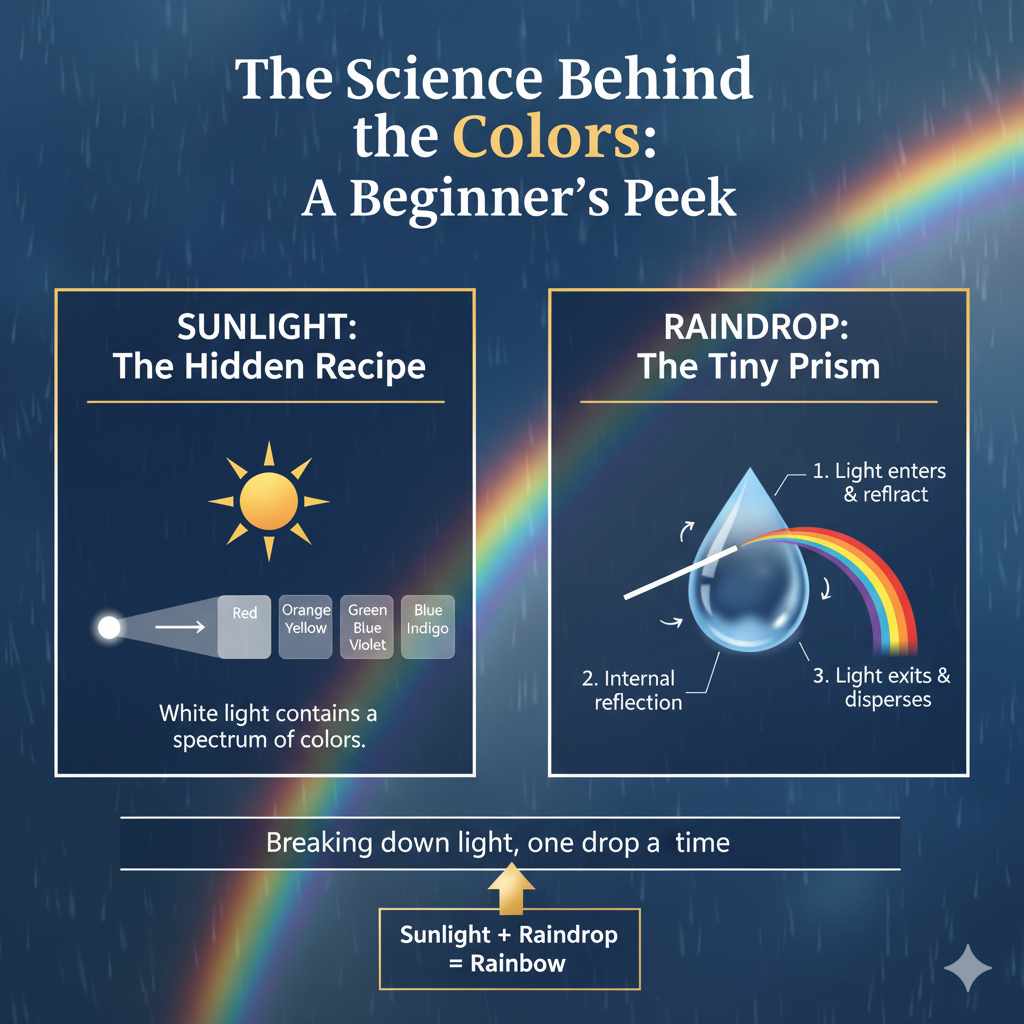
Rainbows are a classic example of how light behaves when it interacts with water. To understand how they form, we need to think about two main things: sunlight and raindrops. Sunlight, which appears white to us, is actually made up of a whole spectrum of colors. Think of it like a hidden recipe that rain helps reveal.
When sunlight meets a raindrop, something special happens. The raindrop acts like a tiny, spherical prism. A prism is a specially shaped piece of glass that can split white light into all its component colors. Raindrops can do the same thing! This process involves light bending as it enters and exits the water, and also bouncing off the back of the raindrop. It sounds a bit complicated, but let’s break it down into simple steps.
Step-by-Step: How Sunlight Becomes a Rainbow
Forming a rainbow isn’t a single event; it’s a sequence of interactions between sunlight and millions of tiny water droplets. Each droplet plays a role in showing us the full spectrum of color.
1. Sunlight as a Mix of Colors
The starting point is the sun. The light that comes from the sun is often called “white light.” But, this white light is actually a combination of all the colors of the visible spectrum: red, orange, yellow, green, blue, indigo, and violet (often remembered by the acronym ROY G. BIV). These colors are all present, but they are mixed together so we can’t see them individually without help.
2. Entering the Raindrop: Refraction Begins
When a ray of sunlight hits a raindrop, it doesn’t pass straight through. Instead, it bends. This bending is called refraction. Light travels at different speeds through different materials. When light moves from air (where it travels fast) into water (where it travels slower), it slows down and changes direction. Because each color of light bends at a slightly different angle, the white light starts to separate.
Think of it like a group of runners starting a race on different types of terrain. If the path ahead suddenly becomes muddy, some runners might slow down more than others because their shoes handle the mud differently. Similarly, the different colors within white light are slowed down differently by the water, causing them to spread apart.
3. The Bounce: Internal Reflection
After the light refracts and begins to separate into colors as it enters the raindrop, it travels to the back of the droplet. Here, most of the light reflects off the inner surface. This is called internal reflection. It’s like a tiny mirror inside the raindrop, bouncing the light back towards the front.
4. Exiting the Raindrop: More Refraction and Separation
As the light, already separated into its colors, exits the raindrop and goes back into the air, it refracts (bends) a second time. This second bending further separates the colors. Each color emerges from the raindrop at a slightly different angle.
This combination of two refractions and one internal reflection is what allows a raindrop to act like a prism and split white sunlight into the familiar band of colors. For you to see a rainbow, the sun must be behind you, and the rain must be in front of you.
| Stage | What Happens | Analogy |
|---|---|---|
| 1. Sunlight Hits Drop | White light enters the raindrop. | A team of runners enters a new terrain. |
| 2. First Refraction | Light bends and begins to separate into colors. | Runners adjust speed differently to the muddy path. |
| 3. Internal Reflection | Light bounces off the back of the raindrop. | Runners hit a wall and turn back. |
| 4. Second Refraction | Light bends again as it exits, colors separate further. | Runners leave the muddy path, spreading out even more. |
Why We See an Arc: The Geometry of a Rainbow
Now that we know how colors are separated, why do rainbows always appear as an arc? It’s all about the angles. For you to see a specific color from a raindrop, that light needs to reach your eyes at a particular angle. Red light, for example, exits raindrops at about a 42-degree angle relative to the incoming sunlight, while violet light exits at about a 40-degree angle.
Imagine you are standing with the sun directly behind you. You are seeing sunlight that has been scattered by raindrops. All the raindrops that send red light to your eyes are located on a cone with your eye at the tip, and the cone’s axis pointing directly away from the sun. The edge of this cone is the 42-degree angle. When this cone intersects the sky, it forms an arc. The same applies to violet light, but with a slightly smaller cone angle (40 degrees).
Since there are millions of raindrops in the sky, and each one is doing its job with light, you are essentially seeing parts of many different cones. The collective effect creates the full, beautiful circular arc we call a rainbow. We usually see only a semicircle because the ground (or the horizon) blocks the lower part of the circle.
The Sun’s Position Matters
This is why you can only see a rainbow when the sun is behind you and relatively low in the sky. If the sun is high overhead, the arc would be below the horizon and thus invisible. This is also why after a rain shower, as the sun starts to emerge from behind clouds, you get the perfect conditions for a rainbow sighting.
The Rainbow’s Colors: ROY G. BIV
The precise order of colors in a rainbow is always the same. From the outermost edge of the arc to the innermost, the sequence is:
- Red
- Orange
- Yellow
- Green
- Blue
- Indigo
- Violet
This order is due to the different wavelengths of light and how they are refracted and reflected by the water droplets. Red light has the longest wavelength and is bent the least, appearing on the top (outer edge) of the primary rainbow. Violet light has the shortest wavelength and is bent the most, appearing on the bottom (inner edge).
Types of Rainbows: More Than Just One Arc!
While the classic rainbow is what most people imagine, there are actually different kinds of rainbows, each with its own unique characteristics. Understanding these can add another layer of wonder to your observations.
The Primary Rainbow
This is the most common and brightest rainbow we see. It’s formed by one internal reflection of sunlight within the raindrops, as we’ve discussed. The colors are arranged with red on the outside and violet on the inside.
The Secondary Rainbow
Sometimes, you might be lucky enough to see a fainter, larger rainbow outside the primary one. This is called a secondary rainbow. It’s formed when sunlight is reflected twice inside the raindrops before exiting. Because of this double reflection, the colors in a secondary rainbow are reversed, with violet on the outside and red on the inside. It’s also dimmer because some light is lost with each reflection.
The angles for a secondary rainbow are also different. Red light exits at about 50 degrees, and violet at about 53 degrees. This makes the secondary bow appear wider and fainter, encircling the primary bow.
Alexander’s Dark Band
Between the primary and secondary rainbows, you might notice a region that appears noticeably darker than the sky around it. This is called Alexander’s dark band. It’s caused by the fact that raindrops are reflecting light either once or twice, but not in the angular range between approximately 42 and 50 degrees from the antisolar point. Therefore, very little light from this region reaches your eyes, making it appear dark.
Supernumerary Arcs
Occasionally, you might also spot narrow, pastel-colored bands just inside the violet band of the primary rainbow. These are called supernumerary arcs. They form due to the interference of light waves, specifically when light rays that have undergone the same number of reflections and refractions in different raindrops interfere with each other. They are more common when raindrops are very uniform in size.
Creating Your Own Mini-Rainbows
You don’t always need a full rain shower to see a rainbow. You can create your own miniature versions at home using simple tools! This is a fun way to demonstrate the science in person.
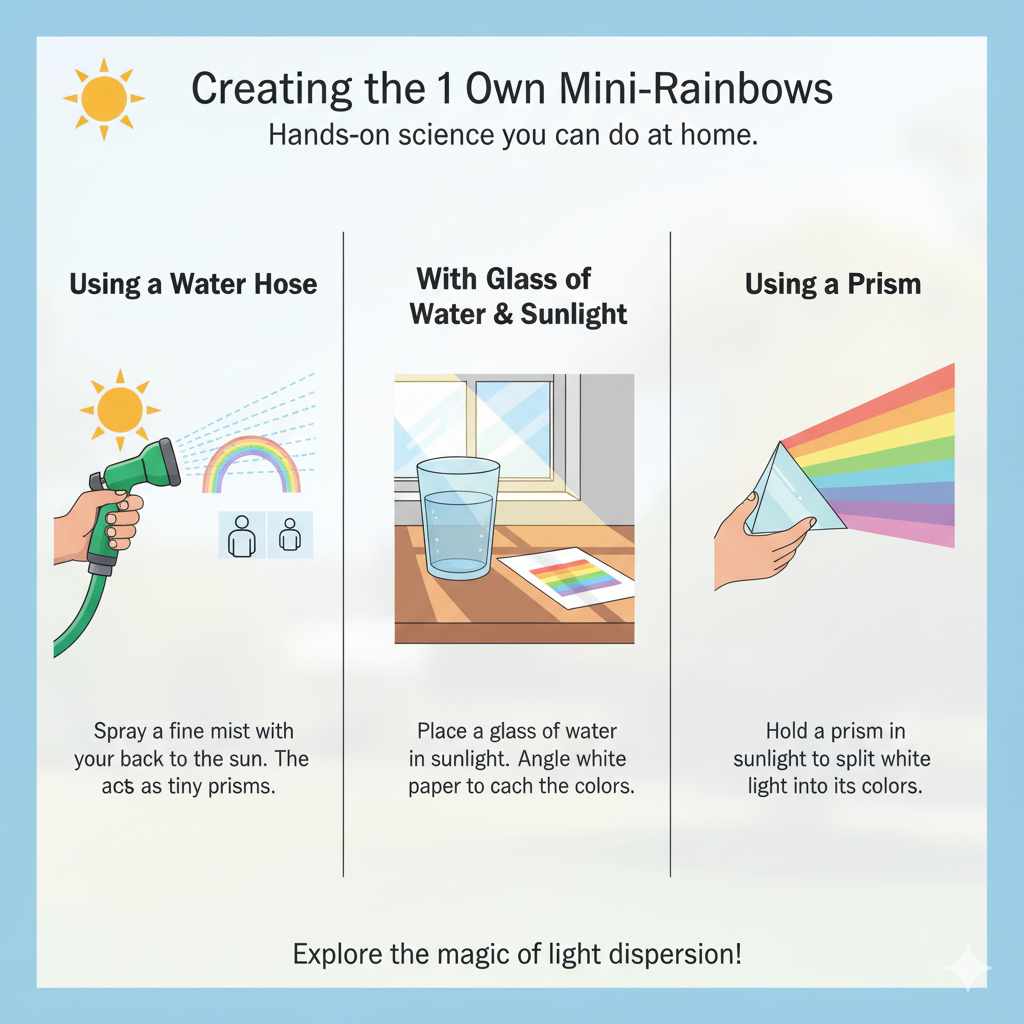
Using a Water Hose
On a sunny day, try spraying water from a garden hose in a fine mist. Stand with your back to the sun and look towards the mist. You should be able to see a faint rainbow. The tiny water droplets from the hose act just like raindrops.
With a Glass of Water and Sunlight
Place a clear glass filled with water on a table near a sunny window. Position a white piece of paper next to the glass. Try to adjust the paper’s angle. The water in the glass will act as a lens, and the light passing through it will refract and reflect, potentially creating a small spectrum of colors on the paper.
Using a Prism
The most direct way to see how light splits is with a prism. You can purchase inexpensive glass or acrylic prisms from science supply stores or even online. Hold the prism in a beam of sunlight, and you’ll see the white light break into its constituent colors on a wall or ceiling. This is a fundamental demonstration of light dispersion, the same principle that makes rainbows visible.
For more on accurate light dispersion and prisms, the National Institute of Standards and Technology (NIST) offers extensive resources on optical physics.
Common Questions About Rainbows
Q1: Why are rainbows always in an arc shape?
Rainbows are arcs because of the geometry of light reflection and refraction. For you to see a specific color, the light must reach your eyes at a particular angle (about 42 degrees for red, 40 for violet) relative to the direction of the sun. All the water droplets that send light to your eye at that exact angle form a cone, and the intersection of this cone with the sky appears as an arc.
Q2: Can you see a rainbow at night?
While it’s extremely rare, you can see a “moonbow.” Moonbows are formed by moonlight instead of sunlight. Since moonlight is much fainter than sunlight, moonbows are very difficult to see with the naked eye and often appear white. However, if your eyes are well-adjusted to the dark, you might be able to discern faint colors.
Q3: Is it possible to see a full circle rainbow?
Yes! While we typically see only a semicircle from the ground due to the horizon, it is possible to see a full circular rainbow from a very high vantage point, such as an airplane or a mountaintop. The higher you are, the more of the circle you will be able to see.
Q4: Why do rainbows have different colors in different orders sometimes?
The primary rainbow always has red on the outside and violet on the inside. If you see a fainter, second rainbow outside the primary one, it’s a secondary rainbow, and its colors are reversed (violet on the outside, red on the inside). This reversal is due to the light reflecting twice inside the raindrops.
Q5: What is the “pot of gold” myth about?
The myth of a pot of gold at the end of the rainbow is a legend. Rainbows don’t have an end; they are optical illusions and appear to be a fixed distance away. As you move, your perspective changes, and the rainbow seems to move with you, meaning you can never reach its “end.”
Q6: Does a rainbow have moisture in the air?
Yes, a rainbow requires moisture in the air, in the form of water droplets. These droplets are essential for the sunlight to refract, reflect, and disperse into its different colors, creating the visible spectrum of the rainbow. It can be rain, mist, or even spray from a waterfall.
Conclusion: The Wonder of Light and Water
So, there you have it! Rainbows, those breathtaking arcs of color, are not a product of chance but a beautiful testament to the physics of light and water. From the initial bending of sunlight as it enters a raindrop to the final colorful display as it exits, each step plays a crucial role in forming this natural wonder. Understanding the processes of refraction and reflection not only demystifies the rainbow but also deepens our appreciation for the intricate workings of our world.
Whether you’re witnessing a vibrant primary bow, a fainter secondary bow, or even creating your own mini-rainbow with a hose or a prism, the science behind it remains a source of fascination. Remember, for every rainbow you see, the sun was behind you, and water droplets were in front, working together to paint the sky. So next time the rain starts to clear and the sun peeks through, look up – you might just witness a spectacular show of light and color, a perfect reminder of the simple yet profound beauty that nature offers.