How to Add Arrows in PowerPoint: 3 Quick Steps (Shapes Menu)
Adding arrows in PowerPoint takes just 3 steps: open the Shapes menu, pick an arrow style, then draw and resize it, holding Shift for a perfectly straight line. Skip that last part and a crooked arrow is the fastest way to make a slide look unpolished. This guide covers the Shapes menu method, resizing and recoloring arrows, curved and double-headed styles, and where arrows work best in a deck. For more on this, see our guide on How To Bleach Knees And Elbows. For more on this, see our guide on How To Bow Hunt Florida. For more on this, see our guide on How To Attach Nock To Arrow With Swage End.
Why Arrows Are Your Presentation’s Best Friend
Think of arrows in a presentation like the fletching on an arrow – they guide and provide direction. They can highlight key information, show relationships between ideas, illustrate processes, and break down complex data visually. Without them, your audience might miss crucial details or feel lost in a sea of text.
In archery, a good arrow is essential for a successful shot. Similarly, in presentations, well-placed arrows are essential for effective communication. They help:
- Focus Attention: Draw the viewer’s eye to specific elements.
- Show Flow: Illustrate sequential steps or processes.
- Indicate Relationships: Connect related information.
- Highlight Changes: Point out differences or trends.
- Add Visual Interest: Break up text-heavy slides and make them more dynamic.
Getting them right is simpler than you might think. We’ll cover everything from finding them to making them look exactly how you want.

Finding and Inserting Arrows in PowerPoint (The Easy Shot)
PowerPoint has a fantastic built-in library of shapes, and arrows are a big part of that. Let’s learn how to find and place them on your slide. It’s like learning to nock an arrow – a fundamental step for success!
Step 1: Access the Shapes Menu
First, open your PowerPoint presentation and navigate to the slide where you want to add an arrow.
Once your slide is selected, go to the Insert tab at the top of the PowerPoint ribbon. You’ll see a group of options here. Look for the Illustrations group, and within that, you’ll find the Shapes button. Click on it.
Step 2: Choose Your Arrow Style
A large menu of shapes will appear, categorized neatly. Scroll down through the categories until you find the Lines section. Here, you’ll see various line options, including different types of arrows.
For most general purposes, you’ll want to choose one of the basic arrow shapes, like the simple Arrow or the Elbow Arrow Connector (which is great for connecting text boxes or objects). There are also arrows with double heads, open heads, and stylized options. Pick the one that best fits the message you want to send.
Step 3: Draw Your Arrow on the Slide
After selecting your arrow shape, your mouse cursor will change into a crosshair. Click and drag on your slide to draw the arrow. You can control the length and direction by how far you drag. If you want to draw a perfectly straight horizontal or vertical arrow, hold down the Shift key while you drag. This is a handy tip, just like keeping your drawing arm steady in archery!
Don’t worry if it’s not perfect right away. You can easily resize and reposition it after drawing. The same Shapes-menu approach carries over almost exactly if you need arrows in Word or AutoCAD instead — only the menu names shift slightly.
Customizing Your Arrows: Making Them Hit the Mark
Now that you have an arrow on your slide, it’s time to make it stand out and serve its purpose perfectly. PowerPoint offers a lot of options to change the appearance of your arrows, much like tuning your bow for optimal flight.
Changing Arrow Color, Weight, and Style
With your arrow shape selected, a new tab called Shape Format (or Format, depending on your PowerPoint version) will appear at the top of the ribbon. This is where all the magic happens!
- Shape Fill: This changes the color of the arrow’s body (though most arrows are lines and don’t have a fill).
- Shape Outline: This is the most important one for arrows! Click on Shape Outline to change the color of the arrow line itself. You’ll find a palette of theme colors and standard colors, or you can choose ‘More Outline Colors’ for custom shades.
- Weight: Still under Shape Outline, you’ll find Weight. This allows you to make the arrow thicker or thinner. A thicker arrow is more noticeable, while a thinner one can be more subtle. Choose based on your slide’s design and what needs to be highlighted.
- Dashes: You can also change the arrow to be solid, dashed, or even dotted by selecting different dash styles under Shape Outline.
Modifying Arrowheads
Arrows aren’t just lines; they have heads! You can change the style and size of both ends of your arrow.
Go back to the Shape Format tab and click on Shape Outline. Then, hover over Arrows. This will bring up a flyout menu with dozens of different arrowhead styles for the end of your arrow, and even options for arrows that have heads on both ends. You can also adjust the size of the arrowhead relative to the shaft here. Experiment to find a look that’s clear and fits your presentation’s aesthetic.
Adding Arrow Text
Sometimes, you need a little explanation right with your arrow. You can add text directly to an arrow shape!
- Right-click on the arrow you’ve inserted.
- Select Add Text from the context menu.
- Start typing. The text will appear inside or next to the arrow. You can then format this text like any other text box in PowerPoint (font, size, color, etc.).
Resizing and Rotating Arrows
After drawing, you’ll see small circles and squares around your arrow. These are handles:
- Corner Handles (Squares): Drag these to resize the arrow proportionally.
- Side Handles (Circles/Squares): Drag these to stretch or squash the arrow.
- Rotation Handle (Circular Arrow Icon): Click and drag this to rotate the arrow to any angle. Hold Shift while rotating for precise 15-degree increments.
You can also use the Format > Size options on the ribbon for precise control over height, width, and rotation angle.
Advanced Arrow Techniques for Powerful Presentations
Once you’ve mastered the basics, you can explore more advanced ways to use arrows to enhance your slides.
Connecting Objects with Arrows
PowerPoint offers special Connectors in the Shapes menu, which are perfect for linking different elements on your slide. These connectors have “attachment points” that stick to objects. When you move the objects, the connector stays attached and adjusts its path. This is incredibly useful for flowcharts or diagrams.
To use a connector:
- Go to Insert > Shapes.
- Under the Lines category, choose a connector arrow (e.g., Elbow Arrow Connector, Curved Arrow Connector).
- Hover over one object until you see small dots appear. Click on a dot to attach one end of the connector.
- Drag the other end of the connector to another object and hover until attachment points appear. Click on one of these points to connect it.
These connectors are dynamic and help maintain the integrity of your diagrams as you rearrange your slide elements.
Using Arrows to Show Trends and Data
Arrows can be fantastic for adding context to charts and graphs. A simple upward-pointing arrow next to a rising bar can instantly convey growth.
For example, when presenting sales figures, you might insert a green upward arrow next to a column representing an increase in revenue. Conversely, a red downward arrow can signify a decrease. This visual cue is much faster for your audience to process than reading a caption solely.
Pro Tip: Use the Format Shape pane (right-click the arrow and choose “Format Shape”) for more granular control. You can find settings for line properties, arrowhead types, and even transparency here.
Creating Custom Arrow Graphics
Sometimes, the built-in arrows aren’t quite enough. You can combine shapes to create your own unique arrow designs.
For instance, to make a thicker, more stylized arrow:
- Insert a Rectangle shape.
- Insert a Triangle shape.
- Position the triangle at one end of the rectangle to form an arrowhead.
- Select both shapes (hold Shift and click each one).
- Go to the Shape Format tab, click Group, and then Group again.
Now you have a single, custom arrow shape that you can resize, recolor, and manipulate as one object. You can also use this technique to create arrows with special effects, like glowing edges or 3D appearances.
Arrow Animation for Dynamic Effects
To make your arrows even more impactful, consider animating them!
Select the arrow you want to animate. Go to the Animations tab. Choose an animation, such as “Wipe” (which can make the arrow appear to draw itself onto the slide) or “Fly In”. You can customize the direction and timing of the animation in the Animation Pane. This can add a professional flourish and further guide your audience’s attention at the opportune moment.
For example, you might have a sequence of data points appear, and then use an animation on an arrow to point to the latest data, drawing focus precisely when you’re about to discuss it.
Where Else Can Arrows Be Used In Presentations?
Arrows are incredibly versatile. Here are a few more ideas:
- Process Flows: Showing steps in a workflow or how a service operates.
- Comparisons: Pointing out differences between two items or columns in a table.
- Cause and Effect: Linking a cause to its resulting effect.
- Navigation: In complex infographics or diagrams on a single slide, arrows can act like directional signs.
- Emphasis: Simply to highlight a compelling statistic or quote.
The key is to use them purposefully. Every arrow should have a reason for being there, guiding your audience’s understanding, just like every part of an archery setup serves a purpose.
Best Practices for Using Arrows Effectively
Just like a well-practiced archer knows when and how to shoot, using arrows effectively in presentations follows a set of best practices.
Keep It Simple
Don’t clutter your slides with too many arrows. Each arrow should serve a clear purpose. Overuse can confuse your audience more than it helps.
Consistency is Key
Maintain a consistent style for your arrows throughout the presentation. Use the same color, weight, and arrowhead style for similar purposes. If an upward arrow signifies growth, make sure all upward growth arrows look alike.
Contrast and Visibility
Ensure your arrows stand out against the background of your slide. If you have a dark background, use a light-colored arrow, and vice versa. Use sufficient weight to make them visible from a distance.
Strategic Placement
Place arrows thoughtfully. They should naturally lead the viewer’s eye to the information you want to emphasize. Avoid placing them where they might obstruct important text or images.
The visual hierarchy you create with arrows is crucial. Think about what you want people to see first, second, and third. Arrows can help establish this order.
Consider the Audience
For a technical audience, you might use more complex diagrams with connectors. For a general audience, keep arrow usage simple and direct. A good rule of thumb is to use arrows to simplify, not complicate, the message.
Arrow Styles and Their Meanings (A Quick Reference)
Here’s a table to help you choose the right arrow for your message. Think of these as different arrow types in archery – each is suited for a specific task.
| Arrow Style | Typical Use Case | Description |
|---|---|---|
| Simple Line Arrow | Pointing to a specific item, general direction | A basic arrow, easy to adjust length and angle. Universal. |
| Elbow/Bent Arrow Connector | Connecting text boxes, processes, flowcharts | Sticks to objects, adjusts path when objects move. Great for structured diagrams. |
| Curved Arrow Connector | Showing cyclical processes, feedback loops | Offers a more organic flow than elbow connectors, good for continuous actions. |
| Double-Headed Arrow | Indicating two-way relationships, comparison between two points | Shows a connection or flow in both directions simultaneously. |
| Thick Arrow | Highlighting critical information, strong emphasis | More visually dominant, good for drawing immediate attention. |
| Dashed/Dotted Arrow | Indicating a potential path, future projection, or optional step | Subtle, good for implying something less concrete than a solid arrow. |
Choosing the right arrow style is like selecting the right arrow for your bow – it impacts how well your message “flies” to your audience.
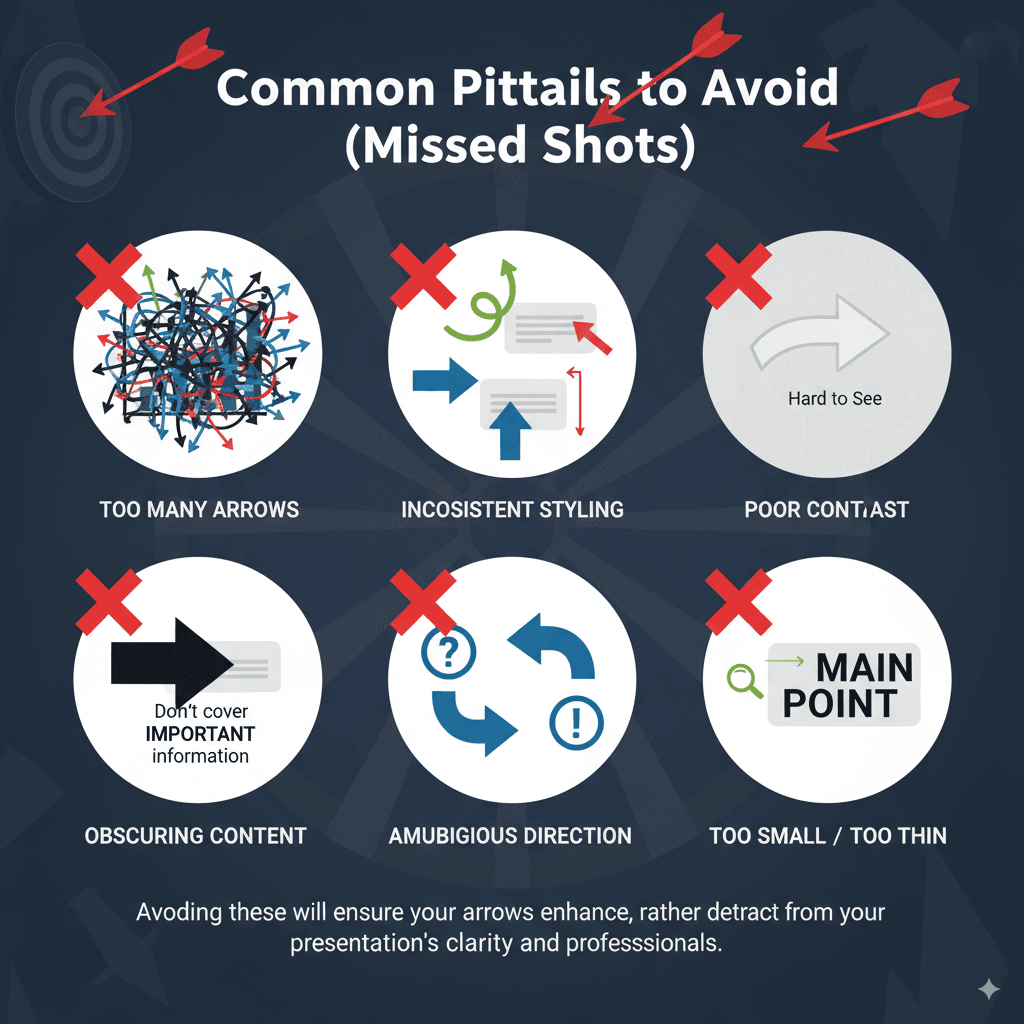
Common Pitfalls to Avoid (Missed Shots)
Even with simple techniques, it’s good to know what to watch out for. Here are a few common mistakes when using arrows:
- Too Many Arrows: Creating visual clutter.
- Inconsistent Styling: Mixing arrow types and colors haphazardly.
- Poor Contrast: Arrows that blend into the background, making them hard to see.
- Obscuring Content: Arrows that cover important words or images.
- Ambiguous Direction: Arrows whose purpose isn’t immediately clear.
Avoiding these will ensure your arrows enhance, rather than detract from, your presentation’s clarity and professionalism.
Getting More Advanced: The Shape Format Pane
For truly detailed control over your arrows, the Shape Format Pane is your best friend. To open it, right-click on any arrow and select Format Shape.
This pane allows you to:
- Adjust line transparency.
- Set exact line weights and colors.
- Choose from a vast library of — AND control the size of — arrowhead styles at both the start and end of your arrow.
- Add shadow effects or glow effects to make your arrows pop.
- Control the “begin arrow type,” “begin arrow size,” “end arrow type,” and “end arrow size” with precision.
This is where you can really fine-tune your arrows to match your brand guidelines or create a specific visual impact. For instance, if you need to show a subtle but important dependency, you might opt for a thin, dashed arrow with a small arrowhead, adjusting its transparency in this pane.
Resources like the official Microsoft Support pages for PowerPoint can offer even more in-depth guides on these advanced formatting options, explaining the nuances of controlling every aspect of your shape elements.
Frequently Asked Questions (FAQ)
Q1: How do I make arrows appear one by one on a slide?
Answer: You can achieve this by applying animations to your arrows. Select each arrow, go to the Animations tab, and choose an animation like ‘Wipe’ or ‘Appear’. You can then control the order and timing in the Animation Pane to make them appear sequentially.
Q2: Can I change the color of an arrow after I’ve inserted it?
Answer: Absolutely! With the arrow selected, go to the Shape Format tab, click Shape Outline, and choose your desired color from the palette. You can also select ‘More Outline Colors’ for custom shades.
Q3: My arrows are too thin. How do I make them thicker?
Answer: Select the arrow, go to the Shape Format tab, click Shape Outline, then Weight, and choose a thicker line from the options. You can also use the Format Shape pane for precise measurements.