How to Make a Traditional Bow: Stave to Finished Self-Bow
A traditional self-bow is crafted from a single seasoned stave of hickory, ash, or oak, shaped down with a drawknife and spokeshave, then tillered (bent evenly) until it flexes smoothly across both limbs. It’s a genuinely achievable weekend project with basic hand tools, not exotic materials. Here’s the full step-by-step, from picking your stave to your first shot. For more on this, see our guide on How to Blend Traditional Archery and Olympic Style for Success.
Why Build Your Own Traditional Bow?
There’s a unique satisfaction that comes with creating something with your own hands, especially a tool as historically significant as a bow. Building a traditional bow offers several benefits:
- Connection to Nature: You’ll often be working with natural materials, fostering a deeper appreciation for the environment.
- Understanding Archery Mechanics: Building a bow teaches you about the fundamental principles of tension, flex, and energy storage that are crucial for shooting.
- Cost-Effective: Compared to buying a high-quality traditional bow, building one yourself can be significantly cheaper, especially for your first project.
- Personalization: You get to shape and design your bow exactly to your preferences.
- Historical Appreciation: It’s a tangible link to ancient traditions and the ingenuity of our ancestors.

Choosing Your Wood: The Heart of Your Bow
The wood is arguably the most critical component of your bow. For beginners, it’s best to choose woods that are readily available, relatively easy to work with, and possess good “tillering” qualities. Tillering refers to how evenly a bow’s limbs bend.
Best Woods for Beginner Bows
Here are some commonly recommended woods for your first traditional bow:
- Hickory: A fantastic choice, especially for self-bows (bows made from a single piece of wood). It’s strong, elastic, and relatively forgiving.
- Ash: Also good for self-bows, ash is durable and can withstand significant bending.
- Oak: While sturdy, oak can be a bit brittle if not handled carefully during the tillering process. White oak is generally preferred.
- Maple: Offers good elasticity and is a bit softer than oak, making it easier to shape.
- Hazel: A good option for lighter bows, often used in more primitive designs.
What to Look for in a Stave
A “stave” is a piece of wood prepared for bow making. When selecting your stave, keep these points in mind:
- Straight Grain: Look for a stave where the wood grain runs as straight and parallel as possible along the length of the piece. Avoid knots, twists, or significant deviations in the grain.
- Seasoned Wood: It’s crucial to use seasoned (dried) wood. Green wood is much harder to work with and far more prone to warping or cracking as it dries. Ideally, the wood should have been seasoned for at least a year, but for a first bow, carefully dried lumber from a wood supplier might suffice, provided it’s straight-grained.
- Size: For a standard adult bow, aim for a stave that is about 65-75 inches long and at least 1.5-2 inches wide and 1 inch thick. This length allows for a roughly 60-66 inch finished bow, which is ideal for durability and reducing the risk of the limbs breaking during tillering.
- No Pests or Rot: Inspect the wood thoroughly for any signs of insect damage or rot.
You can often find suitable staves at local lumber mills, specialty woodworking stores, or online bowyery suppliers. If purchasing lumber, ensure it’s kiln-dried but not heat-treated, as heat treatment can weaken the wood. For a truly traditional approach, air-dried, naturally seasoned wood is best.
Tools You’ll Need
While you can get very specialized, here are the essential tools for a beginner:
- Hatchet or Axe: For rough shaping to remove excess wood.
- Drawknife: Excellent for shaving wood and shaping the limbs.
- Spokeshave: For finer shaping and smoothing.
- Scrapers (Cabinet Scrapers): For final smoothing and removing tool marks.
- Rulers and Measuring Tape: For accurate measurements.
- Pencils: For marking.
- Sandpaper (various grits, e.g., 80, 120, 220): For smoothing.
- Clamps or a Vice: To hold the wood securely.
- A Tillering Stick/Tree: A notched board or a sturdy tree branch to hold the bow while checking its bend.
- String Material: Dacron (B-50/B-55) is a good modern, beginner-friendly option for a bowstring.
- Bow Square: To ensure the bow string is centered on every draw.
Best Pick for Shaping Your First Bow
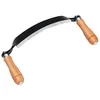
10-Inch Curved Draw Knife
The primary shaping tool this guide’s own tool list calls essential for shaving wood and roughing out the bow’s limbs.
- Best for: shaping limbs from a rough stave, per this guide’s own step-by-step
- Why we picked it: curved blade matches how bowyers work down a stave’s surface
- Main drawback: takes practice to control depth of cut safely
Compare more options
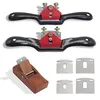 Option 1 Adjustable Flat Spokeshave Set
|  Option 2 DFM Cabinet Scraper Cards
|  Option 3 Bohning Tex-Tite Bowstring Wax
|
As an Amazon Associate we earn from qualifying purchases.
Step-by-Step Guide to Making Your Traditional Bow
Let’s get hands-on! Remember to take your time and enjoy the process. Safety first – always cut away from yourself and wear eye protection.
Step 1: Preparing the Stave
Start with your nicely figured, seasoned stave. If it’s rough-sawn, you might want to flatten one side as a reference or “belly” side. The belly is the side that will be compressed when the bow is drawn. The back of the bow is the side that will be under tension.
Crucial Rule: Never violate the back of the bow. This means no cutting, scraping, or removing wood from the back of the stave. This side is under tension and is the most likely place for the bow to break if weakened.
Pencil a centerline down the belly side of your stave. Also, mark the handle section (about 4-6 inches) and the start of the limbs. You’ll typically want the widest part of the bow to be in the handle area, tapering towards the tips.
Step 2: Rough Shaping
Using your hatchet or axe, carefully begin removing wood from the belly side. Work slowly and remove small amounts at a time. Aim to create a rough taper from the handle towards the tips. Leave the tips slightly thicker for now; you’ll refine them later.
Focus on making the limbs roughly symmetrical. You can hold the stave up and eyeball the taper. Imagine a flat board that’s about 1.5 inches wide at the handle, tapering to about 0.5 inches at the tip. Don’t strive for perfection yet. A drawknife and spokeshave will be your primary tools for refining the shape, but an axe or hatchet can get you to a manageable starting point.
For a more accurate method, you can mark out a profile and cut to it. For a simple flatbow design, you might aim for a rectangular cross-section that tapers evenly in width and thickness.
Table: Basic Bow Dimensions (Adult Self-Bow)
| Section | Approximate Width (Start) | Approximate Width (End of Limb) | Approximate Thickness (Start) | Approximate Thickness (End of Limb) |
|---|---|---|---|---|
| Handle | 1.5 – 2 inches | N/A | 1 inch | N/A |
| Limb (working part) | 1.5 inches | 0.5 – 0.75 inches | 1 inch | 0.25 – 0.5 inches |
| Tip (before nocks) | 0.5 – 0.75 inches | 0.4 inches | 0.25 – 0.5 inches | 0.2 inches |
Step 3: Shaping the Limbs and Tillering
This is the most crucial and often the most challenging part of bow making. Tillering is the process of ensuring both limbs bend evenly and in a smooth, parabolic curve when the bow is drawn. An uneven bend not only looks bad but can lead to catastrophic failure (breaking).
The Tillering Process:
- Initial Bend Check: Place the bow on your tillering stick or a sturdy branch. Gently pull the string loop (or just the end of the limb if no string yet) just a few inches. Observe where the wood is bending.
- Identifying Stiff Spots: Stiff spots are areas that are not bending. You need to remove wood ONLY from the belly side of these stiff spots.
- Removing Wood: Use your drawknife, spokeshave, or scraper to remove very thin shavings from the stiff areas on the belly side of the limbs. Work slowly and remove as little wood as possible with each pass.
- Regular Checks: After each small adjustment, place the bow back on the tillering stick and pull it slightly further. Observe the bend. You are looking for a smooth, even curve across both limbs.
- Progressive Pulling: As the limbs start to bend more evenly, you can pull them further on the tillering stick. Aim to gradually increase the draw length while maintaining an even bend. For a first bow, don’t aim for a very long draw; 24-28 inches is usually plenty.
- Symmetry is Key: Constantly compare one limb’s bend to the other. If one limb is bending too much (called “hinging”), you need to carefully remove wood from the areas adjacent to the hinge on the belly side to push that bend further out. If both limbs are bending too much, you might need to shorten the bow or accept a lighter draw weight.
This stage requires patience. It can take hours, even days, to tiller a bow correctly. Never rush it. If you remove too much wood from one spot, you’ve weakened it permanently. Always remove less than you think you need to. You can always take more off, but you can never put it back on.
For more detailed guidance on tillering, you can refer to resources like the U.S. Fish and Wildlife Service’s guide on building bows, which although focused on a different type, illustrates the principle of understanding wood properties and careful shaping.
Step 4: Creating the Nocks
Once your limbs are tillered to your satisfaction and hold a decent curve, it’s time to create the nocks – the grooves where the bowstring will rest at the limb tips.
- Simple Nocks: For a basic traditional bow, you can simply file or saw shallow grooves into the sides of the limb tips. Make sure the groove is deep enough to hold the string securely but not so deep that it concentrates stress.
- Reinforced Nocks: More robust designs often involve carving out a section of the tip and binding it with sinew or rawhide, and then carving the nock into the binding. For a beginner’s first bow, simple carved nocks are usually sufficient.
- Placement: The nocks should be on the belly side or sides of the limb tips. They should angle slightly towards the belly.
Use a small saw or a file to carefully carve these grooves. Ensure they are smooth to prevent fraying the bowstring.
Step 5: Stringing Your Bow
Now for the moment of truth! You need to make a bowstring and string your bow.
Making a Simple Bowstring
- Measure out your string material (Dacron is forgiving). The string should be roughly 3-4 inches shorter than the nock-to-nock length of your unstrung bow.
- Create a loop at one end (the “string loop”) that will fit over your bow limb’s nock.
- Wrap one end of the string around a sturdy object (like a chair leg or even a friend’s leg) to create a temporary brace.
- Wind the string material around your hand or a jig, creating a multi-strand string. The number of strands depends on your string material and desired draw weight – for Dacron B-50, 4-6 strands are common for a beginner’s bow.
- At the other end, create a second loop, or a flemish twist loop if you’re feeling ambitious and have the right material.
- Once the string is the correct length and has loops, you can serve the middle section where the arrow will nock and the loops themselves to protect them from wear.
- For a beginner, purchasing a pre-made Dacron bowstring is also perfectly acceptable and highly recommended for ease.
Stringing the Bow
There are several ways to string a bow. The most common for beginners is the “step-through” method:
- Place one limb tip on the ground (on a soft surface to avoid damage).
- Step your foot onto the belly of the bow, near the handle. Be careful not to put your foot on the limbs where they are bending.
- Grip the bow handle firmly.
- Take the string loop and place it over the upper limb tip, past the nock.
- Gently bend the bow by pushing down with the handle and pulling up with the limb you’re stepping on/near, while simultaneously pulling the string loop up with your hand.
- Slide the upper string loop into the nock.
- Carefully remove your foot.
Ensure your bow square is used. The center of the string should be centered on the handle. The distance from the string to the grip (brace height) should be consistent and as per your desired measurement (typically 6-7 inches for many traditional bows).
If the string is too tight, you’ll need to untwist it or make it longer. If it’s too loose, you’ll need fewer twists or to make it shorter. A good starting point for brace height is around 6 inches. You can find great examples of stringing techniques on archery forums or YouTube.
Step 6: Final Tillering and Shooting
Once strung, draw the bow to your desired draw length (or slightly less for initial shots). Check the bend again. Make any final minor adjustments to achieve that smooth, even arc. You may need to tiller it one last time after it’s been strung for a while.
Before you shoot:
- Ensure your bowstring is securely nocked on both ends.
- Check the limbs for any signs of cracking or splintering.
- Pick a safe, clear area to shoot.
Start by drawing the bow back just a few inches and releasing. Gradually increase the draw length as you gain confidence in the bow’s strength and the smoothness of its bend. Listen for any creaks or groans – these are often warning signs. If you hear them, stop, inspect carefully, and potentially tiller again.

Maintaining Your Traditional Bow
To keep your handmade bow in good condition:
- Storage: Store your bow unstrung in a cool, dry place, away from direct sunlight and extreme temperature changes. Hanging it on a wall or laying it flat are good options.
- Handling: Avoid excessive overdrawing. Always tiller your bow to a safe, manageable draw length.
- Inspection: Before and after each shooting session, inspect the bow for any cracks, splinters, or damage to the back or belly. Pay special attention to the nocks and limb tips.
- Moisture: While traditionally cured wood is quite resistant, prolonged exposure to moisture can still degrade it. Dry your bow if it gets wet.
FAQ: Your Traditional Bow Making Questions Answered
Q1: What is the most important part of making a traditional bow?
A: Tillering is the most critical step. It’s the process of ensuring your bow’s limbs bend evenly. An uneven bend can cause your bow to break.