How To Measure Cabinet Overlay For Hinges Easily
Dealing with cabinet doors can sometimes feel like a puzzle. You want them to look just right. They need to close smoothly.
And they should match the style of your kitchen or bathroom. One of the trickiest parts is getting the hinges to work perfectly. This often comes down to something called “cabinet overlay.”
Measuring this overlay might sound technical. But it’s really just about understanding how much your cabinet door covers the cabinet box. Getting this right means your doors will sit flush and look professional.
It’s a small detail that makes a big difference in the final look and function of your cabinets. Let’s break it down simply.
Understanding cabinet overlay is key for hinge selection and door alignment. It describes how much a cabinet door extends over the cabinet frame. Proper measurement ensures doors close smoothly and sit evenly, creating a professional and finished look for your cabinets.
What is Cabinet Overlay?
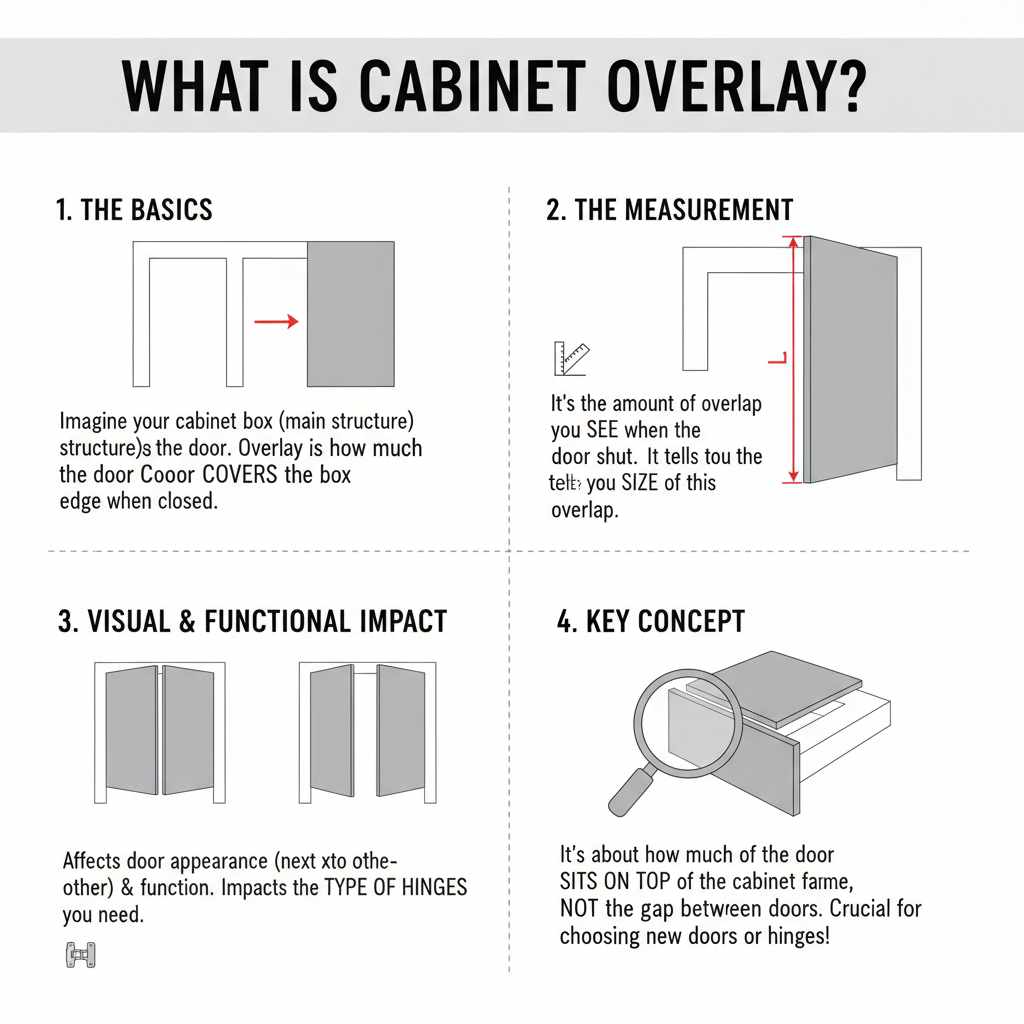
Imagine your cabinet box. It’s like the main structure. Now think about the cabinet door.
This door covers up part of that box. Cabinet overlay is simply how much of the cabinet box edge the door covers when it is closed. It’s a measurement that tells you the size of the overlap.
This overlap is what you see when the cabinet door is shut.
The amount of overlay affects how your cabinet doors look and function. It changes how they appear next to each other. It also impacts the type of hinges you need.
Different overlay sizes work best with specific hinge styles. So, knowing your overlay is super important before you buy new doors or hinges.
Think of it like this: if you have two doors side-by-side on a cabinet, the overlay is the space between them. Or, it’s how much one door covers the edge of the cabinet frame. This isn’t about the gap between doors.
It’s about how much the door itself sits on top of the cabinet face frame.
Why Does Cabinet Overlay Matter So Much?
So, why is this “overlay” thing such a big deal? Well, it directly affects how your cabinets look and how they work. When the overlay is correct, your cabinet doors will look neat.
They will sit evenly. There won’t be weird gaps or doors that look crooked. It gives your kitchen or bathroom a polished, professional finish.
It’s like getting the tailoring just right for your clothes.
It also matters for hinges. Hinges are designed to work with specific overlay amounts. If you have the wrong hinge for your overlay, your doors might not open fully.
They might hit each other. Or they might not close properly. You might even see the cabinet frame sticking out too much.
This can make your cabinets look unfinished. It’s a common issue people run into.
Choosing the right overlay also influences the style. There are different types of overlays. Some are full overlays, meaning the doors cover most of the cabinet frame.
Others are partial overlays. These leave more of the frame visible. The type you choose sets the aesthetic of your cabinets.
It’s a foundational decision for cabinet design.
Finally, it affects how you might
Types of Cabinet Overlay
There are three main types of cabinet overlay. Understanding these helps you figure out what you have or what you want. Each type has a different look and uses different hinges.
Full Overlay
This is the most common style today. With full overlay cabinets, the doors cover almost all of the cabinet frame. You will see very little, if any, of the cabinet box when the doors are closed.
There’s usually a small gap between doors. This gap is often about 1/16 to 1/8 of an inch. It looks very clean and modern.
Full overlay doors give you the most storage space inside your cabinets. They also offer a sleek, minimalist look. This is why they are popular in newer kitchen designs.
They make the cabinet fronts look more like a solid panel. This style requires specific types of hinges that allow for this wide coverage.
Partial Overlay
Partial overlay cabinets were very popular in older homes. With this style, the doors cover only a part of the cabinet frame. You will see more of the cabinet box frame between the doors.
The gap between doors is also larger. It’s typically around 1/2 inch. This shows off the cabinet frame more.
This style has a more traditional or vintage feel. It’s often seen in shaker-style cabinets or farmhouse kitchens. The hinges used for partial overlay are usually simpler.
They don’t need to accommodate as much door coverage. It’s important to know if you have partial overlay if you are trying to match existing cabinets.
Insetting Overlay (or Inset Doors)
Inset overlay is quite different. Here, the doors are actually set inside the cabinet frame. They sit flush with the frame itself.
When the doors are closed, they are level with the cabinet box. There is no overlap onto the frame. Instead, the door edges sit right against the inside edge of the frame.
This gives a very high-end, custom look. It requires very precise construction. The hinges for inset doors are special.
They are often visible from the outside, acting as a design element. This style is more expensive to produce. It’s less common than full or partial overlay because of the cost and complexity.
How to Measure Cabinet Overlay: A Step-by-Step Guide
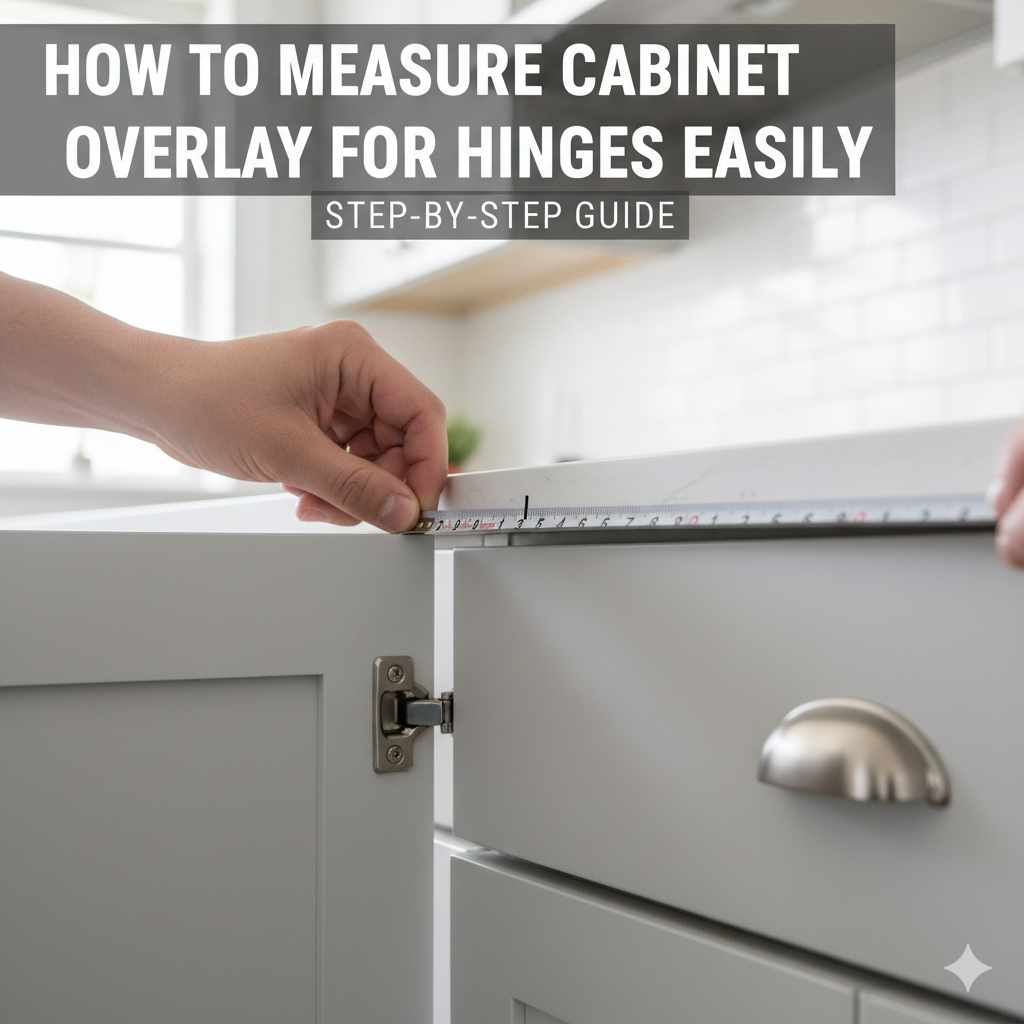
Measuring cabinet overlay is not hard. You just need a tape measure and a little patience. The key is to measure the right spots.
We’ll go through this for both face frame cabinets and frameless cabinets. Most people will have face frame cabinets, especially in older homes.
For Face Frame Cabinets
Face frame cabinets have a solid wood frame around the front of the cabinet box. This frame is what the doors attach to. Here’s how to measure the overlay on these:
Step 1: Identify Your Cabinet Door
Look at a single cabinet door. Make sure it is fully closed. You want to see how much of the cabinet frame it covers.
Step 2: Locate the Cabinet Frame Edge
When the door is closed, you will see the edge of the wooden frame around the cabinet opening. This frame is typically about 1.5 inches wide. The door sits on top of this frame.
You need to measure how much of this frame the door covers.
Step 3: Measure the Overlap on One Side
Take your tape measure. Place the end of it on the outer edge of the cabinet frame. Now, stretch the tape measure across the door until you reach the opposite edge of the frame.
This measurement tells you how much the door overlaps the frame on one side. Record this number.
Step 4: Measure the Overlap on the Other Side
Repeat the measurement on the opposite side of the same door. Measure from the outer edge of the frame on that side to the other edge of the frame. You should get a similar number.
These two measurements help confirm your overlay amount.
Step 5: Measure the Gap Between Doors (If Applicable)
If you have two doors next to each other, you might also want to know the gap between them. Measure from the edge of one door to the edge of the other door. This is not the overlay itself, but it’s useful information for hinge selection and alignment.
Important Note: Most doors have the same overlay amount on all sides. So, measuring one side is usually enough. But if you want to be absolutely sure, measure all four sides.
The overlay is the distance the door covers the frame. If you measure from the edge of the door to the edge of the cabinet box opening, you are measuring the setback. You want the overlay, which is how much the door extends past that opening onto the frame.
For Frameless Cabinets (European Style)
Frameless cabinets, also known as European style cabinets, do not have a wooden frame around the front opening. The doors attach directly to the sides of the cabinet box. These cabinets usually have full overlay doors.
Measuring overlay on frameless cabinets is different. You are measuring how much the door covers the cabinet box itself.
Step 1: Close the Cabinet Door
Ensure the cabinet door is fully closed. It should be sitting flush against the front edge of the cabinet box.
Step 2: Locate the Edge of the Cabinet Box
Look at the side edge of the cabinet box where the door sits. This is the part the door is covering. You can often feel this edge with your finger.
Step 3: Measure the Overlap on One Side
Place your tape measure on the outer edge of the cabinet door. Now, measure across the door to the edge of the cabinet box. This distance is the overlay.
Record this number.
Step 4: Measure on the Other Side
Repeat the measurement on the opposite side of the door. This helps confirm your measurement. Most frameless cabinets use full overlay, meaning the doors cover nearly the entire cabinet box.
The overlay amount is often around 1/2 inch to 1 inch, or even more.
Tip: For frameless cabinets, the measurement is often from the center of the gap between doors (if there is one) to the edge of the door. Or, it can be measured as how much the door extends beyond the cabinet box edge. If you are unsure, it’s best to check the manufacturer’s specifications or consult a cabinet professional.
Often, you’ll see overlay measurements like 1/2″, 5/8″, 3/4″, or 1″.
Quick Overlay Measurement Check
Goal: Find how much your door covers the cabinet frame (face frame) or box (frameless).
For Face Frame: Measure from the outer edge of the cabinet frame, across the frame, to where the door stops covering it. Repeat on the other side. Both numbers should be similar.
This is your overlay.
For Frameless: Measure from the outer edge of the door to the edge of the cabinet box it rests on. This is your overlay. These usually have a larger, full overlay.
Understanding Overlay Measurements for Hinges
The overlay measurement is crucial for picking the right hinges. Hinges are designed to work with specific door thicknesses and overlay amounts. They often have terms like “full overlay hinges,” “partial overlay hinges,” or “inset hinges.”
When you buy hinges, they will specify the overlay they are designed for. For example, you might see hinges listed as “1/2″ overlay hinges” or “full overlay hinges.” This means they are made for doors that have that specific amount of overlap.
Let’s look at what these hinge types mean:
Full Overlay Hinges
These hinges are used for full overlay cabinets. They allow the doors to cover most of the cabinet frame. The hinge cup is drilled into the door.
The hinge arm then attaches to the cabinet frame or box. These hinges have a specific arm shape and mounting plate that accommodates the large door coverage. You’ll often find these for frameless cabinets too, where the door covers the entire box edge.
Partial Overlay Hinges
These are for partial overlay cabinets. The doors cover only a portion of the cabinet frame. The hinges are designed so that the doors will sit correctly, leaving a larger gap between them and showing more of the frame.
They typically have a different arm shape than full overlay hinges. The opening of the hinge is less pronounced.
Inset Hinges
For inset doors, you need inset hinges. These are very different. The hinge is mounted so the door sits flush within the cabinet frame.
Sometimes these hinges are visible on the outside, like quadrant hinges or strap hinges. Other times, they are concealed but designed to allow the door to sit inside the frame. They don’t “overlay” in the same way.
Common Mistakes People Make When Measuring Overlay
Even with a simple process, people can make mistakes. These errors can lead to frustration and the wrong parts.
One big mistake is confusing overlay with the gap between doors. The overlay is how much the door covers the cabinet box. The gap is the space between two doors.
They are different measurements.
Another error is measuring the wrong thing. Some people might measure the door itself. Or they might measure the entire cabinet opening.
You need to focus on the overlap onto the frame or box. Always measure from the edge of the door to the edge of the cabinet structure it covers.
Not checking all doors is also an issue. While most doors on a cabinet run will have the same overlay, it’s possible for one to be slightly different due to installation or door adjustment. It’s good practice to check a few doors, especially if they seem misaligned.
Finally, people sometimes measure the wrong cabinet style. They might try to measure overlay on a frameless cabinet as if it were a face frame cabinet, or vice-versa. Knowing whether you have a frame around your cabinet opening is the first crucial step.
Overlay Measurement Quick Tips
- Know Your Cabinet Type: Face frame or frameless? This changes how you measure.
- Measure the Overlap: Focus on how much the door covers the cabinet frame or box edge.
- Use a Tape Measure: A flexible tape measure is best.
- Check Multiple Doors: Ensure consistency across your cabinet run.
- Distinguish from Gaps: Overlay is door coverage, not space between doors.
Real-World Scenarios & Why It Matters
I remember helping a friend renovate her kitchen a few years back. She had bought beautiful new cabinet doors online. She was so excited to install them.
But when they arrived, they just didn’t look right. They seemed to hang off the cabinet boxes strangely. Some doors had big gaps, and others almost touched.
She was completely baffled.
We went over to her house. She showed me the old doors and the new ones. It turned out she had partial overlay cabinets.
The new doors she ordered were designed for full overlay. The hinges were also different. The doors were covering too much of the frame, and the hinges weren’t set up for it.
The whole effect was just off. It looked amateur, not the professional look she was after.
We spent the afternoon carefully measuring the overlay on her original doors. We compared it to the specifications of the new doors. It was clear the doors were not compatible.
She had to return them and order the correct full overlay doors. It was a costly lesson in the importance of knowing your cabinet overlay. She learned that day that even a small measurement can have a big impact on the final outcome.
This happens more often than you might think. People see a beautiful cabinet door design online and order it without checking the specifics. They don’t realize that the doors must match the cabinet’s existing overlay type.
Or they might be replacing hinges and guess at the overlay size. This leads to doors that don’t align correctly. They might not open or close as they should.
Consider someone building a new home. They are choosing everything from scratch. They might opt for full overlay doors for a modern look.
This choice dictates the type of hinges they’ll need. These hinges will allow the doors to cover the cabinet frames almost completely. The doors will appear to be a solid surface.
On the other hand, someone restoring a vintage home might prefer partial overlay doors. This style shows off the cabinet frame, adding a classic touch. The hinges will be chosen to work with this partial coverage.
The gaps between doors will be larger, enhancing that traditional aesthetic. The choices are tied to the desired look and the overlay measurement.
What This Means for You: When is it Normal?
It’s normal for your cabinet overlay to be consistent. If you have full overlay cabinets, all your doors should cover the frame almost completely. If you have partial overlay, the amount of frame showing should be the same on all doors.
Likewise, inset doors should sit perfectly flush with the frame.
It’s also normal for there to be a small, consistent gap between doors. For full overlay, this might be 1/16″ to 1/8″. For partial overlay, it’s often around 1/2″.
This gap allows doors to open and close without rubbing. It’s a functional necessity.
The overlay amount itself can vary. Full overlay doors might cover 1/2″ to over 1″ of the cabinet box edge, depending on the door size and cabinet construction. Partial overlay doors might leave 1/2″ to 1″ of the frame exposed on each side.
The key is consistency. If one door covers more than another, that’s usually a sign something is off.
When to Worry About Your Cabinet Overlay
You should worry if your cabinet doors don’t look right. Are they uneven? Do some doors stick out more than others?
Are there large, irregular gaps? This often means the hinges need adjusting, or the doors are not the correct type for your cabinets.
Another sign to worry is if doors don’t function properly. Do they hit each other when you try to open them? Do they sag?
Do they not close all the way? These issues can stem from incorrect hinge installation or the wrong type of hinge for the overlay. It might also mean the cabinet box itself is not square.
If you’re trying to order new doors or hinges, an incorrect overlay measurement can lead to a lot of problems. You might end up with doors that don’t fit your cabinet boxes. Or hinges that won’t allow the doors to hang correctly.
This can be a costly mistake.
Simple Checks:
- Visual Alignment: Do all doors look straight and evenly spaced?
- Door Clearance: Can you open and close doors easily without them hitting each other or the cabinet frame?
- Hinge Visibility: Are the hinges installed correctly and performing their function?
- Consistent Gaps: Are the spaces between doors uniform across your cabinet run?
Contrast Matrix: Normal vs. Concerning Overlay
| Observation | Normal Overlay Behavior | Concerning Overlay Behavior |
|---|---|---|
| Door Alignment | Doors sit evenly, covering the frame consistently. | Doors are crooked, uneven, or sit at odd angles. |
| Gaps Between Doors | Consistent, small gaps (e.g., 1/16″ to 1/2″) between doors. | Large, uneven, or non-existent gaps; doors hit each other. |
| Door Coverage | Consistent amount of frame or box covered by doors. | One door covers much more or less than another. |
| Hinge Function | Doors open and close smoothly without hitting anything. | Doors stick, sag, or won’t close properly due to alignment issues. |
Quick Fixes & Tips for Cabinet Overlay
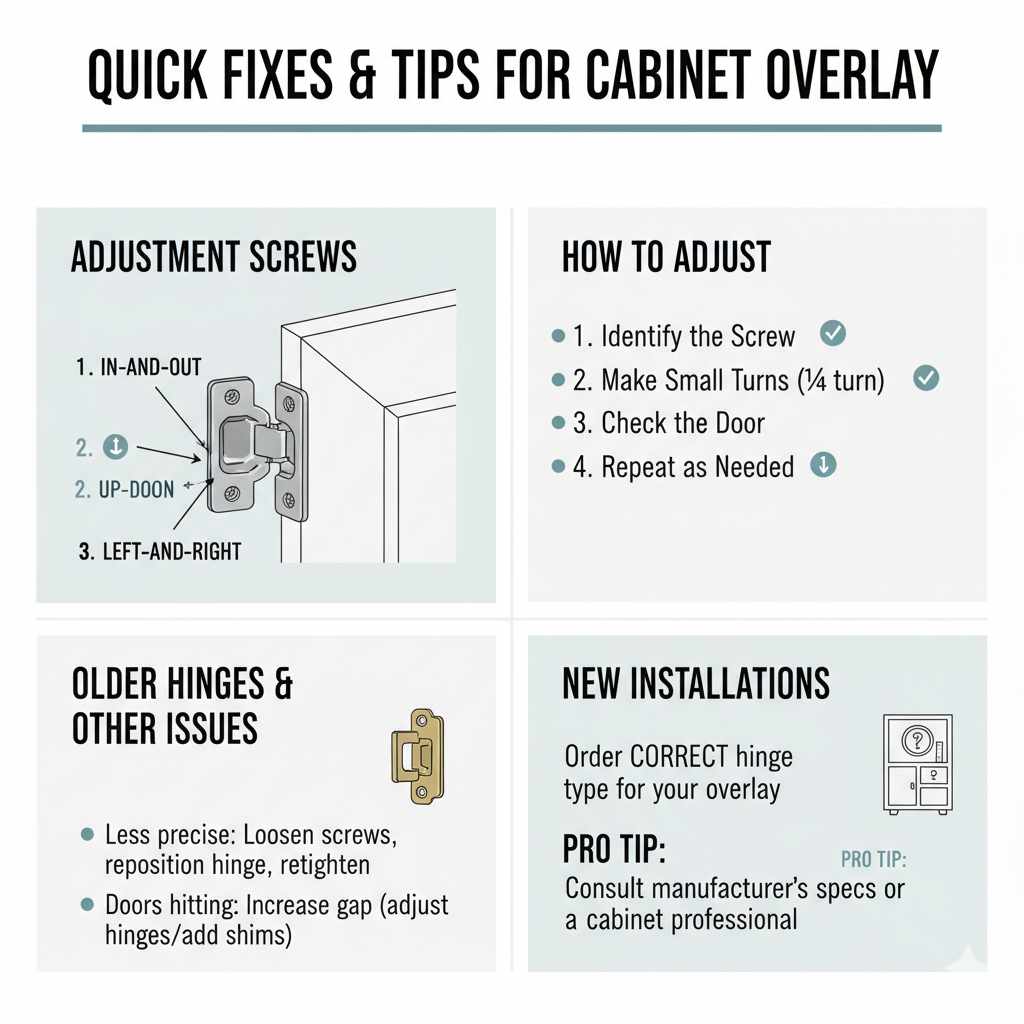
Most issues with cabinet overlay can be fixed by adjusting the hinges. Cabinet hinges, especially European-style concealed hinges, have adjustment screws. These screws allow you to fine-tune the position of the door.
There are typically three adjustment screws on most concealed hinges:
- In-and-Out Adjustment: This screw moves the door closer to or further away from the cabinet frame. This can help manage the overlay depth.
- Up-and-Down Adjustment: This screw adjusts the height of the door. This is useful if a door is sagging or not level.
- Left-and-Right Adjustment: This screw moves the door horizontally. This helps align the gaps between doors.
How to Adjust:
- Identify the Screw: Locate the adjustment screws on your hinges.
- Make Small Turns: Turn one screw a small amount (e.g., a quarter turn).
- Check the Door: Open and close the door to see the effect.
- Repeat as Needed: Continue making small adjustments until the door is aligned correctly.
If you have older, non-concealed hinges, adjustment might be less precise. Sometimes, loosening the mounting screws, repositioning the hinge, and retightening can help. If doors are hitting each other, you might need to increase the gap between them.
This can sometimes be done by adjusting the hinges or by adding small shims behind the hinge mounting plate.
If you are installing new doors and hinges, ensure you order the correct hinge type for your overlay. It’s much easier to get it right the first time. When in doubt, consult the hinge manufacturer’s specifications or a cabinet professional.
They can guide you to the perfect hinge for your specific overlay.
Frequently Asked Questions about Cabinet Overlay
What is the standard cabinet overlay measurement?
The term “standard” can vary. For modern kitchens, full overlay is most common, where doors cover almost the entire cabinet frame. This can mean 1/2 inch to over 1 inch of coverage on each side.
Older homes often have partial overlay, leaving about 1/2 inch of the frame visible between doors. Inset doors sit flush within the frame.
How do I know if I have full or partial overlay cabinets?
Look at your closed cabinet doors. If the doors cover most of the cabinet frame with only a small gap between them, you likely have full overlay. If you can see a significant portion of the cabinet frame between doors, you probably have partial overlay.
Can I change my partial overlay cabinets to full overlay?
Yes, you can, but it often requires replacing your cabinet doors and hinges. Your existing cabinet boxes will stay the same, but you’ll need new doors sized for full overlay and new hinges designed to accommodate that coverage. The cabinet frame itself might need to be modified in some cases, depending on the hinge type.
What happens if I order the wrong cabinet hinges for my overlay?
If you order the wrong hinges, your doors may not align correctly. They might not open or close properly. You could have doors that hit each other, doors that sag, or gaps that are too large or too small.
It’s crucial to match the hinge type to your specific overlay measurement.
How do I measure for inset cabinet doors?
For inset doors, you measure the inside dimensions of the cabinet frame opening. The doors are then made to fit precisely within this opening, usually with a very small tolerance (e.g., 1/16 inch) for clearance. The overlay is essentially zero, as the door sits flush with the frame.
Is it okay for my cabinet doors to not touch?
Yes, it is not only okay but often necessary for cabinet doors to have a small gap between them. This gap, typically 1/16 to 1/2 inch depending on the overlay type, prevents doors from rubbing against each other when opening and closing. It’s a sign of proper installation and hinge alignment.
Conclusion
Understanding cabinet overlay might seem like a small detail, but it’s fundamental to cabinet appearance and function. Whether you’re planning a renovation or just fixing a cabinet door, knowing how to measure overlay correctly saves time and prevents mistakes. It ensures your cabinets look professional and work smoothly for years to come.
With a simple tape measure and these tips, you can easily tackle this task.