Best Protective Gear for 3D Foam Target Courses: Based on Specs and Reviews
The best protective gear for 3D foam target courses is a bow-specific set: finger tab or release aid, forearm guard, shooting glove or half-finger tab, eye protection, and weather skin coverage, adjusted for recurve, compound, or crossbow use. Skip the wrong piece, and you raise the odds of string slap, cut fingers, glare, wet-hand slips, and missed shots. This guide breaks down gear by bow type and course conditions, with clear picks for field and tournament shoots.
Best protective gear for 3D courses
The minimum safe stack typically includes hand protection, a forearm guard, and eye protection when debris may enter the lane. Add weather coverage when the course is cold, wet, or bright enough to dry out skin and hands.
3D foam targets are commonly used for field and hunting practice, and some models use self-healing foam, weatherproof skins, UV-resistant materials, and replaceable inserts or cores. That helps the target last, but it does not remove the need for the right gear on the line. Broadheads, high-poundage compound bows, and crossbows change the risk profile fast.
Top pick by bow type and course condition
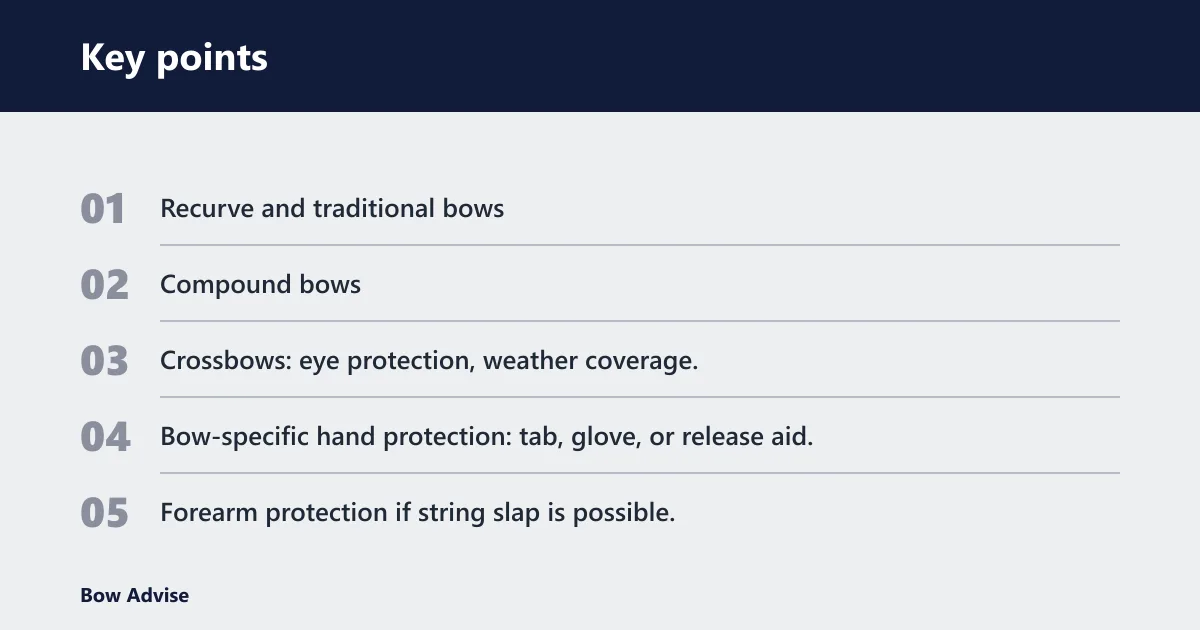
- Recurve and traditional bows: finger tab or shooting glove, snug armguard, and weather-ready outer layer.
- Compound bows: release aid, eye protection in brushy lanes, and a hand-ready pull aid for tight foam.
- Crossbows: eye protection, weather coverage, and a course-approved high-density target setup only.
Field points are the default for most 3D target use. Broadheads cut differently, pull harder, and can wear foam faster, so the gear stack should account for tighter pulls and more target damage when a course allows them.
Minimum safe gear stack for most archers
- Bow-specific hand protection: tab, glove, or release aid.
- Forearm protection if string slap is possible.
- Safety glasses for brush, dust, glare, or wind.
- Weather gear that handles rain, cold, and UV exposure.
- Arrow puller for dense foam or heavy use lanes.
When to add optional extras
Optional extras make sense when the course is dense with brush, the foam is tight from heavy traffic, or the forecast calls for cold rain and wind. A light glove, neck gaiter, packable rain shell, or extra lens wipe can matter more than another accessory that never leaves the bag.
Say your course has a 40-yard downhill lane with wet grass, low branches, and a target that has been shot all morning. A draw-hand tab plus safety glasses is the better call than bare fingers and no eyewear, because the two biggest failure points are slipping on the draw and catching debris in the eye.
Quick comparison
| Product | Badge | Best for | Price | ||
|---|---|---|---|---|---|
 | Ringsun Leather Archery Finger Tabs,Handmade Archery FingerRingsun | Our pick | Brown · Leather · Recurve bow | $12.99 Price as of 24 Oct 2026 | View |
 | Medieval Leather Bracers for Men Embossed Sword VikingHOEACXY | Also great | Pair · Genuine leather · Arm guard | $14.89 Price as of 24 Oct 2026 | View |
 | NoCry Clear Shooting Glasses for Men with Anti-Fog andNoCry | Also great | Clear · ANSI Z87 · Anti-fog | $15.99 Price as of 24 Oct 2026 | View |
 | Hunt & Seek Thick Cow Leather Archery Hand Guard ProtectorHunt & Seek | Also great | Black · Thick cow leather · Left hand | $15.99 Price as of 24 Oct 2026 | View |
 | Kugnala Mens Rain Jacket Waterproof Raincoat LightweightKugnala | Pair with it | Green camo · L · Water-resistant | $32.99 Price as of 24 Oct 2026 | View |
The best gear is the gear that solves the lane problem in front of the archer, not the gear that looks complete in a gear bag. For tournament and field shoots, fit and interference matter as much as protection.
How we chose
The comparison below is built around course safety first, then fit, then weather coverage, then bow type and target density. It favors gear that protects the places where failures actually happen: the bow hand, draw hand, forearm, eyes, and exposed skin.
Course safety first
Protection should cover common failures such as string slap, brush abrasion, finger pinch, wet-hand slips, and pull strain. Gear that blocks those risks without changing the shot ranks higher.
Fit and interference with shooting form
A forearm guard should sit snugly and stay out of the draw. Safety glasses should not disturb anchor point or sight picture. A glove or tab should protect fingers without making release awkward.
Weather and terrain coverage
Outdoor 3D courses expose archers to rain, cold, sun, dust, and dew. Materials that resist moisture and UV exposure are more useful than gear that only looks tough indoors.
Bow type and target density fit
Recurve, compound, and crossbow setups do not need the same protection. Dense foam and repeated arrow pull also change what belongs in the pack.
Armguards: best for beginner and recurve shooters
An armguard is most useful when string slap is plausible, which is common for beginners and many recurve shooters. It protects the forearm from a bad release, but it should fit snugly and never block draw length or forearm movement.
What string slap looks like
String slap usually shows up as a sharp sting on the forearm after release, sometimes with a red line or bruise. It is more likely when form breaks down, when clothing is loose, or when the bow arm is too straight at release.
How to choose fit and coverage
Choose an armguard that covers the inner forearm where the string travels. It should stay put without sliding, and it should not make the arm so stiff that anchor and follow-through change.
When an armguard is optional
Experienced archers with consistent form may wear one only on rough terrain or during long sessions. On a brushy course, or when shooting in layers, skipping it increases the chance of a painful slap.
Finger tabs and shooting gloves: best for draw-hand protection
Finger tabs and shooting gloves matter most for recurve and traditional bows, where the fingers take the draw load directly. The right choice depends on release style, finger sensitivity, and whether the course is cold, wet, or full of tight foam that may require repeated pulls.
Tab vs glove for recurve and traditional bows
A finger tab usually gives a flatter, cleaner release surface. A glove may feel warmer and more flexible in cold weather, but it often gives less consistent string feel. Either can work if it protects the fingers without changing the anchor too much.
What matters in cold or wet weather
In cold rain, leather and synthetic materials behave differently. A damp draw hand can slip, so grip texture and drying speed matter. Weather-resistant materials are a better choice than a glove that turns heavy after one wet end.
When compound shooters can skip this gear
Most compound shooters using a mechanical release do not need a finger tab or shooting glove for the draw hand. They may still want a glove or warm layer for the bow hand in cold weather, especially if they are waiting through a long tournament round.
Safety glasses: do you need them on a 3D course?
Safety glasses are a smart add-on on brushy or windy 3D courses, but they are not always mandatory. They help with stray debris, dust, and low branches, and they are useful when the lane has uneven ground or heavy vegetation.
Brushy lanes and stray debris
Low brush can flick bits of leaf, bark, or grit into the face during movement to the stake. Glasses reduce that risk, especially when the lane forces the shooter close to branches or tall grass.
Wind, dust, and low-light conditions
Wind can carry dust into the eyes and dry them out during a full round. In low light, clear lenses are usually easier to live with than dark tint, because they preserve the sight picture without making the target harder to read.
Fit issues that affect anchor and sight picture
Glasses should sit close enough to stay stable, but not so far out that they interfere with anchor point. Fogging matters too. A lens that clouds every few shots can be worse than no glasses at all in a calm lane.
Arrow pullers and extraction aids: best for tight foam
An arrow puller belongs in the bag when foam is dense, heavily used, or designed for harder-hitting bows. It reduces hand strain and gives more control during extraction, especially when field points sit deep in a target face that has seen many rounds.
High-density targets and heavy use
Some 3D foam targets are made to stop harder shots, including models rated by manufacturers for repeated hits from 70-lb compound bows. Dense foam helps with stopping power, but it can also make arrow removal tougher.
Reducing hand strain during repeated pulls
Repeated pulls can tire the grip and forearm, especially on a full course day. An arrow puller gives better purchase on the shaft and can cut down on the twisting and yanking that leaves hands sore.
What to avoid with damaged shafts
Do not force an arrow puller on a bent shaft, cracked carbon, or damaged nock end. A damaged shaft can fail during extraction. If the arrow feels stuck in a way that changes suddenly, stop and inspect it first.
Course-ready gear matrix
This matrix turns course conditions into a minimum safe stack, then adds optional extras only when they solve a real problem. It separates recurve, compound, and crossbow needs because those bows stress foam and hands in different ways.
| Bow type | Course condition | Minimum safe gear stack | Optional extras | Main trade-off |
|---|---|---|---|---|
| Recurve | Open lane, field points | Finger tab, armguard | Clear safety glasses, light rain shell | Less bulk, less cover from brush |
| Recurve | Brushy lanes, cold weather | Finger tab or glove, armguard, safety glasses | Water-resistant jacket, lens cloth | Warm layers can affect draw feel |
| Compound | Standard 3D course, field points | Release aid, safety glasses | Arrow puller, weather shell | Release aid limits finger protection needs |
| Compound | High-poundage bow, dense foam | Release aid, safety glasses, arrow puller | Weather-resistant gloves for the bow hand | Dense foam makes removal harder |
| Crossbow | Dedicated approved lane only | Safety glasses, weather coverage | Extra extraction aid, dry storage towel | Higher penetration risk and course limits |
| Any bow | Broadhead practice allowed | Course-approved eye protection, puller, hand protection suited to the bow | Spare gloves or tab, tougher outer layer | Broadheads wear foam faster and pull harder |
For broadhead practice, use only targets and lanes that allow it. Feradyne says some Shooter 3D targets stop all broadheads and field tips at multiple angles, but it also says crossbows should only use the Crossbow Shooter Buck. That split matters because energy and penetration risk change fast.
Legend says a good foam target should stop arrows from 80 lbs and 350 fps, and that arrows should be removable by hand. That is a useful benchmark for course planning, but it does not mean every bow can shoot every target, or that every lane should allow broadheads.
Suppose a shooter arrives with a 70-lb compound bow on a wet morning and the target has been hit hard all week. A release aid, safety glasses, and an arrow puller are the minimum sensible stack. Add a light rain shell if the grip gets slick.
Which one should you buy first?
Buy the gear that fixes the most likely failure first. For recurve shooters, that is usually a finger tab or glove, then an armguard. For compound shooters, it is usually eye protection and an arrow puller. Crossbow shooters should check course approval before anything else.
Budget-first decision rules
- If your fingers contact the string, buy a tab or glove first.
- If your forearm gets slapped, buy an armguard next.
- If the lane is brushy or windy, add safety glasses.
- If arrows are hard to pull, add an arrow puller.
- If rain or cold is common, add weather-resistant outerwear.
Gear priority by bow type
For recurve and traditional bows, hand and forearm protection come first. For compound bows, the release system handles finger contact, so eyewear and pull aids move up the list. For crossbows, course approval and target density matter before accessory choice.
What to bring for a tournament
Bring the gear the course is most likely to notice and allow: bow-specific hand protection, armguard if you shoot recurve, safety glasses if the course has brush or wind, and weather coverage for a long outdoor round. Keep extra gear small and quiet, since tournament bags get used on the move.
Ringsun leather finger tabs: best for recurve draw protection
This tab fits recurve and traditional shooters who want a simple draw-hand layer without much bulk. The 3 x 2.75 inch size and adjustable belt make it easier to settle on a snug fit, and the full-grain leather build suits repeated use on field points.
Its main drawback is that it is a right-hand recurve tab, so it will not fit every shooter. Leather also needs a break-in period, and a tab alone does not solve forearm slap or eye protection needs.
Medieval leather bracers: best for forearm coverage
This pair works best for archers who want forearm coverage with a firmer leather feel. It is more than enough for casual range wear, and the soft thick texture may help against string slap on a recurve or traditional setup.
The drawback is fit and purpose. The design leans decorative, so the shape may not be as purpose-built for archery as a narrower, simpler guard. It can also feel more bulky than a plain armguard on a long round.
NoCry clear shooting glasses: best for eye protection
This is the strongest fit for brushy or windy 3D courses because it pairs ANSI Z87.1 certification with anti-fog and scratch-resistant wraparound lenses. Adjustable temples and nose pads help keep the glasses stable without throwing off anchor or sight picture.
The drawback is that wraparound glasses can still fog or shift if fit is wrong, especially in hot-cold transitions. Clear lenses are not ideal for bright glare control, so some shooters may want a different lens color for strong sun.
Hunt & Seek leather hand guard: best for draw-hand cover
This hand guard suits traditional and recurve archers who want more coverage than a small tab gives. Thick cow leather and hook-and-loop fastening can help shield the hand from arrow scratches and from brush contact while moving between stakes.
The drawback is that it is listed as a left-hand piece, so right-handed shooters need to check fit before buying. It is also less precise than a finger tab for those who want a very clean string feel.
Kugnala rain jacket: best for weather cover
This jacket fits the weather problem better than most gear-only accessories because it is packable, hooded, and built for wet or windy outdoor use. On a long 3D course, that matters when cold rain turns wet hands into a grip problem and starts to chill the bow arm.
The drawback is that a jacket can add bulk around the shoulders and forearm if sizing is off. It also protects the torso and outer skin, but it does not replace eye protection or hand gear.
Frequently asked questions
What protective gear do I need for a 3D foam target course?
Most archers need a bow-specific hand solution, forearm protection if string slap is possible, eye protection when brush or wind is part of the course, and weather coverage for sun or rain. Recurve shooters usually need a tab or glove. Compound shooters usually need a release aid and a pull tool for dense foam.
Do I need arm protection for 3D archery?
Arm protection is most useful for beginners and recurve shooters because string slap happens more often when form is still settling in. It is still useful for anyone shooting in layered clothing or on a brushy lane. The key is fit: it should protect without limiting the draw.
Should I wear safety glasses at a 3D archery range?
Yes, when the course has brush, dust, wind, or low branches near the line. Safety glasses help guard against debris and stray movement through thick lanes. They should fit well enough that they do not disturb anchor point or sight picture, and anti-fog lenses are a plus.
What kind of gloves work best for 3D archery?
For recurve and traditional archers, a finger tab usually gives a more precise release, while a glove can feel warmer and simpler in cold weather. Choose the option that protects the fingers without changing your anchor. Compound shooters usually do not need a draw-hand glove if they use a release aid.
How do I choose gear for shooting broadheads on 3D targets?
Start with the course rules, because many courses restrict broadheads. If they are allowed, expect more target wear and more effort on extraction. A pull aid and hand protection become more useful, and the target should be rated for broadhead use rather than assumed safe for it.
What gear should I bring to a 3D archery tournament?
Bring the same protection you need on a normal outdoor course, then add weather coverage and a small cleanup kit. A safe tournament bag usually includes a tab or glove, armguard if you shoot recurve, safety glasses, and an arrow puller. Skip bulky extras that interfere with movement or form.