Camo Jacket vs Solid-Color Jacket for Bowhunting
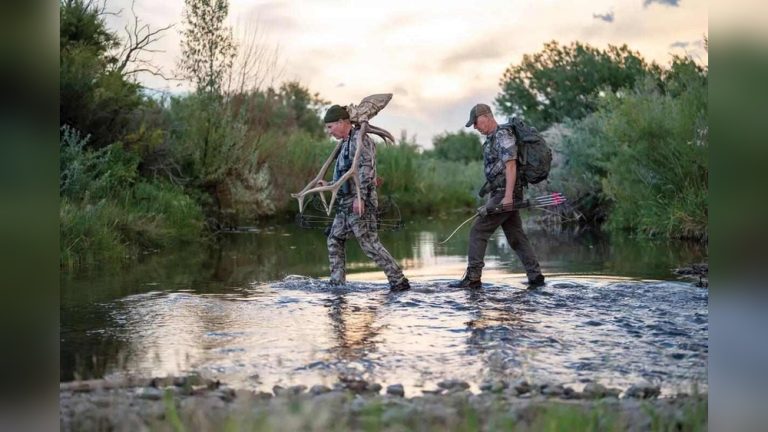
Camo tends to help most when it breaks your outline at bow range; in some setups, a plain dark jacket can work well if it stays still, quiet, and legal. Skip movement control, and deer may catch shine, a hard silhouette, or a sudden shift before the shot window opens. This guide compares camo and solid-color jackets for concealment, movement, and legality.
| Factor | Camo Jacket | Solid-Color Jacket | Winner |
|---|---|---|---|
| Outline breakup | Works when the pattern matches cover and creates macro and micro breakup | Depends on low-contrast color and a dull finish; breaks outline less on its own | Camo Jacket |
| Noise and sheen | Varies by fabric; print does not reduce fabric noise by itself | Varies by fabric; dark solids can still be quiet if brushed and soft | Tie |
| Layering flexibility | Can be harder to mix with nonmatching insulation pieces | Easier to layer across seasons and reuse outside hunting | Solid-Color Jacket |
| Legal visibility | May conflict with blaze orange or season-specific visibility rules | Also subject to orange rules, but easier to pair with required visible layers | Solid-Color Jacket |
| Best use case | Tree stand, open hardwoods, and patterned cover where breakup matters | Ground blind, early season, layered setups, and mixed-use wear | Tie |
Does pattern matter for bowhunting jackets?
Yes. Pattern matters when it changes how your body reads at bow range. Whitetail deer are often described as relying heavily on motion detection, contrast sensitivity, and low-light vision, so a jacket that breaks up the shoulders, chest, and arms into uneven shapes can help more than a plain surface in open sightlines.
What deer notice first: motion, contrast, or color
Motion comes first, then contrast and shape. Deer do not need sharp color detail to catch a head turn, a raised elbow, or a bright patch of fabric against bark or snow. That is why a still hunter in a simple dark jacket may go unnoticed, while a camo hunter who shifts at the draw gets flagged.
Where camo helps and where it does not
Camo can help most when its macro pattern breaks the larger body outline and its micro pattern softens smaller edges. It helps less if the jacket is shiny, noisy, too cleanly fitted, or paired with bright gloves and a pale face. Pattern cannot fix bad movement or wind that carries scent into the deer’s lane.
Why a jacket is only one part of concealment
Concealment works as a system: jacket, face cover, gloves, hat, movement discipline, wind direction, and background all matter. A strong pattern on the torso means little if the hunter leans into open sky, reaches across the body at full draw, or lets an odor-heavy outer layer drift downwind.
Camo vs solid color at a glance
Camo Jacket wins when the goal is visual breakup, especially in open cover or a tree stand. Solid-Color Jacket wins when layering, quiet fabric, and multi-season use matter more than printed breakup. Neither option works well if the fabric is loud or reflective.
Concealment value
Camo Jacket has the edge in open hardwoods and any setting where the deer can see a torso against bark, brush, or sky gaps. A pattern that matches vegetation and shadow can interrupt outline better than a solid surface. Solid-Color Jacket can still work if the color stays low contrast and the hunter remains behind cover.
Noise risk and fabric behavior
Noise comes from fabric, cut, and layer bulk, not from pattern alone. A brushed fleece or softshell is usually better than a stiff shell for close bow range, while a water-resistant outer layer can be useful only if it stays quiet enough at full draw. The same rule applies to both jacket types.
Layering flexibility and multi-season use
Solid-Color Jacket usually layers more easily over insulation, midlayers, and base layers that may not match a hunting print. That matters for late-season hunts and for hunters who wear the same jacket for scouting, range time, or cold-weather chores. Camo Jacket can do the same job, but it is less likely to pull double duty cleanly.
Visibility and regulation checks
Both jacket types can run into state hunting regulations. Blaze orange rules, season-specific visibility requirements, and local regulations can override personal color preference. If orange is required in a unit or season, the jacket choice has to fit under or over that requirement.
Can you bowhunt in solid colors?
Solid colors can work well for bowhunting if they are neutral, matte, and quiet, and if cover is used correctly. Dark gray, olive, brown, and charcoal are practical options because they keep contrast low and pair well with insulation layers.
Which neutral colors work best?
Low-contrast neutrals are the safest route: olive drab, dark brown, charcoal, and deep gray. These colors do not create a bright block at the shoulders the way a light tan or reflective black nylon can. For whitetails, the goal is reduced visibility, not perfect imitation of leaves.
When solids beat pattern for layering
Solid-Color Jacket is often better for early season mornings that warm fast, because it can be worn over a light base layer without looking mismatched. It also works well for late-season systems where a puffy midlayer, fleece, or shell needs to be swapped in and out. The simpler the layering plan, the easier it is to keep movement quiet.
When solids fail in open woods
Solids can fail when the hunter is exposed against pale trunks, open hardwood understory, or a bright sky gap. In those conditions, the torso shape stays too clean unless the hunter hides behind bark, brush, or a blind. That is where a broken pattern has a real edge.
How deer vision changes the jacket choice
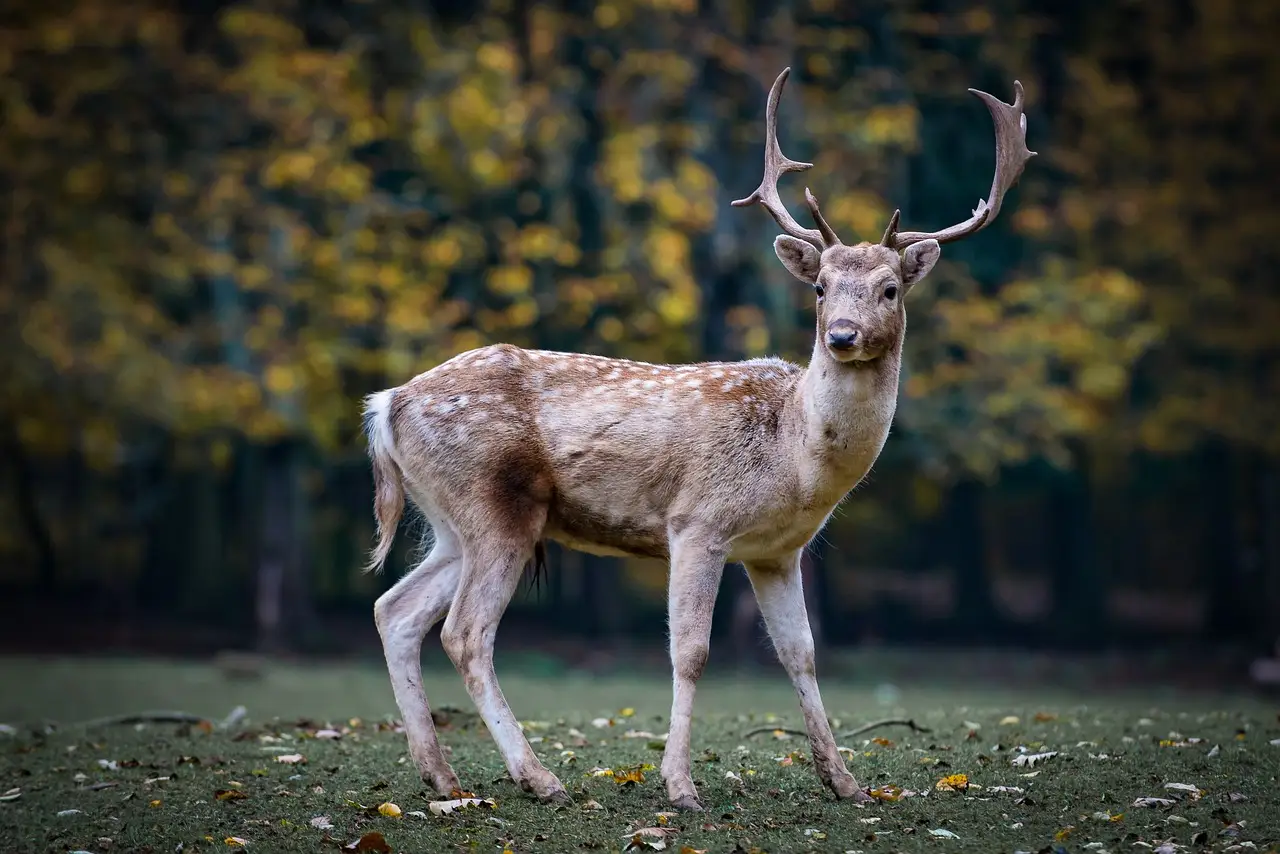
Deer vision pushes the decision toward contrast control, not perfect color matching. At bow range, whitetails are more likely to catch movement, a hard edge, or a bright patch than they are to identify a precise jacket color. Pattern helps only if it changes how the body reads from a distance.
Motion detection and silhouette break
A jacket with pattern breakup can reduce the hard line of the torso, shoulders, and sleeves. That matters most during slow head movement, slight leaning, or the draw itself, where the deer may already be looking in your direction. Solid colors can still work, but they offer less help against a clear silhouette.
Low-light conditions and contrast sensitivity
Deer see well enough in low light to catch dark blocks against lighter backgrounds. That is why a plain jacket can be fine in deep shade and still look obvious in a pale oak stand at dawn. Pattern breakup is useful when the light shifts and the background changes from dark to bright.
What pattern breakup can actually do
Macro pattern breaks the large shape of the chest and shoulders. Micro pattern softens smaller edges near seams, zippers, and sleeves. Shadow breakup matters when the jacket has darker and lighter sections that mimic uneven cover. None of that makes a hunter invisible, but it can lower the odds of being read as one clean shape.
Say your jacket is charcoal and brushed, but you stand under a bright opening in a hardwood ridge. The solid color may still read as a single block at 25 yards. Add a tree trunk or blind edge, and the same jacket becomes far less obvious.
What jacket fabric matters most?
Fabric matters as much as print, and often more. Softshell, fleece, and brushed exteriors usually beat stiff synthetics because they are quieter and less likely to flash light. A water-resistant shell helps in wet weather, but only if its surface stays dull and its cut does not rustle at full draw.
Softshell vs fleece vs water-resistant shell
Softshell jackets usually balance noise control and weather resistance well. Fleece is often quieter, especially in cold conditions, but it can bulk up under a harness or pack. Water-resistant shells are useful in rain or wet snow, though they can be noisier, so they fit best when weather protection matters more than absolute silence.
Brushed exterior, sheen, and noise
A brushed exterior cuts shine and softens the outer surface, which helps both camo and solid colors. Sheen is a real problem because a glossy sleeve can stand out more than a poor pattern match. Noise matters too; a quiet jacket that moves without swish is more valuable than a highly printed one that crackles at the elbow.
Why texture can matter more than print
Texture changes how light reflects and how sound travels. A matte, brushed jacket with a simple color often hides better than a glossy camo shell with sharp edges and rustle. For close bow work, the jacket should disappear as a sound source before it tries to disappear visually.
Bowhunting jacket comparison matrix
The right choice changes with the setup. Tree stand hunters can often use more pattern and more outer-layer bulk than ground hunters, while blind hunters often benefit from comfort, quiet fabric, and simple layering. Open hardwoods and public land raise the stakes because other hunters and deer may both see you.
| Scenario | Concealment value | Noise risk | Layering flexibility | Legal visibility concerns | Best use case | Recommended choice |
|---|---|---|---|---|---|---|
| Tree stand | High for Camo Jacket | Medium for both | Good for both | Check orange rules | Open limbs, bark, and shadowed lanes | Camo Jacket |
| Ground blind | Medium for both | Low if fabric is brushed | Better for Solid-Color Jacket | Check blind and season rules | Low movement inside a covered hide | Solid-Color Jacket |
| Open hardwoods | High for Camo Jacket | Medium for both | Good for both | Check orange rules | Broken trunks, partial cover, long sightlines | Camo Jacket |
| Early season | Moderate for both | Low if fabric is light | Better for Solid-Color Jacket | Usually moderate, but state rules still apply | Warm mornings, thin layers, quiet stalking | Solid-Color Jacket |
| Late season | Moderate for Camo Jacket | Low if fleece or softshell | Better for Solid-Color Jacket | Check orange overlayers | Cold-weather layering with low movement | Solid-Color Jacket |
| Public-land hunting | Moderate for Camo Jacket | Medium for both | Better for Solid-Color Jacket | Higher chance of visible-layer rules | Mixed use, visibility checks, and extra layers | Solid-Color Jacket |
Tree stand
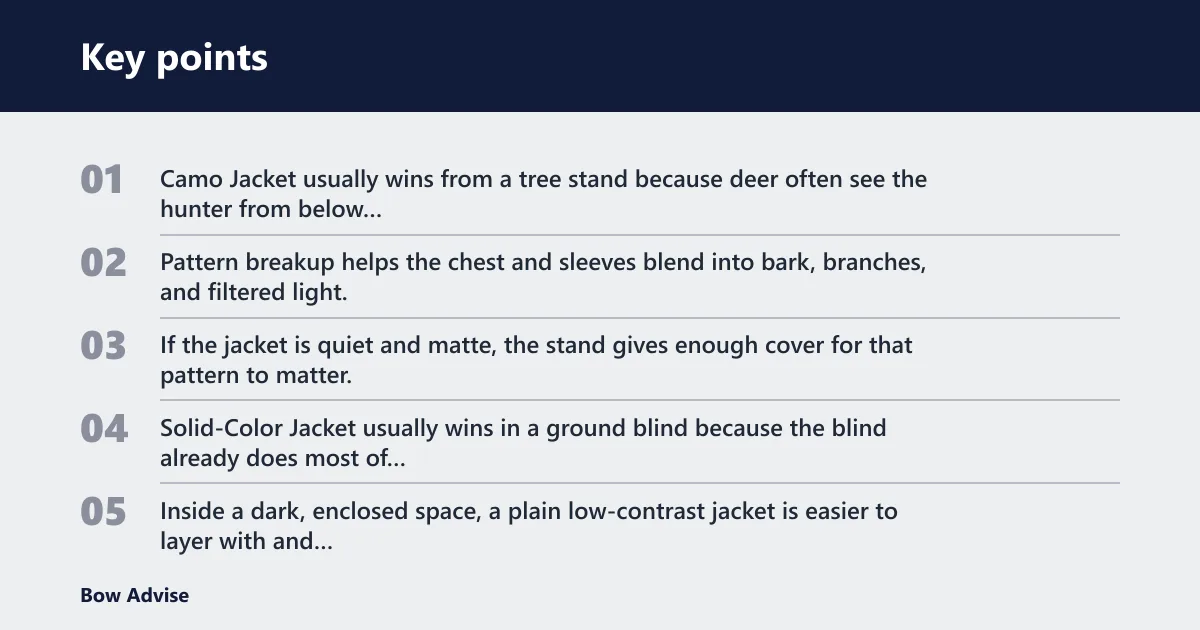
Camo Jacket usually wins from a tree stand because deer often see the hunter from below at a shallow angle. Pattern breakup helps the chest and sleeves blend into bark, branches, and filtered light. If the jacket is quiet and matte, the stand gives enough cover for that pattern to matter.
Ground blind
Solid-Color Jacket usually wins in a ground blind because the blind already does most of the visual work. Inside a dark, enclosed space, a plain low-contrast jacket is easier to layer with and less likely to snag attention when the hunter shifts or reaches for gear.
Open hardwoods
Camo Jacket is the stronger choice in open hardwoods, where deer may catch a full torso between trunks. A broken print can reduce the clean outline that shows through gaps. That matters more here than in thicker cover, because every visible edge has more weight.
Early season, late season, and public-land hunting
Early season favors lighter, quieter layers, so Solid-Color Jacket often makes more sense if heat control and comfort are the priority. Late season pushes the same way because bulkier insulation and outer shells are often needed. On public land, visible-layer rules and mixed-use practicality often make a neutral solid the safer, easier jacket to manage.
Suppose a hunter sits in a 20-foot oak stand on a 38-degree morning and wears a dark olive fleece. The jacket may be enough on its own if the deer never gets a clean angle. Swap that same setup to an open field edge, and Camo Jacket becomes the better call because the torso outline is more exposed.
Choose Camo Jacket if… / Choose Solid-Color Jacket if…
Choose Camo Jacket if you hunt from a tree stand, spend time in open hardwoods, or want pattern breakup to soften your outline at bow range. Choose Solid-Color Jacket if you use a ground blind, layer heavily across seasons, or want one jacket that works for hunting and general cold-weather wear.
Best use cases for camo
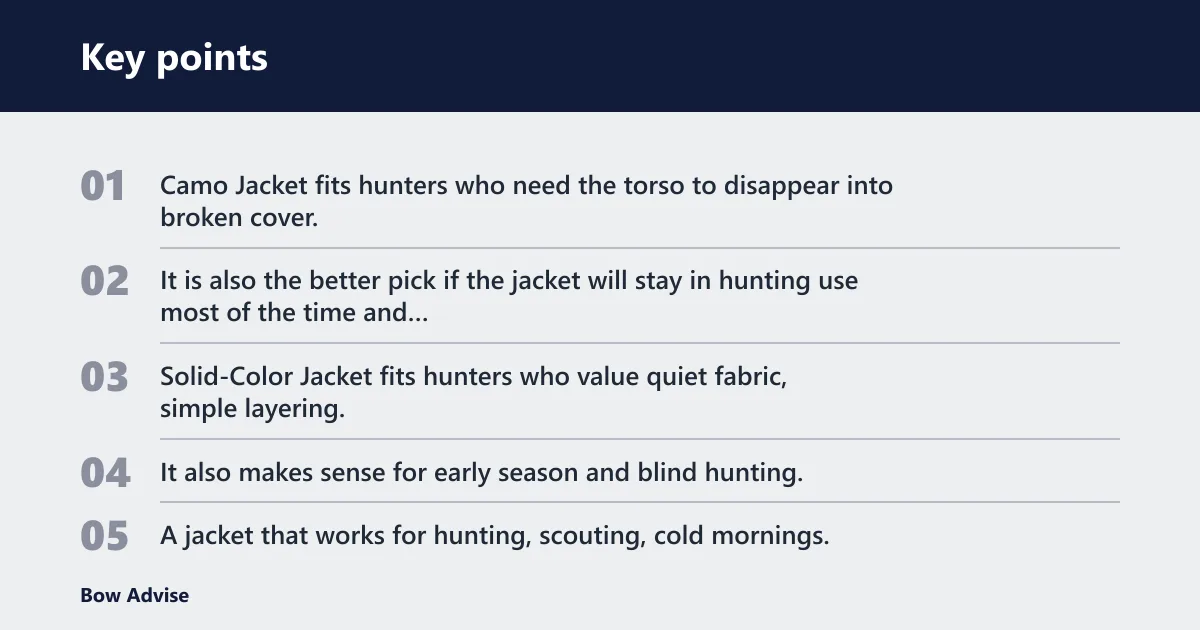
Camo Jacket fits hunters who need the torso to disappear into broken cover, especially in a stand or on edge habitat. It is also the better pick if the jacket will stay in hunting use most of the time and the pattern matches the local vegetation and season.
Best use cases for solid color
Solid-Color Jacket fits hunters who value quiet fabric, simple layering, and broader use outside the season. It also makes sense for early season and blind hunting, where a matte neutral layer can do the job without the cost or visual fuss of a specialized print.
Cost-per-use and mixed-use jackets
A jacket that works for hunting, scouting, cold mornings, and general outdoor wear has better cost-per-use than one that stays in the closet until opening day. That often favors Solid-Color Jacket. Camo Jacket becomes worth the extra cost when the hunter regularly faces open sightlines and wants the strongest possible outline breakup.

Frequently asked questions
Does camo pattern really matter for bowhunting?
Yes, but only in the right setup. Camo pattern matters most when it breaks up a hunter’s outline in open woods, from a tree stand, or in changing light. It matters much less than movement control, quiet fabric, and wind discipline.
Can I bowhunt in solid colors and still stay hidden?
Yes. Solid colors work if they are neutral, matte, and paired with good cover, slow movement, and clean scent control. They are strongest in blinds, thick cover, and layered cold-weather setups where the background does most of the hiding.
Is blaze orange allowed or required for bowhunting?
Sometimes yes. State hunting regulations can require blaze orange or other visible clothing during certain seasons, on certain lands, or in specific weapon seasons. The local rule overrides any jacket preference, so hunters need to check season-specific mandates before choosing a camo or solid outer layer.
What camo pattern works best for tree stand hunting?
The best pattern is one that matches the background at stand height and breaks the torso into irregular light and dark blocks. Macro pattern helps with the body shape, while shadow breakup helps with sleeves and shoulders. No single print works everywhere.
Does movement matter more than the pattern on a jacket?
Yes. Deer key on motion first, especially at bow range. A perfect pattern cannot hide a full draw, sudden lean, or bright exposed hand. Pattern still helps, but only after movement discipline, wind direction, and quiet fabric are already handled.
What jacket color is safest for scent control and layering?
Color does not control scent, but a neutral, low-contrast jacket is usually safest for layering and mixed use. Dark olive, brown, and charcoal are practical because they avoid visual flash and pair well with odor-resistant layers, base layers, and cold-weather insulation.