QAD UltraRest Hunter Review: Is It Worth It?
QAD UltraRest Hunter is a budget drop-away rest built for hunters who want full arrow containment and a simple setup, but skip it if you need fine tuning or broad setup adjustment. Poor setup can cost arrow flight consistency, vane clearance, and quiet containment. This review covers fit, tuning limits, hunting use, and where better-tuned rests make more sense.
Verdict
Based on the published product details, the Hunter makes sense for straightforward hunting bows, especially when the goal is full containment without moving into a premium rest price bracket. It is a weaker choice for shooters who want more adjustability, frequent bow swaps, or a rest that gives extra room for imperfect geometry and advanced tuning demands.
Specs at a glance
| Spec | QAD UltraRest Hunter |
|---|---|
| Rest type | Drop-away rest |
| Arrow containment | Full arrow containment |
| Handedness | Right-hand and left-hand variants |
| Use case | Hunting |
| Price point | Budget hunting rest |
| Timing system | Velocity Drop-Away Technology (VDT) |
| Timing connection | Lower cable attachment with cord length adjustment |
| Containment behavior | Arrow stays captured at full draw |
Who it
The Hunter fits bowhunters who want a containment rest, a clean drop-away launch, and a lower price than premium QAD options. It is a sensible pick for treestand hunters, mobile hunters, and anyone who wants the arrow held secure while climbing, nocking, or moving through cover.
It is less suitable for shooters who expect a wide adjustment range, frequent setup changes, or the easiest possible path to exact tuning. If the bow has unusual geometry, a very short brace window, or a finicky cable path, a higher-tier rest can save time and frustration.
What works
The main strength is practical hunting fit. A drop-away rest lowers the launcher after the shot, which helps fletching clearance and cuts the chance of vane contact on the way out. For a hunter, that matters more than spec-sheet detail because it supports clean arrow flight on real bows, not just in theory.
Velocity Drop-Away Technology, or VDT, is the timing system QAD uses to move between the capture position and the drop-away position. The full draw indicator behavior is part of that setup logic, so the rest gives a clear visual reference when the launcher is c ocked and ready. That makes the system easier to confirm before a hunt.
Suppose a treestand bow gets carried with an arrow nocked while the hunter climbs, steadies, or shifts position. Full containment keeps the arrow locked in place instead of balancing loosely on a small launcher. That is the kind of security most bowhunters want from a hunting rest.
What does not?
The Hunter’s price position is also its limit. A budget rest can be perfectly workable, but it offers less room for correction when the bow is not cooperating. If timing is off, if cable geometry is awkward, or if a shooter needs extra adjustment range, the Hunter gives less forgiveness than premium QAD models.
QAD timing systems are sensitive to cord length and cable attachment quality. The cord should be set from the lower cable attachment, and small changes can affect when the launcher begins its movement. That does not make the rest difficult for everyone, but it does mean casual setup errors can show up as inconsistent clearance or noisy operation.
A common first-timer mistake is to assume any drop-away will tune itself. That is rarely true. If the bow needs shop-level attention, the rest may still be fine, but the setup will not compensate for a bad nock point, poor center shot, or a cable path that is already out of spec.
Pros and cons
- Pros: Full containment for hunting movement; drop-away launcher improves fletching clearance; available in right-hand and left-hand variants; budget pricing; built around QAD’s VDT timing system.
- Cons: Less adjustability than premium QAD rests; timing is more sensitive to setup quality; not the best choice for broad tuning demands; may need more shop help on difficult bows.
QAD UltraRest Hunter fit check
This table separates the Hunter’s best-fit cases from the ones that tend to produce setup trouble. The main question is not whether it works in general. It is whether the bow and the shooter’s tuning comfort match the rest’s adjustment range and timing sensitivity.
| Bow type | Draw-weight range | Hunting style | Tuning comfort | Smart buy, borderline, or skip | Likely failure-case setup issues |
|---|---|---|---|---|---|
| Standard hunting compound with clean cable path | Typical hunting range | Treestand or blind | Comfortable with basic setup steps | Smart buy | Minor timing drift, center-shot error, vane contact if launcher timing is rushed |
| Shorter axle-to-axle hunting bow | Typical hunting range | Spot-and-stalk | Moderate comfort | Borderline | Cable angle can make timing more sensitive; may need extra attention to launcher clearance |
| Bow with tight riser geometry or crowded accessory area | Any hunting range | Mobile hunting | Low to moderate | Borderline | Mounting space issues, cord routing trouble, noisy contact points, limited adjustment margin |
| Bow that already needs advanced tune correction | Any hunting range | Broadhead-focused setup | Advanced | Skip | Launcher timing may not solve the underlying tune problem; vane clearance may stay inconsistent |
| Heavy-limb-construction bow with less forgiving geometry | Any hunting range | Any hunting style | Advanced or shop-supported | Skip | Cable attachment and cord length can be more sensitive; may require repeated retiming and verification |
Is the QAD UltraRest Hunter good for bow hunting?
Yes, for the right bow and the right buyer. The Hunter fits hunting better than target use because it gives full arrow containment, a drop-away launch, and a simple containment setup that supports stalking, climbing, and stand hunting. It is a good hunting rest when the bow is already close to tune.
What it does well in the field is keep the arrow secure, then get out of the way at the shot. That combination matters because a hunter wants the arrow held safely during movement and released cleanly when the shot happens. The budget build, however, leaves less margin for bows that need frequent correction.
Picture a blind setup with a compact compound and a fixed-blade broadhead. If the rest is timed correctly and the launcher clears cleanly, the Hunter can do its job without calling attention to itself. If the setup is sloppy, the same rest can become the source of noise or vane contact.
What accuracy gains to expect
The most realistic gain is cleaner clearance, not magic accuracy. A drop-away rest can improve arrow flight consistency because the fletching is less likely to hit the launcher. That helps broadhead flight and general repeatability when the rest is timed correctly and the bow is already reasonably tuned.
Do not expect the rest to fix spine mismatch, poor cam timing, or a bad nock point. It can support accuracy by removing one variable, but it does not replace good bow geometry or a sound tune.
How much does the QAD UltraRest Hunter cost?
At publication, Magnum Archery lists the Hunter at R 1,799.00 ZAR, and that places it in the budget hunting-rest category. That price point is part of the appeal. It gives bowhunters a QAD containment rest without stepping into premium-rest pricing.
Price matters here because the Hunter is easiest to justify when the buyer wants dependable hunting performance without paying for extra adjustment features. If the bow needs more tuning range, the lower cost can disappear quickly once a shop has to spend time correcting setup problems.
Is the QAD UltraRest Hunter a drop-away rest?
Yes. The Hunter is described as a drop-away rest, which means the launcher drops away at the shot instead of staying in the arrow’s path. That matters because fletching clearance is one of the main reasons hunters choose this style.
Quiet operation depends on timing as much as design. If the launcher moves too early, too late, or inconsistently, noise and vane contact become more likely. The rest can be quiet when it is timed well, but the cable setup has to be right.
Does the QAD UltraRest Hunter fully contain the arrow?
Yes. The Hunter is described as having full arrow containment, so the arrow stays captured in place instead of sitting loosely on an open launcher. For hunting, that gives better security while climbing, moving through brush, or waiting in position.
Containment is not a small feature. It reduces the chance of losing control of the shaft during movement, and that is one reason hunters favor this category over simpler rests. It also makes the bow feel more settled when the arrow is nocked and carried.
Is the QAD UltraRest Hunter available in left hand and right hand?
Yes. The Hunter is offered in right-hand and left-hand variants, which is a basic but necessary detail for a hunting rest. The handedness has to match the bow and the shooter, or the cable routing and launcher orientation will not make sense.
That matters for buyers because a left-hand option is not always stocked as broadly as the right-hand version. Anyone ordering should confirm the correct handedness before purchase, especially if the rest is being bought online rather than through a local pro shop.
How do I need a bow press to install the QAD UltraRest Hunter?
Often, yes, at least for a clean and secure installation. Because the Hunter uses a lower cable attachment and timing cord adjustment, the setup usually benefits from a bow press so the cable can be handled safely and the cord can be set without fighting tension.
The key is not just installation. The launcher timing must be checked after the rest is mounted, and a clearance test should follow. If the bow is awkward to work on, or if the cable path is tight, shop help makes sense because small mistakes show up quickly in timing and vane clearance.
Setup and clearance check
- Mount the rest and set a reasonable center-shot starting point.
- Attach the timing cord to the lower cable point specified by the setup instructions.
- Set the cord length so the launcher reaches the intended capture position at full draw.
- Check the full draw indicator behavior before shooting.
- Paper tune or use a vane-clearance test to confirm the launcher drops cleanly.
- Inspect for any bounce-back, launcher drag, or contact marks after several shots.
One useful check is a simple clearance test with bare shaft or powder on the fletching. If the vane shows contact, the issue may be launcher timing, cord length, or riser geometry rather than the arrow itself. That is why a careful setup pays off before hunting season.
How does it compare to HDX or MXT?
The Hunter is the simpler budget choice. The HDX sits higher in QAD’s lineup and is described with total arrow containment, a convenient thumbwheel that cocks the launcher into position, and vertical, horizontal, and overdraw adjustments. The MXT uses a magnetic-thrust mechanism for timing control, weighs approximately 3.1 ounces, and is also a full-containment design with a standard dovetail system to a Berger hole mount.
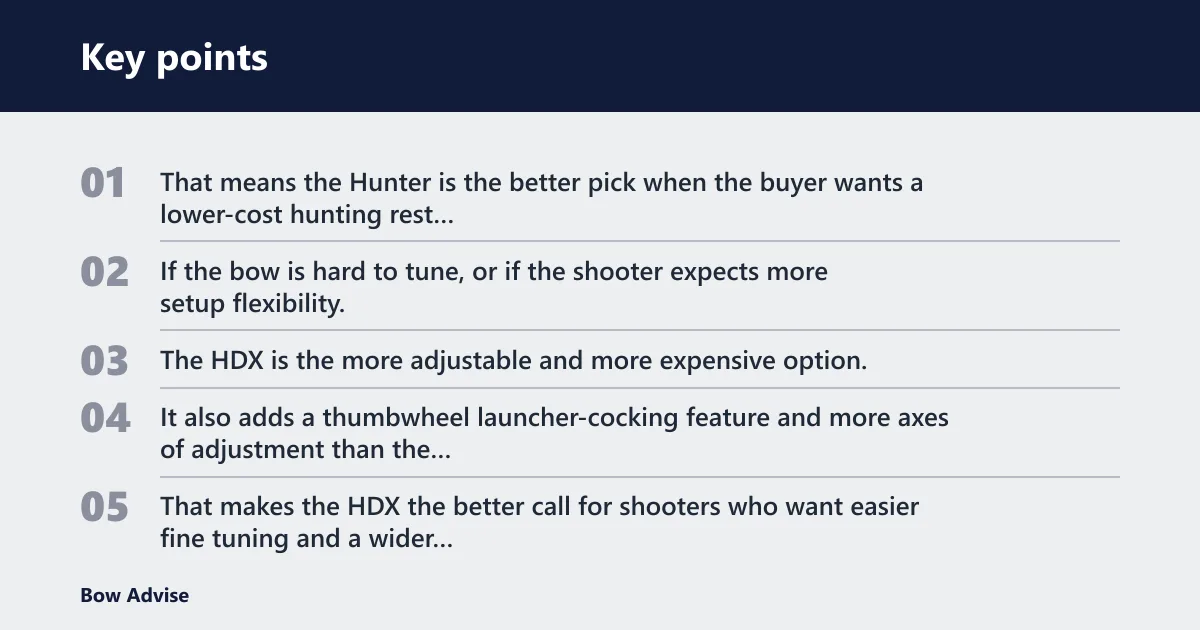
That means the Hunter is the better pick when the buyer wants a lower-cost hunting rest and does not need the adjustment range of the HDX or the broader timing control approach of the MXT. If the bow is hard to tune, or if the shooter expects more setup flexibility, stepping up makes more sense.
Hunter vs HDX
The HDX is the more adjustable and more expensive option, with a published price of $219.99 from Antler River Archery. It also adds a thumbwheel launcher-cocking feature and more axes of adjustment than the Hunter. That makes the HDX the better call for shooters who want easier fine tuning and a wider correction range.
The Hunter still makes sense when the buyer wants the essentials without paying for extra adjustment hardware. The trade-off is simple: less money up front, but less room to fix difficult setups later.
Hunter vs MXT
The MXT takes a different route with magnetic timing control and a standard dovetail mounting system. That points to a more flexible, more configurable rest for shooters who may want to move it between bows or tune timing with more control. It is not simply “premium”; it is built around a different adjustment philosophy.
Compared with the Hunter, the MXT is the better fit for a bowhunter who expects to swap setups or work around more complex tuning needs. The Hunter remains the simpler answer for a single hunting bow that already sits close to tune.
Who should step up?
Step up to HDX or MXT if the bow has repeated vane contact, if the cable geometry makes the Hunter hard to time, or if the shooter wants more room for adjustment after the rest is mounted. Those are the situations where a budget drop-away can feel too narrow in function.
Suppose a hunter changes broadhead style and sees inconsistent clearances after the swap. That does not automatically mean the Hunter is bad. It may mean the bow needs a rest with more adjustment range, or the setup needs shop-level correction rather than a simpler containment solution.
Alternatives
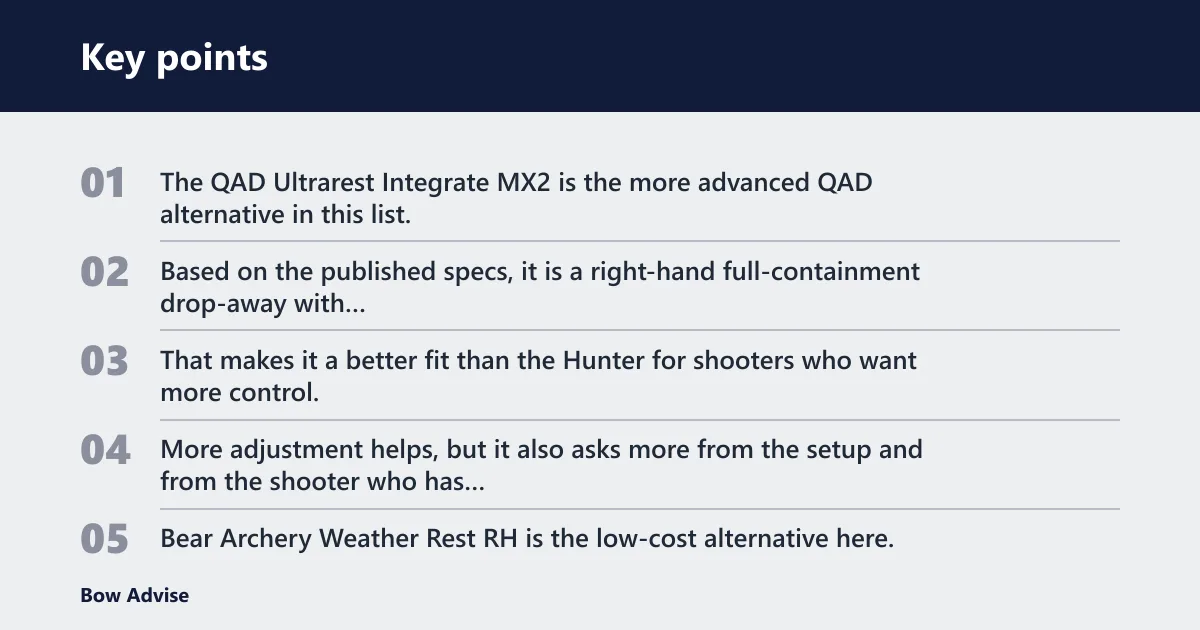

The QAD Ultrarest Integrate MX2 is the more advanced QAD alternative in this list. Based on the published specs, it is a right-hand full-containment drop-away with micro-adjustable tuning, anti-vibration dampers, and total containment that holds arrows at an 80° angle. That makes it a better fit than the Hunter for shooters who want more control, but it is also a much higher-priced step at $259.99.
The drawback is cost and complexity. More adjustment helps, but it also asks more from the setup and from the shooter who has to dial it in correctly.

Bear Archery Weather Rest RH is the low-cost alternative here. It is far cheaper than a QAD containment rest, so it can appeal to a bare-bones hunter or a backup bow setup. The downside is obvious: it does not give the same drop-away behavior, containment security, or tuning benefit that the Hunter is built to provide.
For a hunter who wants a serious drop-away rest, this is a compromise choice rather than a like-for-like substitute.
Should you buy it?
Buy the QAD UltraRest Hunter if you want a budget drop-away for hunting, value full arrow containment, and are working with a bow that already sits close to tune. It is a practical choice for treestand, blind, or mobile hunting when the goal is dependable containment and clean fletching clearance without premium-rest pricing.
Skip it if your bow needs repeated correction, if you want broader adjustment travel, or if you know your setup is sensitive to timing changes and cable routing. In that case, the HDX or MXT is the better fit because the extra adjustment range is what actually solves the problem.
Frequently asked questions
Do I need a bow press to install the QAD UltraRest Hunter?
Usually, yes, or at least some safe way to manage cable tension. The rest uses a lower cable attachment and timing cord adjustment, so a bow press makes installation and timing much easier. After mounting, the launcher should be checked at full draw and verified for clearance.
Will a budget drop-away rest hurt arrow flight or accuracy?
Not by itself. A budget drop-away can shoot cleanly if it is timed correctly and the rest matches the bow. The risk comes from setup mistakes, not from the price tag alone. Poor timing, poor center-shot setup, or awkward cable geometry can create vane contact and inconsistency.