Decoding Your Bear Compound Bow Serial Number Guide
A Bear compound bow serial number narrows the model and year, but I never buy on that code alone. I match it against the riser, cam style, axle-to-axle length, draw-length range, and limb specs. Miss that check and you can overpay for a bow that is mislabeled, or end up with a draw length that never fits. I’ll show you how I verify a used Bear bow, read the serial number, and cross-check age, specs, and condition before money changes hands.
This guide is part of our Bow types and care: choosing, shooting, and upkeep series.
What a Bear compound bow serial number can tell you
A Bear compound bow serial number can sometimes narrow the bow’s production era, but it is only one piece of the puzzle. On older and newer Bear Archery bows, the serial may sit beside model markings, and the format can change by year and model. I use it as a starting point, then verify the rest.
Serial number vs. model number vs. spec labels
These markings do different jobs. The serial number identifies one bow or one production run, while the model number or model name tells you the platform, axle-to-axle length, and performance class. Spec labels usually carry draw weight, draw length range, or limb information. Buyers mix them up all the time, and that mistake leads to bad purchases.
When I check a used compound bow, I separate three questions: what bow is it, what year or era is it from, and does it fit me? A serial can help with the first two. The spec label helps with the third.
What the serial can help verify
The serial can help verify whether the bow matches the seller’s claim, whether it lines up with available Bear catalog information, and whether the parts look period-correct. If the serial format and markings fit the model year, that is a good sign. If they do not, I slow down fast.
What it cannot prove on its own
A serial number alone does not prove draw fit, safe function, or a clean ownership history. It also does not prove that the limbs, cams, or strings are original. I have seen bows where the frame looked right but the cam set was swapped, and that changed the whole story.
Where to find the serial number on a Bear bow
On a Bear compound bow, the serial number is often found on the riser, near the limb pocket, or on a sticker on or near the limb pocket or limb side. Older bows may have faded stickers, stamped markings, or worn printing. If the surface has scratches, paint chips, or tape residue, read carefully before trusting what you see.
Riser markings
The used-bow riser is the first place I inspect. Look along the grip area, upper and lower riser, and any flat machining surface where Bear Archery often placed model and serial markings. Dirt, glare, and camouflaged finishes can hide the code. I wipe the area gently and use angled light before I decide it is missing.
Limb pocket and sticker areas
Some Bear bows place identification near the limb pocket or on a sticker area close to it. Sticker loss is common on older bows, especially if the bow lived in a truck, basement, or hot gear room. If the label is half gone, I photograph it anyway. A partial code can still help when matched with catalog records.
What worn or altered markings look like
Look for uneven sanding, fresh paint around the marking, scratched-off printing, or a label that sits at a strange angle. Those are not automatic deal-breakers, but they deserve questions. I also watch for labels that look too clean on an otherwise beat-up bow. That mismatch often means the part was replaced or touched up.
How do I decode the year and model?
I decode the year and model by starting with the model name, then checking the serial format against Bear catalog archives and old spec sheets. For Bear bows, the exact year is not always obvious from the serial alone. Production era matters more than forcing a fake-certain date when the markings are incomplete.
Use the model name first
The model name usually narrows the search faster than the serial. Once I know the model, I can compare axle-to-axle length, brace height, cam type, and listed draw range against archive information. That is where some listings fall apart. A seller may call a bow one model, but the numbers point to another.
Cross-check with Bear catalog archives
Bear catalog and archive lookup is where the serial becomes useful. I compare the bow’s naming style, logo placement, and spec pattern with archived model years. If the archery shop or seller says the bow is from one era but the cam package and sticker style match another, I treat the listing as unverified until I get better proof.
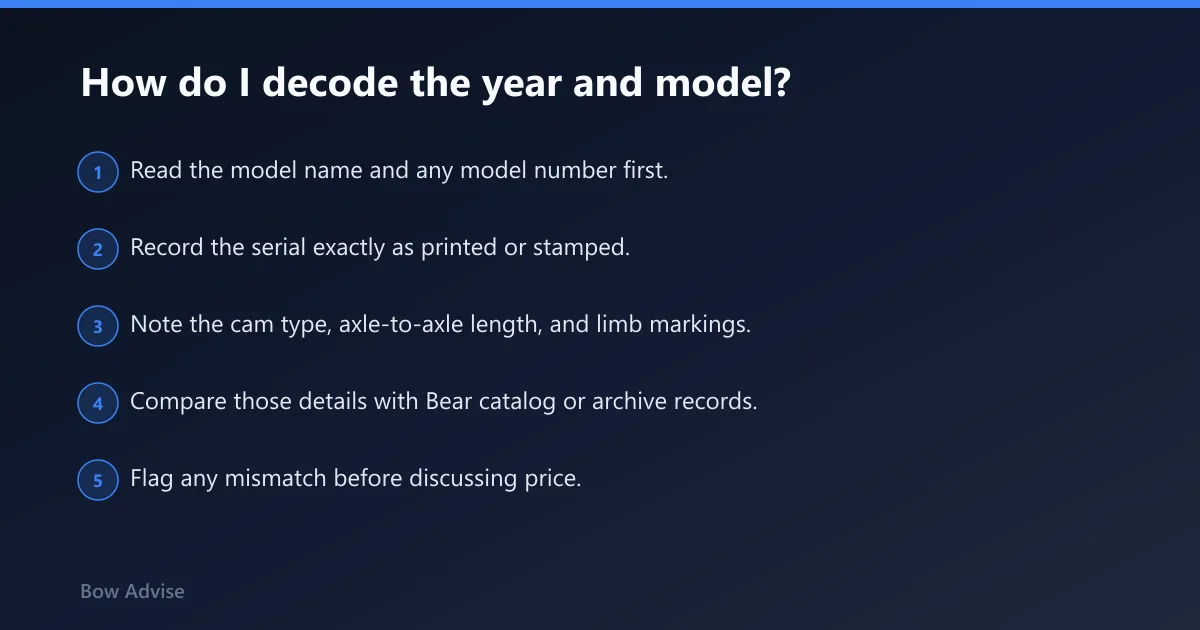
Here is the method I use:
- Read the model name and any model number first.
- Record the serial exactly as printed or stamped.
- Note the cam type, axle-to-axle length, and limb markings.
- Compare those details with Bear catalog or archive records.
- Flag any mismatch before discussing price.
When production era matters more than an exact year
Sometimes I can narrow a bow to a range rather than a single year. That is still useful. Production era tells me which cam system, limb design, and parts family I should expect. If the bow is older, I care more about whether replacement parts still exist and whether the limbs and cams match that era.
How can I verify a used Bear bow is authentic?
I verify authenticity by matching the markings to known Bear naming patterns, checking whether the finish and parts agree with the claimed model year, and looking for signs of tampering or parts swapping. A real Bear bow can still be a bad buy. Authenticity is only one layer of the check.
Match markings to known Bear naming patterns
Bear Archery usually follows recognizable model naming conventions. The brand marking, model label, and serial format should all make sense together. If a listing mixes a model name from one era with a serial style from another, I slow the deal. The same rule applies here: the details have to fit together.
Check whether the finish, parts, and labels agree
A legit bow should look internally consistent. The finish wear should match the age claimed. The cams should match the generation of the bow. The limb pockets, labels, and grip style should all point in the same direction. A polished riser with corroded hardware can mean replacement parts or hard use, and I want that explained.
Flag signs of tampering or parts swapping
Fresh tool marks on limb bolts, scraped screw heads, odd shims, mismatched cams, or a label that looks re-applied are warning signs. I also check whether the string stop, cable guard, and cam set look like they belong together. Parts swapping is common in used bows, and it can change timing, tune, and safety.
What to inspect before buying the bow
Before I buy a used Bear compound bow, I inspect the riser for cracks, the limb pockets for wear, the strings and cables for age, and the cams for timing and damage. Fit and condition travel together.
Used bow riser wear and cracks
Start with the riser. Look for hairline cracks near the grip, limb bolts, sight holes, and stabilizer bushing. Surface scratches are normal. Cracks are not. If the riser shows impact marks or bent hardware, I walk away unless a trusted shop can inspect it in person.
Limb pockets and limb condition
Inspect the limb pocket / limb sticker area for separation, spreading, missing material, or signs the limb has shifted. On older bows, stickers can disappear, but pocket wear still tells a story. I want clean pocket contact, no uneven gaps, and no signs that one limb is twisted more than the other.
Bowstring, cables, cams, and timing
Bowstring and cables tell me how the bow has been treated. Fuzzing, serving separation, deep grooves, or dry, chalky material usually means replacement is near. Then I check cam timing. A single-cam, hybrid, or dual-cam Bear bow may tune differently, and the cam system affects parts compatibility and age clues. If the seller cannot explain the replacement history, I assume the maintenance record is weak.
Can the serial number tell me draw weight or draw length?
Not reliably. Draw weight and draw length are often printed on the bow, listed on limb stickers, or shown in the model specs, rather than being decoded from the serial alone. I always verify both against seller claims because they affect fit, safety, and whether the bow is usable without extra parts.
Where spec info is usually printed
Look on the limbs, limb stickers, or the riser area near the model markings. Some bows list draw length range and peak weight right on the limb. Older bows may have faded or partly removed labels, so I photograph every visible spec before I leave the seller’s house or the shop counter.
How to verify draw weight
Do not trust a verbal claim by itself. Compare the printed limb rating with the current limb bolt position and, if possible, a scale reading at a shop. If the bow feels wildly heavier or lighter than stated, something may be off with the limbs, bolts, or label. That is a negotiation point, not a minor detail.
How to confirm draw length and adjustability
Check the cam modules or rotating modules, then compare them with the model’s draw-length range in Bear archives. Some bows adjust within a range, but not every Bear bow fits every archer. I always confirm the actual draw length setting before I hand over money, because a wrong fit turns a good deal into a shelf ornament.
Used-bow verification checklist for Bear compound bows
This is the workflow I use on a used Bear bow, and it covers a set of inspection points. It keeps me from buying on hope. I start with the markings, then I move to condition, then I decide whether the bow is worth a shop check, a price cut, or a hard pass.
| Inspection point | What I check | Action if it fails |
|---|---|---|
| 1. Serial number | Readable, consistent format, and placed on riser or limb area | Ask for more photos or pass |
| 2. Model name / model number | Matches Bear archive naming and spec family | Verify before negotiating |
| 3. Draw weight marking | Matches seller claim and limb rating | Negotiate or pass |
| 4. Draw length setting | Fits me and matches cam/module setup | Pass if it cannot be adjusted |
| 5. Riser condition | No cracks, bends, or fresh grind marks | Pass |
| 6. Limb pockets | No spreading, chips, or uneven contact | Pass or confirm with shop |
| 7. Limbs | No splinters, delamination, or twist | Pass |
| 8. String and cables | Serving wear, fray, and replacement history | Budget for replacement |
| 9. Cams and timing | No damage, wobble, or mismatched set | Confirm with shop |
| 10. Ownership proof | Seller history, receipt, serial photos, and ID match | Pass if story is weak |
Photo requests to send the seller
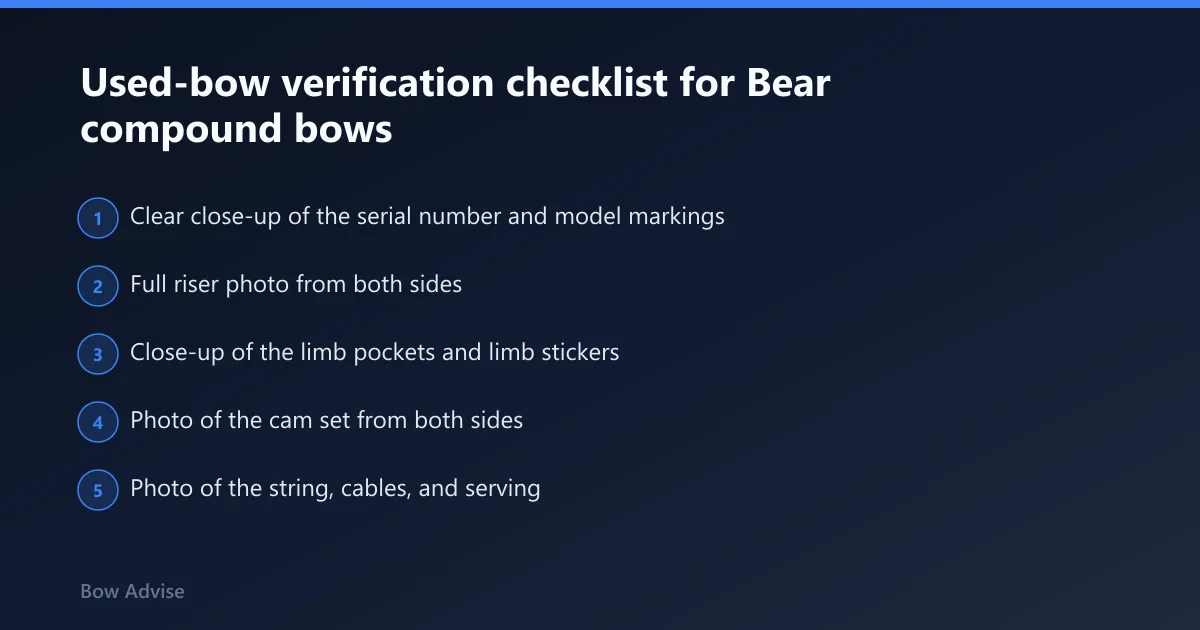
I ask for photos before I drive anywhere. That saves time and filters out vague listings. Ask the seller for a few photos and details:
- Clear close-up of the serial number and model markings
- Full riser photo from both sides
- Close-up of the limb pockets and limb stickers
- Photo of the cam set from both sides
- Photo of the string, cables, and serving
- Photo of the draw weight and draw length markings
- Any receipt, shop tag, or service record
Decision grid: pass, negotiate, or confirm with Bear
Pass if the serial is missing and the bow also shows cracks, mismatched parts, or a bad ownership story. Negotiate if the markings are readable but the strings need replacement, the finish is rough, or the spec labels are worn. Confirm with Bear Archery if the model is unclear, the serial format looks odd, or the bow is older and the archive match is uncertain.
How do I avoid buying a stolen or altered Bear bow?
I reduce that risk by checking the serial, asking for the seller’s story, and comparing the bow’s details with the paperwork and photos. If the serial plate looks tampered with, the seller cannot explain ownership, or the details keep changing, I stop. A cheap bow is still too expensive if it brings trouble.
Ask whether the seller is the original owner, whether the bow was serviced by a shop, and whether they still have a receipt or work order. If the story sounds rushed, vague, or inconsistent, I treat the bow as questionable. I also check that the serial has not been scratched, ground down, or moved to another part.
What Bear bow details should I ask the seller for?
I ask for the serial number, model name, draw weight, draw length setting, cam type, string replacement history, and recent service records. That gives me enough to compare the bow against Bear archives and decide whether to keep talking. If a seller cannot answer basic setup questions, I assume the bow was not maintained carefully.
Before I meet, I also want photos of the riser, limb pockets, cams, and markings. If they can send those without hesitation, that is a good sign. If they push back on simple photos, I move on.
Frequently asked questions
How do I find the serial number on a Bear compound bow?
Look on the riser first, then inspect the limb pocket area and any sticker or label near the limbs. On older Bear bows, the marking may be stamped, printed, or partly worn off. I use angled light and wipe away dirt before I decide the serial is truly missing.
How do I tell what year my Bear compound bow was made?
Start with the model name, then compare the serial format, cam style, and spec markings against Bear catalog archives. The serial alone may only narrow the production era. If the bow is older, I care more about matching the model family than forcing an exact year from one code.
What if the serial number is missing, worn, or unreadable?
Do not stop there. Use the model name, cam type, limb markings, and riser details to narrow the bow. Then ask the seller for older photos, service records, or a shop receipt. If the bow also has cracks, tampering, or a weak ownership story, I pass.
Where is the model name on a Bear compound bow?
The model name is usually on the riser, near the serial marking, or on a label close to the limb pocket or grip area. Some Bear bows also have a separate model number. I read both, because the model name and the serial number do different jobs.
Can I use the serial number to check draw weight or draw length?
Not by itself. Draw weight and draw length are usually printed on the bow or listed in the model specs. I verify the actual setting, check the limb rating, and compare it with what the seller claimed. If the fit is wrong, the serial number does not save the deal.