Safety Harness vs Tree Rope for Stand Hunting
For most stand hunting, use both systems: the full-body harness helps arrest a fall, while the tree rope keeps you tied in and steady during the climb. This guide separates each task and shows how ladder, hang-on, and climber setups change the answer.
| Decision factor | Safety Harness | Tree Rope for Stand Hunting | Winner |
|---|---|---|---|
| Primary job | Fall arrest from the ground up and back down | Attachment during climb and descent | Safety Harness |
| Best phase | Sit, climb, descend | Climb, descend | Safety Harness |
| Stand-alone use | Can protect against a fall when fitted correctly | Cannot replace full-body fall arrest | Safety Harness |
| Setup burden | Wear before leaving the ground and keep on until back down | Must be installed on the tree or stand, often for the season | Safety Harness |
| Climbing control | Works with a lineman’s belt for hands-free movement | Works with a Prusik knot and carabiner for tied-in ascent | Tie |
| Bow-draw mobility | Vest and waist styles can help movement | Does not solve draw clearance by itself | Safety Harness |
Why the distinction between harness and rope matters
A full-body harness and a tree rope do different jobs. The full-body harness should stop a fall. The tree rope is the connection system that keeps a hunter tied in while climbing or descending, but it is not a substitute for the harness.
That split matters because climbing risk and fall-arrest risk are different problems. A rope can keep you attached to the tree while you move upward. A full-body harness, worn from the ground to the stand and back, is what you want if the tree gives way or a tied-in move goes wrong.
Why the distinction matters
Most failures happen when a hunter treats one part like the other. A rope without a full-body harness leaves no real fall-arrest system. A full-body harness without a climb connection leaves a gap during ascent and descent, especially on hang-on and ladder setups where hands are busy.
Say your hang-on stand is about 18 feet up and the tether is twisted above shoulder height. The hunter may feel connected, but the wrong attachment height can create slack or poor body position if a slip happens. The fix is not more rope, it is correct harness fit plus the right tree connection.
Side-by-side setup comparison
The practical choice depends on phase, not brand names. On the way up, the lineman’s belt and tree lifeline manage movement. While seated, the full-body harness is the fall-arrest system. During the climb down, the same system stays on, and the lifeline or lineman’s belt is used for the setup that calls for it.
| Setup item | What it does | Used during | Best fit |
|---|---|---|---|
| Full-body tree stand safety system | Captures the body to arrest a fall; often has shoulder, leg, and torso straps | Ground, climb, sit, descend | Ladder, hang-on, climber |
| Tree lifeline / safety rope | Keeps the hunter attached while moving up or down; commonly uses a Prusik knot and carabiner | Climb, descend | Ladder, hang-on, climber |
| Lineman’s belt | Allows hands-free work while climbing or hanging stands | Climb, stand setup | Hang-on, ladder, some climber work |
| Suspension relief strap | Helps reduce leg pressure after a fall while waiting for rescue | After a fall | All stand users who wear a harness |
Climb
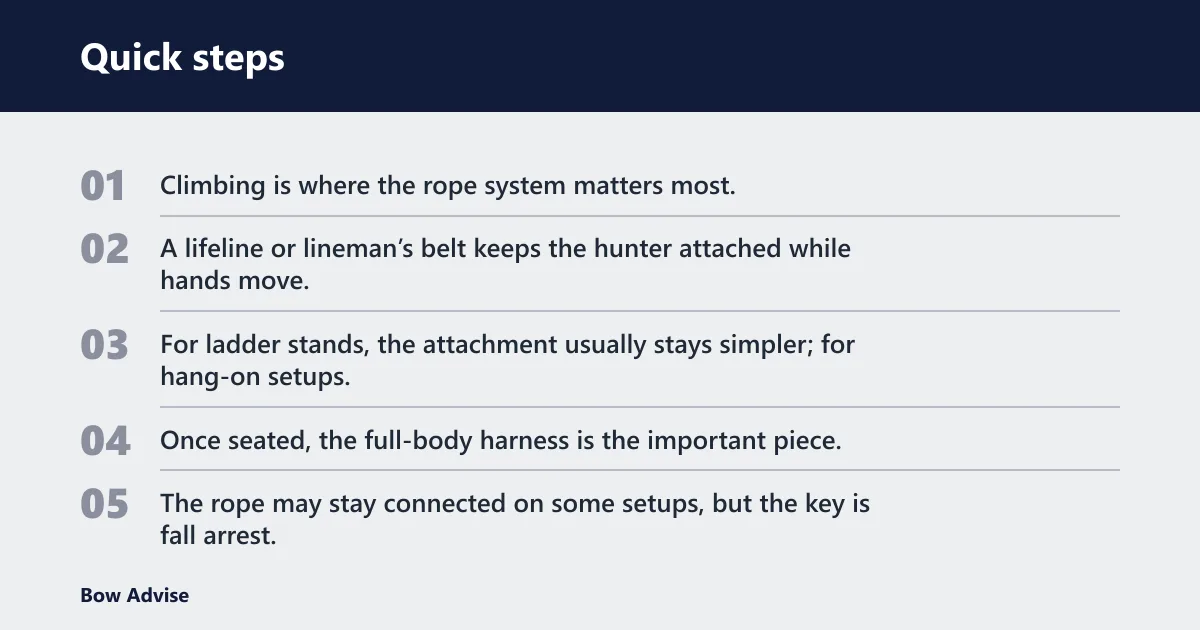
Climbing is where the rope system matters most. A lifeline or lineman’s belt keeps the hunter attached while hands move, but the full-body harness still needs to be on first. For ladder stands, the attachment usually stays simpler; for hang-on setups, the climb phase is where the rope earns its place.
Sit
Once seated, the full-body harness is the important piece. The rope may stay connected on some setups, but the key is fall arrest, not upward movement. A full-body harness with correct fit over hunting layers is what matters here, along with a tether set at the right height and not twisted.
Descend
Descending repeats the same risk as climbing. The full-body harness stays on until both feet are back on the ground. A lifeline can still help on the way down if the stand system is built for it, but it never replaces the fall-arrest job of the full-body harness.
Which gear fits each stand type?
The answer changes with the stand. Ladder stands usually make the lifeline easier to install and follow. Hang-on stands depend most on a lifeline and lineman’s belt. Climbers still need a safety harness, and a rope system only makes sense if the stand and tree setup support it safely.
Ladder stands
Ladder users should wear a full-body harness before leaving the ground and keep it on until back down. A lifeline can help during the climb if it is installed for the season, but the ladder itself does not remove the need for fall protection. The main risk is assuming the ladder is safe enough on its own.
Hang-on stands
Hang-on stands are where the complete tree stand safety setup matters most. The full-body harness, lifeline, lineman’s belt, tree strap, and suspension relief strap all have clear jobs. A rope without a harness leaves the hunter unprotected if the platform or a step fails.
Climbers
Climbers still need a full-body harness from ground to ground. Some climber users skip the rope because the stand moves with the user, but that does not remove fall risk. A tied-in connection and correct fit still matter when the stand is being adjusted or when the hunter is settled in the tree.
Tree stand safety setup matrix
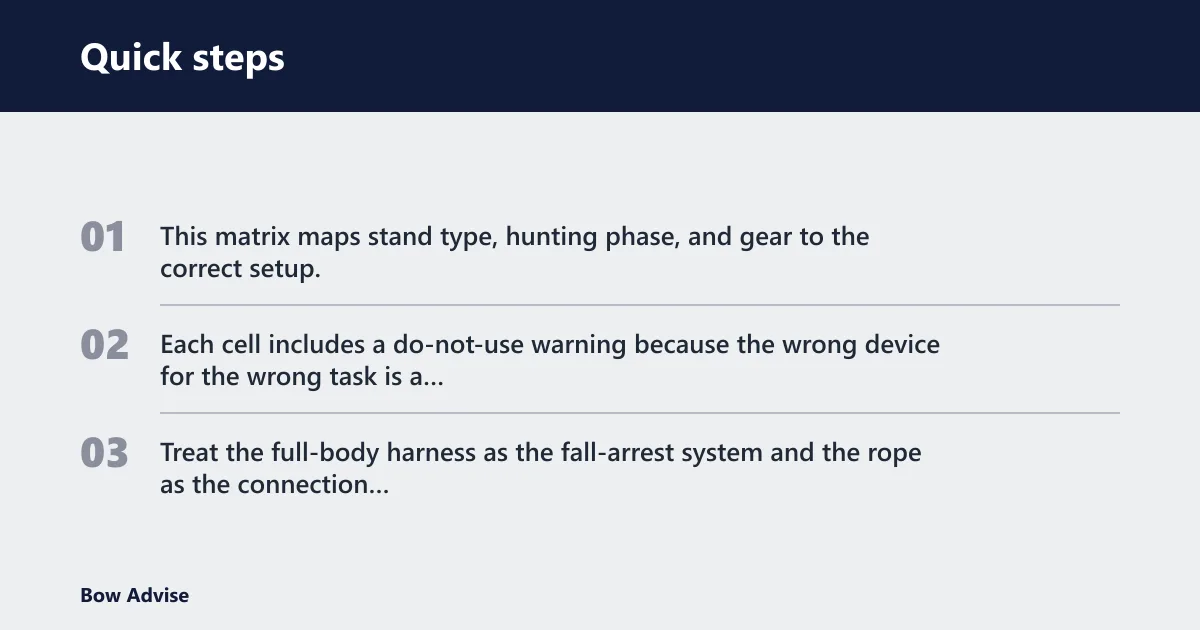
This matrix maps stand type, hunting phase, and gear to the correct setup. Each cell includes a do-not-use warning because the wrong device for the wrong task is a common failure point. Treat the full-body harness as the fall-arrest system and the rope as the connection system.
| Stand type | Phase | Correct gear choice | Do not use if |
|---|---|---|---|
| Ladder | Climb | Safety harness + lifeline rope | Do not use a rope alone or skip the body-capture system. |
| Ladder | Sit | Safety harness + tether set correctly | Do not use a climbing rope as the only fall protection. |
| Ladder | Descend | Safety harness + lifeline rope | Do not remove the system before reaching the ground. |
| Hang-on | Climb | Safety harness + lineman’s belt + lifeline rope | Do not climb hands-free without a lineman’s belt. |
| Hang-on | Sit | Safety harness + tether + suspension relief strap available | Do not sit with no fall-arrest attachment. |
| Hang-on | Descend | Safety harness + lifeline rope | Do not assume the platform alone keeps you safe. |
| Climber | Climb | Safety harness + lifeline rope or tree connection as designed | Do not use a rope that is not rated for hunter weight. |
| Climber | Sit | Safety harness + tether | Do not leave the system loose or twisted. |
| Climber | Descend | Safety harness + lifeline rope | Do not climb down with no connection to the tree. |
When do you need a lineman’s belt?
A lineman’s belt is for hands-free work while climbing or hanging a stand. It lets the hunter stay attached to the tree with weight spread around the waist and hips while both hands handle sticks, steps, or platform adjustment. It is not the same job as a seated tether.
Correct attachment and adjustment matter. Too loose, and the hunter can lean too far off the tree. Too high, and it can interfere with movement. The belt belongs to the climb and setup phase, not the sitting phase, and it should be used with the safety harness system it was designed to support.
Common failure cases with a lineman’s belt
- Attaching above the working position, which can pull the body off balance.
- Leaving the belt slack while both hands are busy, which allows a larger slip.
- Using it as the only fall-arrest system, which it is not built to do.
How lifelines and prusik knots work
A lifeline is a season-long attachment line installed on the tree or stand so the hunter can stay connected from the first step up to the last step down. The Prusik knot is generally described as sliding when loaded lightly and grabbing when loaded suddenly. That sliding-and-stopping behavior is why it is used on many rope-style stand systems.
On the HSS Lifeline, the rope is described as 30 feet with a Prussic knot and carabiner, and it is designed for tree stands up to 30 feet. That setup is meant to give a moving connection during ascent and descent, not replace the full-body safety harness.
Set it before the season
Season-long installation reduces the chance of skipping the connection on a rushed morning. It also keeps the hunter from trying to rig a rope in the dark while already on the tree. For ladder, hang-on, and climber users, that pre-hung line is part of a safer routine.
Suppose a hang-on stand sits about 24 feet up and the lifeline was never installed. The hunter may still wear a safety harness, but the climb has a gap. Adding the line before season solves the attachment gap; it does not change the need for a full-body harness with the correct tether setup.
What makes a harness safe?
A safe tree stand harness fits over hunting layers, stays adjusted, and is built for the stand task. A full-body model often uses shoulder, leg, and torso straps, which helps spread force better than a simple belt-style device. Treestand Manufacturers’ Association standards are commonly used as a benchmark for harness and treestand safety gear.
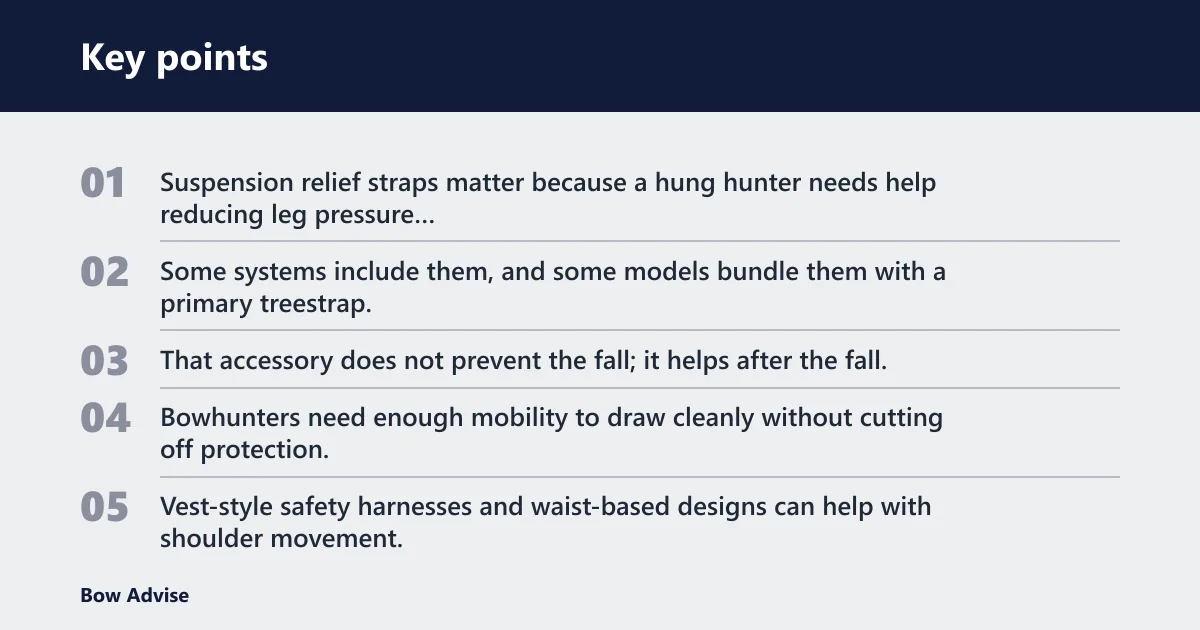
Suspension relief straps matter because a hung hunter needs help reducing leg pressure while waiting for rescue. Some systems include them, and some models bundle them with a primary treestrap. That accessory does not prevent the fall; it helps after the fall.
Fit and mobility for drawing a bow
Bowhunters need enough mobility to draw cleanly without cutting off protection. Vest-style safety harnesses and waist-based designs can help with shoulder movement, and padded shoulder straps may feel better over layers. The key is not just comfort. It is whether the system stays in position while drawing and leaning.
The Hunter Safety System X-1 Bowhunter is described as a vest-style system built for bow-draw mobility. The Muddy Magnum Elite is listed at 1.5 pounds. The Summit Treestands Pro system uses padded shoulder straps, a torso strap, MOLLE attachment loops, and waist-based sizing.
Tma standards and example harness styles
Outdoor Life says it tested how easy it was to draw and shoot a bow while wearing each system, and it says all systems on its list met or exceeded TMA safety requirements. That matters because comfort should never come at the cost of safety benchmarks.
Examples help show style differences, not endorsements. A vest-style system such as the X-1 points toward draw mobility. A waist-based system such as the Summit model points toward storage and fit control. A budget-oriented bundle such as the Muddy Magnum Elite may include a lineman’s belt, tree strap, and relief strap, which helps some hunters cover more of the full setup at once.
Choose Safety Harness if… / Choose Tree Rope for Stand Hunting if…
Choose Safety System if your main concern is fall arrest, you want one piece that stays on from ground to ground, or you need a full-body fit over hunting layers. It is the right pick for sitting in the stand, drawing a bow, and surviving a slip that happens after the climb.
Choose Tree Rope for Stand Hunting if your main concern is staying tied in while climbing or descending, especially on a hang-on or ladder setup with a preinstalled lifeline. It is the right connection system for ascent control, but it should be used with a full-body safety harness, not instead of one.

Frequently asked questions
Do I need a safety harness or tree rope for bowhunting from a stand?
For most stand hunting, you need both functions: the full-body harness for fall arrest and the tree rope for climb-time attachment. The rope helps you stay tied in; the harness is the part that is meant to catch a fall.
What is the difference between a tree stand harness and a lifeline rope?
A tree stand harness is worn on the body and is meant to stop a fall. A lifeline rope is attached to the tree or stand and keeps the hunter connected during the climb or descent. One is the body system; the other is the connection system.
Can I use a climbing rope instead of a harness in a tree stand?
No. A climbing rope can be part of a connection system, but it is not a full-body fall-arrest device by itself. A rope without the safety harness leaves the hunter without the body support needed if a slip or platform failure happens. Use the right harness first.
What safety gear is required when climbing into a tree stand?
Wear a full-body harness before leaving the ground, then use the setup the stand calls for: a lifeline rope, a lineman’s belt, or both. On hang-on and ladder setups, the lineman’s belt helps hands-free movement; the lifeline helps keep the hunter attached during the climb.
Which is safer for bowhunting: a full-body harness or a rope system?
The full-body harness is safer because it is the fall-arrest system. The rope system is valuable, but mainly as an attachment line for climbing and descending. The safest practical answer for stand hunting is to use both together, with each one doing its own job.
Do I need a lineman’s belt and a lifeline, or just one of them?
They solve different climb-stage problems. A lineman’s belt helps with hands-free climbing or hanging the stand. A lifeline keeps you tied in while moving up or down the tree. Many bowhunters benefit from both on hang-on setups, while some ladder or climber situations may use one more heavily than the other.