What is Olympic Archery? Rules, History, and How to Get Started
Every four years, Olympic archery captures the world’s attention with its mix of skill, focus, and tradition. It’s a sport that looks simple on the surface, a person shoots arrows at a target, but behind each shot is a story of discipline, precision, and years of preparation.
If you’ve ever wondered what Olympic archery is, how it works, and what makes it different from other forms of archery, this article is for you. I’ll break down the rules, equipment, history, and what it takes to compete at the highest level.
Even if you’re new to the sport, you’ll walk away with a clear understanding of Olympic archery, plus a few insider tips that most beginners miss.
The Origins And Evolution Of Olympic Archery
Archery is one of the world’s oldest sports, dating back thousands of years. People first used bows and arrows for hunting and war, but over time, archery became a test of skill and accuracy. The modern form of archery, as seen in the Olympics, is rooted in the target archery style.
Olympic archery first appeared at the 1900 Paris Games, but it was not included in every Olympics after that. The sport returned permanently in 1972 with standardized rules, thanks to the efforts of the World Archery Federation (WA). The inclusion of women’s events and team competitions expanded the sport’s appeal and diversity.
Today, Olympic archery is watched by millions, with athletes from over 80 countries competing. The sport has grown from a niche pastime into a global competition, with national programs, youth development, and even tech innovations like electronic scoring.
Olympic Archery Events And Competition Format
At the Olympics, archery follows strict formats to ensure fairness and excitement. The main events are:
- Individual events for men and women
- Team events (three archers per country)
- Mixed team events (one man, one woman)
All Olympic archery competitions use the recurve bow, no compound, traditional, or longbows are allowed.
How The Competition Works
Olympic archers compete in a knockout-style tournament. First, they shoot a ranking round to determine seeding. Each archer shoots 72 arrows at a target 70 meters away, and their total score ranks them from highest to lowest.
After the ranking round, archers face off one-on-one in match play. Each match uses a “set system”, the first archer to win three sets (best of five) moves on. In team events, three archers shoot alternately, and the highest-scoring team advances.
Example: Olympic Archery Match Flow
- Ranking round: 72 arrows per archer, total score ranks all competitors
- Elimination rounds: Head-to-head matches using the set system
- Finals: Gold medal match between top two archers or teams
This format creates drama and unpredictability. An underdog can defeat a favorite in a single match, and every arrow counts.
The Olympic Archery Target: Size And Scoring
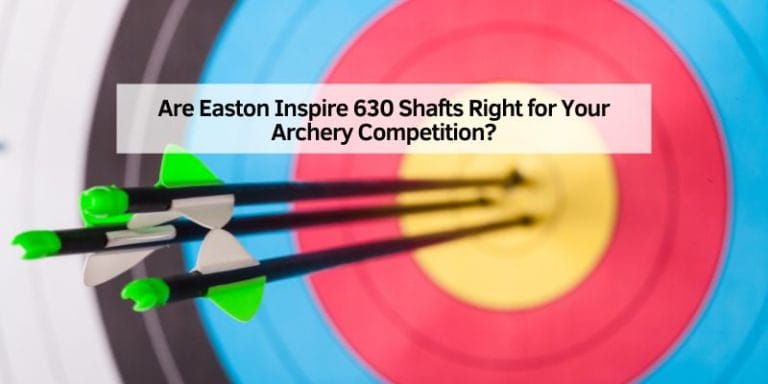
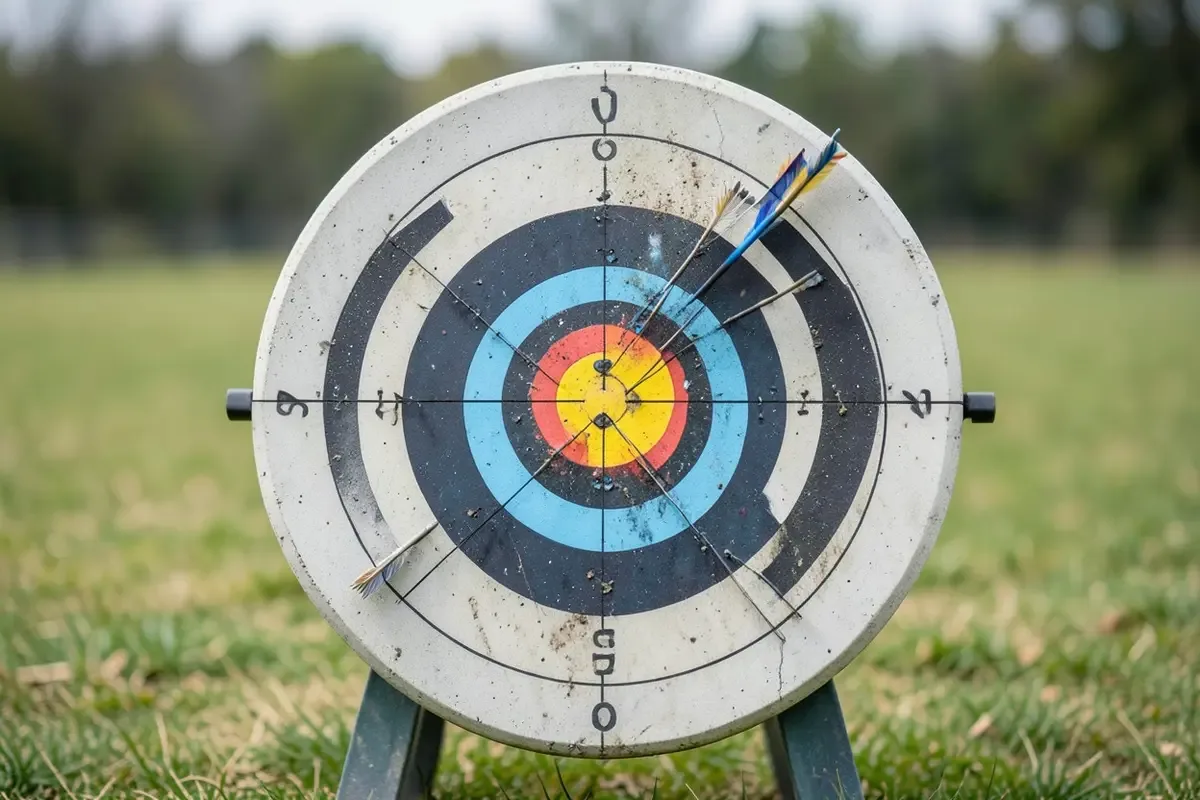
The Olympic archery target is instantly recognizable: a set of concentric colored rings, each with a different point value.
| Ring Color | Points | Diameter (cm) |
|---|---|---|
| Gold (center) | 10, 9 | 12.2 |
| Red | 8, 7 | 24.4 |
| Blue | 6, 5 | 36.6 |
| Black | 4, 3 | 48.8 |
| White | 2, 1 | 61.0 |
The 10 ring is only 12.2 cm across, about the size of a CD, yet archers must hit it from 70 meters away. The smallest mistake can cost points and change the outcome of a match.
Pro Tip: Olympic archers often train to group arrows within a few centimeters at 70 meters. Beginners underestimate how hard this is, especially outdoors with wind.
Equipment Used In Olympic Archery
Olympic archers use specialized gear to maximize accuracy and consistency. Every item is regulated by World Archery rules.
The Recurve Bow
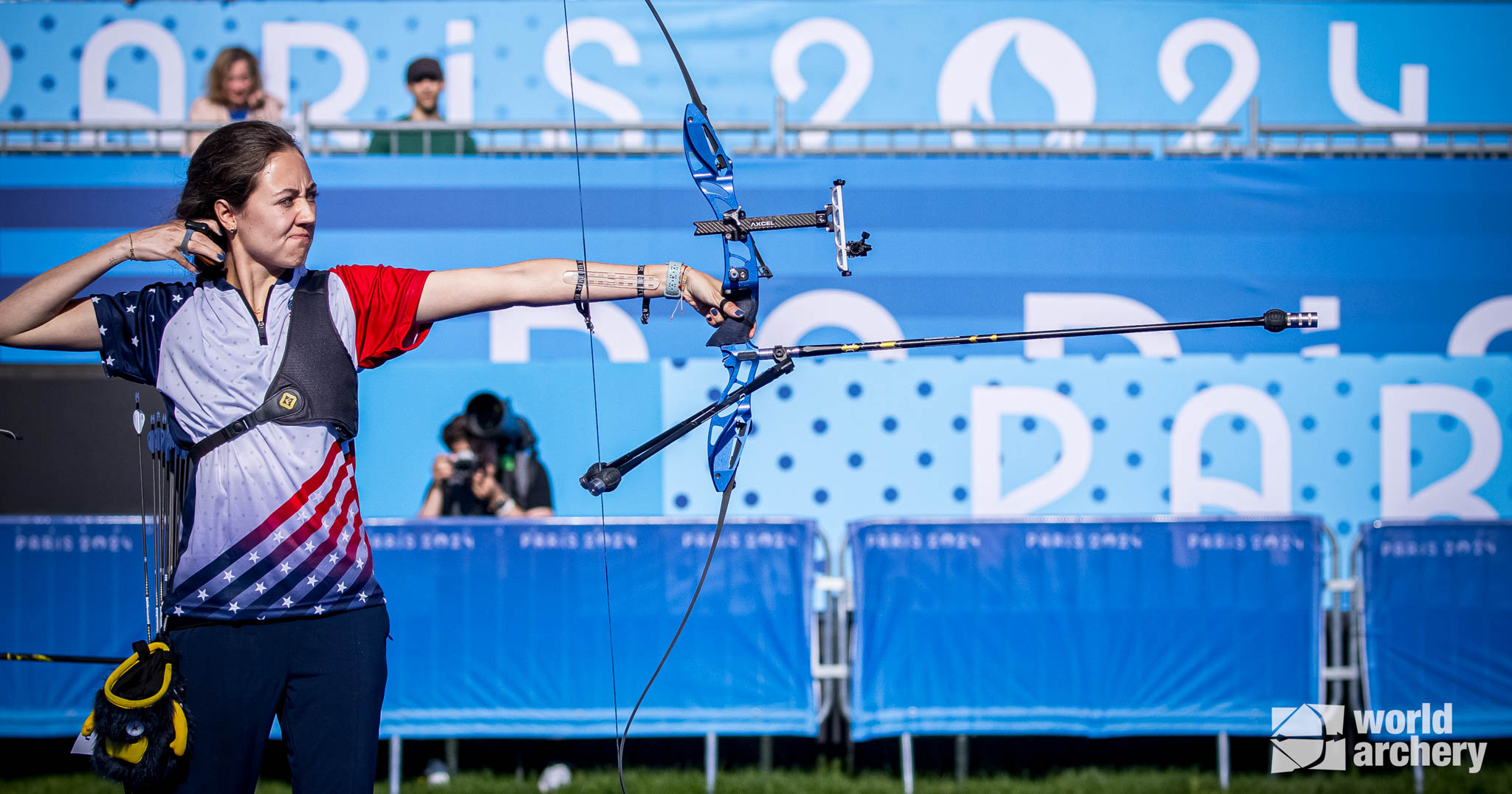
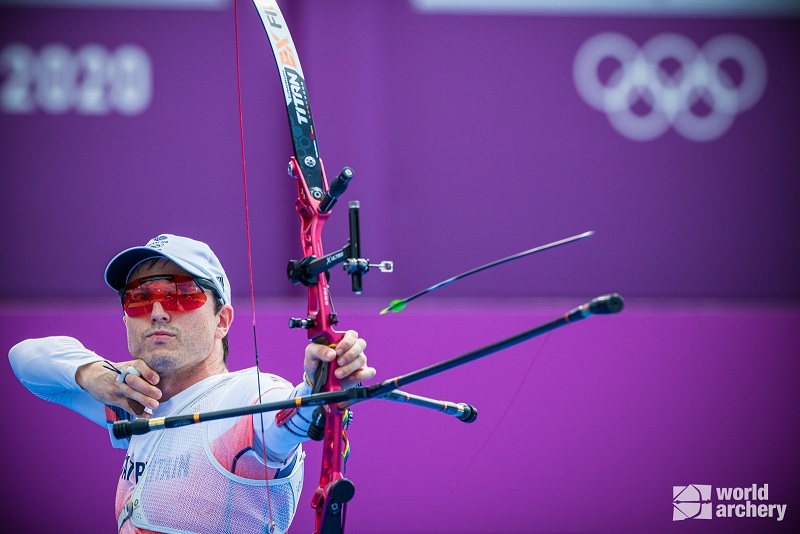
The only bow allowed in Olympic archery is the recurve bow. It’s named for its curved tips, which help store and release energy efficiently. Modern recurve bows are made from lightweight materials like carbon fiber and aluminum.
A typical Olympic recurve bow has:
- Riser (the central handle): Usually metal or carbon
- Limbs: Flexible, made of composite materials
- Sight: Adjustable for aiming
- Stabilizers: Rods that balance the bow and reduce vibration
- String: Synthetic, strong and thin
The bow’s draw weight (how hard it is to pull) is usually 40, 50 pounds for men and 30, 40 pounds for women, but it varies by athlete.
Arrows
Olympic arrows are made of carbon or carbon-aluminum for straightness and speed. Each arrow is about 70, 75 cm long and weighs 20, 25 grams. The fletching (small feathers or vanes) stabilizes the arrow in flight.
Archers use the same set of arrows throughout a competition, carefully checking each for damage or imperfections.
Accessories
Other gear includes:
- Finger tab: Protects fingers when drawing the string
- Chest guard: Prevents clothing from interfering with the shot
- Arm guard: Shields the forearm from string slap
- Quiver: Holds arrows
All equipment must meet size and weight rules. No electronics or magnifying sights are allowed.

Credit: en.wikipedia.org
Olympic Archery Rules And Judging
Olympic archery is governed by strict rules to ensure fair competition. Judges monitor every match for compliance.
Key Rules
- Only recurve bows are allowed.
- Archers must shoot within a set time limit: 40 seconds per arrow in match play.
- No coaching or outside communication during matches.
- Equipment checks before and during competition.
- No touching the bow or arrows after shooting.
Judges use electronic scoring systems and video cameras to verify scores and resolve disputes. If an arrow lands between two rings, it’s scored as the higher value.
Penalties
Breaking the rules can lead to penalties:
- Warning for minor violations (e.g., shooting late)
- Point deduction for more serious infractions
- Disqualification for repeated or major violations
Example: In my experience, forgetting to check your equipment before a match can result in costly penalties or even elimination.
Training And Skills Needed For Olympic Archery
Olympic archers are some of the most focused athletes in the world. Their training goes beyond simply shooting arrows.
Physical Skills
Archery demands strong upper body strength, especially in the shoulders, back, and arms. Core stability is crucial for holding the bow steady. Some athletes cross-train with weightlifting, yoga, or cardio to improve endurance and balance.
Mental Skills
Perhaps more important is mental focus. Olympic archers practice meditation and visualization to calm nerves and stay sharp under pressure. One missed shot can mean losing a match, so staying positive and focused is essential.
Practice Regimens
Most Olympic archers shoot hundreds of arrows per day during training. They work on:
- Perfecting technique
- Building muscle memory
- Simulating competition conditions
They also track performance data, analyze their shots, and adjust equipment for maximum precision.
Common Beginner Mistakes
- Neglecting mental training, many new archers focus only on physical skills.
- Using inconsistent equipment, minor variations can affect accuracy.
- Ignoring wind and weather factors, Olympic archery is always outdoors.
Credit: www.usarchery.org
Olympic Archery Vs. Other Archery Styles
Olympic archery stands apart from other forms of archery in several ways.
| Feature | Olympic Archery | Compound Archery | Traditional Archery |
|---|---|---|---|
| Bow Type | Recurve only | Compound | Longbow, recurve |
| Distance | 70 meters | Varies (18, 50m) | Varies |
| Target | Standard 122 cm | Varies | Varies |
| Scoring System | Set system | Raw score | Raw score |
| Allowed Accessories | No electronics | Magnifying sights, release aids | Minimal |
Olympic archery requires more consistency and mental discipline because of the long distance and outdoor conditions. Compound archery uses mechanical aids and is often shot indoors. Traditional archery focuses on historical techniques and equipment.
Countries, Champions, And Olympic Records
Some countries dominate Olympic archery. South Korea has won more gold medals than any other nation, thanks to rigorous training and national support. USA, China, and Italy are also strong contenders.
Notable Olympic Archers
- Kim Soo-Nyung (South Korea): 4 gold medals, considered the greatest female Olympic archer
- Darrell Pace (USA): 2 gold medals, legendary for his accuracy
- Chang Hye-Jin (South Korea): Double gold in 2016
Olympic Records
The highest score in the ranking round is held by Im Dong-Hyun (South Korea), who scored 686 points out of 720 at the 2012 London Olympics. Interestingly, Im is legally blind, showing that archery rewards technique and mental strength as much as eyesight.
Credit: archerygb.org
The Path To Becoming An Olympic Archer
Competing in the Olympics is the highest achievement for an archer, but the journey is long and demanding.
Steps To Olympic Qualification
- Join a club: Most Olympic archers start at local clubs.
- Compete nationally: Earn recognition and ranking in national tournaments.
- Qualify for trials: Each country holds Olympic trials; only the top archers are selected.
- Train with national teams: Intensive coaching and practice.
- Compete internationally: Gain experience at World Archery events.
Athletes must meet strict age, nationality, and skill requirements. Only a handful earn spots on Olympic teams every four years.
Example: South Korea’s System
South Korea’s archery program is famous for its tough selection. Athletes undergo months of trials, shooting thousands of arrows under pressure. Only the most consistent and mentally strong survive.
Technology And Innovations In Olympic Archery
While Olympic archery bans electronic gadgets, technology still plays a role in training and preparation.
Training Tools
- High-speed cameras: Used to analyze form and arrow flight
- Electronic scoring: Tracks performance and identifies patterns
- Biomechanical software: Helps coaches adjust technique
Archers also use wind meters and weather apps to plan their shots. Even small changes in humidity or temperature can affect arrow flight.
Equipment Advances
Modern recurve bows and arrows are lighter, stronger, and more consistent than ever. Materials like carbon fiber and titanium reduce vibration and improve stability. These advances help archers shoot more accurately in tough conditions.
Pro Tip: Beginners often overlook tuning their equipment. Even slight misalignment can cause arrows to drift at 70 meters.
The Olympic Archery Experience: What Makes It Special
Watching Olympic archery is unique because of its atmosphere. Crowds are quiet, respecting the concentration required. Each shot is followed by applause or gasps, depending on the outcome.
Athletes describe the pressure as intense. The world is watching, and every arrow can decide a medal. Yet archers must stay calm and focused, blocking out distractions.
Spectator Tips
- Look for archers’ routines before each shot, deep breaths, visualization, and focus.
- Watch for weather changes; wind and rain create extra challenges.
- Pay attention to team dynamics, communication is crucial in team events.
How To Get Started In Archery
If Olympic archery inspires you, starting is easier than you might think. Most cities have archery clubs or ranges where you can try the sport.
- Attend a beginner class: Coaches provide equipment and guidance.
- Practice regularly: Start with short distances (10, 20 meters).
- Join local competitions: Build experience under pressure.
- Upgrade equipment: As you improve, invest in your own bow and arrows.
Archery is open to all ages and backgrounds. Many Olympic archers began as teenagers or even younger.
Why Olympic Archery Is More Than Just Hitting The Target
Olympic archery is about discipline, patience, and continuous improvement. Athletes spend years refining their technique, learning to control nerves, and adapting to unpredictable conditions. The sport teaches valuable lessons, focus, resilience, and humility.
In my experience, archery helped me develop mental strength and patience in ways few other sports could. Shooting arrows is meditative, but competing at a high level turns it into a test of character.
For anyone looking for a sport that challenges both mind and body, Olympic archery offers a unique journey. Whether you’re watching the Olympics or picking up a bow for the first time, you’ll find that archery’s rewards go far beyond the target.
Frequently Asked Questions
What Is The Minimum Age To Compete In Olympic Archery?
The minimum age for Olympic archery is 16 years old at the time of the Games. Some countries set higher age requirements for their national teams, and athletes must also meet eligibility rules set by the World Archery Federation.
How Do Archers Deal With Wind And Weather During Olympic Competitions?
Archers train to read wind flags, watch tree movement, and adjust their aim for wind drift. Some use lightweight arrows that are less affected by wind, but experience is the biggest factor. Coaches help during ranking rounds, but in match play, archers must rely on their own judgment.
Are Olympic Archers Allowed To Use Glasses Or Contact Lenses?
Yes, archers can wear glasses or contact lenses if needed. Some even use special lenses to reduce glare or enhance contrast. However, electronic aids or magnifying sights are not allowed under Olympic rules.
Can Left-handed People Compete In Olympic Archery?
Absolutely. Many top Olympic archers are left-handed. Equipment can be set up for either hand, and being left-handed does not affect scoring or eligibility.
Where Can I Find Official Olympic Archery Rules And Updates?
The most reliable source is the World Archery Federation website. You’ll find current rules, event calendars, and updates at