When Bucks Ignore Calls During the Rut: Silent Ambush
Set up on the downwind side of bedding cover, then use ridges, creek banks, ditches, or thick timber to hide your entry. Stop calling if a buck is already pressured or roaming. In that situation, a silent ambush beats a poor sequence every time. Ignore those cues and you blow the woods out, educate deer, and turn a daylight rut chance into a night watch. This guide shows where to sit, how to slip in without scent or noise, and which terrain features still force a buck to slip up in daylight.
Why silence beats calling here
Rut calling still has a place, but pressure changes the math fast. Once a buck has heard repeated grunts, bleats, or rattling in the same cover, silence often wins because it removes the last clue that tells him something feels wrong. Buck movement still peaks during the rut, and in Kentucky the peak rut runs Nov. 8–15, with the steadiest breeding activity Nov. 10–12.
Silent ambushes work best when terrain already forces travel. Your job is to create a daylight mistake with wind, position, and timing instead of noise.
What you’ll need
- Stand or blind with a clear downwind side
- Wind checker or powder
- Quiet boots and low-noise pack straps
- Rangefinder
- Harness and climbing system, if needed
- Decoy only if the lane and wind can control it
- Short grunt tube for limited use
- Rattle bag or antlers for thick-cover setups only
Build the silent rut ambush
-
Pick the travel line.
Hunt the places deer already choose: funnels, saddles, creek bottoms, inside corners, or a soft field edge. Mature bucks often stage 100–200 yards inside cover, and many cruise parallel trails 20–40 yards inside timber, so do not sit the open edge unless the cover forces a close approach. -
Set the wind first.
Place the stand so your scent drifts away from the line you expect a buck to use. A circling buck usually tries to get downwind before committing, so the stand-side wind has to protect the lane, not just the tree. -
Slip in quietly.
Use the same cover the buck uses: creek banks, ridge breaks, thick timber, or a ditch line. Avoid crossing the main trail at close range. A noisy entry teaches a deer to stop short, circle, or simply wait until dark. -
Leave room for silence.
If the first deer appears and hangs up, do not force sound immediately. Give him the cover edge, the lane, and a few minutes of stillness. A silent setup works because the buck must finish the decision on his own. -
Use sound sparingly.
A soft grunt can still help when a buck is close and already looking for the last clue. Keep it short and use it only when he is within roughly the last 30–40 yards. If the deer already looks edgy, stay quiet.
When should you stop calling?
Stop calling when a buck shows pressure sensitivity: he freezes at the first sound, skirts the lane, or starts checking downwind after a single grunt. After one failed attempt, repeated noise often makes the deer more cautious, especially in pressured cover. At that point, silence and position usually beat another sequence.
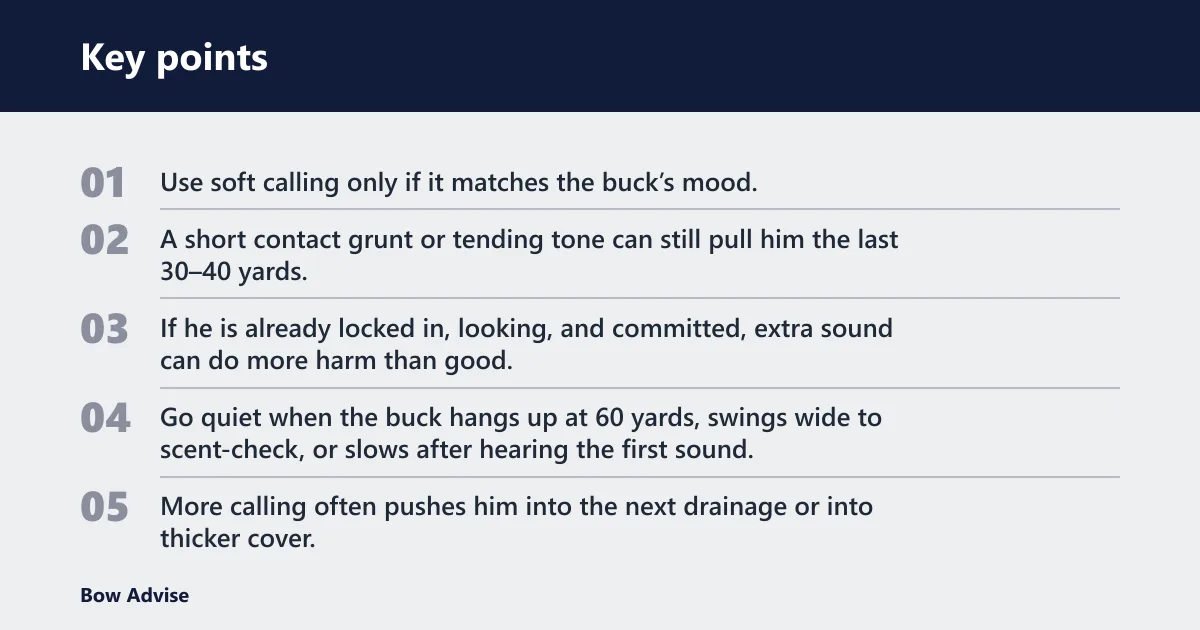
Use soft calling only if it matches the buck’s mood. A short contact grunt or tending tone can still pull him the last 30–40 yards. If he is already locked in, looking, and committed, extra sound can do more harm than good.
Pressure signs that say to go quiet
Go quiet when the buck hangs up at 60 yards, swings wide to scent-check, or slows after hearing the first sound. Those are signs the call was enough to make him cautious, not enough to make him commit. More calling often pushes him into the next drainage or into thicker cover.
How buck behavior changes after the first call-in attempt
After one attempt, many bucks turn from curiosity to verification. They may circle, pause behind brush, or take a trail that gives them a better wind read. That is the moment to rely on terrain and patience instead of another louder sequence.
When a soft grunt still makes sense
Use a soft grunt only as a finishing tool when the buck is already inside close range and moving slowly. A contact tone or tending tone is useful when he is almost committed but needs one more cue. Keep it brief. One short pull is enough in many cases.
Should you hunt funnels or edges?
Hunt funnels when you need a narrow, predictable lane and a buck is moving between bedding blocks, ridges, or creek crossings. Hunt edges when deer are staging, visibility is low, and the buck is likely to travel just inside cover before stepping out. Wind decides which one gives the cleaner chance.
Funnel setups for tight travel lanes
Funnels work best where terrain narrows movement: pinch points, timber edges that squeeze into a corridor, ridge saddles, or creek transitions. They are the better no-call option when you want the buck to appear inside bow range with limited room to detour.
Edge setups for staging deer and low visibility
Inside corners and soft field edges matter when bucks stage before dark. Mature deer often stay 100–200 yards inside cover, then edge toward food with caution. Put the stand where you can see the approach without overexposing yourself to the open field.
How wind changes the better choice
If the wind is steady and one-directional, a funnel can be the best option because you can predict the scent cone. If the wind swirls near a field edge or drainage, choose heavier cover and a shorter shot lane. Circling bucks punish sloppy wind faster than bad calling.
Silent ambush matrix
| Setup | Best wind | Best entry route | Expected shot lane | When to sit it | Main failure mode |
|---|---|---|---|---|---|
| Funnel | Crosswind that carries scent away from the travel seam | Along a ditch, ridge break, or timber edge | 20 to 35 yards through a narrow lane | When trails, rubs, and crossings stack together | Buck circles downwind and catches scent before entering |
| Saddle | Wind that stays stable across the crest | From the back side of the ridge | Down the travel dip or along the crest break | When cruising bucks use the terrain to save energy | Thermals shift and warn deer before daylight |
| Creek bottom | Light, steady wind that does not swirl in the drainage | Quiet approach from above, not through the bottom | Close-range shot through bends, crossings, or brush edges | When bedding links to food through low ground | Noise carries and scent sinks into the travel line |
| Inside corner | Wind blowing out of the corner and away from the trail | Through the thicker side cover | Diagonal lane from cover into the corner | When deer stage before entering an open field | Too much open exposure makes the buck hold up early |
| Staging edge | Wind that protects the cover edge and keeps scent off the field | Along the inside cover line | Last-look lane at the edge of darkness or first light | When bucks are visible but unwilling to step out | The deer stays in cover and never gives a clean lane |
How far should I place a decoy from my stand?
Place it 10 to 30 yards from the stand or blind, and set it upwind so a circling buck moves through the lane. The decoy should control the shot angle, not create a wide open stare-down. Skip it if the field is too exposed or if a pressured buck is likely to hang up at the first unnatural shape.
A decoy works best when visibility is limited enough to focus the buck, but not so wide that he can inspect it from a distance. Put it where the buck has to step into your lane to verify it.
When to skip the decoy entirely
Skip the decoy in tiny setups with no room for a controlled circle, in swirling wind, or on a ridge where every approach line is visible. A bad decoy placement can make a mature buck stop at 80 yards, stare, and leave. Silence alone is often cleaner.
When is rattling too risky?

Rattling is often considered too risky when the woods are open, the wind is unstable, or the deer are already jumpy from hunting pressure. It fits thick cover, funnels, ridges, and heavy edges better than open grass or scattered timber. If the sound carries too far, it can educate deer you never see.
Use rattling only when the cover can hide the source and absorb the noise. If you do use it, keep the volume low at first and save any escalation for the rare case where the buck is nearby but not moving.
Cover types that can hide the sound
Thick cedar pockets, brushy creek bottoms, and tight ridges can absorb rattling better than open hardwoods. Those places already compress movement, so a buck is less likely to hear the sound from too far out and decide the setup is wrong.
Situations where extra noise ruins the setup
Do not rattle on pressured field edges, in calm open timber, or where deer must cross bare ground to reach you. Those conditions make the sound too obvious. A mature buck is more likely to turn inside cover and wait for dark.
How to keep rattling limited if you use it
Start with a short, low-intensity sequence. If nothing changes, stop. Only add more sound when the buck is already inside the cover and the lane is protected. That keeps the noise from becoming the reason the deer avoids the area.
Common mistakes
Most failures come from overcalling, bad wind, or an entry that alarms deer before the stand is even occupied. Another common miss is sitting too open on a field edge when the buck is staging in cover. Silence cannot fix a busted approach.
- Calling after the buck shows pressure. Go quiet and let terrain work.
- Picking a stand for visibility instead of wind. The scent cone matters more.
- Entering through the same trail the deer use. Find a separate quiet route.
- Using a decoy where a buck can circle and inspect it from the open side.
- Rattling in light cover where the sound carries too far.
For example, a buck may appear at about 70 yards on the downwind side of a creek bottom, stop, and angle his head toward the brush. The next move is not louder calling. It is stillness, because that pause usually means he is checking the wind before he decides.
A mature buck may cruise a parallel trail about 30 yards inside the timber on a calm morning. A soft grunt may still pull him the last few yards if he is already interested, but a second louder sequence can turn him back into the cover he already trusts.
Frequently asked questions
What should I do when bucks ignore grunt calls during the rut?
Stop adding sound and move to a terrain-first setup. Hunt the closest funnel, saddle, or inside corner that puts your scent away from the trail. A buck that ignores one grunt often needs a cleaner lane, not a louder call.
Can silent setups still work on rutting bucks?
Yes. Silent setups work especially well when deer are pressured, staging, or circling downwind. Use cover, entry discipline, and the wind to force a daylight mistake. If the buck already suspects danger, silence is often the more dependable choice.
Where should I set up when bucks are already pressured?
Choose thick cover with a narrow travel line: a creek bottom, a ridge saddle, or an inside corner with a protected wind. Avoid open edges with long sightlines. Pressured deer need security cover more than they need noise.
What are the best ambush locations for a no-call rut hunt?
Start with funnels, saddles, creek bottoms, inside corners, and staging edges. Those areas let you predict where a buck will travel without asking him to react to sound. Fresh rub lines on bigger trees can also help mark the route.
How far should I place a decoy from my stand during the rut?
Set it 10 to 30 yards from the stand and upwind of the likely approach. That placement helps a circling buck enter the lane instead of stopping short. Skip the decoy if the setup is too open or the wind is unstable.
When is rattling too risky on pressured deer?
Rattling is too risky when the cover is thin, the wind swirls, or deer have already been educated by other hunters. Save it for thick cover, funnels, ridges, and tight timber. If the sound has nowhere to hide, leave the antlers in the pack.
What wind setup works best for a silent rut ambush?
Use a wind that carries scent away from the expected travel line and protects the stand side. A stable crosswind is often better than a swirling calm. If the buck can get downwind without crossing the lane, the setup is weak.