Arrow Spine for Light Target Points: When to Go Weaker?
A lighter point can justify moving one spine step stiffer only when the setup is already near the weak side; With carbon arrows, about 75-100 grains may allow that change on the weak side of the chart, while about 125-150 grains often push the arrow weaker. Get it wrong and you can fight poor groups, weak-side fishtailing, and broadhead tuning headaches. This guide shows how point weight, arrow length, draw weight, and bow type change spine choice, plus when to stay stiffer and tune instead.
Quick answer on light points
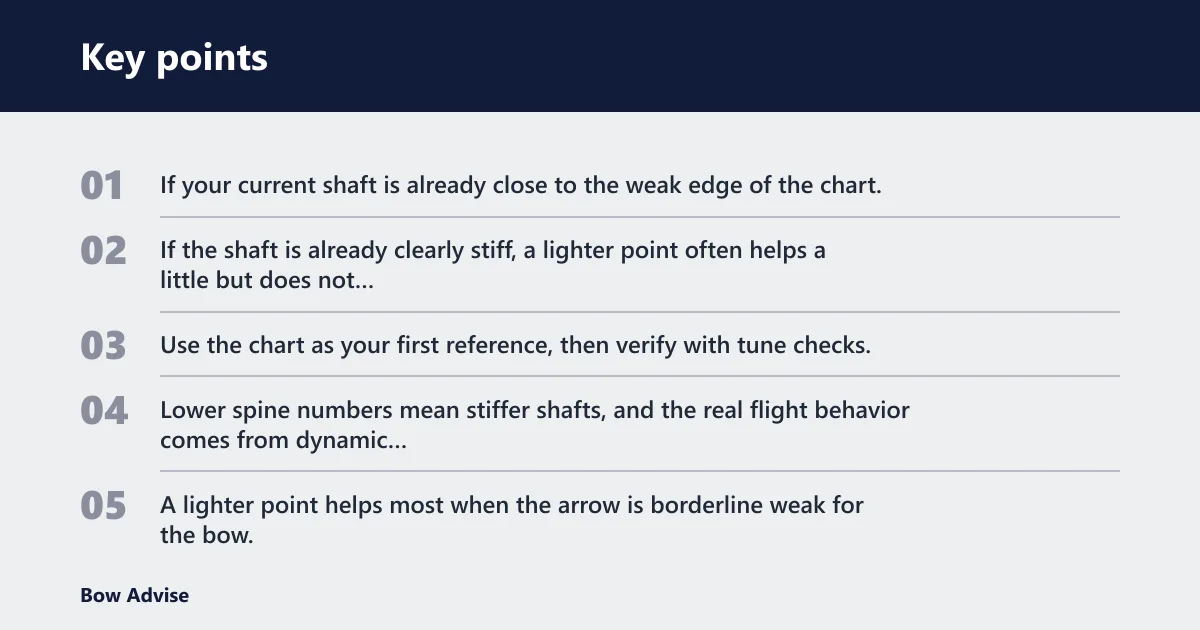


If your current shaft is already close to the weak edge of the chart, dropping from 100 grains to 85 or 75 grains can sometimes justify one stiffer spine step. If the shaft is already clearly stiff, a lighter point often helps a little but does not replace proper tuning.
Use the chart as your first reference, then verify with tune checks. Lower spine numbers mean stiffer shafts, and the real flight behavior comes from dynamic spine after the shot, not the static number alone.
When a lighter point helps
A lighter point helps most when the arrow is borderline weak for the bow, the shaft length is on the long side, or the bow already prefers a slightly stiffer dynamic setup. That is common with target arrows built from 300, 340, 400, 500, 600, 700, 800, 900, and 1000+ spine bands.
If the setup is only one step from the next stiffer shaft, a 75 or 85 grain point may be enough to move you there. If the shaft is two or more steps off, point weight alone is usually the wrong fix.
When to stay stiff and tune instead
Stay with the current shaft when a lighter point would create a mismatch with the bow type, release style, or cut length. That matters especially when the arrow is short, the bow is a compound with an aggressive cam, or the group is already clean and the bare shaft only needs a small correction.
Do not chase point weight alone. A light point can hide an over-stiff setup at one distance and still leave broadhead tuning or paper tears unresolved.
What arrow spine means
Arrow spine is a static deflection rating measured in thousandths of an inch. A 400 spine shaft deflects 0.400 inches under the standard test load, and lower numbers mean stiffer shafts. That rating is only the starting point for arrow selection.
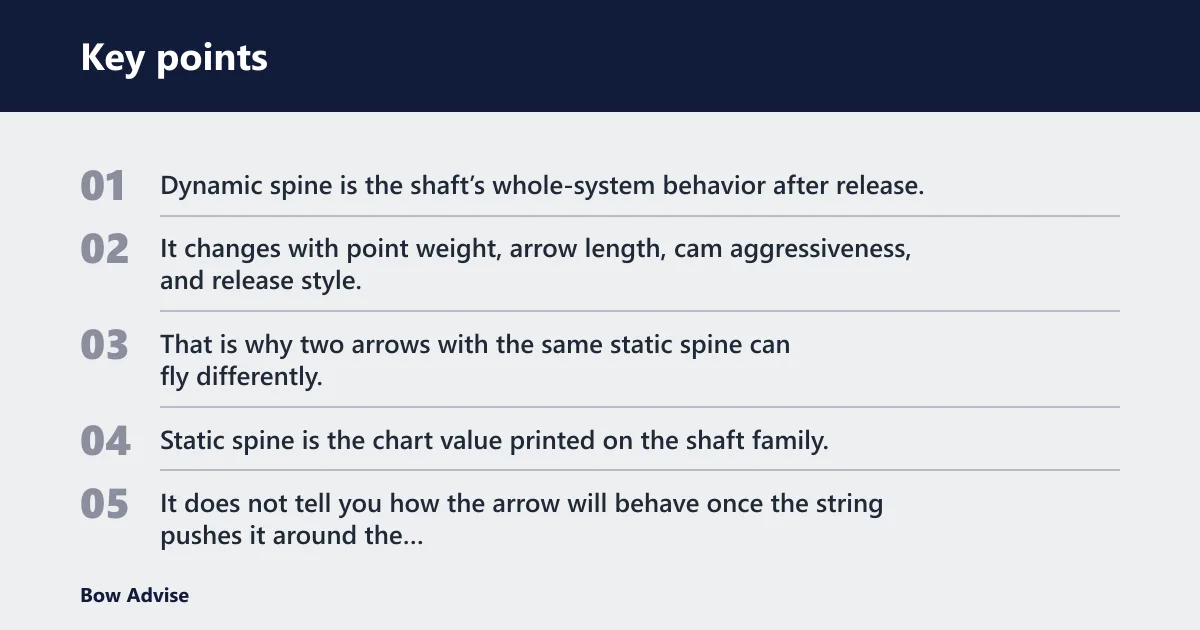
Dynamic spine is the shaft’s whole-system behavior after release. It changes with point weight, arrow length, cam aggressiveness, and release style. That is why two arrows with the same static spine can fly differently.
Static spine and lower-number shafts
Static spine is the chart value printed on the shaft family. It does not tell you how the arrow will behave once the string pushes it around the riser, the point weight loads the front, and the nock end starts oscillating.
As the spine number drops, the shaft gets stiffer. A 300 shaft is stiffer than a 400, and a 400 is stiffer than a 500.
Why dynamic spine changes after the shot
After release, the arrow bends and recovers under load. Longer arrows act weaker dynamically, heavier points make arrows act weaker dynamically, and compound bows often drive the arrow harder than finger-shot setups at the same weight. That is why chart choice and tune check both matter.
Suppose a 28-inch carbon shaft tunes clean with 100 grains on a target compound. Switching to 125 grains may move it weak enough that the bare shaft lands closer to the group, but the same change on a short, stiff setup may do little more than shift impact.
Does point weight change spine?
Yes, point weight changes dynamic spine rather than static spine. A lighter point makes the arrow act stiffer dynamically, while a heavier point makes it act weaker dynamically. In competitor charts, 100 grains is the baseline.
That baseline matters because many chart rows assume a 100 grain point. When you move away from that weight, the shaft choice can move with it.
75, 85, 100, 125, and 150 grain point effects
As a practical rule, 75 grains can behave about one group stiffer than 100 grains, and 125 grains can behave about one group weaker.
Those heavier points often push the setup toward weaker spine.
How much does a 100 grain point affect arrow spine?
It is the baseline, so it does not count as an adjustment in the chart system.
The exact response still depends on shaft length and bow type. Point weight is one input, not the only input.
Arrow length and draw weight
Arrow length must be treated as cut shaft length, not draw length. Longer shafts act weaker dynamically, and shorter shafts act stiffer. That is why a change of even an inch or two can matter when you are on the edge between two spine groups.
Draw weight also changes the starting spine. Compound charts typically use peak draw weight, while recurve charts use the weight actually held at draw length. A recurve shooter uses the weight actually held at draw length, not the limb label.
Why cut shaft length matters more than draw length
Charts for compound shafts commonly run from 26 inches through 31 inches. That range shows how much the cut length can move the choice. Longer arrows act weaker, so a longer cut often pushes you toward a stiffer shaft number.
Shortening the shaft does the opposite. A shorter arrow acts stiffer and may let you stay with the same spine or move weaker only if the rest of the setup already sits near the edge.
Compound peak weight vs recurve actual holding weight
A 60 lb compound with a 28 inch arrow and 100 grain point needs about 400 spine. A compound 50 lb setup with a 28 inch arrow lands on 400 spine in the competitor chart. Those references show why peak draw weight matters for compounds.
A 40 lb recurve with a 28 inch arrow lands on 600 to 700 spine. The recurve chart uses 20 to 28 lb, 28 to 34 lb, 34 to 40 lb, 40 to 46 lb, and 46 to 52 lb bands, because finger shooting behaves differently from release aid shooting.
When should you go weaker?
Go one spine step stiffer only when the current shaft is already near the weak side of the chart and the lighter point moves it toward a cleaner tune. If the setup is already close to center, or the shaft is short and the bow is already aggressive, a lighter point usually is not enough.
That rule keeps you from chasing point weight when the real fix is shaft selection. It also avoids moving too far weak and creating poor flight at the target face.
A practical rule for stepping down one spine
- Start with the chart for your bow type, draw weight, and cut shaft length.
- Assume 100 grains unless you have a reason to change it.
- If the setup is borderline weak, try 85 or 75 grains before changing shaft family.
- If the bare shaft still lands weak, move to a stiffer shaft or reduce point weight.
- If the bare shaft lands stiff, move one step weaker only if the chart already put you near that boundary.
Cases where a lighter point is not enough
A lighter point is not enough when the shaft is too short, the draw weight is too high for the spine band, or a release aid setup is already demanding a stiffer shaft. Compound shooters usually need stiffer shafts than finger shooters at the same weight.
A common first-timer mistake is to fix point weight before checking length. If the arrow is long and the bow is strong, a 75 grain point may still leave the arrow weak.
Arrow spine decision table
This table gives a starting rule for common target carbon shafts. Use it to decide whether a lighter point might justify one weaker step, or whether to keep the current shaft and confirm with tuning.
| Point weight | Arrow length | Bow type | Likely spine direction | Decision | If bare shaft lands weak/stiff |
|---|---|---|---|---|---|
| 75 gr | 26-27 in | Compound release | Stiffer than 100 gr baseline | Stay if already clean; go weaker only if borderline stiff | Weak: keep shaft, move point heavier or shorten nothing; Stiff: one step weaker |
| 75 gr | 28-29 in | Compound release | Stiffer, but length still matters | Keep current shaft unless chart already sits on the stiff edge | Weak: keep shaft, confirm with paper; Stiff: one step weaker if groups stay open |
| 75 gr | 30-31 in | Compound release | Often still weak overall from length | Usually stay stiffer; lighter point rarely justifies a weaker shaft by itself | Weak: do not go weaker; Stiff: consider point change before shaft change |
| 85 gr | 26-27 in | Recurve or fingers | Slightly stiffer than baseline, but fingers prefer weaker than compound | Possible one-step weaker only if chart already borders the next group | Weak: keep current spine; Stiff: one step weaker if bareshaft is right of group |
| 85 gr | 28-29 in | Compound release | Moderately stiffer than 100 gr | Stay unless the current shaft is clearly stiff | Weak: keep shaft; Stiff: move one spine weaker |
| 85 gr | 30-31 in | Compound release | Length may cancel the lighter point | Keep the shaft; do not assume 85 gr alone justifies a weaker step | Weak: keep shaft and tune; Stiff: check nock fit and paper first |
| 100 gr | 26-27 in | Compound release | Baseline | Use chart value as starting shaft | Weak: stay stiff side and confirm; Stiff: move weaker one step |
| 100 gr | 28-29 in | Recurve or fingers | Baseline for that chart row | Use chart value, then confirm with bare shaft | Weak: keep shaft; Stiff: one step weaker if bare shaft lands left of group |
| 125 gr | 26-27 in | Compound release | Weaker than baseline | Often stays on the current spine or moves one step weaker | Weak: go one step stiffer only if groups are poor; Stiff: keep current shaft |
| 125 gr | 28-29 in | Compound release | Weaker than baseline | Commonly enough to justify one weaker spine step if the chart was borderline | Weak: keep shaft; Stiff: one step weaker |
| 125 gr | 30-31 in | Recurve or fingers | Weakens dynamic spine further | Stay with current shaft unless the chart is already stiff and tune confirms it | Weak: do not go weaker; Stiff: keep or tune nocking point first |
| 150 gr | 26-27 in | Compound release | Much weaker than baseline | Usually keep the current shaft; this point often pushes too weak for many setups | Weak: move one step stiffer; Stiff: only go weaker if chart is clearly stiff |
| 150 gr | 28-31 in | Compound or recurve | Strong weakening effect | Only choose one weaker step if the shaft is already near the stiff edge | Weak: do not add more point weight; Stiff: stay or move stiffer if needed |
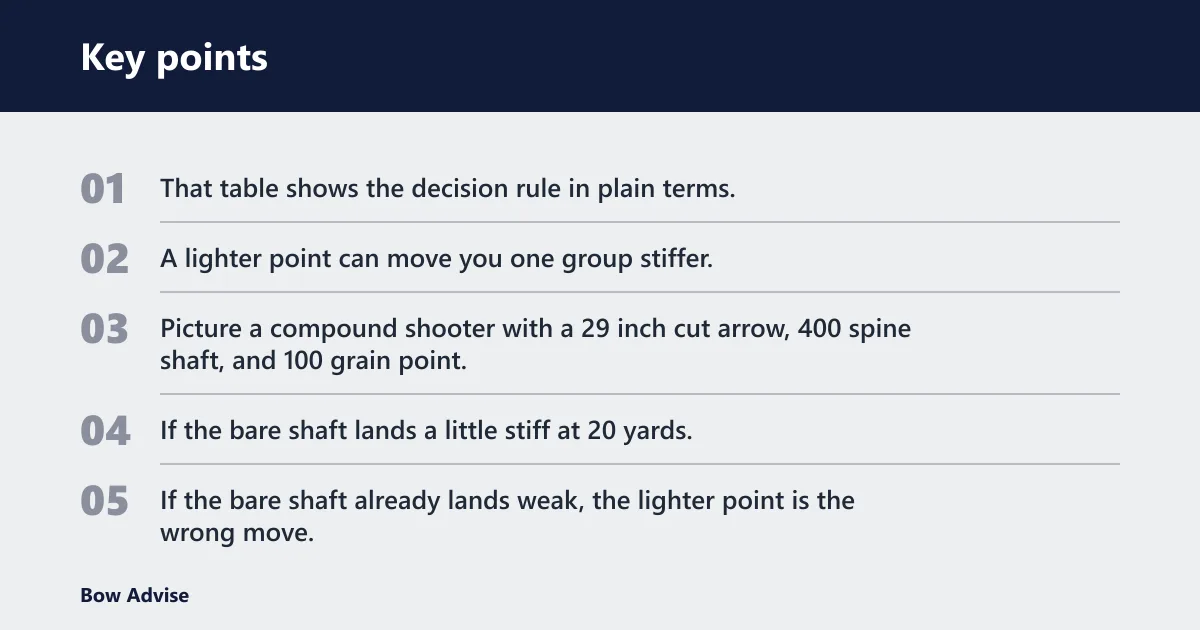
That table shows the decision rule in plain terms. A lighter point can move you one group stiffer, but only when the rest of the build already points that way.
Picture a compound shooter with a 29 inch cut arrow, 400 spine shaft, and 100 grain point. If the bare shaft lands a little stiff at 20 yards, moving to 125 grains may bring it into tune without changing the shaft. If the bare shaft already lands weak, the lighter point is the wrong move.
How to confirm the choice
Use bare-shaft tuning after chart selection. Paper tuning can then confirm poor flight and help separate weak from stiff behavior. Neither one replaces the chart; both help verify that the starting shaft matches the bow.
If the chart suggests one spine and the tune disagrees, trust the tune check before changing again. Small changes in point weight or nocking point height can move the result.
Bare-shaft tuning after chart selection
- Pick the shaft using draw weight, cut length, and bow type.
- Start with 100 grains unless the setup calls for a different point.
- Shoot a fletched group and a bare shaft at the same distance.
- If the bare shaft lands weak, move to a stiffer shaft or reduce point weight.
- If the bare shaft lands stiff, move one step weaker or add point weight.
Paper tuning as a check, not a substitute
Paper tears can show whether the arrow is leaving cleanly, but they do not replace shaft selection. A clean tear with the wrong shaft can still leave broadhead steering problems later. A poor tear can come from rest timing, nocking point height, or grip.
For that reason, use paper tuning after the chart and bare-shaft check. It is a confirmation step, not a shortcut around the chart.
Frequently asked questions
When should I go weaker on arrow spine for light target points?
Go weaker only when the current shaft is already near the stiff side and the lighter point moves the dynamic spine toward center. If the shaft is already balanced, or the arrow is long and the bow is strong, point weight alone usually does not justify a weaker spine step.
Is a 500 spine too stiff for my 30 lb target bow?
It depends on arrow length, bow type, and point weight. A 30 lb recurve or finger-shot setup often needs a much weaker shaft than a compound at the same number, and a 30-inch shaft will act weaker than a 27-inch shaft. Chart and tune check are both needed.
Do longer arrows need a weaker or stiffer spine?
Longer arrows need a weaker dynamic spine or a stiffer shaft choice because the shaft bends more over its length. Shorter arrows do the opposite and act stiffer. That is why cut shaft length matters so much in both compound and recurve charts.
How do I know if my arrows are underspined after tuning?
Underspined arrows often show weak bare-shaft behavior, poor paper tears, or broadhead instability that does not settle with small rest changes. If the shaft is already weak on the chart and a lighter point makes it worse, the fix is usually a stiffer shaft, not more point tuning.
Should compound and recurve shooters use the same spine chart
No. Compound charts usually use peak draw weight and release aid shooting, while recurve charts use the actual weight held at draw length and finger shooting. At the same weight, compounds usually need stiffer shafts than finger shooters because the arrow leaves the string differently.