How to Select Arrow Spine for Indoor Target Archery
Start with the spine chart for your actual draw length, then move one step stiffer if indoor point weight is heavy or bareshafts hit weak. For many indoor setups, about 600-500 spine covers a lot of recurve and light compound arrows. Wrong spine costs you points through poor grouping, broad tuning problems, and shafts that refuse to hold a tight center group at 18m or 20yd. This guide shows how to match shaft stiffness to draw length, point weight, and bow type so you can choose the smallest tune that still groups cleanly.
What arrow spine means
Arrow spine is shaft stiffness. Lower spine numbers mean stiffer shafts. A 330 arrow is stiffer than a 500 spine arrow, so the number matters more than the label on the box.
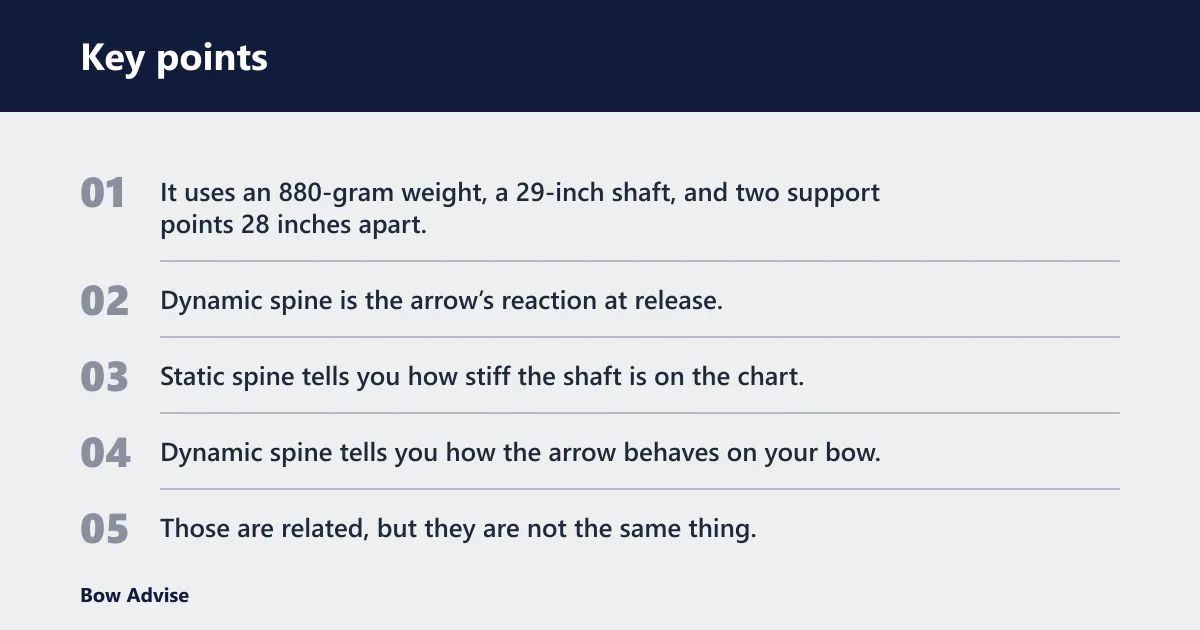
Static spine is the lab measurement. It uses an 880-gram weight, a 29-inch shaft, and two support points 28 inches apart, then the shaft deflection in inches times 1000 gives the spine size. Dynamic spine is the arrow’s reaction at release, and that reaction changes with bow energy, point weight, arrow length, string setup, and nock setup.
Static spine and dynamic spine
Static spine tells you how stiff the shaft is on the chart. Dynamic spine tells you how the arrow behaves on your bow. Those are related, but they are not the same thing, and indoor target tuning depends on the dynamic result more than the label alone.
That is why two arrows with the same static spine can tune differently. A long shaft with a heavy point can act weaker dynamically than a shorter shaft with a lighter point, even though the printed spine number never changes.
How do you choose arrow spine for indoor target archery?
Start with your actual draw length and measured draw weight, then add shaft length and point weight before you read a spine chart. For indoor target archery, the goal is usually the weakest clean tune that still groups well at around 18m or 20yd, not the stiffest shaft that merely clears the bow.
Use the chart as a starting point, then confirm with bareshafts. If the bareshaft lands weak, step stiffer or reduce point weight. If it lands stiff, go the other way only after checking that your shaft length and point weight are already where you want them.
Measure first
- Use actual draw length, not estimated label weight.
- Use measured draw weight at your draw length.
- Record cut shaft length from nock throat to shaft end under the maker’s convention.
- Note point weight, because it changes dynamic spine.
- Check the bow type and whether it is recurve or compound.
Picture a recurve archer drawing 28 inches with a heavy indoor point and a cut shaft that is longer than expected. The chart may point to one spine, but the long shaft and heavier tip can push the setup weaker dynamically. The fix is usually to test a stiffer shaft first, then confirm with bareshafts before changing more parts.
Indoor spine decision table
This table turns the common indoor inputs into a stiffness direction, then gives the first tuning move if bareshafts show left/right or high/low impact. Use it as a decision check, not as a final verdict. The goal is the smallest change that still produces clean grouping.
| Draw weight, draw length, shaft length, point weight | Recommended stiffness direction | First adjustment if bareshafts are off |
|---|---|---|
| Lower draw weight, shorter draw, short shaft, light point | Same or weaker | If bareshafts hit stiff, add point weight before changing shaft |
| Medium draw weight, actual draw length, normal shaft, moderate point | Same | If bareshafts hit left on a right-handed setup, check nocking point before changing spine |
| Higher draw weight, longer draw, normal shaft, moderate point | Stiffer | If bareshafts hit weak, move one step stiffer or shorten shaft if clearance allows |
| Indoor target point weight is heavy, shaft is long, bow is aggressive | Stiffer | If bareshafts hit weak and group right, reduce point weight only after confirming clearance |
| Recurve with clicker, long shaft, heavy point for indoor scoring | Same or stiffer | If bare shaft is high, check nocking point and tiller first |
| Compound with high let-off, short release stroke, light point | Same or weaker | If bareshafts hit stiff, step weaker before trimming shaft further |
For a right-handed archer, Easton notes an under-spined arrow will veer right, and a shaft that is too stiff will favor slightly left. That makes the first correction simple: weak reaction means stiffer shaft, shorter shaft, or lighter point; stiff reaction means weaker shaft, longer shaft if safe, or heavier point.
Our picks by need
Best starting choice for recurve indoor setups: Easton Platinum Plus XX75 Shafts

Based on the published specs, these Easton XX75 shafts suit archers who want a durable aluminum target shaft with a known 1916 spine. The hard anodized finish and G Uni Bushing are useful for indoor target work where repeatable setup matters more than extreme speed.
The drawback is simple: a fixed spine like 1916 only helps if it matches the bow. If the draw length or point weight pushes the setup weaker or stiffer, a different shaft size can still tune better.
Best starting choice for compound indoor setups: Easton Gamegetter Aluminum Arrow Shafts

These 340-spine bare shafts fit the archer who wants a ready starting point for tuning. The 7075-T9 aluminum construction and straightness tolerance support repeatable flight, and the bare-shaft format makes spine checks easier before final assembly.
The drawback is that bare shafts still require components and setup work. They are not a finished answer by themselves, and a 340 spine can be too stiff or too weak depending on actual draw weight, shaft length, and point weight.
Best starting choice for aluminum target shafts: Easton Genesis XX75 Aluminum Arrows

These NASP-approved arrows make sense for archers who want a factory-assembled aluminum target option. The 7075 aluminum construction helps consistency, and the finished format saves setup time for controlled indoor practice or entry-level target shooting.
The drawback is reduced flexibility. Because they arrive assembled, they are less suited to fine spine changes than bare shafts, so they work best when the draw weight and arrow length already land near the correct tune.
Best starting choice for all-carbon shafts: use chart-confirmed carbon size
All-carbon shafts can work well indoors, but the material does not replace correct spine. Use the same chart process: measured draw weight, actual draw length, cut shaft length, and point weight first, then confirm with bareshafts. Carbon often gives broad choice in spine sizes, but the wrong number still tunes badly.
A common first-timer mistake is picking carbon because it sounds faster, then leaving point weight and shaft length unchanged. That can leave the arrow weak at 18m even when the group looks acceptable at first glance.
How do draw weight, length, and point weight change spine?
Heavier draw weight weakens the dynamic reaction. Longer arrows also act weaker than shorter arrows. Heavier points weaken the shaft dynamically, while lighter points make it act stiffer dynamically. That is why the same spine chart result can shift once the indoor point weight changes.
Easton says too many factors determine dynamic spine, so chart numbers are only a starting point. The practical rule is straightforward: if you need more point weight for indoor stability, be ready to move stiffer in shaft or accept a weaker dynamic reaction that still tunes cleanly.
Indoor point weight and clicker setups
Indoor recurve setups often use heavier points to calm the bow and help the sight picture settle through the clicker. That heavier point weakens the arrow dynamically, so a shaft that looked correct outdoors can read weak indoors once the point weight goes up.
Suppose a recurve archer keeps the same shaft length but moves from a lighter point to a heavier indoor point. If the bareshaft starts landing right on a right-handed bow, the next move is usually a stiffer shaft or a point-weight reduction, not a guess at the chart.
Which chart or selector should you trust?
Use a manufacturer spine chart or selector with measured bow weight and draw length. Lower chart numbers mean stiffer shafts, so the chart gives you the direction before tuning confirms it. The Easton target and hunting selector is useful for target and hunting shafts, but it requires JavaScript.
Archery Calculators also notes that arrow size includes length, spine, diameter, and weight. That matches the indoor decision process: chart first, then confirm with the actual arrow setup you plan to shoot.
How to read the chart
- Enter measured draw weight at your draw length.
- Use your actual cut shaft length, not the box label.
- Add the indoor point weight you plan to shoot.
- Check whether the chart points to a stiffer or weaker shaft.
- Confirm with bareshafts and group shape at 18m or 20yd.
The chart should not be the finish line. It is the first pass. If a chart says one size and the bareshaft says another, trust the bow’s behavior and then make the smallest change that fixes the tune.
What spine arrow should I shoot?
You should shoot the spine that matches your measured draw weight, actual draw length, shaft length, and point weight, then clean up the tune with the smallest change possible. For many indoor recurve and light compound setups, that means starting near 600-500 spine and adjusting from there if the bareshaft shows a weak or stiff reaction.
Do not pick by bow label alone. A 70 pound bow question sounds simple, but the real answer depends on actual draw length, release style, shaft length, and whether the point weight is heavy for indoor grouping or light for a stiffer dynamic reaction.
What spine arrow for 70 pound bow?
A 70 pound bow often needs a much stiffer shaft than a light indoor setup, but the exact spine still depends on actual draw length, arrow length, point weight, and bow type. A labeled draw weight is not enough on its own. Measure the setup first, then use the chart and tune check.
For a higher-poundage bow, the risk is usually too weak a shaft rather than too stiff a one. If the bareshaft lands weak, the first check is point weight and shaft length before moving farther into a softer spine.
Mistakes to avoid
Choosing by labeled bow weight only is the fastest way to miss the tune. Indoor archery needs actual draw length and measured draw weight, because both change the dynamic reaction and the chart result.
Ignoring indoor point weight changes is another common error. Heavier points can be useful indoors, but they weaken the shaft dynamically. If you add weight and never recheck spine, the bare shaft can drift weak even when the group looks passable for a few ends.
Mixing up static spine and dynamic spine also causes bad calls. Static spine is the test number. Dynamic spine is how the arrow behaves on your bow. They are linked, not identical.
Material choice is not a shortcut. Carbon, aluminum, carbon-aluminum, and wood all behave differently, but none of them can fix the wrong spine size by themselves.
Frequently asked questions
What does spine mean on archery arrow?
Spine means arrow shaft stiffness. Lower spine numbers mean stiffer arrows. The printed number comes from a standardized static test, but the arrow’s real behavior depends on your bow weight, arrow length, point weight, and setup at release.
What is arrow spine?
Arrow spine is the stiffness rating used to compare shafts. Static spine comes from the lab test, while dynamic spine describes how the arrow reacts on the bow. Indoor tuning depends on the dynamic result because that is what shows up in bareshaft behavior and group shape.
How does draw weight affect arrow spine selection?
Higher draw weight weakens the arrow dynamically, so it usually needs a stiffer shaft. Lower draw weight does the opposite. That is why label weight alone is not enough; the real draw weight at your draw length is the number that matters for the chart.
How does arrow length change spine selection?
Longer arrows act weaker dynamically than shorter arrows. If you keep the same point weight and draw weight, extra shaft length can push the arrow toward a softer reaction. Use the cut length from nock throat to shaft end under manufacturer convention when you compare options.
How does point weight affect arrow spine?
Heavier point weight makes the arrow act weaker dynamically. Lighter point weight makes it act stiffer dynamically. That is why indoor target points can change the tune even when the static spine number stays the same, and why bare shaft checks matter after point changes.