Do Carbon Arrows Break Often? Essential Facts
Carbon arrows are remarkably durable and designed for repeated use. While they can break under specific conditions like significant impact or manufacturing defects, they do not break “often” for typical archery practices. Proper care and inspection significantly reduce the risk of breakage, ensuring a long lifespan for your arrows.

SERfawnCH
SERfawnCH 24Pcs 30" Carbon Archery Arrows, Hunting…
- ✔ Dimensions: Length: 30.7 in (78 cm); Rear tilt length: 31.5 in (80 cm); Outer diameter: 0.31 in (7.87 mm); Inner diameter: 0.24…
- ✔ Bow-Safe Plastic Vanes: Rubber-bonded design minimizes string wear and maintains arrow stability
- ✔ Tool-Free Adjustable Nocks: No glue required; adjust vane orientation (left/up) with a coin
As an Amazon Associate I earn from qualifying purchases.
For a related arrow setup, How to Barrel Wooden Arrows: Essential gives readers another detail to check before shooting.
For a related arrow setup, How Good Are Carbon Arrows: Essential gives readers another detail to check before shooting.
Hey there, fellow archers! If you’re just getting into the exciting world of archery, you might be wondering about your gear. One of the biggest questions beginners often ask is about the arrows they’re using, especially carbon arrows. You’ve probably heard that they’re great, but then a little voice whispers, “Do carbon arrows break often?” It’s a valid concern! Nobody wants to constantly replace their arrows, and the thought of a broken arrow can seem a bit daunting. But don’t worry, that’s exactly what we’re here to clear up. We’ll dive into the facts, what causes breakage, and how you can keep your carbon arrows in top shape for many shooting sessions to come. Let’s get your confidence soaring like a well-shot arrow!
Understanding Carbon Arrows: The Archer’s Choice
Carbon arrows have become the go-to choice for archers of all levels, from seasoned professionals to enthusiastic beginners. Why the popularity? It boils down to their impressive combination of strength, speed, and consistency. Unlike older materials, carbon fiber is incredibly lightweight yet exceptionally strong. This means your arrows can fly faster and with less wobble, leading to more accurate shots. They are also more forgiving in terms of environmental factors; they don’t warp easily in humidity like wooden arrows might.
When you invest in carbon arrows, you’re investing in a reliable piece of equipment that can genuinely enhance your archery experience. They are engineered to withstand the rigors of shooting, including the forceful release from your bow and impact with targets. However, like any piece of equipment, understanding their limits and how to care for them is key to their longevity.
The Durability Factor: What Makes Carbon Special?
The core strength of a carbon arrow lies in its material. Carbon fiber is made of incredibly thin strands of carbon atoms bonded together. These strands are woven or layered and then bound with a resin. This process creates a material that is:
- High Strength-to-Weight Ratio: Carbon is very strong for how little it weighs. This allows for faster arrow flight and less arrow drop over distance.
- Stiffness: Carbon arrows are generally stiffer than their aluminum counterparts. This stiffness is crucial for consistent arrow flight, as it helps the arrow straighten out quickly after leaving the bowstring (arrow paradox).
- Consistency: When manufactured properly, carbon arrows offer a high degree of consistency in weight and spine (stiffness), meaning each arrow in a set will perform very similarly.
This combination of properties makes carbon arrows ideal for a wide range of archery disciplines, from target shooting and 3D archery to hunting. They are designed to endure numerous shots without significant degradation in performance, provided they are handled correctly.

So, Do Carbon Arrows Break Often? The Truth Revealed
Let’s get straight to the heart of the matter: Do carbon arrows break often? No, not under normal circumstances. Reputable, well-manufactured carbon arrows are built to be robust and endure repeated shooting. They are designed to flex and return to their original shape, a phenomenon crucial for straight arrow flight. When you hear about carbon arrows breaking, it’s almost always due to specific, often avoidable, situations rather than a common occurrence.
Think of it this way: A car’s engine is designed to run for thousands of miles, but it can break down if it’s not maintained, driven recklessly, or has a manufacturing defect. Carbon arrows are similar. They are engineered for durability, but understanding what can stress them is your best defense against premature breakage.
Common Scenarios That Can Lead to Carbon Arrow Breakage
While rare, breakage can happen. Knowing these situations can help you prevent them:
- Impact with Hard Surfaces: This is the most common cause. If a fired arrow hits something harder than the target, like a rock, a steel object, or even another arrow at very high speed and angle, it can cause catastrophic failure. This can manifest as a crack or complete shatter upon the next shot.
- High Back-Wall Contact: If an arrow hits the riser or shelf of your bow with excessive force during shooting, it can weaken the shaft. This is often a sign of an improperly spined arrow selection or a tuning issue with your bow.
- Accidental Damage: Dropping an arrow from a significant height, or stepping on it, can create hairline fractures that may not be immediately visible. These micro-fractures can lead to breakage on subsequent shots.
- Manufacturing Defects: While rare with reputable brands, a faulty manufacturing process can lead to a weak point in the arrow shaft. This is why purchasing from trusted manufacturers is important.
- Improper Maintenance or Inspection: Not checking your arrows for damage before each shot is akin to driving a car without checking the tires. Small cracks can turn into big problems.
It’s important to remember that these are not everyday occurrences. With a bit of awareness and care, your carbon arrows should serve you well for a long time.
Inspecting Your Carbon Arrows: A Crucial Habit
The single most important thing you can do to prevent breakage (and ensure safety) is to develop a habit of inspecting your carbon arrows before every single shot. This isn’t a chore; it’s a vital part of being a responsible archer. A damaged arrow can shatter upon release, sending fragments in unpredictable directions, which is dangerous for you and anyone nearby. Thankfully, a quick visual and tactile inspection is usually all it takes.
How to Perform a Quick Arrow Inspection
Here’s a simple, step-by-step method:
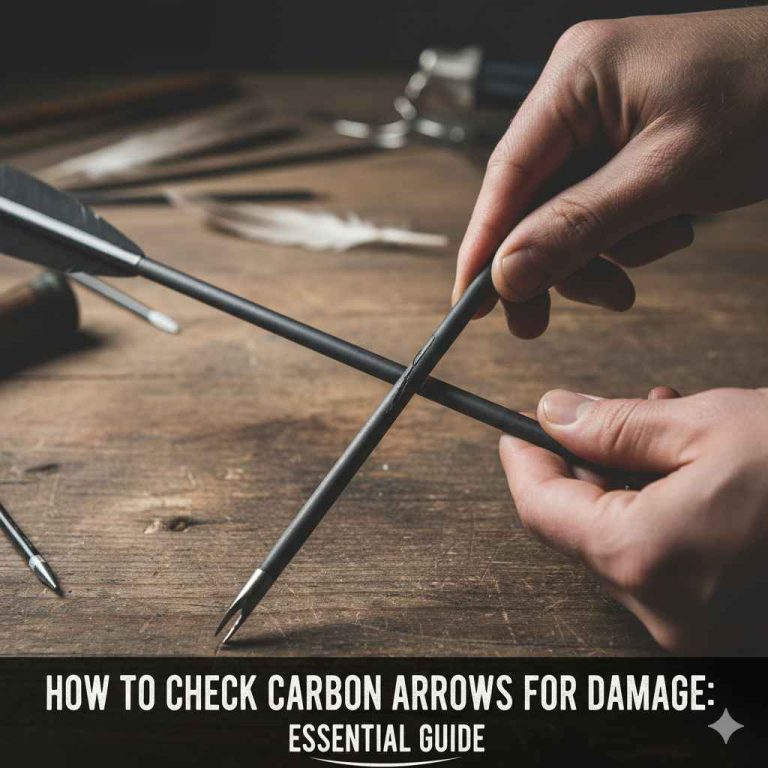
- Visual Check: Hold the arrow up to the light. Look closely all along the shaft for any signs of cracks, splinters, or deep scratches. Pay special attention to the area around the nock and the front of the shaft where the point is attached. Sometimes, cracks can be very fine.
- Tactile (Feel) Check: Gently run your fingers along the entire length of the arrow shaft. You can often feel hairline cracks or rough patches that you might not see immediately.
- Flex Test (Gentle!): This is a common and effective method. With the nock and point removed or secured, gently press the arrow against a soft surface (your thigh is good, avoid hard floors). With very little pressure, try to flex the shaft slightly. You should feel a uniform stiffness. If you feel any “dead spots,” stiffness variations, or hear any cracking or crunching sounds, the arrow is compromised and should be discarded. Crucially, do not over-flex the arrow, as this can cause it to break. The goal is to detect existing damage, not to induce new damage.
- Check the Nock: Ensure the nock is seated properly. Look for any cracks or stress marks around it. A damaged nock can lead to arrow failure.
- Check the Fletchings and Insert: Make sure the fletchings (the plastic or feather vanes) are intact and firmly attached. Also, check that the arrow insert (the piece holding the point) is not loose or damaged.
If you find any sign of damage – a crack, a crunching sound, a loose insert, or a damaged nock – the safest course of action is to discard the arrow immediately. It’s not worth the risk.
When to Consider Discarding an Arrow
Always err on the side of caution. If you notice any of the following, it’s time to retire the arrow:
- Visible cracks or splinters on the shaft.
- A crunching or cracking sound when gently flexing the arrow.
- A noticeable “dead spot” or change in stiffness along the shaft.
- A damaged or cracked nock that cannot be safely replaced.
- A loose or damaged arrow insert.
- Evidence of a severe impact where the arrow didn’t break immediately (it might be weakened internally).
Think of discarded arrows as peace of mind payouts. A new arrow is far cheaper than an emergency room visit.
Factors Influencing Arrow Durability
Beyond just impact, a few other elements play a role in how long your carbon arrows last:
Arrow Spine and Bow Tuning
The “spine” of an arrow refers to its stiffness. Selecting arrows with the correct spine that matches your bow’s draw weight and length is foundational for good flight and arrow health.
What happens if the spine is wrong?
- Too weak (under-spined): The arrow can flex too much upon release, potentially hitting the bow riser. This impact can create stress fractures or even cause the arrow to break.
- Too stiff (over-spined): The arrow won’t flex enough, which can lead to erratic flight. While less likely to cause immediate breakage from riser contact, it compromises accuracy greatly.
Ensuring your bow is properly tuned and you’re using arrows with the correct spine is paramount. A well-tuned bow and correctly spined arrows work in harmony, minimizing stress on the arrow shaft.
Arrow Components and Quality
Not all carbon arrows are created equal. The quality of the carbon fiber, the resin used, and the manufacturing process all contribute to an arrow’s overall durability. High-quality arrows from reputable brands often feature better materials and more rigorous quality control.
Similarly, the components attached to the arrow – the nocks, inserts, and points – play a role. Inserts that are glued in poorly or nocks that are brittle can be weak points. Investing in good quality components and ensuring they are installed correctly (often by a pro shop for beginners) adds to the arrow’s resilience.
Shooting Technique and Environment
Your shooting style can also influence arrow life. Consistent follow-through and a clean release reduce the chances of the arrow impacting the bow. Also, be mindful of where you’re shooting. Shooting into soft targets like foam or dense straw is ideal. Avoid shooting into surfaces that can cause glancing blows or direct impacts, such as dirt mounds (which can hide rocks), metal objects, or very hard backstops.
For a deeper dive into arrow selection based on your bow, resources like this article on OutdoorLife’s guide to choosing arrows can be incredibly helpful.
Comparing Carbon Arrows to Other Materials
Understanding how carbon stacks up against other common arrow materials can further highlight its benefits and nuances.
Carbon vs. Aluminum Arrows
Aluminum arrows were the standard for a long time before carbon took over. They are known for their straightness and consistency out of the factory.
Pros of Aluminum:
- Generally less expensive upfront.
- Very consistent straightness.
- Easier to detect damage (dents are easily visible).
Cons of Aluminum:
- More prone to bending and denting, which also compromises flight.
- Heavier than carbon for equivalent stiffness.
- Can lose straightness permanently if bent.
Pros of Carbon:
- Much lighter and faster.
- More durable against impacts that might bend aluminum (carbon is more likely to crack or shatter if it breaks).
- Excellent stiffness and consistent flight.
- More forgiving spine selection.
Cons of Carbon:
- Can be more expensive.
- Damage (cracks) is not always visible and requires careful inspection.
- Catastrophic failure (shattering) can be more sudden if an unseen crack is present.
For beginners, the speed and forgiving nature of carbon often make it the preferred choice, despite requiring diligent inspection.
Carbon vs. Wood Arrows
Wooden arrows harken back to traditional archery. They offer a classic feel and are often used in historical reenactments or for simple backyard shooting.
Pros of Wood:
- Authentic, traditional feel.
- Relatively inexpensive.
- Easy to identify damage (warping, cracks).
Cons of Wood:
- Highly susceptible to humidity and warping.
- Less durable and consistent in performance compared to carbon or aluminum.
- Heavier and slower.
- Can break easily upon impact.
While wood has its place, carbon arrows offer superior performance and durability for most modern archery applications. The learning curve for maintaining consistent flight with wood is also significantly higher.
Maintaining Your Carbon Arrows for Longevity
Proper care is key to making your carbon arrows last. It’s not complicated, but consistency is important.
Storage Guidelines
When you’re not shooting, store your arrows properly. This means keeping them in an arrow case or tube.
- Protect Them: Arrow cases prevent them from being bent, stepped on, or impacted.
- Keep Them Dry: While carbon doesn’t absorb water like wood, excessive moisture can affect components like fletchings or the glue holding inserts and nocks in place.
- Avoid Extreme Temperatures: Don’t leave arrows in a hot car trunk for extended periods or exposed to freezing conditions; extreme temperatures can potentially affect the resin and adhesives.
Transporting Your Arrows Safely
Always use an arrow tube or quiver when transporting arrows. Never carry them loosely. This protects them from damage and prevents accidental injury to yourself or others.
When in Doubt, Throw it Out
We’ve said it before, but it bears repeating: If you have any suspicion that an arrow is compromised, do not shoot it. The cost of a new arrow is negligible compared to the potential injury from a catastrophic failure.

Frequently Asked Questions (FAQ)
Here are some common questions beginners have about carbon arrow durability:
Q1: Can carbon arrows shatter?
A1: Yes, a damaged carbon arrow, especially one with unseen micro-cracks, can shatter upon release if it’s shot. This is why regular inspection is crucial for safety.
Q2: How long do carbon arrows typically last?
A2: A well-maintained carbon arrow can last for thousands of shots. It depends heavily on usage, the types of targets shot into, and proper inspection and care. Some archers may never break a carbon arrow.
Q3: Is it okay to shoot an arrow with a small crack?
A3: Absolutely not. Even a small crack can propagate under the stress of shooting, leading to catastrophic failure and potential injury. Always discard cracked arrows.
Q4: What is the best way to dispose of a damaged carbon arrow?
A4: To ensure it can’t be accidentally used, it’s best to break the shaft into several pieces. You can then dispose of the pieces safely.
Q5: My friend told me carbon arrows are dangerous. Is that true?
A5: Like any tool or piece of equipment, archery equipment requires respect for its capabilities and limitations. Carbon arrows are safe when used properly and inspected regularly. Dangers arise from using damaged equipment, improper technique, or unsafe shooting practices.
For more detailed safety guidelines, you can always consult resources from organizations like the USA Archery.
Q6: Can I repair a cracked carbon arrow?
A6: In most cases, no. While some superficial scratches might be smoothed out or minor component issues (like a loose nock) addressed, structural cracks in the carbon shaft indicate it’s compromised and cannot be safely repaired for shooting. Attempting to repair a cracked shaft is extremely risky.
Conclusion: You’re Ready to Shoot with Confidence!
So, do carbon arrows break often? We’ve seen that the answer is a resounding no, not when handled with care and respect. They are incredibly strong, reliable tools designed to enhance your archery journey. The key to their longevity and your safety lies in simple diligence: regular inspection, proper storage, and understanding the potential pitfalls.
Developing the habit of checking your arrows before each shot takes mere seconds but can save you from disappointment and, more importantly, prevent dangerous accidents. Remember, a well-tuned bow, correctly spined arrows, and a mindful approach to equipment care will ensure your carbon arrows fly true and last for a very long time. You’ve got this! Now, it’s time to grab your bow, take a deep breath, and enjoy the incredible experience of archery with confidence in your gear.
Related pick: Check today's price on Amazon