How to Determine Left or Right Hand Bow: Full Guide
To determine if you need a left or right-hand bow, you must identify your dominant eye, not your dominant hand. A right-handed bow is for a right-eye dominant archer—you hold the bow with your left hand and draw the string with your right. A left-handed bow is for a left-eye dominant archer. For more on this, see our guide on Did Any 4 Fletch Jigs Debut At Ata 2019.
Welcome to the exciting world of archery! Choosing your first bow is a huge step, but one question often trips up new archers: “Should I get a left or right-handed bow?” Many people assume it’s based on the hand you write with, but that’s one of the biggest myths in archery. Getting this wrong can lead to frustration and make aiming feel impossible.
Don’t worry, the solution is surprisingly simple and has nothing to do with your hand strength. It’s all about your eyes. In this guide, I’ll walk you through a foolproof method to find out which bow is perfect for you, ensuring you start your archery journey with confidence and accuracy. Let’s get you aiming like a pro from day one.
For a shorter version of this test with a printable quick-reference, see Right vs Left Hand Draw: How to Tell Which Bow You Need.
Why Your Eyes Matter More Than Your Hands
In archery, your goal is to align the arrow with your target. To do this, your brain needs a clear, consistent line of sight. While you have two eyes, your brain naturally prefers to receive visual information from one eye over the other. This preferred eye is called your “dominant eye.”
Think of your dominant eye as the “rear sight” on a rifle. It dictates the entire alignment from your eye, through the bow’s sight (or down the arrow), to the target. If you use a bow that doesn’t match your dominant eye, you’ll constantly struggle to line up your shots. Your body will be fighting your brain’s natural instinct, leading to missed targets and a lot of confusion.
Using a bow that aligns with your dominant eye makes aiming feel intuitive and natural. It allows you to keep both eyes open, which improves your depth perception and peripheral vision, making you a safer and more aware archer.
Hand Dominance vs. Eye Dominance: The Core Concept
Let’s clear this up once and for all. Your hand dominance (being right-handed or left-handed) relates to motor skills—writing, throwing, or swinging a bat. Your eye dominance is purely about visual processing.
Interestingly, your hand and eye dominance don’t always match. Many people who are right-handed are actually left-eye dominant, and vice versa. This is called “cross-dominance,” and it’s completely normal. The key takeaway for archery is simple:
- You hold the bow with your non-dominant hand.
- You draw the string with your dominant hand.
- Your bow choice (left or right-handed) is determined by your dominant EYE.
This means a “right-handed bow” is designed for a right-eye dominant person. They will hold the bow riser in their left hand, allowing their dominant right eye to easily look down the arrow’s path.

How to Find Your Dominant Eye: Two Simple Tests
Finding your dominant eye is easy and takes less than a minute. You can do these tests right now, wherever you are. For best results, stand up and focus on an object at least 10-15 feet away, like a light switch or a picture on the wall.
Test 1: The Triangle (or Aperture) Test
This is the most common and reliable method used by archery coaches worldwide.
- Extend both of your arms straight out in front of you.
- Bring your hands together, creating a small triangular opening between your thumbs and index fingers.
- With both eyes open, look through this triangle and center the distant object within the opening.
- Now, slowly bring your hands toward your face while keeping the object centered in the triangle. Don’t think about it, just let your hands move naturally.
- Your hands will automatically come to one of your eyes. That is your dominant eye!
Alternate version: If you prefer, you can keep your arms extended. Once the object is centered in the triangle with both eyes open, close your left eye. If the object stays in the triangle, you are right-eye dominant. If the object jumps out of view, you are left-eye dominant. You can confirm by closing your right eye instead; the object should remain visible for your left eye if you are left-eye dominant.
Test 2: The Pointing Test
This test is even simpler and works just as well. It reinforces the idea of natural alignment.
- Pick a small, distant object across the room.
- With both eyes open, extend one arm and point your index finger directly at the object.
- Focus on the object, not your finger. You will see two faint images of your finger; this is normal.
- Now, close your left eye. If your finger is still pointing directly at the object, you are right-eye dominant.
- If your finger appears to have jumped to the side of the object, open your left eye and close your right eye. It should now be perfectly aligned, which means you are left-eye dominant.
Perform each test a couple of times to be absolutely sure. Once you know your dominant eye, you know which type of bow to get. It’s that simple!
Best Pick Once You Know Your Dominant Eye
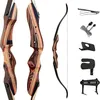
Deerseeker Takedown Recurve Bow, RH & LH Riser Options
Sold with a choice of right-hand or left-hand riser at checkout, so once you know your dominant eye, you order the matching version directly.
- Best for: buying once you already know your dominant-eye result
- Why we picked it: same bow line offered in both RH and LH, no guessing needed
- Main drawback: double-check the riser handedness in the listing before ordering
Compare more options
 Option 1 CVLIFE Right Hand Recurve Bow and Arrow Set
|  Option 2 HANDBAIGE Left Hand Recurve Bow and Arrow Set
|  Option 3 TOPARCHERY Youth Takedown Recurve Bow, RH/LH
|
As an Amazon Associate we earn from qualifying purchases.
Decoding Bow Hand Orientation
Now that you know your dominant eye, let’s connect it to the actual equipment. The terms “right-handed bow” and “left-handed bow” can be confusing because they refer to the archer, not how you hold the bow.
What is a Right-Handed Bow?
A right-handed bow is the most common type and is designed for someone who is right-eye dominant.
- You hold the bow’s riser (the handle) with your left hand.
- You pull or “draw” the bowstring back with your right hand.
- The arrow shelf or rest, where the arrow sits, is on the left side of the riser.
- This setup aligns the arrow perfectly with your dominant right eye.
What is a Left-Handed Bow?
A left-handed bow is a mirror image of a right-handed one and is designed for someone who is left-eye dominant.
- You hold the bow’s riser with your right hand.
- You draw the bowstring back with your left hand.
- The arrow shelf or rest is on the right side of the riser.
- This setup aligns the arrow perfectly with your dominant left eye.
Here is a simple table to help you remember the correct setup:
| Your Dominant Eye | Bow You Need | Hand That Holds the Bow | Hand That Draws the String |
|---|---|---|---|
| Right Eye | Right-Handed Bow | Left Hand | Right Hand |
| Left Eye | Left-Handed Bow | Right Hand | Left Hand |
What If I’m Cross-Dominant? The Big Question
Cross-dominance is when your dominant eye is on the opposite side of your dominant hand. For example, you write with your right hand but are left-eye dominant. According to studies on ocular dominance from the American Academy of Ophthalmology, this is very common and affects a significant portion of the population.
If you discover you’re cross-dominant, you have a choice to make. Let’s say you are right-handed and left-eye dominant. Do you shoot a right-handed bow to match your strong hand, or a left-handed bow to match your dominant eye? The overwhelming advice from experienced coaches is clear:
Always choose the bow that matches your dominant eye.
It might feel awkward at first to hold the bow and draw the string with your “weaker” arms, but strength can be built. You cannot easily retrain your brain’s lifelong preference for one eye. Aiming is a visual skill, while drawing a bow is a physical one. It is far easier to train your muscles than it is to rewire your brain’s visual processing system.
The Two Paths for Cross-Dominant Archers
Let’s break down the two options for a right-handed, left-eye dominant archer.
Path 1: Shoot Matching Your Eye (Recommended)
You would use a left-handed bow. You will hold it with your dominant right hand and draw with your left. At first, your left arm and back muscles may feel weak, and the motion will seem clumsy. However, with practice, your body will adapt. The huge advantage is that aiming will feel natural and effortless because you are using your dominant eye. This leads to faster progress and a higher potential for accuracy.
Path 2: Shoot Matching Your Hand (Not Recommended)
You would use a right-handed bow. You will hold it with your left hand and draw with your stronger right arm. This will feel more physically comfortable initially. However, to aim, you must force your non-dominant right eye to take over. This usually requires you to close your dominant left eye, wear an eye patch, or use a blinder. This method creates several problems:
- Loss of Depth Perception: Closing one eye makes it much harder to judge distances.
- Reduced Field of View: Your peripheral vision is cut in half, which can be a safety issue.
- Mental Strain: You are actively fighting your brain’s natural wiring, which can cause eye strain and make aiming feel like a chore.
While some archers have found success this way, it is generally considered a harder path with a lower accuracy ceiling.
Pros and Cons for a Cross-Dominant Archer
Here’s a table summarizing the decision. This example is for a right-handed, left-eye dominant person.
| Approach | Pros | Cons |
|---|---|---|
| Match Your Eye (Use a Left-Handed Bow) |
|
|
| Match Your Hand (Use a Right-Handed Bow) |
|
|
Does This Rule Apply to All Bows?
Yes! Whether you are interested in a modern compound bow, a traditional recurve bow, or a classic longbow, the principle of eye dominance remains the same. Your dominant eye is your aiming eye, and your bow should always be chosen to accommodate it.
- Compound Bows: These have sights, peeps, and other aiming aids. Aligning the peep sight (the little hole on the string) with the main sight and the target is impossible without using your dominant eye.
- Recurve Bows: Whether you use a sight (“Olympic Recurve”) or shoot instinctively (“Barebow”), your dominant eye provides the critical line of sight down the arrow.
- Longbows: This is the purest form of instinctive archery. You are looking at the target, not the arrow. Your brain uses the information from your dominant eye to subconsciously calculate the shot. Using the wrong bow makes this nearly impossible.
- Crossbows: The same rule applies, even though a crossbow is shouldered more like a rifle. Your dominant eye should still be the one lined up behind the scope or sight for the clearest, most accurate picture.
A Note on Equipment Availability
In the past, it was sometimes difficult to find a wide variety of left-handed bows and accessories. Thankfully, that is no longer the case. Virtually every major bow manufacturer, such as Hoyt, Mathews, and Bear Archery, produces a left-handed version of their flagship models. Local archery shops may have fewer left-handed bows in stock to try, but they can always order one for you.
Don’t be tempted to buy a right-handed bow just because it’s available on the spot. Waiting a week or two for the correct bow is far better than spending years struggling with the wrong equipment. Your patience will be rewarded with a much more enjoyable and successful archery experience.
I Already Bought the Wrong Bow. What Now?
It happens more often than you think, so don’t feel bad. If you’ve discovered you bought a bow that matches your hand instead of your eye, you have a few options.
- Return or Exchange It: If you bought it recently from a pro shop, explain the situation. Most reputable dealers understand the importance of eye dominance and will be happy to help you exchange it for the correct model.
- Sell It: If you can’t return it, you can sell it secondhand. The archery community is large, and there’s always someone looking for a good used bow. You may lose a little money, but it’s a small price to pay for getting the right gear.
- Try to Make It Work (Last Resort): If you are absolutely stuck with the bow, you can commit to shooting with your non-dominant eye. Buy an eye patch and be prepared for a steeper learning curve. It’s not ideal, but with dedication, you can still learn to shoot. However, for a beginner, this adds a huge layer of unnecessary difficulty.
My best advice is to do whatever you can to get the right bow. Starting with the proper foundation will save you countless hours of frustration and help you fall in love with the sport.

Frequently Asked Questions (FAQ)
1. Can a left-handed person shoot a right-handed bow?
Only if they are right-eye dominant. The bow should always match the dominant eye, not the dominant hand. A left-handed person who is also left-eye dominant must use a left-handed bow for best results.
2. What if my eye dominance is weak or I feel it’s in the middle?
Some people do have weaker ocular dominance. If the tests are inconclusive, try the pointing test again but focus hard on the distant object. Usually, one eye will provide a clearer, more stable image. If you are truly unsure, visit an archery pro shop. A good coach can observe your form and help you determine the best fit.
3. Does eye dominance apply to crossbows too?
Not in the same way. Since a crossbow is mounted with a scope and held like a rifle, you can simply shoulder it on whichever side feels most comfortable and look through the scope with either eye. However, most people find it natural to use their dominant eye with a scope as well.
4. Why do archers recommend shooting with both eyes open?
Shooting with both eyes open provides better depth perception, a wider field of view for safety, and allows more light to enter your eyes, which can help in low-light conditions. It feels more natural and reduces squinting and muscle tension in your face. This is only possible if your bow matches your dominant eye.
5. Is it hard to find left-handed archery accessories?
Not at all! All major manufacturers produce left-handed versions of arrow rests, sights, quivers, and other essential accessories. They are just as available as right-handed gear, though a local shop might need to order them for you.
6. What if I’m perfectly ambidextrous?
Even if you are ambidextrous with your hands, you will still have a dominant eye. Your brain’s visual pathway has a preference. Go through the eye dominance tests carefully to discover which eye your brain favors for aiming tasks.
7. Can my eye dominance change over time?
It’s very rare for a person’s natural eye dominance to change, though certain eye injuries or vision problems can cause the brain to shift preference. For nearly all archers, the eye that is dominant today will be dominant for life.
Conclusion: Your First Step to a Perfect Shot
Choosing the right bow is the most important first step in your archery journey. Now you know the secret that all great archers understand: your dominant eye is the key to everything. By taking a few moments to perform a simple eye dominance test, you can avoid the number one mistake that holds beginners back.
Remember, a “right-handed” bow is for a right-eye dominant person, and a “left-handed” bow is for a left-eye dominant person. Even if you’re cross-dominant, trust the process and choose the bow that aligns with your vision. It may feel a little strange for the first few sessions, but your body will quickly adapt, and your aim will thank you for it.
Welcome to this amazing sport. You’ve already taken a huge leap forward by learning this fundamental principle. Now, go out there, get the right gear, and have fun sending arrows downrange with confidence!