Summer Archery Bow Care: Heat, Sun, and Hot-Car Damage to Avoid
Do not leave a bow in a hot car, in direct sun, or in a closed case. Check it before shooting, and replace any warped string, soft limb, lifted finish, or heat-softened adhesive immediately. Heat can change string length, weaken limb resins, and damage cams, so a small mistake can lead to a dry-fire-like failure or an expensive repair. This guide shows what heat damage looks like on recurve, compound, and wood bows, what to inspect first, and how to store them safely in summer.
Why heat matters for bows
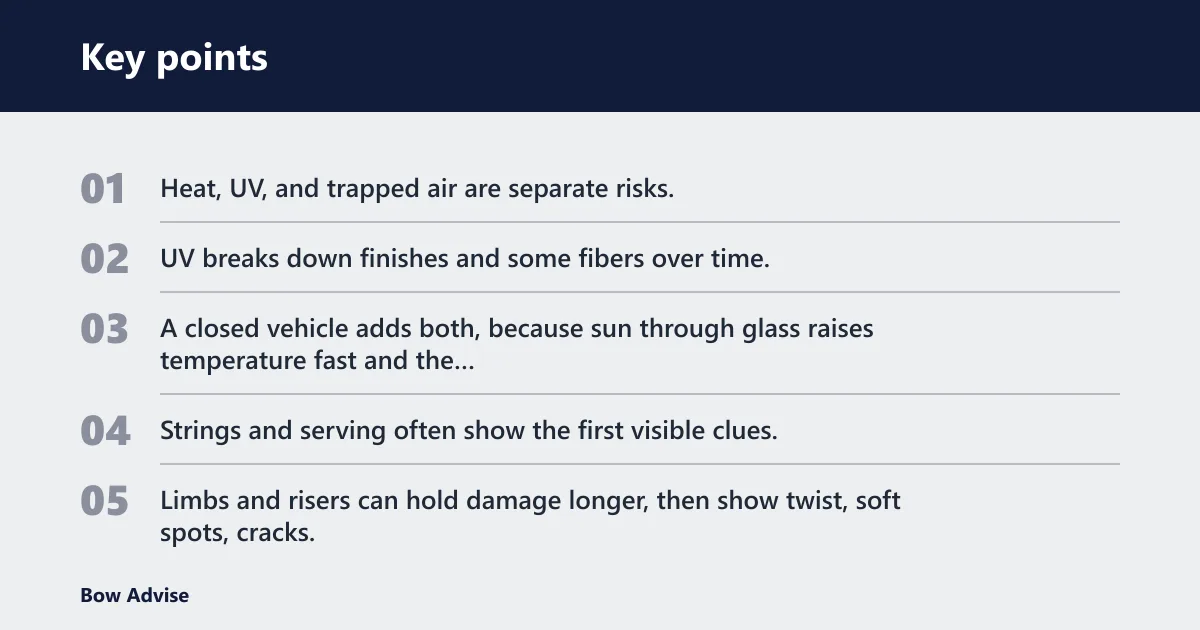


Heat, UV, and trapped air are separate risks. Heat changes materials. UV breaks down finishes and some fibers over time. A closed vehicle adds both, because sun through glass raises temperature fast and the cabin can stay hot after the bow is removed.
Most bow parts do not fail at the same rate. Strings and serving often show the first visible clues. Limbs and risers can hold damage longer, then show twist, soft spots, cracks, or alignment changes. Compound bows add cams and cables to that list.
Which parts fail first under summer stress?
Strings, serving, adhesive-backed accessories, and finish layers are often among the first parts to show trouble. Next come limbs and limb pockets, especially if the bow sat in a vehicle or in direct sun near a window. Compound cams can also shift if string and cable tension changes.
Wood bows are the most sensitive to moisture swings and heat-driven warp. Recurve limbs can twist or take a set if the material and load are pushed too far. Compound limbs are built for a narrower working range, so they need a close look after high heat exposure.
Can I leave my bow in a hot car?
No, not as a normal storage plan. A hot car can raise bow temperature well above recommended storage conditions, especially on surfaces that absorb heat. especially on the dashboard, rear seat, or inside a black case. Short stops can still matter because trapped air and sunload keep the interior rising after parking.
Dashboard, trunk, and rear seat exposure
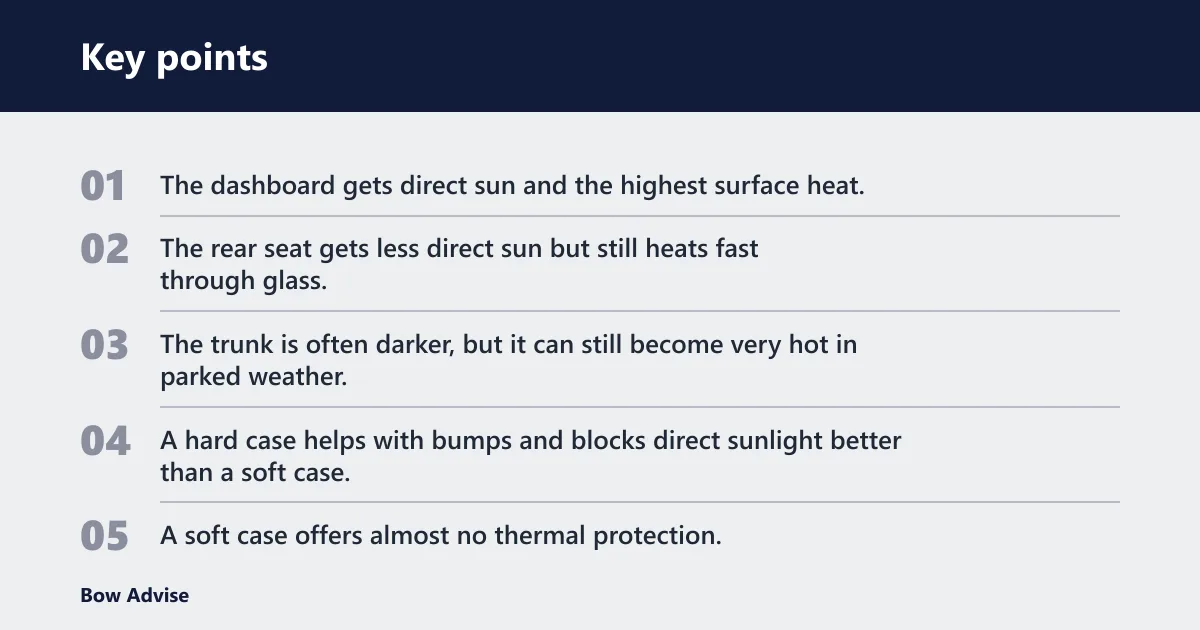
The dashboard gets direct sun and the highest surface heat. The rear seat gets less direct sun but still heats fast through glass. The trunk is often darker, but it can still become very hot in parked weather, and heat may linger longer because airflow is poor.
A hard case helps with bumps and blocks direct sunlight better than a soft case, but it does not cool the interior. A soft case offers almost no thermal protection. If the case sits in a vehicle, the bow is still exposed to the same hot air as the cabin.
What a short hot-car stop can do
A brief stop can soften adhesive on sights, rests, arrow dampers, or limb stickers if the cabin is hot enough. It can also dry out string wax and make serving feel rough. In a compound, heat can change string and cable tension enough to move cam timing slightly.
Suppose a compound bow sits on the rear seat for 25 minutes on a 95-degree day. If the case is black and the sun hits the window, the inside of the case can be much hotter than the air outside. That is enough reason to inspect cams, strings, and adhesive points before the next shot.
When the bow needs a full inspection
Inspect the bow fully if it was in a hot car, sat in direct sun for a long stretch, or feels different in hand after cooling. A string that feels stiff, a limb with a new twist, or a sight that moved are all reasons to stop and check before shooting.
If any part shows a crack, delamination, soft spot, lifted edge, or odd alignment, do not shoot it. Take it to a pro shop if the damage is unclear or the bow has a history of heat exposure and repeated storage in a vehicle.
Heat risk checklist
| Bow type | Most vulnerable component | Post-exposure action |
|---|---|---|
| Recurve | Limbs, string, finish | Check for limb twist, soft spots, finish lift, and string fuzzing before unstringing or shooting |
| Compound | Cams, cables, limbs | Inspect cam timing, cable tension, limb surfaces, and any shifted rests or sights before drawing |
| Traditional wood bow | Wood limbs, finish, grip glue | Look for warp, finish checks, glue lift, and moisture shift; store inside and let it cool fully |
| Hot car triage | String, adhesive accessories, limbs | Cool the bow indoors, then check strings, serving, limbs, and mounted accessories before any shot |
Use that table as triage, not as a guess. If the bow was exposed to heat, the first question is not whether the case looked intact. The first question is which part likely moved or softened first.
What heat does to limbs and risers
Limbs are where heat damage can become structural. Heat can soften resins in composite limbs, raise the chance of limb twist or warp, and open the door to delamination if a hidden weak spot was already present. Recurve and compound limbs both need a close visual check.
Limb twist, warp, and delamination clues
Look along each limb from tip to pocket. A limb that no longer tracks straight, shows a new bow in the profile, or sits differently from its mate may have moved. Cracks near the limb edges, bubbling, or a soft-looking surface are warning signs.
Delamination often shows up as a seam line, lifted layer, or sound change when tapped lightly with a fingertip. If a limb looks uneven, do not try to “shoot it straight.” Heat damage does not correct itself under load.
Aluminum, carbon, and wood riser concerns
Aluminum risers tolerate heat better than many other materials, but mounted parts and adhesives can still fail. Carbon risers can be stable, yet adhesive-backed parts and finish layers still need inspection. Wood risers are the most sensitive to heat plus moisture change, so grip area and finish need a careful look.
Check the grip for softening, lifted wrap, or glue creep. On painted or coated risers, look for chalking, fading, or hairline finish cracks. These are not always structural, but they can point to heat stress that reached deeper parts.
Does sunlight damage bow strings and finish?
Yes. Sunlight does two different kinds of harm. UV slowly breaks down string fibers and finish layers, while heat changes tension, softens some adhesives, and can speed up creep in a loaded string. The prevention steps overlap, but they are not the same thing.
UV exposure on string fibers and serving
String fibers can dry out, fade, or show fuzzing after repeated sun exposure. Serving can loosen or separate sooner if the bow is stored where direct light hits the string through a window or case opening. Check the center serving and end servings for gaps, flattening, or shifts.
Wax helps with moisture and fray control, but it does not block UV or stop heat damage. A common rule of thumb is to wax when the string looks dry or after several shooting sessions in dusty or hot conditions. Avoid over-waxing; too much wax can collect grit.
Finish fade, surface cracking, and adhesive wear
UV can fade clear coats and paint, especially on wood and painted limbs or risers. Heat can make small finish cracks more visible and can weaken adhesive on arrow rests, sights, dampers, and decals. Aluminum usually resists UV damage better than wood, but accessories attached to it still need checks.
Picture a wood riser left near a sunny window for a week. The finish may look dull before any structural issue appears. That difference matters: a dull finish is a surface concern; a lifted edge, crack, or soft patch needs more attention.
How should I store a bow in summer?
Store the bow indoors in a cool, dry location with stable temperature and low UV exposure. A closet, interior room, or conditioned space is better than an attic, garage, or trunk. Let the bow cool to room temperature before inspection so heat does not hide alignment changes.
Hard case vs soft case in heat
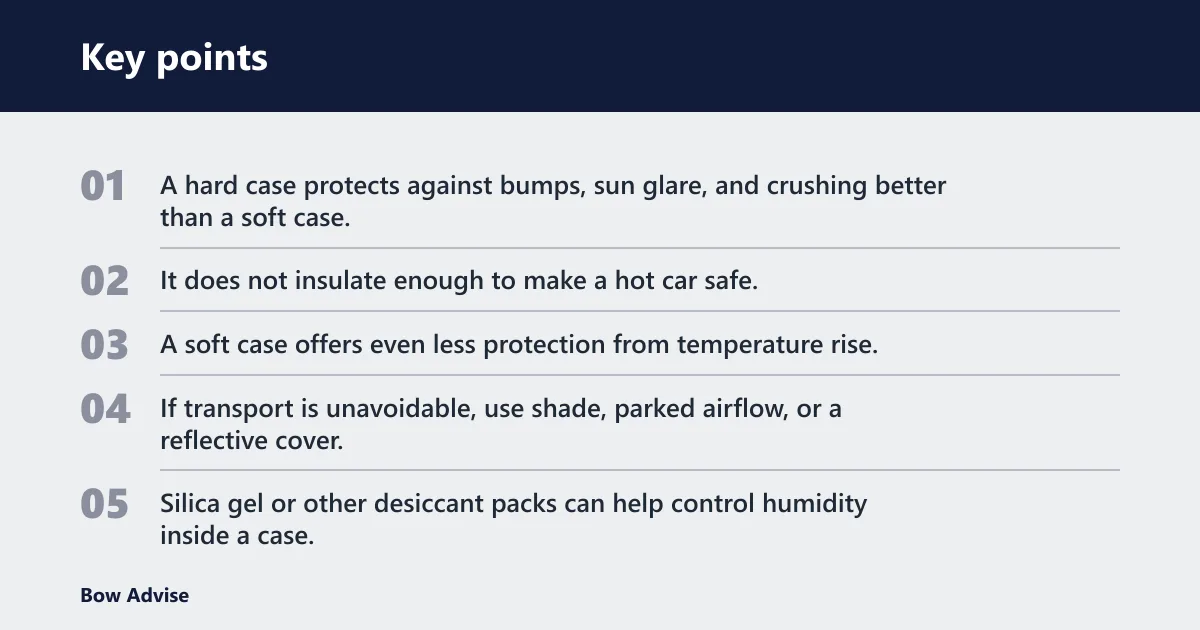
A hard case protects against bumps, sun glare, and crushing better than a soft case. It does not insulate enough to make a hot car safe. A soft case offers even less protection from temperature rise. If transport is unavoidable, use shade, parked airflow, or a reflective cover, but still avoid long exposure.
Silica gel or other desiccant packs can help control humidity inside a case. They are not a heat fix. Recharge or replace them on the maker’s schedule, often after the indicator changes or after repeated humid storage. Their job is moisture control, not temperature control.
Why attics, garages, and trunks are poor choices
Attics and garages can swing from hot to cooler air and back again. That movement is hard on finishes, glue lines, and string condition. Trunks are dark, but they still heat up and can hold that heat for a long time after the vehicle is parked.
Use the case as transport gear, not as a long-term storage vault. If the bow must ride in a vehicle, keep it out of direct sunlight, cover the case with a light reflective layer when possible, and bring it inside as soon as the trip ends.
What to check before shooting after heat exposure
Start with a full cool-down indoors. Then inspect the string, limbs, cams if present, and every mounted accessory. The goal is to catch softening, movement, or alignment changes before the first draw. If anything looks off, stop there.
- Feel the string for dryness, stiffness, fuzzing, or flat spots in the serving.
- Check both limb faces for cracks, soft-looking areas, twist, or edge lift.
- On compounds, verify cam timing and cable tension, and look for cam lean or mismatch.
- Inspect arrow rests, sights, dampers, and other adhesive-backed parts for lift or shift.
- Check arrows for loose nocks, shaft finish damage, and heat-softened glue on points or inserts.
- If any structural change appears, do not shoot until a shop confirms the bow is safe.
A common first-timer mistake is leaving the bow strung in a parked truck and assuming the shade from the cab will protect it from heat damage. The case may look fine while the bow inside has shifted string tension or lifted adhesive. Another common miss is drawing the bow once “just to feel it.” That is the wrong test after heat exposure.
Frequently asked questions
Does sunlight damage bow limbs and strings?
Yes. Sunlight causes UV wear on finishes and string materials, while heat changes tension and can dry out wax. Long exposure through a window can fade coatings, loosen serving, and stress adhesives. Keep the bow out of direct sun whenever possible and store it indoors.
How hot is too hot for an archery bow?
There is no single safe number for every bow, but closed vehicles can climb far above outdoor air temperature, and that is the danger zone. If a bow has sat in a hot car or direct sun, treat it as suspect until it cools and passes inspection.
Should I unstring my recurve in summer heat?
If the recurve will sit unused for a while, unstringing is usually the safer choice. It removes constant load from the limbs and reduces stress during storage. Do not use unstringing as a fix for heat damage, though. Still inspect the limbs and string before use.
How do I protect my bow case from heat?
Use shade, a reflective cover, and short transport times, but do not treat the case as thermal insulation. A hard case blocks sunlight and bumps better than a soft case, yet both can heat up inside a vehicle. Keep the case out of the car whenever possible.
What should I inspect after my bow has been in a hot car?
Check the string for stiffness, fuzzing, or serving separation, then inspect limbs for twist, cracks, or delamination. On a compound, verify cam timing and cable tension. Finish, rests, sights, and other adhesive-backed parts should be checked for lift or shift before any draw.