Archery Rules in Kingdom Come: Deliverance (KCD) Explained
Kingdom Come: Deliverance’s archery blends historical-feel mechanics with real gameplay rules: aim for the center, stay stationary once shooting, and manage your draw and hold time carefully — drawing too far or holding too long causes the reticle to shake and wrecks your accuracy. If you’re also interested in real traditional archery inspired by the game, the core principles (form, anchor point, no dry-firing) carry straight over. For more on this, see our guide on What is Cadet Field Basic Training Like at West Point? Insights & Tips.
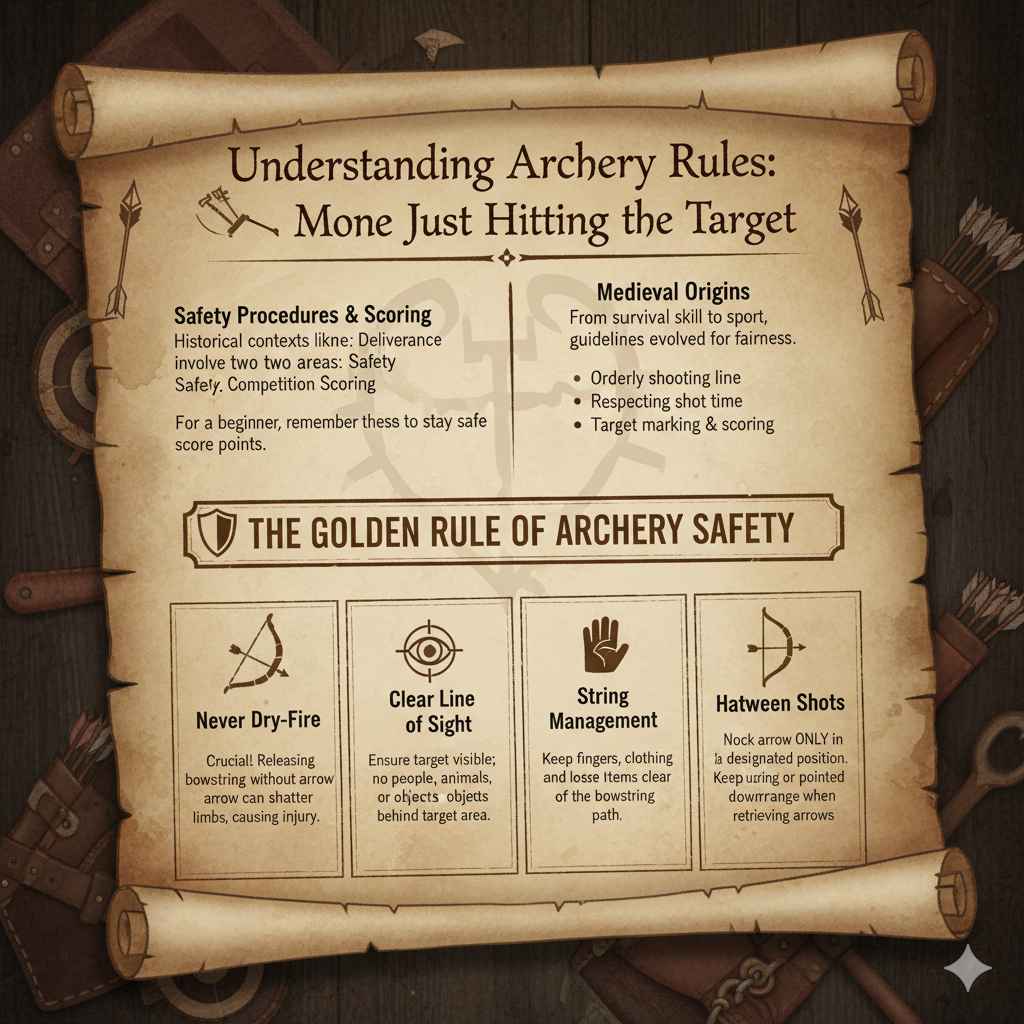
Understanding Archery Rules: More Than Just Hitting the Target
When we talk about archery rules, especially in historical contexts like the game Kingdom Come: Deliverance, we are talking about two main areas: safety procedures and competition scoring. For a beginner, remembering these rules ensures you stay safe and actually score points rather than losing them.
In the medieval world, archery was a skill of survival and defense, but when it turned into sport, specific guidelines developed to keep things fair. These guidelines usually focus on maintaining an orderly shooting line, respecting the time taken for each shot, and ensuring everyone understands how the target is marked and scored.
The Golden Rule of Archery Safety
Before we even look at scoring, safety must come first. This rule applies whether you are using a $50 beginner bow or a premium recurve. A serious accident can happen in an instant if rules are ignored.
- Never Dry-Fire: This is crucial. Dry-firing means drawing the bowstring back and releasing it without an arrow nocked (loaded). The energy has nowhere to go except back into the bow limbs, which can cause them to crack or shatter, potentially injuring the archer or bystanders.
- Clear Line of Sight: Always ensure your target is clearly visible and that there are no people, animals, or objects immediately behind or around your target area that could be hit if you miss (or if an arrow passes through).
- String Management: Keep fingers, clothing, and loose items clear of the bowstring path. An unexpected snag can cause a painful snap against your arm or face.
- Handling Between Shots: Never nock an arrow until you are in your designated shooting position and the range is declared “Hot” or “Ready.” When the all-clear is given to retrieve arrows, always keep your bow unstrung or pointed safely downrange.
The Basics of Scoring: How Points are Earned
If you are competing or practicing for accuracy, knowing how the target is divided and what each ring is worth is the absolute foundation of archery rules. Most traditional and competition targets use the same concentric ring system.
Anatomy of an Archery Target
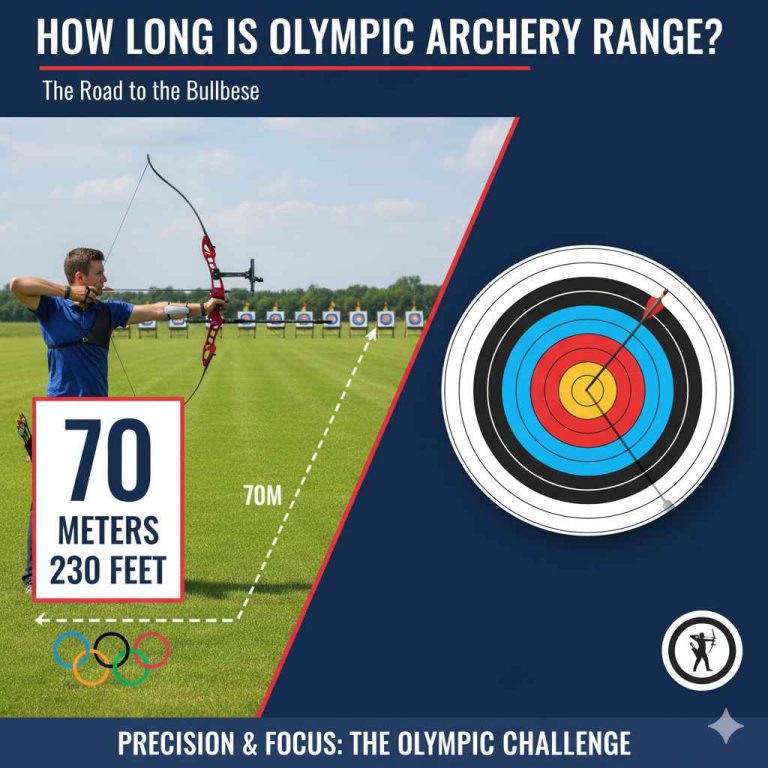
An archery target face is divided into colored rings. The closer you are to the center, the more points you score. While colors can sometimes vary slightly by style (like Field Archery vs. Target Archery), the scoring hierarchy remains consistent.
Here is the standard breakdown of scoring zones from the center outward:
- Gold (Center): Highest value. Usually worth 10 points (or sometimes 9 in older/different formats).
- Red Ring: The next highest value, usually 8 or 7 points.
- Blue Ring: The middle section, usually worth 6 or 5 points.
- Black Ring: The outer edge of the main scoring area, usually worth 4 or 3 points.
- White Ring: The outermost ring, usually worth 2 or 1 point.
- Miss: Any arrow that hits the ground before the target, hits the target boss (the backing material) outside the white ring, or hits the target stand receives 0 points.
Scoring Table Example (Standard FITA/World Archery Style)
For most modern target practice, you will see 10 zones, with 10 being the dead center.
| Zone Color | Points Awarded | Description |
|---|---|---|
| Inner Gold (X-Ring) | 10 | The absolute center point. |
| Outer Gold | 9 | Inside the main gold ring. |
| Inner Red | 8 | The inner portion of the red zone. |
| Outer Red | 7 | The outer portion of the red zone. |
| Inner Blue | 6 | The inner portion of the blue zone. |
| Outer Blue | 5 | The outer portion of the blue zone. |
| Inner Black | 4 | The inner portion of the black zone. |
| Outer Black | 3 | The outer portion of the black zone. |
| Inner White | 2 | The inner portion of the white zone. |
| Outer White | 1 | The outermost scoring ring. |
Rules Specific to Kingdom Come: Deliverance (KCD) Archery
If your goal is mastering Henry’s skill in the world of Kingdom Come: Deliverance (KCD), the rules blend historical simulation with simple gaming mechanics. While KCD does not follow strict international archery competition rules, it does enforce rules related to time, position, and shot execution that affect your score.
1. Stance and Shooting Position
In KCD archery contests, you must start from a designated spot, usually marked clearly. You cannot move closer to the target once the round starts, as this changes the distance unfairly.
To achieve the best scores in KCD, focus on these mechanical ‘rules’:
- Stationary Shooting: Remain rooted to your spot until the round is over.
- Visual Confirmation: In KCD, you must wait for the targeting reticle to fully stabilize before firing for maximum accuracy. This acts as a simulated preparation timer.
2. Time Limits: The Pace of the Shot
Real-world and KCD-style competitions often impose a time limit per end (a set of shots). In KCD, if you take too long, the game might penalize your performance or simply not let you keep shooting indefinitely.
The KCD “Rule of Thumb” for Speed:
- Draw your bow quickly but smoothly.
- Hold your breath briefly (as you would in real life) to steady your aim.
- Release immediately when the sight settles on your desired spot. Hesitation causes wobble!
3. No “Cheating” the Draw (KCD Mechanic)
In KCD, the distance and strength of Henry’s draw directly impact arrow velocity and drop. The “rule” here is balance: drawing too far without the strength to hold it steady results in a huge penalty to accuracy (shaking). Drawing just enough for a steady hold is better than maxing out the draw bar if you shake wildly afterward.
Essential Archery Etiquette and Range Rules
Whether you are at a local range or participating in a friendly KCD tournament, good etiquette is the social backbone of archery. These aren’t written on official scorecards, but ignoring them is a serious breach of trust and safety.
The “Ready, Fire, Clear” System
This sequence is universal for any organized shooting line.
| Command | Meaning | Archer Action |
|---|---|---|
| “Nock and Stand” | Get ready; prepare your arrows. | Place arrows on the string, draw your bow partially, and assume your ready stance behind the shooting line. |
| “Fire” (or Whistle Signal) | It is safe to shoot now. | Execute your shot(s) at your target. |
| “Cease Fire” | Stop shooting immediately. | Lower your bow, un-nock any remaining arrows, and put your bow down safely. |
| “Line Clear / Retrieve Arrows” | It is safe to approach the target. | Only after the Range Officer confirms this, may you walk forward to check scores and retrieve arrows. |
Respecting the Shooting Line and Boundaries
The shooting line is your boundary. Never cross it while shooting is active. In a formal setting, if you are shooting at multiple distances (a common format in field archery), the rules dictate which target you shoot at based on your assigned lane.
For beginners learning form, practicing boundary respect helps build discipline. Always know where your arrow will land if it flies completely over the target. This is why organizations like the National Archery in the Schools Program (NASP) enforce strict backstops and range designs. For more information on general range safety, reputable organizations often provide detailed guidance, such as the safety guidelines provided by USA Archery.
Achieving Master Archer Status: Form is the Unwritten Rule
While the score tells you what you hit, your form dictates how often you hit it. The best “rule” for improving is adherence to sound shooting mechanics. If your form breaks, your score will inevitably suffer.
The Five Steps to a Consistent Shot Sequence
This sequence is the foundation of repeatable accuracy, regardless of whether you are using a longbow like in KCD or a modern compound bow.
- Stance: Establish a balanced, square, or slightly open stance. Your feet should be shoulder-width apart, perpendicular to the target line. Stability prevents sway.
- Nock and Grip: Nock the arrow correctly (nock index upward or downward depending on the bow type). Hold the bow grip lightly—too tight restricts limb movement and accuracy.
- Pre-Draw and Transfer: Smoothly bring the bow arm (the arm holding the bow) up toward the target. Simultaneously, draw the string back using back muscles, not just arm strength.
- Anchor Point: This must be consistent every single time. Find a fixed point on your face (e.g., index finger touching the corner of your mouth or under your jawbone). This sets your draw length perfectly.
- Release and Follow-Through: Relax your drawing fingers—let the string slip away cleanly (no plucking!). Crucially, hold your bow arm up and still until the arrow hits the target. This follow-through ensures you don’t snatch your aim away early.
Understanding Arrow Flight and Game Physics (KCD Note)
In realistic simulators like KCD, gravity and wind affect the arrow significantly. The “rule” here is compensation:
Distance Compensation: You must aim higher for further targets. In KCD, this is represented by the aiming reticle dropping. You need to practice judging that drop.
Weight/Draw Weight: Heavier arrows fly flatter but require more strength. Lighter arrows drop faster but fly quicker. KCD simulates this by making stronger bows inherently more accurate if you can handle the draw weight.
Penalties and Fouls in Competitive Archery
In formal target archery (which informs many historical tournament setups), breaking the rules leads to penalties, which usually mean losing points or being disqualified from that end (round).
Common Scoring Fouls
- Touching the Target Line: Stepping across the shooting line before the “Retrieve Arrows” command results in zero points for that end.
- Shooting Out of Turn: If you fire when the range is marked “Cease Fire,” you risk a warning or point deduction.
- Intentional Interference: Deliberately distracting another shooter is grounds for immediate disqualification.
- Arrow Passing Through: If an arrow passes through the target face and sticks in the ground or boss behind it, it is usually scored based on where the main body of the arrow struck the scoring area. If it misses entirely, it’s zero.
When playing KCD, the game simplifies this: if you miss the time window or act erratically, your score simply reflects what you hit, but the overall sense of good conduct is what makes the experience enjoyable.
Best Pick for Historical-Style Archery
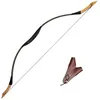
54in Traditional Recurve Horsebow, 20-50lb
A recurve/horsebow matching the historical, no-sights-or-stabilizers equipment rules this guide describes for traditional archery.
- Best for: trying real archery inspired by KCD’s historical setting
- Why we picked it: 20-50lb adjustable range, no compound-bow cams or mechanical parts
- Main drawback: no sights, exactly as historical formats require, so it takes practice
Compare more options
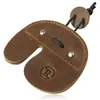 Option 1 Ringsun Leather Archery Finger Tab
| 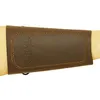 Option 2 SAS Traditional Leather Arm Guard
|  Option 3 SinoArt Sparrow Traditional Longbow, 20lb
|
As an Amazon Associate we earn from qualifying purchases.
Equipment Rules: What You Can and Cannot Use
In many beginner competitions or specific historical reenactment settings (which KCD often leans toward), there are rules dictating what kind of bow or arrow equipment is permissible. This is designed to level the playing field and preserve historical feel.
Historical vs. Modern Equipment Guidelines
If you are aiming for historical accuracy in a living history event or even trying to emulate the feel of KCD, you are generally restricted to traditional equipment:
Bows: Recurve or longbows only. Compound bows (with cams/wheels) are usually banned because they require modern engineering.
Sights and Stabilizers: Absolutely no mechanical sights, scopes, or external stabilizers. You must rely only on the arrow rest and your natural alignment.
* Release Aids: Finger tabs or shooting gloves are usually allowed, but mechanical releases (used heavily in compound archery) are almost always forbidden in traditional/historical formats.
For official information on what equipment is allowed in sanctioned events, organizations often refer to the World Archery rulebook, which details specifications for barebow, recurve, and compound classes. For general guidance on purchasing safe, entry-level equipment, always check manufacturer guidelines, such as those sometimes offered by reputable bow makers.
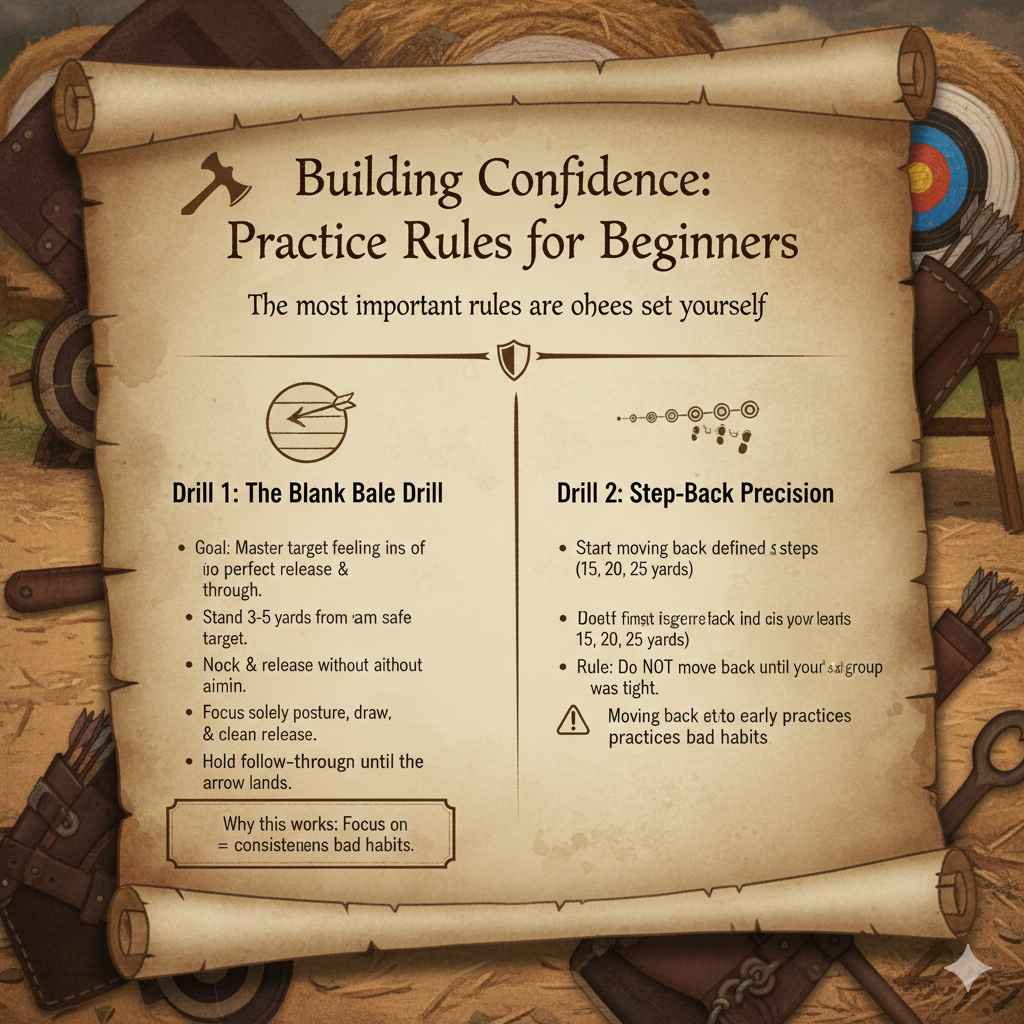
Building Confidence: Practice Rules for Beginners
The most important rules are the ones you set for yourself during practice. Confidence in archery comes from making the shot process automatic.
Drill 1: The Blank Bale Drill (Focus on Feel, Not Score)
This drill removes the pressure of aiming entirely.
Goal: Master the feeling of a perfect release and follow-through.
- Stand 3 to 5 yards from a solid, safe target (a hay bale or thick foam block).
- Nock an arrow, establish your anchor, and release without trying to aim at a specific spot.
- Focus solely on maintaining perfect posture, a smooth draw cycle, and a clean release.
- After every shot, hold your follow-through until the arrow lands.
Why this works: If you focus only on form, your brain stops compensating for bad habits, leading to a more consistent release. Consistency is the true rule for hitting the gold.
Drill 2: Step-Back Precision
Once your grouping tightens up at close range (say, 10 yards), start moving back in defined steps (15, 20, 25 yards).
The rule here is: Do not move back until your last group was tight. If you move back before your 10-yard grouping is satisfyingly small, you are just practicing bad habits at a longer distance.
Frequently Asked Questions (FAQ) for New Archers
Q1: What is the most important rule for a complete beginner?
A: The most important rule is safety, specifically never dry-firing your bow. Secondly, focus on consistency in your anchor point—where your drawing hand touches your face—every single time.
Q2: In KCD, how do I know how far to aim for targets?
A: In KCD, the aiming reticle changes based on how far you draw the bow and the target’s distance. For longer shots, you must aim significantly higher than the target. Practice at known distances until you recognize the necessary aim point visually.
Q3: Do I need a release aid to shoot well?
A: For traditional bows (like those used in historical settings or KCD), no. A release aid is primarily for compound bows. Beginners with recurves should learn to shoot using finger protection (a tab or glove) to avoid damaging their fingers.
Q4: What happens if my arrow touches another arrow already in the target?
A: In most competitions, if your arrow touches another arrow already scored, it is scored based on where it physically rests. If it nudges the first arrow into a higher-scoring ring, it still counts the points of its own point of entry, but this area is often complex. For casual practice, don’t worry about it—just aim for the gold!
Q5: How long should I spend drawing the bow before releasing?
A: As short as possible while maintaining full control. Once you hit your anchor point and are aligned, release within 2 to 3 seconds. Holding too long introduces fatigue, shaking, and inconsistency—this is often called target panic in advanced shooters.
Q6: Is it okay to stand sideways to the target?
A: Yes — in fact, it’s recommended. In both historical archery and modern target shooting, a sideways (square) stance is the standard position. This means:
Your shoulders align naturally with the bowstring.
Your feet are shoulder-width apart.
Your body is perpendicular to the target line.
Q7: What’s the difference between long-distance and tournament arrows in KCD?
A: Long-distance arrows have a verified 10% greater range than standard arrows thanks to a higher power modifier, making them the better pick for long shots. “Tournament arrows” aren’t a separately confirmed named item type in the game’s data — archery contests typically just use standard practice arrows unless the quest specifies otherwise, so don’t assume there’s a dedicated tournament-only arrow to hunt down.
Conclusion
Archery rules — whether in real life or in Kingdom Come: Deliverance — come down to three essentials:
Stay safe. Stay steady. Stay consistent.
Never dry-fire, use a stable side-on stance, anchor the same way every time, and release smoothly. Master these basics, and hitting the gold becomes a habit — not luck. 🏹