DIY bag target stand vs block target stand changes
A block target usually needs a wider, deeper base than a bag target. I usually plan for a modestly larger footprint, move the support points farther apart, and use a tighter strap or shelf so the block cannot tip or slump. If I keep the bag stand geometry, the target can rock, drag the frame forward, or collapse under repeated shots. I’ll show exactly what changes to make in the base, support spacing, height, and anchoring when swapping from a bag target to a block target.
This guide is part of our Target stand DIY: Plans, materials, and builds series.
| Decision factor | DIY bag target stand | block target stand: What changes in the build | Winner |
|---|---|---|---|
| Base and footprint | Can often run with a smaller footprint because the load is lighter and the target is meant to hang or move a little. | Usually needs a wider, deeper base to hold a heavier foam load without tipping or sliding. | block target stand |
| Support spacing and contact style | Works best with spaced bars or straps that cradle the bag without pinching the body. | Needs a cradle, shelf, or capture frame that matches the rectangular footprint and stops side-to-side shift. | block target stand |
| Portability | Easier to move and reset. | Heavier frame and tighter capture points usually make it less portable. | DIY bag target stand |
| Outdoor stability | Needs swing control and a dense enough target so the stand does not walk forward. | Usually needs more anchoring and better front-to-back stability because the target tends to stay planted. | block target stand |
| Target wear management | Wear is driven by movement, strap rub, and sagging contact points. | Wear is driven by edge pressure, frame capture, and repeated compression in the same area. | tie |
What changes in the build?



The build difference is plain. A bag target is a hanging load that can move, while a block target is a heavier foam load that sits fixed. I change the frame around that difference, not around target “type” alone. That means support spacing, base shape, height, and anchoring all shift when I swap one for the other.
Base width and footprint
A bag target can sit on a narrower A-frame or box-frame because the stand mainly has to resist sway and forward drag. A block target needs more footprint, especially front to back, because the load stays rigid and will try to pry the frame over if the center of gravity sits too high.
Support spacing and cradle points
For a bag, I keep the support points far enough apart to let the body hang cleanly without being squeezed flat. For a block, I move those points farther apart and shape them into a shelf or cradle so the foam block sits captured instead of perched on an edge.
Height and target overhang
Bag stands can run a little taller if the hanging point keeps the target centered and off the ground. Block stands should stay lower when possible, because extra height raises the center of gravity and can make the frame easier to tip. If the target overhangs the front rail, I treat that as a warning sign, not a styling choice.
Anchoring priority
Bag stands need swing control first. Block stands need tip resistance first. When I build outdoors, I anchor the block stand early, because a heavier foam load can still walk the frame if the feet skid on grass, gravel, or soft dirt.
Side-by-side build checklist for bag versus block targets
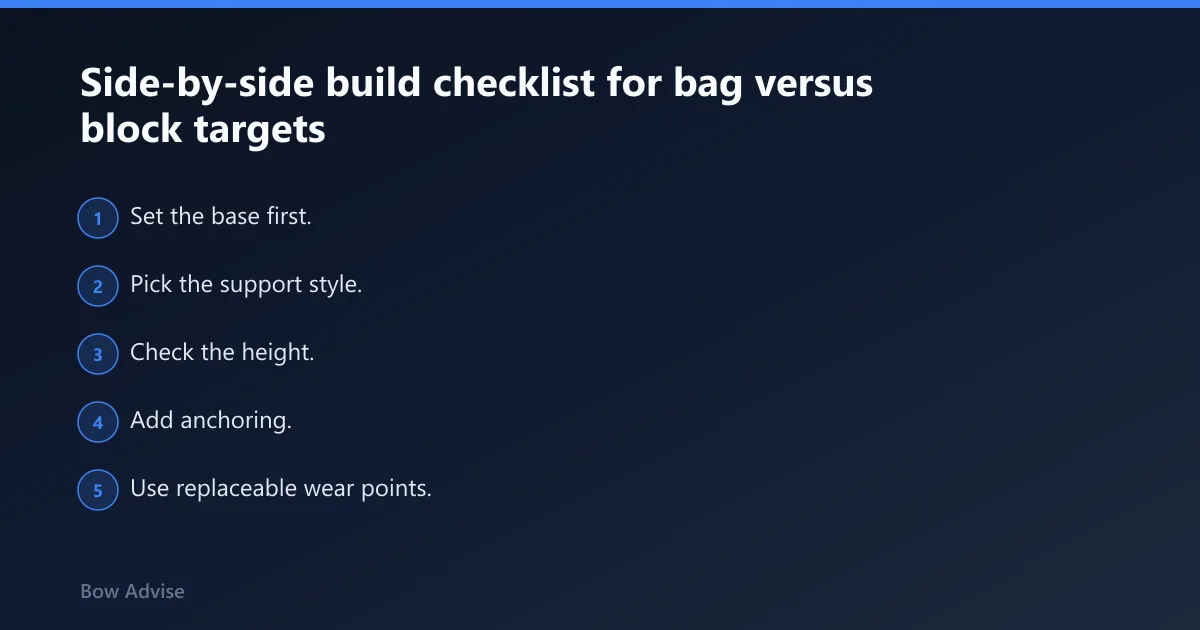
When I build one stand for both, I start with the harder load case. That usually means the block target decides the base width and anchoring method, while the bag target decides the contact style and swing control. I do not size the frame only by target weight.
- Set the base first. For a bag, use a smaller footprint with room for a hanging load. For a block, widen the stance and keep the feet planted front to back.
- Pick the support style. Bag: straps, hooks, or bars with soft contact. Block: shelf, cleats, or a capture frame that matches the rectangular body.
- Check the height. Bag can sit higher if the bottom clears the ground. Block should sit low enough that the center of gravity stays inside the frame.
- Add anchoring. Bag may only need light stakes or fixed feet. Block usually needs stronger stakes, wider feet, or a no-dig base with more mass.
- Use replaceable wear points. Put pads, cleats, or sacrificial contact surfaces where the target rubs the frame.
- Test with real shots. Watch for forward creep, frame twist, or target bounce before you call it finished.
Bag target stand checklist
- Use a softer contact surface so the bag can hang or suspend.
- Keep support spacing wide enough to avoid pinching the stuffed body.
- Add swing control with a back strap, lower stop, or side guide.
- Choose rust-resistant fasteners if the stand stays outside.
- Store the bag inside after use so rain does not soak the fill.
Block target stand checklist
- Build a wider base and a deeper front-to-back stance.
- Use a cradle or frame capture so the foam block cannot slide out.
- Keep the target low in the frame to improve stability.
- Use bolts, washers, and locking hardware where the load presses hardest.
- Plan for repeated compression at the contact points and make them replaceable.
Universal parts that can stay the same
- Wood or metal frame members can both work if they are sized for the load.
- Adjustable brackets help when you swap target style later.
- Quick-release pins are handy if you change targets often.
- Rust-resistant outdoor hardware matters in either build.

How do base width and support spacing change?
A bag target needs enough spacing to control swing without pinching the body. A block target needs a wider cradle so the rectangular footprint sits flat and does not get squeezed at the edges. I adjust the stand for how the target sits in the frame, then I test for motion under real impact.
Bag target: control swing without pinching the body
Bag targets use a softer stopping surface than block targets, and they are typically filled with fibrous material. Because they hang or suspend, I want the stand to allow a little movement while stopping the kind of rocking that makes the bag walk forward shot after shot. A bag target should be heavy and dense enough to avoid moving during use.
Block target: hold the rectangular footprint without squeeze
Block targets are made of compressed foam blocks and offer a denser stopping surface. That denser body needs a frame that captures it without bending the sides inward, or the foam can load the frame unevenly and slip under repeated hits. I use contact points that spread the load, not ones that bite into the corners.
Recommended spacing rules for each build
For a bag, I keep the support bars just wide enough to center the target and keep the hanging point clean. For a block, I widen the spacing so the foam sits in a cradle with room for the full footprint and no hard squeeze at the edges. If the target touches only one edge, the load path is wrong.
How do load path and anchoring change outdoors?
Outdoors, the target shape matters as much as the target weight. A bag’s center of gravity shifts as it swings, while a block stays more fixed and pushes that load straight into the frame. That means the bag needs motion control, and the block needs tip resistance and better footing on uneven ground.
Center of gravity and front-to-back stability
With a bag, the target can move the center of gravity forward when it swings after impact. With a block, the center of gravity is steadier but higher if you mount it too tall. In my own backyard setup, I learned quickly that a tall stand feels fine until the first hard hit pushes the frame into a wobble.
Stakes, fixed feet, and no-dig options
Stakes work well when the ground is soft and the stand needs extra bite. Fixed feet are better when I want a stand that stays put on a flat pad or deck. No-dig options are useful for portability, but they need enough footprint and weight to keep a block from creeping under repeated shots.
Uneven ground leveling and wind exposure
Uneven ground turns small stability problems into big ones. I level the feet before I shoot, because a stand that leans even a little will move more with every hit. Wind matters too; a broad-faced block catches more air than a hanging bag, so I anchor the block stand harder when the weather turns messy.
Materials and hardware that make each stand work
Wood and metal both work, but they fail in different ways. Wood is easy to cut and adjust, while metal holds shape better under repeated impacts and weather exposure. I choose the material based on how hard the stand has to resist movement, not on what I have lying around.
Wood versus metal frame members
Pressure-treated outdoor lumber makes sense when the stand will live outside and I want quick changes in the shop. Metal frame members are better when I want less flex and more repeatability between builds. PVC has limits here; it can work for light layouts, but repeated impact and outdoor exposure punish it fast.
Fasteners, washers, quick-release pins, and brackets
Lag screws, bolts, and washers handle clamping force better than light fasteners. Quick-release pins are useful when I swap a bag for a block on the same frame. Adjustable brackets matter because they let me move support spacing without rebuilding the entire stand.
Replaceable pads or cleats plus rust-resistant parts
Replaceable pads help with bag targets because they reduce wear where the body rubs. Cleats and shelf inserts help with block targets because they keep the foam from creeping. I use rust-resistant outdoor hardware on both, since weather exposure ruins a stand faster than a few bad groups.
What fails first?
Bag stands usually fail by tipping, swinging too far, or sagging at the suspension points. Block stands usually fail by sliding, spreading the frame, or wearing the contact points until the foam no longer sits tight. Those failure modes tell me which part of the build needs the first upgrade.
Bag target tipping, swinging, and sagging
A bag target that is too light or too loosely hung will swing after impact and drag the frame forward. If the support spacing is too narrow, the body can pinch and sag until the stand loses shape. I watch for side movement first, because that is the early warning sign.
Block target sliding, frame spread, and contact wear
A block target slides when the cradle is too shallow or the base is too narrow. Frame spread shows up when the load pushes the side rails apart under repeated shots. Contact wear happens when the same edge takes every hit, which is why I like replaceable pads and cleats.
Arrow safety zone and backstop issues
Bag targets work great with target points, and broadheads are not recommended for bag targets. Block targets can handle high-velocity arrows without damage, but I still match them to a proper backstop and a safe shooting angle. I keep side clearance clear on both builds, because a miss can leave the stand and go somewhere I did not plan for.
Choose DIY bag target stand if… / Choose block target stand: What changes in the build if…
Choose a DIY bag target stand if you want a lighter setup, easier movement, and a frame that can tolerate a little swing. Choose a block target stand: What changes in the build if you want a heavier, more fixed setup with a wider base, tighter capture points, and better resistance to slide and tip.
I use a bag stand when I move targets often, coach beginners, or want a simple frame that I can reset fast after a session. I use a block stand when I want something that stays outside, holds its shape under repeated shots, and handles a dense foam load better. If you want one universal stand, build to the block target first and add adjustable contact points for the bag.
Frequently asked questions
What’s the difference between a bag target stand and a block target stand?
A bag target stand is built around a suspended, moving load, while a block target stand holds a heavier, fixed foam load. That means the bag frame focuses on swing control and contact spacing, and the block frame focuses on a wider base, capture points, and tip resistance.
Do I need different lumber or frame support for a block target versus a bag target?
Usually, yes. A block target asks more from the base and side rails because it is heavier and sits more rigidly in the frame. I use stronger lumber, better bracing, or a metal frame when the foam block is large enough to push the center of gravity outside a narrow stance.
Which stand is more stable for a heavy bag target?
A heavy bag target is usually more stable on a stand with a wider base and controlled hanging points. The bag itself should be dense enough to avoid moving during use, but the stand still needs to stop swing and forward drag. If the support points are too close, the bag will rock.
Can I use the same stand dimensions for both bag and block targets?
Not cleanly. A bag can live on a narrower, taller layout if the suspension is right, while a block needs more width and a deeper stance. I only use one set of dimensions when the stand is already sized for the block and I can adjust the contact points for the bag.
How do I prevent a bag target from swinging or tipping on the stand?
I start with a dense bag and a stand that does not pinch the body. Then I add swing control with lower stops, side guides, or a back strap, and I anchor the feet if the ground is soft. If the bag still walks forward, the base is too light.
What hardware changes if I want a stand that works for both target types?
I use adjustable brackets, bolts, washers, and quick-release pins so I can move support points without rebuilding the frame. Replaceable pads or cleats help me swap between a soft hanging load and a rigid foam block. Rust-resistant outdoor hardware matters if the stand stays outside.