How to Measure Bow Poundage Without a Scale
You can estimate bow poundage without a scale by using the marked draw weight on the limbs, a measured draw length, and the 28-inch reference used for traditional bows. When you need a more exact reading, use a bow scale or take it to a shop, since that is generally the most dependable way to confirm it. Guessing wrong can leave you overbowed, underpowered, or mismatched to your arrows. This guide covers the safest at-home estimation methods, their limits, and the point where you should stop estimating and get a real reading.
Bow poundage overview
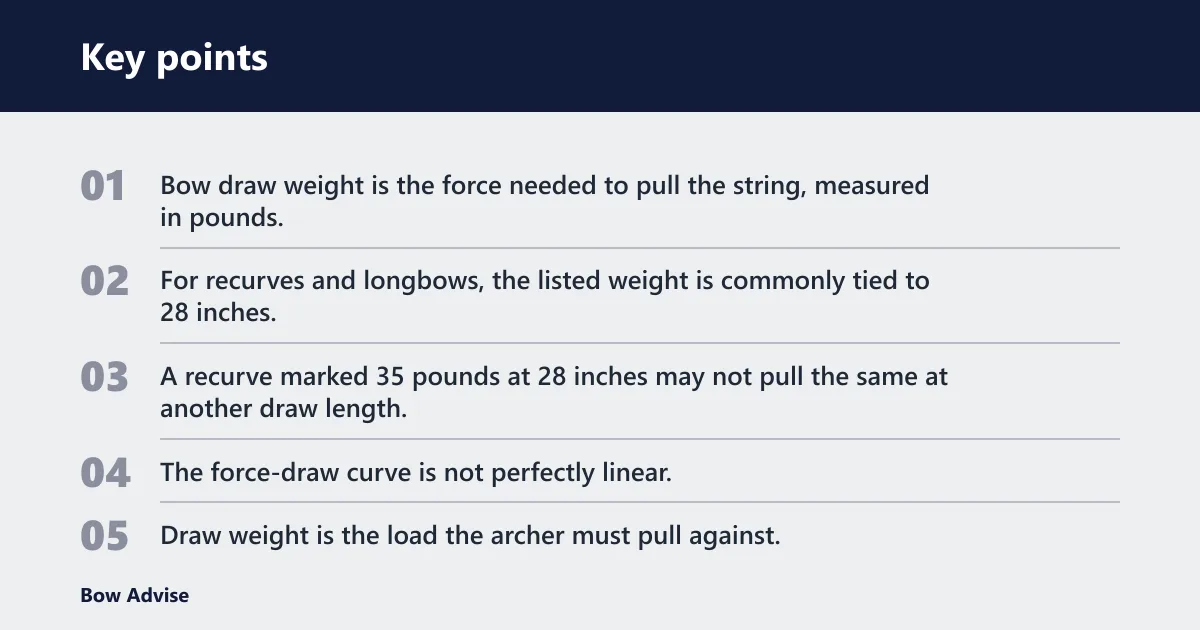


Bow draw weight is the force needed to pull the string, measured in pounds. For recurves and longbows, the listed weight is commonly tied to 28 inches, while compound bows need separate treatment because peak draw weight and holding weight are different because of let-off. (Wikihow)
That difference matters. A recurve marked 35 pounds at 28 inches may not pull the same at another draw length, and a compound marked 60 pounds may not feel like a single fixed number through the whole draw cycle. The force-draw curve is not perfectly linear, so home estimates only stay useful for rough comparison.
What draw weight means
Draw weight is the load the archer must pull against. On traditional bows, the number is usually given at a standard draw length. On compounds, the number on the limb label is usually the peak setting, not the holding weight at anchor.
Why draw length changes the number
A longer draw usually increases the measured weight, and a shorter draw usually lowers it. A practical rough guide is about 2.5 to 3 pounds for each inch away from 28 inches, but that is still only a rough guide and not a direct measurement.
Traditional bows and compounds are not the same
Recurve bows and longbows can be estimated at home more safely because the marked weight is usually referenced at 28 inches. Compound bows are harder to estimate accurately without a scale because cams, draw stops, and let-off change what the archer feels during the draw and at full anchor.
What you’ll need
- The bow’s limb markings or label, if present
- A tape measure for checking draw length
- A clear, calm area with safe backstop space
- Eye protection, if the bow is unfamiliar or aging
- A second person only to observe form and safety, not to pull the string
- A bow scale if direct verification becomes necessary
How to measure a bow without a scale
The safest answer is that you can only estimate, not truly measure, without a bow scale. Use the marked weight, confirm your draw length, and compare the bow type to the standard reference. If the bow is a compound, damaged, unmarked, or unfamiliar, stop at estimation and get a shop reading.
Use the markings as your starting point
Look for the limb label on a traditional bow or the draw-weight range on a compound. If the label is missing or suspect, do not treat a guess as fact. A marked number is only a reference point, not proof of the current setup.
Compare your draw length to the reference
For recurves and longbows, the 28-inch reference is the starting point for interpretation. If your draw is longer than 28 inches, the actual draw weight is usually higher than the marked number. If it is shorter, the actual draw weight is usually lower.
Stop when the bow type makes the estimate unreliable
Estimation works best for known traditional bows with clear markings. It becomes weak fast with compounds, heavily tuned setups, or any bow that feels rough, noisy, or damaged. That is the point to stop and verify directly.
No-scale poundage estimation ladder
| Bow type | What markings or reference you can use | What you can estimate at home | Estimated confidence level | When to stop and visit a shop |
|---|---|---|---|---|
| Recurve | Limb label, usually tied to 28 inches | Rough current draw weight if your draw length is known | Moderate, if the bow is marked and undamaged | If the label is missing, the limbs are newer than the riser, or the bow feels abnormal |
| Longbow | Marked weight at 28 inches, if provided | Approximate weight at your draw length using the 28-inch reference | Moderate to low, because the draw curve is not linear | If the bow is unmarked or your draw length is far from 28 inches |
| Compound bow | Limb label, module setting, draw length setting, cam stop position | Only a rough setup estimate, not a dependable poundage reading | Low without direct measurement | Almost always, unless a shop can confirm the exact setting |
| Unknown or damaged bow | Very little you can trust | Do not estimate as if it were exact | Very low | Immediately |
How to determine bow draw weight at home
Start with the marked weight, then adjust mentally for draw length only as a rough estimate. A traditional bow marked at 30 pounds at 28 inches will usually read lighter at a shorter draw and heavier at a longer draw. The result is still an estimate, not a direct reading.
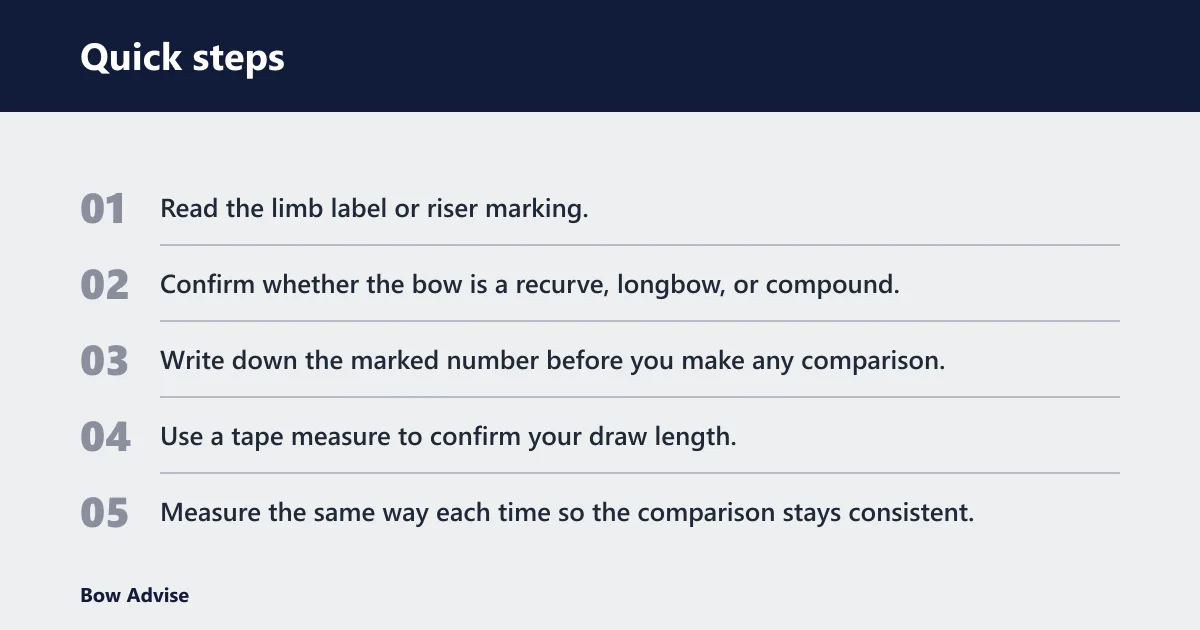
Step 1: Check the marked weight
- Read the limb label or riser marking.
- Confirm whether the bow is a recurve, longbow, or compound.
- Write down the marked number before you make any comparison.
Step 2: Measure your draw length
- Use a tape measure to confirm your draw length.
- Measure the same way each time so the comparison stays consistent.
- If you do not know your draw length, do not treat the estimate as trustworthy.
Step 3: Compare the marked draw length to yours
- Use 28 inches as the reference for a traditional bow.
- Estimate a change of about 2.5 to 3 pounds per inch away from that reference.
- Round toward the safer side if the result matters for beginner setup.
Step 4: Treat the result as an estimate, not a direct reading
Suppose a recurve is marked 30 pounds at 28 inches and the archer draws 30 inches. A rough estimate would put the bow a few pounds above the marked weight. That still does not replace a scale, especially if arrow spine selection depends on the result.
How to estimate a recurve or longbow
A recurve or longbow is the easiest bow type to estimate at home because the marked weight is commonly based on 28 inches. Use the label, check your draw length, and keep the result in the range of a rough guide only. Do not treat it as exact setup data.
Step 4: Use the result cautiously
A common first-timer mistake is assuming a 40-pound recurve always behaves like a 40-pound recurve at every draw length. It does not. If the archer draws well past 28 inches, the actual load can be much higher than the label suggests.
Can a compound bow be measured without a scale?
A compound bow can be estimated without a scale, but it should not be treated as truly measured. The limb label, module setting, and draw length can tell you whether the setup is in the right neighborhood. Peak draw weight and holding weight are different, so a shop check is the safer finish line.
Step 1: Read the label and settings
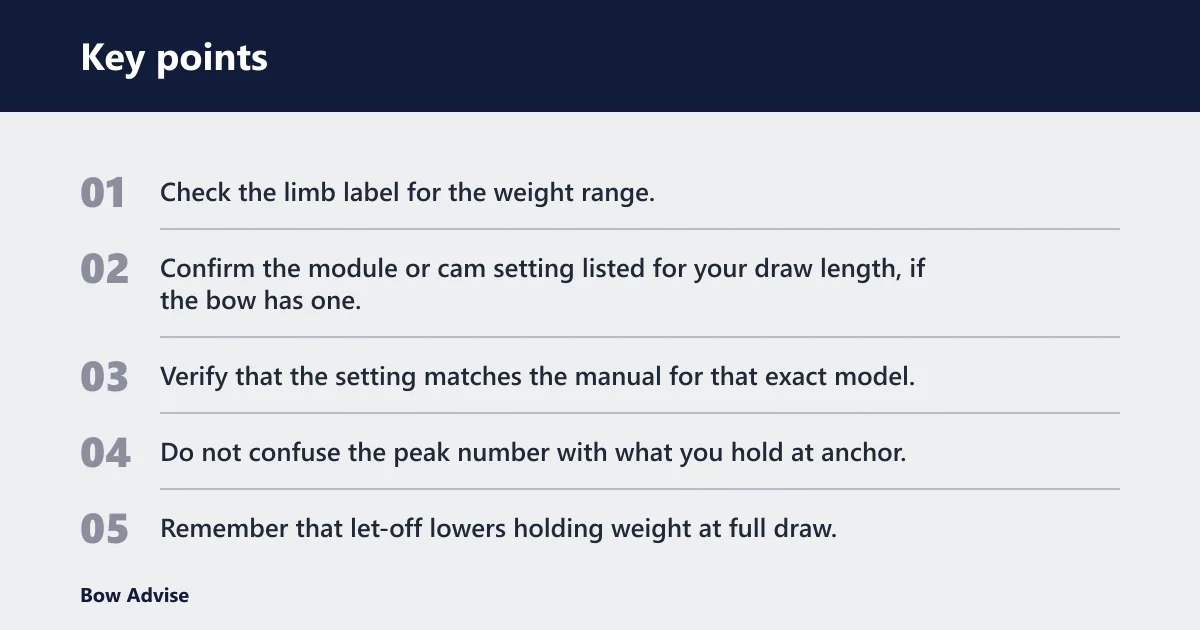
- Check the limb label for the weight range.
- Confirm the module or cam setting listed for your draw length, if the bow has one.
- Verify that the setting matches the manual for that exact model.
Step 2: Separate peak weight from holding weight
- Do not confuse the peak number with what you hold at anchor.
- Remember that let-off lowers holding weight at full draw.
- Use the label only as a setup reference, not as a full measurement.
Step 3: Stop if the setup is unknown
- Stop if the draw stop position is unclear.
- Stop if the cams, cables, or limbs look damaged or mismatched.
- Take the bow to a shop for direct verification before shooting it.
Suppose a compound is labeled in a 70-pound range, but the cam setting and draw length are unknown. The number on the limb does not tell the full story, because the actual peak setting and the draw-stop position can change the reading. That is a shop case, not a guess case.
How do I know if my bow poundage is too high?
If the bow shakes, collapses your front arm, forces short draws, or breaks your anchor, the poundage is too high for clean form. Beginners should choose conservative weight and keep form stable before moving up. If the bow feels abnormal or painful, stop and recheck the setup.
Signs the bow is too much
The most useful signs are form loss and repeatability problems. If the archer cannot hold steady at anchor, cannot finish the draw without strain, or cannot aim without rushing, the bow is likely above a sensible training weight. That is enough reason to step down.
What to do next
- Lower the weight only within the bow’s manual and adjustment limits.
- Use a lighter setup until form stays consistent.
- If the bow is a compound, have a shop confirm the exact setting before further use.
Common mistakes
One common mistake is using feel alone as if it were a measurement. Another is assuming the limb label matches every draw length. A third is forcing a compound past an unfamiliar draw stop. Any of those can give a false number and a poor fit.
- Do not assume a marked weight is exact at your draw length.
- Do not use visual guesswork as a substitute for measurement.
- Do not overdraw a bow to “see what it pulls.”
- Do not keep shooting a bow that feels damaged or inconsistent.
- Do not treat a compound’s holding weight as its peak draw weight.
If a bow seems off, stop and verify it rather than chasing the number. A bow scale is still the standard tool for direct measurement, and a bow shop is the right stop when the bow type, label, or setup leaves too much uncertainty.
Frequently asked questions
How to test bow draw weight without a bow scale
Use only a marked bow and a known draw length for comparison. Do not pull past your normal anchor just to estimate the number. If the bow is unfamiliar, damaged, or a compound with unknown settings, skip the test and take it to a shop.
Does draw length affect bow poundage?
Yes. A longer draw usually increases the measured weight, and a shorter draw usually lowers it. For recurves and longbows, the common reference is 28 inches, so any draw-length change should be judged against that point rather than by feel alone.