How Much Does a Bow Scale Cost?
A bow scale is often priced at about $15 to $40 for a basic handheld model, roughly $50 to $150 for a better digital or analog scale, and about $200 or more for pro-shop units. Cheap scales can miss draw weight and send tuning in the wrong direction. This guide breaks down price tiers, accuracy, and which setup fits a beginner, home tuner, or shop.
This guide is part of our Bow measurements guide series.
What a bow scale measures


A bow scale measures draw weight in pounds. That matters in bow work because actual poundage can differ from the bow’s marked spec, and that difference can change arrow choice, tuning, and how the bow feels through the draw cycle.
Most hand-held bow scale models are portable manual tools with an lbs scale printed or displayed on the body. Some bow draw weight scales are made for easier reading and may include an indexer so the user can read the actual draw weight more clearly.
For compound bow work, the scale is usually used to check peak draw weight. That is one reason a compound bow weight scale often appears as a handheld gauge rather than a fixed shop tool.
How much does a bow scale cost?
The short answer is that most buyers spend $15 to $40 for a basic handheld bow scale, $50 to $150 for a midrange digital or better analog unit, and $200 or more for pro-shop grade tools. The right price depends less on the label and more on how often the scale must repeat the same number.
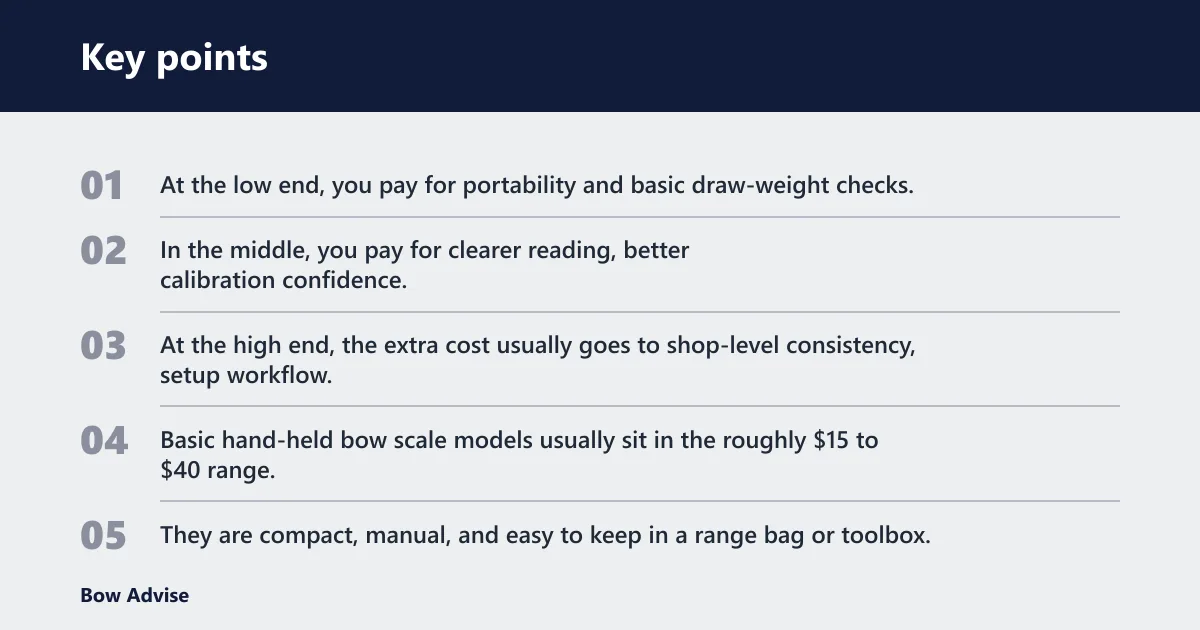
At the low end, you pay for portability and basic draw-weight checks. In the middle, you pay for clearer reading, better calibration confidence, and more repeatable numbers. At the high end, the extra cost usually goes to shop-level consistency, setup workflow, and more exact measurement for tuning.
Budget handheld price range
Basic hand-held bow scale models usually sit in the roughly $15 to $40 range. They are compact, manual, and easy to keep in a range bag or toolbox, which makes them useful for quick draw weight checks on a beginner bow or hunting bow.
That price tier is enough when the goal is a rough confirmation of bow poundage, not a fine-tuned setup decision. It is not enough when a small reading error could change arrow spine choice or hide a peak draw-weight problem on a compound bow.
Midrange digital price range
Midrange digital scales commonly fall in the roughly $50 to $150 range. This is the zone where readability improves, the lbs scaling is easier to track, and repeatability is usually better than on the cheapest manual gauges.
That range suits home tuning, arrow selection checks, and compound bow tuning when the archer wants a steadier number than a basic spring-based gauge can provide. It is not the right tier when a shop needs frequent use, fast turnover, and a tool that stays dependable through heavy daily handling.
Pro-shop grade price range
Pro-shop grade scales are commonly priced at about $200 and up. These tools are bought for consistency, not convenience, and they are most relevant when a shop needs trustworthy readings across many bows and repeated setups.
This tier is worth paying for when draw weight accuracy affects customer setup, pro-shop tuning, or archery measurement workflows that also involve draw boards, bow presses, bow vise tools, and other setup equipment. It is more tool than a beginner home setup usually needs.
Bow scale price bands and features
Bow scale pricing tracks with how clearly the scale reads, how well it repeats a number, and whether the tool stays accurate after regular use. A cheaper scale can still measure draw weight, but a weak spring, poor display, or sloppy zeroing can make the number less useful.
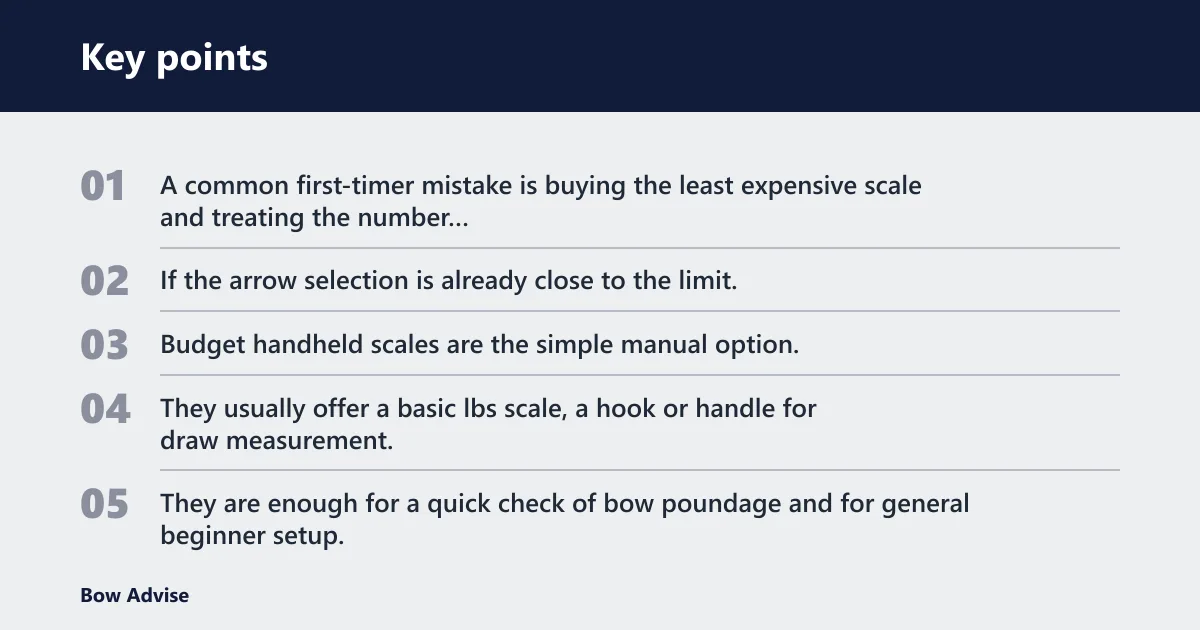
A common first-timer mistake is buying the least expensive scale and treating the number as exact. If the arrow selection is already close to the limit, a few pounds of error can push the setup in the wrong direction.
Budget handheld scales
Budget handheld scales are the simple manual option. They usually offer a basic lbs scale, a hook or handle for draw measurement, and a portable body that is easy to store.
They are enough for a quick check of bow poundage and for general beginner setup. They are not enough when the user needs consistent readings across multiple pulls or wants to compare one bow against another with tight tolerance.
Midrange digital scales
Midrange digital scales aim for better readability and steadier numbers. Some are easier to read at full draw, and some add an indexer so the archer can track the actual draw weight more cleanly during the pull.
They are enough for home tuning, hunting setup checks, and archery bow scale use where the buyer wants more confidence than a basic manual gauge can give. They are not enough for every shop task, especially if the tool will see constant daily use.
Pro-shop grade scales
Pro-shop grade scales are built for repeated measurement and better calibration control. Their value comes from fewer questionable readings and better repeatability, not from flashy extras.
They are worth it for shops, serious tuners, and any setup environment where a bad reading could waste arrows, delay tuning, or cause back-and-forth adjustments that should have been avoided.
Bow scale cost guide
The right cost tier depends on what the scale must do. A beginner checking one bow a few times a season does not need the same tool as a shop that measures poundage all day. Accuracy, calibration, and repeatability matter more as the use case gets stricter.
Budget handheld: when it is enough
Budget handheld scales are enough for a home archer who wants a rough draw weight number before buying arrows or making a basic bow setup change. They are also enough for a bowhunter who wants a portable manual tool for occasional checks.
They are not enough when the setup must land on a very specific poundage or when the archer expects the number to stay consistent over repeated sessions.
Midrange digital: when it is enough
Midrange digital scales are enough for most beginner archers who tune at home and want more reliable numbers for arrow selection and peak draw-weight checks. They are a practical middle ground for compound bows and for recurves that will be measured more than once.
Suppose a 28-inch draw compound is marked at 70 lbs but the measured peak draw weight comes in several pounds off. A midrange scale helps confirm the actual number before the archer buys arrows that are too stiff or too weak.
Pro-shop grade: when it is worth it
Pro-shop grade tools are worth it when the scale must stay trustworthy through frequent use, service work, and repeated bow setups. They are most useful in a shop workflow that already includes bow presses, draw boards, and other measurement tools.
They are not the first purchase for most beginners. For one bow and occasional home tuning, that money is usually better spent on arrows, a rest, or a better sight setup.
Do you need a scale for accurate draw weight?
Not every archer needs a scale to be close enough, but anyone who is tuning arrows, checking peak draw weight, or comparing a bow’s marked rating against its actual poundage benefits from one. For casual use, the marked spec may be enough. For setup decisions, a measured number is safer.
The need rises when arrow spine, hunting weight limits, or a compound bow’s peak draw weight matters. If the scale only needs to confirm that a bow is in range, a basic handheld tool can be enough. If the reading will guide tuning choices, a better scale is the safer buy.
When marked bow weight is enough
Marked bow weight is enough when the archer only needs a general idea of the bow’s setting and is not making exact tuning changes. That is common for a fresh beginner bow or a simple check before a practice session.
It is not enough when the setup needs precise arrow matching or when the measured poundage will decide whether a bow is ready for hunting use.
When tuning needs a measurement
Tuning needs a measurement when the bow’s actual draw weight may differ from the rating and that difference changes arrow choice or draw-cycle feel. This is common with compound bow tuning and with home setups that use arrows selected by spine charts.
A scale also helps when the archer wants to compare different limbs, limbs settings, or draw-weight adjustments in a repeatable way instead of guessing from feel alone.
Handheld vs compound bow weight scale
A compound bow weight scale is not always a different category from a hand-held bow scale, but the use case is different. Handheld manual tools are portable and quick. Compound tuning often benefits from clearer readability and a tool that can register peak draw weight without confusion.
The best choice depends on whether the user wants a simple draw-weight check or a tuning aid that must be read accurately at full draw. Some scales add an indexer for this reason.
Portable manual scales
Portable manual scales are the simplest option. They are light, easy to carry, and common in the lower price bands. Their main advantage is convenience.
The drawback is that readability can suffer, especially if the lbs scale is small or the pointer moves quickly. That matters when the number is being used for more than a rough estimate.
Compound tuning use
For compound tuning, the scale should handle peak draw weight clearly and repeatably. That is why a handheld gauge is often enough for compound bow work, but only if the reading is legible and consistent.
When the number is off, the archer may chase the wrong problem. A bow can feel “wrong” because the scale is inaccurate, not because the bow itself is badly set up.
Indexer and readability
An indexer helps the user read the actual draw weight more easily. On some handheld bow scales, it acts as a reference point so the reading is less guessy at full draw.
That feature matters most when repeatability matters. If the scale is hard to read, the buyer may save money up front and lose it later to bad arrow purchases or extra setup time.
Bow scale buying table
This table compares the main price bands by use case. It focuses on actual buying tradeoffs: what each band usually offers, when it is enough, when it falls short, and what gets hidden if the scale is too cheap for the job.
| Price band | Typical features | When it is enough | When it is not | Hidden costs of buying too cheap |
|---|---|---|---|---|
| $15 to $40 budget handheld | Portable manual design, basic lbs scale, quick draw-weight check, simple hook or handle | Beginner bow checks, occasional home use, rough hunting setup confirmation | Frequent tuning, tight arrow spine decisions, repeated measurements that need strong repeatability | Poor accuracy, weak calibration confidence, inconsistent readings, wasted arrows or extra setup time |
| $50 to $150 midrange digital | Clearer display, better readability, steadier measurements, some models with an indexer | Home tuning, arrow selection, compound peak draw weight checks, regular use | High-volume shop work, constant daily handling, situations that demand shop-grade durability | False confidence if zeroing drifts, slow read changes, repeatability problems on repeated pulls |
| $200+ pro-shop grade | Better calibration control, shop-oriented consistency, repeated-use durability, higher repeatability | Pro-shop tuning, frequent measurements, setup workflows that include draw boards and presses | One-bow casual ownership, occasional checks, buyers who only need a basic draw-weight number | Overbuying for the use case; underbuying here risks inaccurate setup decisions and rework |
Bow scales in the wider archery tool kit
Bow scales sit inside the tools category alongside other setup equipment. Lancaster Archery Supply has a dedicated Bow Scales category, and the scales sit inside the Tools shopping category. The same tools menu also lists Draw Boards, Chronographs, bow presses, and bow vise tools, which shows how scales fit into the broader setup workflow.
Lancaster also lists a specific Bow Scales & Software subcategory, plus related products under Leveling & Alignment Tools. That matters because a scale is rarely the only measurement tool used during setup. Compound bows, recurve bows, and youth bows are all separate major product categories, and each can benefit from a different tuning approach.
- Decide whether the scale will be used for rough checks or tuning.
- Check whether you need a basic handheld gauge or a better digital unit.
- Look for readable lbs scaling and, if needed, an indexer.
- Match the tool to the bow type and the level of repeatability required.
- Only move to pro-shop grade when frequent use justifies the cost.
Say your beginner compound is marked at 60 lbs, but the actual peak draw weight matters for arrow selection. A $25 handheld scale may confirm the general range, yet a $90 model with clearer readability can reduce guesswork before the archer buys a full arrow set.
Picture a home tuner setting up a hunting bow the night before season. If the scale is hard to read or drifts on repeat pulls, the setup can look “close enough” while still landing outside the arrow spine range that the rest of the setup expects.
Frequently asked questions
How much is a bow scale?
The real price depends on readability, repeatability, and how much accuracy the setup requires.
How much does a good bow scale cost?
A good bow scale for home tuning usually sits in the $50 to $150 range. That price band often gives better readability and more dependable repeat readings than the cheapest handheld tools, which matters when arrow selection or peak draw weight is on the line.
What is the price of a hand held bow scale?
A hand held bow scale usually costs $15 to $40 at the budget level. Some better handheld gauges cost more, especially if they improve readability, add an indexer, or hold calibration better over repeated use.
Is a compound bow weight scale different from a hand held bow scale?
Often it is the same kind of handheld gauge used for a different task. A compound bow weight scale is used to check peak draw weight and may need clearer readability, while a general handheld bow scale may be simpler and less exact for tuning work.
Do I need a scale to measure bow draw weight accurately?
If the number will affect tuning, arrow spine, or hunting setup, yes. A marked bow weight can be close enough for casual use, but a scale is the better choice when the setup needs an actual measured poundage rather than an estimate.
How much does an archery bow scale cost for home tuning?
For home tuning, most buyers land in the $50 to $150 range because that tier tends to balance cost with readability and repeatability. A cheaper scale can work for a rough check, but it may not give the confidence needed for careful setup decisions.