Best Tree Stands for Mobile Deer Hunters (2026): Research Shows
Choose a Hang-On Stand if you want the safer bet for mobile deer hunting across mixed trees, longer walks, and public-land setups; choose a Climbing Stand if your woods have straight, limbless trunks and you want the fastest ascent with the fewest parts. The right pick is the one that still works when the tree is crooked, bark is rough, or daylight is slipping.
Quick comparison
Mobile hunters lose time on tree fit more often than on the stand itself. Pick the system that matches the trees you actually have, not the trees you wish you had.
For straight trunks and quick climbs, the climber has the edge. For flexible placement, lighter one-trip carry decisions, and public-land pressure, the hang-on wins more often.
| Decision factor | Climbing Stand | Hang-On Stand | Winner |
|---|---|---|---|
| Tree compatibility | Best on straight, limbless trunks | Works on crooked or limby trees | Hang-On Stand |
| Carry weight | Stand only, but larger bulk can be awkward | Stand plus climbing sticks add load | Climbing Stand |
| Setup time | Fast when the tree fits | Slower because sticks and stand must be placed | Climbing Stand |
| Noise risk | Can be noisy on bark and during repositioning | More contact points, more chances for noise | Tie |
| Bow-draw room | Can be limited by platform size and tree shape | Usually easier to tune for shooting lanes | Hang-On Stand |
| Comfort | Often better for long sits | Comfort depends on platform size and seat design | Climbing Stand |
| Public-land fit | Less flexible if tree choice is narrow | Better when you need many tree options | Hang-On Stand |
| Safety complexity | Needs a full-body safety system and careful climb | Needs a full-body safety system, lifeline, and stick discipline | Climbing Stand |
| Cost to complete the kit | Usually fewer pieces to buy | Sticks and safety gear raise the total | Climbing Stand |
| Best-use scenario | Fast hunts in straight timber | Mobile hunts where tree choice matters | Hang-On Stand |
How we chose
The comparison focuses on the details that decide whether a mobile bowhunting setup actually works in the field: tree fit, full-kit weight, setup friction, noise risk, and safe climbing steps. Stand-only weight matters, but the real carry load is the whole system.
The decision also has to account for platform footprint, because that affects packability, room to turn, and room to draw a bow without scraping metal or bark.
Safety belongs in the main decision, not as a footnote. A full-body safety system matters for both stand types, and a lifeline changes how secure the climb feels from the ground up.
Muddy The Boss Hang On Tree Stand: best for flexible mobile setups
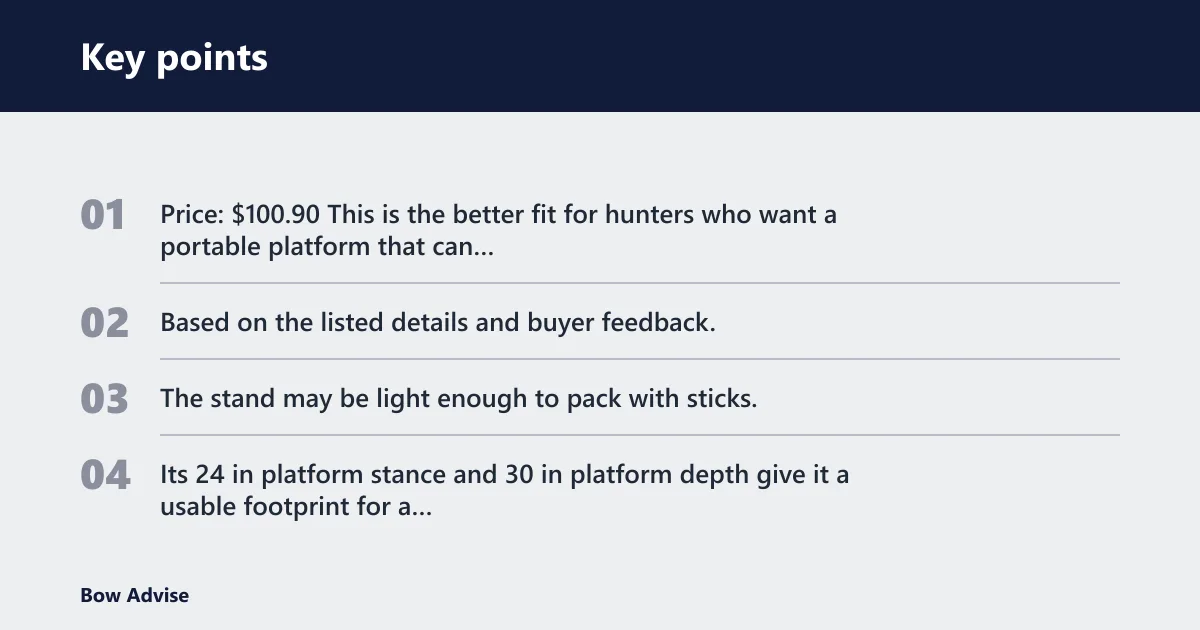

Price: $100.90
This is the better fit for hunters who want a portable platform that can go on crooked or limby trees without waiting for a perfect straight trunk. Based on the listed details and buyer feedback, the silent straps help cut metal-on-metal noise, and the stand is built for mobile setup with climbing sticks.
The honest drawback is the full-kit burden. The stand may be light enough to pack with sticks, but sticks still add carry weight and setup steps, so the system is less simple than an all-in-one climber.
Its 24 in platform stance and 30 in platform depth give it a usable footprint for a one-person setup, though packability and tree access still need to be considered before heading out.
Climbing stand
A climbing stand is the better fit when the woods give you straight, limbless trunks and you want the fastest route from ground to hunting height. The all-in-one design cuts out climbing sticks, which helps on short walks and keeps the carry list simple.
The downside shows up quickly in rough timber. Bark irregularities, low limbs, and tree taper can stop a climber before it reaches height, and the larger size can be awkward in brush or on public land.
Hang-on stand
A hang-on stand is the more versatile option when tree shape is unpredictable. It can work on crooked or limby trees, which can expand tree-choice flexibility on pressured ground, and it may be lighter than some fixed stands when comparing the platform alone.
The tradeoff is setup friction. Climbing sticks or another climbing method add pieces, add time, and add noise risk, especially when the tree is rough or the platform needs a second adjustment to level out.
Stand decision matrix
| Field factor | Climbing Stand | Hang-On Stand | What it means in the woods |
|---|---|---|---|
| Tree compatibility | Needs straight, limbless trunks | Handles crooked or limby trees | Tree fit decides whether the hunt starts at all |
| Carry weight | One unit to carry | Stand plus sticks and safety gear | Full-kit weight matters more than stand weight alone |
| Setup time | Usually faster | Usually slower | More pieces mean more steps before the shot window opens |
| Noise risk | Moderate | Moderate to high | Every contact point can click, scrape, or shift |
| Bow-draw room | Can feel tight in smaller platforms | Often easier to tune for the shot | Platform footprint affects turning room and elbow clearance |
| Comfort | Often better for long sits | Depends more on the stand model | Sitting comfort rises when the platform and seat match the hunt length |
| Public-land fit | Limited by tree choice | Better for changing tree options | Fresh sign matters less if the tree cannot be climbed |
| Safety complexity | Safety system required | Safety system and lifeline required, plus stick discipline | More pieces mean more failure points if the routine is sloppy |
| Cost to complete the kit | Lower total package cost | Higher total package cost | Sticks and fall protection add expense |
| Best-use scenario | Straight-tree hunts with short setup windows | Mobile hunts on mixed timber or pressured ground | The winner depends on tree shape and walk distance |
Tree compatibility
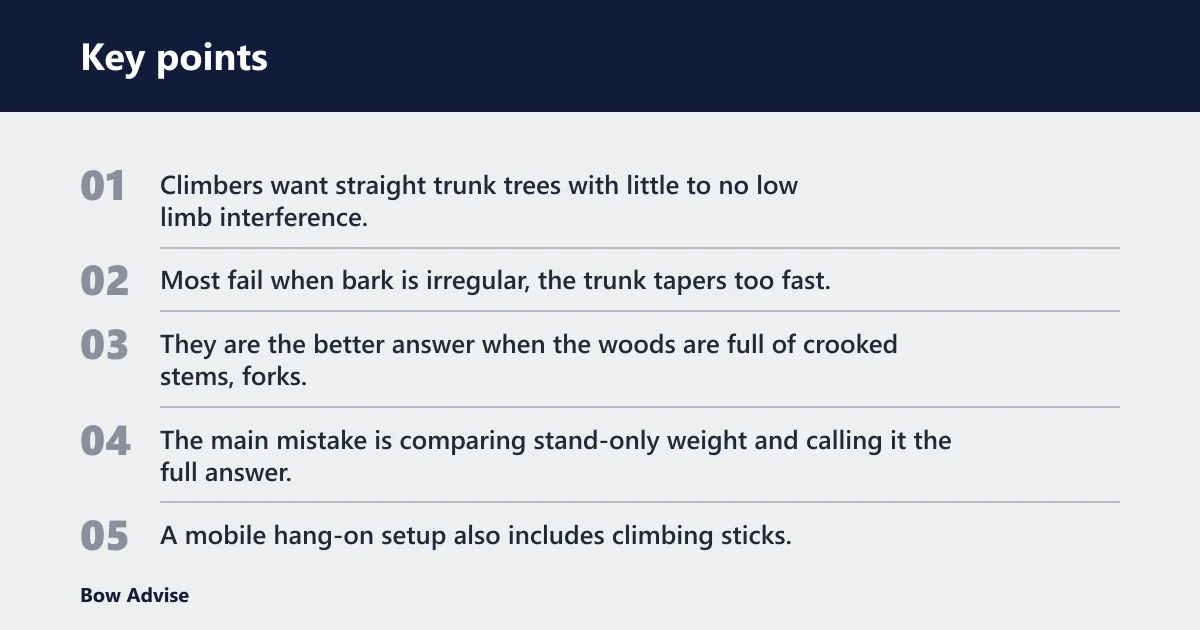
Climbers want straight trunk trees with little to no low limb interference. Most fail when bark is irregular, the trunk tapers too fast, or branches start too low for the top and bottom sections to climb cleanly.
Hang-ons have a much wider tree envelope. They are the better answer when the woods are full of crooked stems, forks, or trees with limbs that would stop a climber cold.
Weight and packability
The main mistake is comparing stand-only weight and calling it the full answer. A mobile hang-on setup also includes climbing sticks, and those sticks change the carry load more than many hunters expect.
Outdoor Life lists a tree saddle kit at 14.1 pounds, a hang-on kit at 23.9 pounds, and a climber kit at 24.2 pounds. Those numbers show why the full kit matters, not just the stand shell.
Setup speed and noise
Climbers are usually faster because the stand and climb happen in one system. If the tree fits, there are fewer separate parts to strap, level, and adjust.
Hang-ons take longer because the sticks must go up first, then the platform must be secured. That extra process can create more noise, especially on rough bark or when the hunter has to reposition the stand for a level seat.
Platform footprint and bow room
Platform footprint affects more than comfort. A larger or better-shaped platform can give extra room to turn, nock, and draw without bumping rail edges, seat brackets, or the tree itself.
That matters most in tight cover. When a buck appears on the wrong side of the trunk, a cramped platform can make the shot feel rushed even if the hunter is at full height.
Safety gear and fall protection
A full-body safety system should be worn with both stand types. A lifeline makes the system safer from the ground up because it keeps the hunter clipped in during ascent and descent.
Hang-on setups add another safety layer to manage because the sticks create the climbing route. A lineman’s belt is commonly used while attaching steps and positioning the stand, so the routine must be deliberate from the first stick to the final move.
What trees can you use a climber in?
A climber works best in straight, limbless trees with enough diameter and clean bark for the stand to bite and slide correctly. Those trees are common in some pines and select hardwoods, but not in every timber stand.
Low limbs and bark irregularities can end a climber hunt early. If the trunk narrows too fast or the bark is too rough, the stand may never track safely to hunting height.
Can a hang-on stand work on crooked or limby trees?
Yes. A hang-on stand is built for tree flexibility, so crooked or limby trees are often the exact reason to choose it. That freedom matters on pressured properties and mixed timber where perfect climber trees are scarce.
The tradeoff is extra setup steps. Sticks, a safety system, and a lifeline all become part of the system, so the hunter gains tree options at the cost of more gear and more chances to make noise.
Which setup is lighter in the field?
The climber is usually lighter in the simplest carry sense because it is one unit. But the better question is full-kit weight, because a hang-on system can change once climbing sticks, a safety system, and carry accessories are added.
The same source lists the climber kit at 24.2 pounds and the hang-on kit at 23.9 pounds, while the tree saddle kit comes in at 14.1 pounds. The exact carry load depends on the whole setup, not just the stand shell.
Long walks and public land
On longer walks to public-land spots, packability starts to matter as much as pounds. A hang-on can be easier to stage around brush, but the extra pieces also mean more straps and more bulk.
If the walk is short and the tree is right, the climber saves time. If the walk is long and the first tree is not predictable, the hang-on usually gives the better chance of a usable setup.
Which stand is quieter to set up: climber or hang-on?
Neither system is silent by default. A climber can scrape on bark and clack during repositioning, while a hang-on can make noise from sticks, attachment straps, and platform contact with the trunk.
Platform footprint affects sound too. A smaller, tighter setup may press harder against the tree and bark, while a larger setup can require more handling, which creates its own noise risk.
Where noise usually shows up
Climbers are most likely to get noisy when the bark is rough or the stand has to be shifted partway up. Hang-ons are most likely to get noisy during the stick climb and final leveling step.
For pressured deer, the quieter option is the one that fits the tree on the first try. A poor fit makes almost any stand louder.
Choose Climbing Stand if… / Choose Hang-On Stand if…
Choose Climbing Stand if your woods give you straight, limbless trunks; you want the fastest setup; you prefer fewer pieces to carry; and your hunting spots are close enough that a slightly larger stand is not a burden.
Choose Hang-On Stand if your trees are crooked or limby; you hunt public land or fresh sign where tree choice changes often; you need more placement options; and you are willing to carry climbing sticks and spend more time on setup.
A common first-timer mistake is choosing a stand without confirming the tree has the right lean, bark texture, and shooting lanes for a quiet setup. If the best sign is under a crooked oak with low limbs, a climber can turn into dead weight before the hunt even starts.
Suppose the walk is 700 yards and the best tree has a fork at chest height. A climber may be unusable there, while a hang-on with sticks still gives a workable path to height.
Which one should you buy?
Buy the climber only when the property gives you repeatable straight trunks and you value the quickest climb over tree flexibility. Buy the hang-on when you want one system that can handle more trees, more public-land situations, and more fresh-sign decisions.
If budget is tight, the climber often wins because it needs fewer added pieces to become hunt-ready. If your priority is choosing the best tree every time, the hang-on is the safer long-term fit even though the full kit costs more.
For most mobile deer hunters, the hang-on is the more practical default. The reason is simple: the hunt fails less often when the stand can adapt to the tree instead of waiting for the tree to fit the stand.
Frequently asked questions
Is a climbing stand or hang-on stand better for mobile deer hunting?
A hang-on stand is usually better for mobile deer hunting because it works on more tree shapes and gives more placement options on pressured ground. A climber is better only when the woods offer straight, limbless trunks and the hunter values the fastest possible setup over flexibility.
What is the main disadvantage of a climbing treestand?
The main disadvantage is tree restriction. A climbing treestand can fail on crooked trunks, low limbs, bark irregularities, or taper that does not let the stand move cleanly, which can make a good-looking spot useless once you arrive.
Do you need a harness for a climber or hang-on stand?
Yes, for both. A full-body safety system should be worn with both stand types, and a lifeline is commonly recommended for safer ascent and descent. Hang-on setups also require careful stick use, so fall protection matters from the first step off the ground.
Which option is faster to set up in the field?
A climber is usually faster because the stand and climbing method are built into one system. A hang-on takes more time since the hunter has to place climbing sticks or another climbing method first, then secure the platform and make final adjustments.