Beginner’s Guide: Effortless Grain Alignment
Effortless Grain Alignment for Wood Arrows Is Achieved by Understanding Wood’s Natural Strengths, Visually Inspecting Each Shaft, and Rotating It to Find the Stiffest Spine, Ensuring Consistent Flight and Durability. Proper alignment enhances accuracy and prevents breakage.
Ever noticed your wooden arrows flying a little wobbly, or worse, breaking unexpectedly? It’s a common challenge for archers, especially when you’re just starting out. This isn’t usually because you’re doing something wrong, but rather because wood has a natural “grain” that affects how it bends and holds up. Getting this grain aligned correctly, or at least understanding it, is key to making your arrows fly straight and last longer. It might sound technical, but it’s actually quite simple once you know what to look for. We’ll walk through it step by step so you can feel confident with every shot.
Why Grain Alignment Matters in Wood Arrows
Wood, as a natural material, isn’t perfectly uniform. It grows with a grain, much like the rings you see on a tree stump. This grain isn’t just for looks; it’s where the wood’s strength lies. When you shoot an arrow, it flexes. If you shoot an arrow with its grain aligned against the direction of flex, it’s much more likely to break. Think of it like trying to bend a fresh twig. If you bend it along the grain, it might flex easily. If you try to bend it across the grain, it snaps. The same principle applies to your arrows.
Proper grain alignment helps ensure that your arrows flex predictably when they leave the bow. This predictable flex, known as “arrow spine,” contributes directly to accuracy. An arrow that flexes consistently will fly truer. Conversely, misaligned grain can lead to inconsistent spine, causing arrows to flutter, fishtail, or even break upon release. For beginners, understanding this concept is a major step towards improving your shooting and making your equipment last.
It’s also important to remember that while we aim for the “best” alignment, wood is natural and perfectly straight without variation is impossible. The goal is to work with the wood’s properties, not against them, to achieve the most stable and durable arrow possible. This guide will help you achieve that.
Understanding Wood Grain and Arrow Spine
Before we get into the “how-to,” let’s quickly touch on what “grain” and “spine” mean in the context of arrows.
- Wood Grain: This refers to the direction of the wood fibers. In arrow making, we’re often looking for straight-grained wood, meaning the fibers run parallel to the length of the shaft.
- Arrow Spine: This is a measure of an arrow’s stiffness. It’s typically measured by how much an arrow deflects when a specific weight is applied at its center. A stiffer arrow has a lower spine number, and a more flexible arrow has a higher spine number.
The magic happens when the arrow’s spine is correctly matched to your bow’s draw weight and your draw length. However, even with perfectly matched spine straight from the factory, the internal grain of the wood can influence how that spine behaves. If the grain runs unevenly or twists within the shaft, it can create weak spots or inconsistent flex. This is what we aim to mitigate through careful alignment.

Visual Inspection: Your First Line of Defense
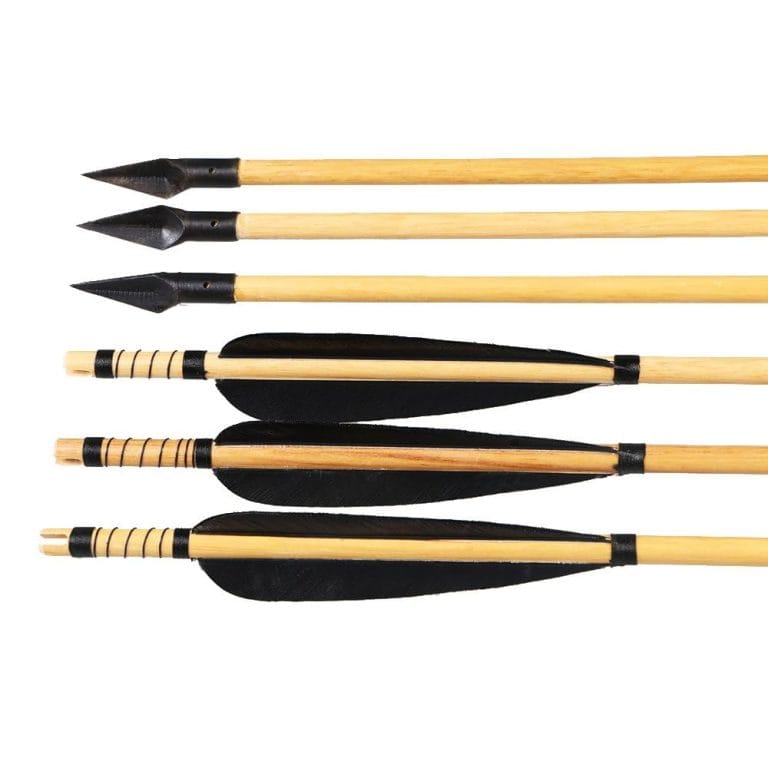
The easiest and most crucial step in grain alignment is simply looking at your arrow shaft. Most commercially made wooden arrows have a visual indicator of grain direction, often a faint line running along the length of the shaft. This line is typically the result of the wood’s growth rings. We want this line to be as straight as possible from nock to point.
What to Look For:
- Straight Lines: Ideally, the visible grain line should run perfectly parallel down the entire length of the shaft.
- Minor Swirls or Twists: Some slight wobble or swirl in the grain is often unavoidable. The goal is to minimize the amount of twist. A little bit of wave is much better than a significant spiral.
- Knots or Burls: Avoid shafts with any knots, burls, or significant imperfections. These are weak points that can easily lead to breakage.
When you receive a new batch of arrows, or even just pick them up, give them a quick visual once-over. If you notice a shaft with a particularly wild or twisted grain, it’s often best to set it aside or use it for lighter practice where less stress is put on the shaft.
The Spine Tester: A Beginner’s Friend
For a more objective measure of an arrow’s spine and how the grain might be affecting it, a spine tester is invaluable. While it might sound like advanced equipment, spine testers are relatively simple and can be quite affordable, especially for beginners. They work by measuring how much an arrow bends under a consistent load.
How a Spine Tester Works (Simplified):
A spine tester typically has a frame that holds the arrow. A weight is then attached to the center of the arrow shaft. The amount the arrow bends under this weight is measured. This measurement tells you the arrow’s stiffness. But more importantly for grain alignment, repeated tests can help you understand if the grain is affecting the stiffness across different points of the shaft.
For our purpose, the spine tester can help us identify subtle variations. If you test an arrow at multiple rotational points and get significantly different bend measurements, it might indicate a more pronounced grain twist or internal weakness. However, for beginners, the primary use of a spine tester is to group arrows of similar spine stiffness.
For more detailed information on spine testing and its importance in archery, you can consult resources like the World Archery Federation equipment regulations, which indirectly highlight the need for consistent arrow properties.
How to Align Grain: The Rotation Method
This is where you actively work with the arrow’s grain. The core idea is to find the direction where the arrow is most resistant to bending along its length. This is essentially finding the path of least resistance for the wood’s fibers.
Step 1: Initial Visual Check
Hold the arrow up to the light. Locate the most prominent grain line. Ideally, it runs perfectly straight from nock to tip. If it’s already very straight, you’re in good shape!
Step 2: The “Stiffest Spine” Test
This is a tactile test. Place the arrow on a flat surface, with one end supported and the other end with just a finger or two applying light downward pressure. You’re not trying to bend it significantly, just find the point of minimal flex. Now, gently rotate the arrow in your fingers. Notice how it feels. It will feel slightly “stiffer” or more rigid in one direction compared to others. This stiffest point is usually where the grain is running most advantageously for strength.
Alternatively, and perhaps more practically for beginners:
- Place the Arrow: Lay the arrow on a soft surface (like carpet or a mat) on its side.
- Apply Gentle Pressure: Place your index finger on the arrow about halfway between the nock and the tip.
- Roll and Feel: Gently roll the arrow under your finger. As you roll, pay attention to how the arrow feels under your finger. You’re looking for the position where the arrow feels the “hardest” or most resistant to being pressed down. This is the direction where the wood fibers are likely strongest along its length.
- Mark the Spot: Once you find this “stiffest” orientation, imagine a line drawn along the top of the arrow in this position.
Step 3: Nocking an Advantage
The goal is to orient the arrow so that the inherent “stiffness” of the grain works in your favor. When an arrow is shot, it flexes horizontally. Therefore, the ideal grain alignment is one that is most resistant to this horizontal flex. This typically means orienting the arrow so that its strongest grain runs along the top, or slightly to the side, rather than running across the top where it might be weakest during flex.
For most archers, this translates to:
- Aligning to Fletching: Many archers find it easiest and most effective to align the grain such that the stiffest orientation is parallel to the orientation of the fletchings (the feathers or vanes).
- Visual Cue: If you can see a clear grain line, orient the arrow so that this line runs along what will be the “top” of the arrow when it’s nocked on the string, or parallel to the vanes.
- Experimentation is Key: This is not a one-size-fits-all rule. Your bow, your shooting style, and the specific wood can all play a role. The best approach is to try nocking your arrows with the grain aligned in slightly different positions (e.g., grain on top, grain to the left of center, grain to the right of center) and see which feels best and flies straightest.
You can also use a jig or a specific tool designed for consistent fletching placement, which will naturally help you orient each arrow’s grain in a similar fashion.
Aligning Grain with Your Existing Arrows
If you’ve already bought arrows and want to check and improve their grain alignment, here’s how:
1. Sort Your Arrows
Lay out all your arrows. Visually inspect each one. Group arrows that have similar-looking grain patterns. Discard or set aside any with obvious flaws like knots or severe twists.
2. The “Spine Feel” Method
For each arrow in a similar group:
- Place the arrow on a soft surface.
- Gently press down on the middle of the shaft with one finger.
- Slowly rotate the arrow. Feel for the direction where it feels stiffest and therefore strongest.
- Note this direction. If you can see a grain “rib,” the direction of that rib is often the strongest.
3. Consistent Nocking
When you nock an arrow onto your bowstring, try to orient it consistently. If you’ve identified that the strongest grain runs along the top, or parallel to the fletching ribs, then always nock your arrows that way. If you found a slightly different orientation worked best for a particular set, stick with that.
Key takeaway: Consistency is more important than perfect alignment. If you can nock all your arrows so their grain is oriented in the same direction, even if it’s not theoretically the absolute “perfect” direction, your shooting will be much more consistent than if you mix them randomly.
When to Consider More Advanced Techniques
For most beginners, the visual inspection and “stiffest spine” feel method are more than enough. However, as you progress, you might want to look into more advanced methods:
- Spine Testers: While mentioned earlier, investing in a basic spine tester allows you to group arrows by actual stiffness. By testing an arrow at multiple rotational points, you can verify if the grain is causing significant variations. If a shaft shows a large variance in spine readings depending on rotation, it might be better for less critical shots.
- Shaft Straighteners: These are tools that use heat and pressure to gently straighten warped or slightly twisted shafts. This is an advanced technique and requires caution, as applying too much heat can damage the wood. Professionals often use these.
- Shaft Selectors: Some arrow manufacturers or high-end retailers have specialized machines that can measure and sort shafts not just by spine but also by grain run.
These advanced techniques are usually for those who are deeply invested in the pursuit of perfect arrow flight and have moved beyond basic hobbyist shooting. For now, focus on mastering the visual and tactile methods.

Tables: Grain Characteristics and Their Impact
To further illustrate the impact of grain alignment, consider this table:
| Grain Characteristic | Visual Appearance | Impact on Arrow Flight & Durability | Beginner Recommendation |
|---|---|---|---|
| Straight, Uniform Grain | Clear, parallel lines running the length of the shaft. | Consistent spine, excellent flight predictability, high durability. | Ideal. All shafts should ideally exhibit this. |
| Slight Swirl or Waviness | Faint curves or waves in the grain pattern. | Minor variations in spine. Can still fly well if consistent, but slightly reduced durability on a curve. | Acceptable. Most commercially made arrows will have some. |
| Significant Twist or Spiral | Grain visibly spirals around the shaft. | Inconsistent spine, poor flight, high risk of breakage under tension. | Avoid. Set aside for practice or discard. |
| Knots, Burls, or Large Imperfections | Dark spots, bulges, or missing wood sections. | Major weak points. Prone to sudden and catastrophic failure. Danger to shooter. | Absolutely avoid. Do not use these shafts. |
Another table to help you categorize your arrows:
| Arrow Group | Purpose | Grain Alignment Focus |
|---|---|---|
| Premium Arrows | Target shooting, competition, hunting. | Straightest, most consistent grain possible. Best spine alignment technique applied. |
| Good Practice Arrows | Regular practice sessions, informal shooting. | Reasonably straight grain, minimal twists. Consistent nocking orientation is important. |
| Backup/Light Duty Arrows | Very casual shooting, training new archers, no consequence shots. | Shafts with minor grain imperfections, slight twists, or those that didn’t make the ‘good practice’ cut. |
| Discard/Repair | None. | Shafts with knots, cracks, severe damage, or significant, unfixable twists. |
Common Mistakes to Avoid
As Salman Arfeen, I’ve seen many beginners make the same few mistakes. Here are some to watch out for:
- Ignoring Grain Entirely: Just grabbing arrows and shooting without any thought to grain is the most common pitfall. It leads to frustration and broken equipment.
- Over-Reliance on Appearance: A perfectly stained and finished arrow might look great, but if the grain is twisted underneath, it’s a disaster waiting to happen. Always prioritize the underlying wood structure.
- Being Too Picky with Beginners’ Arrows: Don’t expect perfection. Wood is natural! Focus on finding arrows that are “good enough” and consistent with each other. The goal is improvement, not unattainable perfection.
- Applying Too Much Force: When testing for stiffness or trying to straighten, be gentle. Wood is strong along the grain but brittle across it or under excessive force.
- Different Arrows, Different Rules: If you have arrows from different manufacturers or batches, they might have slightly different grain characteristics. It’s often best to keep arrows of similar characteristics together for your shooting practice.
Safety First!
Grain alignment isn’t just about accuracy; it’s a critical safety issue. A shaft that breaks under tension from the bowstring can send splinters flying, which can be dangerous to the archer or anyone nearby. Always:
- Inspect Arrows Regularly: Before every shooting session, give your arrows a quick check for any visible cracks, splinters, or signs of damage.
- Discard Damaged Arrows: Never shoot an arrow that looks compromised. It’s not worth the risk.
- Shoot from a Safe Distance: Ensure you have a safe backstop and clear shooting range, especially when using wooden arrows.
Learning to shoot safely is paramount in archery. You can find excellent safety guidelines from organizations like the USA Archery Safety Resources.
FAQ: Your Grain Alignment Questions Answered
Q1: Do I really need to align the grain on my wooden arrows?
Answer: Yes, for the best performance and safety, it’s highly recommended. Aligning the grain helps ensure consistent arrow spine, which leads to more accurate shots and reduces the risk of the arrow breaking during use.
Q2: What’s the easiest way to check the grain on my arrows?
Answer: The easiest way is a visual inspection. Look for the natural line of the wood grain running along the shaft. If it’s straight, that’s great. If it’s twisted, you’ll want to try and orient the arrow so the twist is minimized during flight.