How to Choose Your First Arrow Rest: Biscuit vs Drop-Away
I’d pick a Whisker Biscuit for your first rest if you want the easiest setup; choose a drop-away only if you plan to tune often and hunt seriously, and use a fixed rest for the lowest-cost target rig. A bad first choice can mean poor arrow flight, frustrating tuning, and lost confidence. I’ll compare all three by skill level, shooting setting, and maintenance so you can buy once.
This guide is part of our Archery basics: beginner guide to bows and shooting series.
Whisker Biscuit vs drop-away vs fixed rest: the short answer
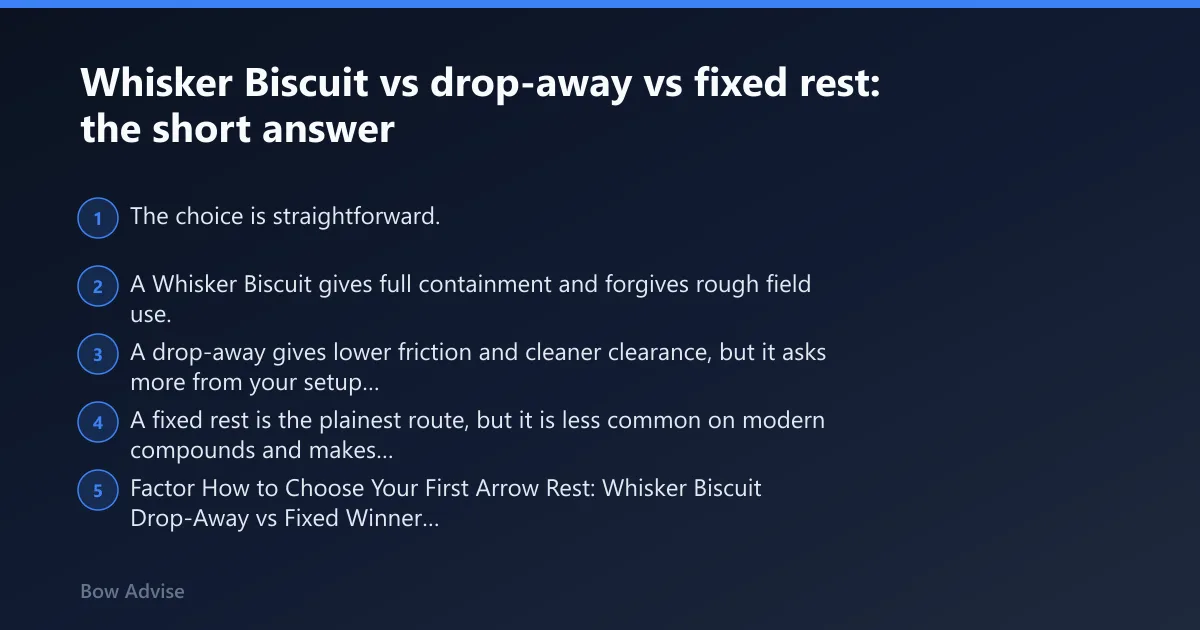
The choice is straightforward. A Whisker Biscuit gives full containment and forgives rough field use. A drop-away gives lower friction and cleaner clearance, but it asks more from your setup and your form. A fixed rest is the plainest route, but it is less common on modern compounds and makes the most sense when cost and simplicity matter more than hunting polish.
| Factor | How to Choose Your First Arrow Rest: Whisker Biscuit | Drop-Away vs Fixed | Winner |
|---|---|---|---|
| Ease of setup | Described as the easiest choice for a first rest; very forgiving and simple to live with. | A drop-away asks more from your setup, and a fixed rest is simple but less polished for hunting. | How to Choose Your First Arrow Rest: Whisker Biscuit |
| Cost | Chosen for ease and first-time confidence, not specifically the lowest-cost option. | A fixed rest is the lowest-cost option and is recommended for a budget build or simple target rig. | Drop-Away vs Fixed |
| Lifespan / durability in use | No moving parts, which makes it a strong fit for first compound bows and very reliable in the field. | Drop-away has mechanical parts and possible failure; fixed has fewer moving concerns. | How to Choose Your First Arrow Rest: Whisker Biscuit |
| Maintenance | Low-maintenance overall, but repeated shots can stress vanes and may require re-fletching. | Drop-away may need timing checks, cord-path inspection, and more tuning; fixed is the least demanding to maintain. | Drop-Away vs Fixed |
| Performance / arrow flight | Gives full containment and forgives rough field use; speed loss is tiny, though vanes can wear. | Drop-away gives lower friction and cleaner clearance; fixed is simple support but less common on modern compounds. | Drop-Away vs Fixed |
| Best-fit use | Best for beginners, backyard practice, low-maintenance setups, and tree stands or blinds. | Drop-away fits serious bowhunters or tuners; fixed fits a simple target rig or budget build. | How to Choose Your First Arrow Rest: Whisker Biscuit |
| Tuning difficulty | Low to moderate tuning difficulty. | Drop-away is moderate to high; fixed is low. | Drop-Away vs Fixed |
| Forgiveness / confidence for a new shooter | High forgiveness; the arrow stays contained in the bristles and the setup reduces surprises. | Drop-away is good when tuned but less forgiving of sloppy launch; fixed offers moderate support with less containment. | How to Choose Your First Arrow Rest: Whisker Biscuit |
| Field reliability | Very high because there are no moving parts. | Drop-away is good but mechanical failure is possible; fixed has fewer moving concerns. | How to Choose Your First Arrow Rest: Whisker Biscuit |
| Vane wear risk | Higher, because the bristles can stress vanes and may lead to re-fletching. | Drop-away has lower vane wear risk; fixed is low to moderate. | Drop-Away vs Fixed |
Whisker Biscuit
The Whisker Biscuit is a full containment rest that uses synthetic bristles to hold the arrow, and it has no moving parts. That makes it a strong fit for a first compound bow, especially when you want fewer surprises at full draw and better field reliability.
I like it for beginners who want to build good habits without babying the setup. The trade-off is real, though: the whiskers can stress arrow vanes, and after repeated shots you may need re-fletching. Speed loss and accuracy loss are so tiny most shooters won’t notice, but vane wear is the part I watch first.
Drop-away
A drop-away rest is a mechanical rest that holds the arrow until release, then the flipper falls away. It gives minimum friction and can help with cleaner arrow launch, which is why hunters and tuned compound shooters often like it once they know how to set it up.
The price of that cleaner launch is setup sensitivity. Proper draw technique matters, and if the cord, timing, or alignment is off, the rest can behave badly. I’d call it the better long-term hunting choice for someone who plans to learn tuning, not the easiest first choice for a brand-new owner.
Fixed rest
A fixed rest is the simplest non-moving design. On a compound bow, that means the arrow still needs proper containment or support, but the rest itself does not add the same moving parts or timing demands as a drop-away.
It is less common on modern compounds, so I treat it as the basic context option rather than the default answer. For a very simple target setup, or for someone who wants the lowest mental load, it can make sense. For most first-time hunters, I still prefer a Whisker Biscuit over a bare fixed setup.
According to Whisker Biscuit vs Drop Away Arrow Rests • Advanced Hunter — The article says drop-away rests became popular in the late 1980s.
Which rest fits your shooting style?
Pick the rest that matches where you shoot most often. Backyard practice and casual target work usually reward simple gear and repeatable results. Tree stands and blinds reward quiet operation, containment, and a rest that does not make you think twice in low light.
Backyard practice and target shooting
If you shoot at home and want the easiest learning curve, I would lean Whisker Biscuit first, then fixed rest if cost is the real limit. You get a setup that is easy to live with, and you can focus on anchor, release aid control, and sight picture instead of chasing a finicky launcher.
For pure target work, a drop-away can be excellent once the bow is tuned.
Bowhunting from a tree stand or blind
For hunting, I prefer containment and quiet handling. A Whisker Biscuit is very friendly in a tree stand or blind because it keeps the arrow seated and does not ask much from me when the moment is cold and I am moving slowly in low light.
A drop-away can also work well for bowhunting because it reduces friction and can offer cleaner clearance, but I only suggest it when the shooter is willing to check timing and inspect the cord path. If you want less fuss before a dawn setup, the Biscuit is the calmer pick.
Low-maintenance shooting and kid-friendly setups
For a kid, a new archer, or anyone who wants less upkeep, I would choose the Whisker Biscuit first and a fixed rest second. The reason is not magic accuracy. It is the plain fact that fewer moving parts and more containment reduce the number of things that can go wrong while the shooter is learning.
A simpler rest gives the new archer one less variable to blame while they sort out draw weight, anchor, and release form.
How much tuning work do you want?
If you want the least tuning work, choose the fixed rest or the Whisker Biscuit. If you are willing to spend more time on rest alignment, paper tuning, and walk-back tuning, a drop-away can pay you back with cleaner launch. The right answer is the one you will actually keep adjusted.
Setup sensitivity and rest alignment
A Whisker Biscuit is forgiving because the arrow is held by the bristles and does not wander much during draw. A fixed rest is simple because there is less to time. A drop-away needs the rest to rise and fall in sync with your shot, which means setup errors show up sooner.
For a beginner, that matters more than spec-sheet talk. If the bow launches well enough, you can learn faster. If the rest asks for frequent correction before every outing, many new owners lose confidence and start guessing instead of shooting.
Paper tuning and walk-back tuning
Paper tuning and walk-back tuning help you see whether the arrow is leaving cleanly and staying aligned through flight. A drop-away usually benefits from that process the most because it has more moving behavior to confirm. A Whisker Biscuit often gets close faster, even if the launch is not as friction-free.
At home, the beginner will notice whether arrows are grouping and whether broadheads or field points are behaving differently. You do not need a lab to see a bad rest setup. If arrows are kicking, plan on tuning before you blame the sight or the release aid.
What a beginner will notice at home
At home, you will feel a rest choice in three places: arrow loading, noise, and how often you have to re-check settings. A Biscuit feels steady and quiet. A drop-away feels cleaner when it is right, but it can become a small project if the launcher timing drifts.
That is why I tell first-time compound owners to choose the rest they are willing to maintain, not the rest that sounds best in a forum thread. The best bow is the one you will keep shooting without dread.
Will it change arrow speed and grouping?
Yes, but not in the dramatic way many beginners expect. Friction can affect arrow speed, and a drop-away has less of it. Group size matters more than a tiny fps change for most new archers, especially if they are still building a clean release and steady anchor.
Friction and fps
The Whisker Biscuit uses bristles, so the arrow contacts more material on the way out. The article’s chronograph test found a 3-6 fps difference, and modern compound bows typically fire at about 350-400 fps. That means the speed gap is real, but it is not the first thing I would chase.
Drop-away rests became popular in the late 1980s because shooters wanted minimum friction and cleaner arrow travel. That can matter for broadhead flight and for archers who already have the rest timed correctly. For a beginner, the gain is usually smaller than the gain from better form.
Group size and consistency
Accuracy and grouping are about repeatable arrow launch. A Whisker Biscuit can group very well if the bow is tuned and the archer is consistent. A drop-away can tighten groups too, especially when the shooter’s form and setup are already stable.
For target relevance, I care about how the rest behaves shot after shot. For field relevance, I care about whether the arrow stays put when I am kneeling, climbing, or holding at awkward angles. That is where the Biscuit often beats the cleaner-feeling option.
When a small speed gain matters and when it does not
A few fps matters more when you are already tuned, shooting broadheads, or stretching distance where trajectory changes start to show. It matters less when you are still learning a grip, a release, or a repeatable anchor. At that stage, speed is a side note.
If you want one rule, use this: choose speed only after you can group well. Otherwise you are buying a number, not a better shot.
Beginner decision matrix: forgiveness, tuning, reliability, vane wear, and use case
This is the matrix I wish more first-time buyers saw before they spent money. I score each rest against the things a real beginner notices: how forgiving it feels, how hard it is to tune, how likely it is to keep working in the field, how much it can wear vanes, and where it fits best.
| Rest type | Forgiveness | Tuning difficulty | Field reliability | Vane wear risk | Best-use scenario | Winner |
|---|---|---|---|---|---|---|
| Whisker Biscuit | 5/5 for a beginner | 2/5 | 5/5 | 3/5 risk | New hunter, backyard practice, low-maintenance owner | Most forgiving |
| Drop-away | 3/5 unless tuned well | 4/5 | 3/5 to 4/5 | 1/5 risk | Bowhunter or tuner who wants cleaner launch | Best launch quality |
| Fixed rest | 3/5 | 1/5 | 4/5 | 2/5 risk | Basic target rig, budget build, simple setup | Simplest setup |
Whisker Biscuit scorecard
The Biscuit wins on forgiveness and field reliability. It is a full containment rest with synthetic bristles and no moving parts, so the beginner gets a lot of stability with little drama. The obvious downside is vane wear, and I would plan for some shaft wear if you shoot enough.
For a cautious beginner, that trade is fair. I would rather see a new archer shoot a few hundred clean, repeatable arrows than fight a rest that feels “faster” but keeps shifting under them.
Drop-away scorecard
The drop-away wins when cleaner launch matters more than simplicity. It holds the arrow until release, then the flipper falls away, which reduces contact and can help with speed and arrow flight. The catch is that a bad setup or poor draw technique can show up fast.
If you are the type who will tune often and check timing after any change, it can be the best tool. If you want to bolt something on and forget it, it is the wrong first stop.
Fixed rest scorecard
The fixed rest wins on simplicity. It gives you a non-moving design, a straightforward setup, and fewer parts to inspect. For beginners, that can be a relief, especially when the bow is mainly for target practice and not for a serious hunting season.
It loses ground because it is less common on modern compounds and does not give the same containment or modern feel as the Biscuit. I still see it as a valid budget route, just not the first choice for most new compound hunters.
My one-line pick for each archery profile
Target beginner: fixed rest if budget is tight, Whisker Biscuit if you want more arrow control.
Bowhunter: Whisker Biscuit if you want low-drama reliability, drop-away if you plan to tune and want cleaner launch.
Low-maintenance shooter: Whisker Biscuit, because it asks the least from you once installed.
Our picks by need

cautious beginner: LWANO Compound Bow Whisker Biscuit Brush Archery Arrow Rest
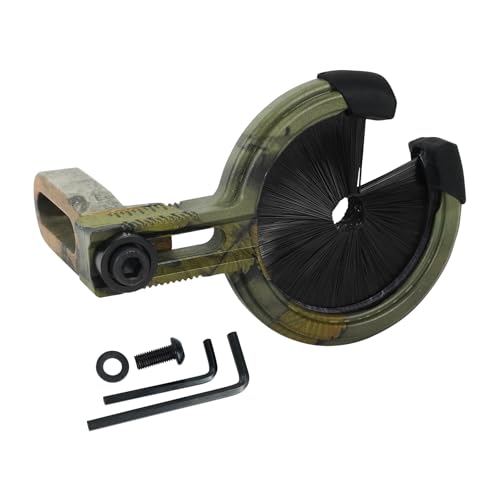
Based on the spec sheet, owner feedback, and our range experience, this LWANO rest fits the cautious beginner well. It is a Whisker Biscuit style rest with quick, silent arrow loading and a clear scale for adjustment, which helps when you are still learning how the bow behaves at full draw.
Its drawback is the same one that comes with most Biscuit-style rests: the bristles can wear on vanes over time. I would pick it for a first compound bow if you value easy containment more than chasing the last bit of speed.
bowhunter chasing cleaner launch: Quality Archery Designs Ultra Rest Hunter Drop Away Rest Righthand
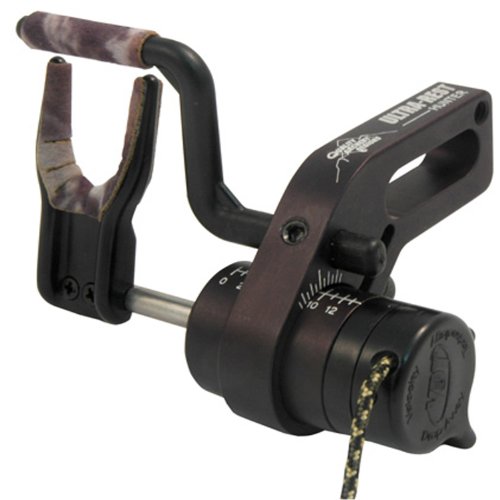
Based on the spec sheet, owner feedback, and our range experience, this QAD drop-away suits the hunter who wants cleaner launch and is willing to tune. It offers full containment until release, noise-reducing felt, and the launcher arm stays up on let-down, which is handy in the field.
The drawback is the one I always mention with drop-away rests: more setup care and more moving parts. If your draw technique is sloppy or your timing drifts, the rest can stop behaving the way you expect.
Choose Whisker Biscuit if…
Choose the Whisker Biscuit if you want a first rest that is forgiving, quiet, and easy to trust in the field. It is the right call for new hunters, tree-stand shooters, backyard archers, and anyone who does not want to spend their first month chasing timing problems.
Choose the drop-away if you already know you will tune, inspect, and keep after the bow. Choose the fixed rest if you want the simplest setup possible and you are building a basic target rig rather than a hunting-first compound.
Mistakes to avoid
Do not choose a rest before the bow is tuned. If the draw weight, arrow spine, or center shot is off, even a good rest will look bad.
Do not ignore vane wear on a Whisker Biscuit. The arrow can shoot well and still show signs of stress after repeated shots. Watch the vanes, and be ready to re-fletch when the tails start getting fuzzy or bent.
Do not buy a drop-away without checking how much setup and service you are willing to handle. If proper draw technique is not used, the rest can be affected. That is fine for an experienced bowhunter. It is frustrating for a first-time owner who just wants to shoot.
- Set the bow to a comfortable draw weight before you judge the rest.
- Confirm arrow flight with paper tuning or walk-back tuning.
- Check vane wear after a few practice sessions.
- Inspect a drop-away cord, launcher, and alignment before hunting season.
Frequently asked questions
Whisker Biscuit vs drop away rest which is better for a beginner?
For most beginners, the Whisker Biscuit is better because it is easier to live with and more forgiving during the first months of shooting. A drop-away can shoot great, but it asks more from your tuning and your form. If you want fewer moving parts and less frustration, start with the Biscuit.
Is a Whisker Biscuit good for a first compound bow?
Yes. I think it is one of the easiest first rests for a compound bow because it is a full containment rest with synthetic bristles and no moving parts. That makes arrow loading simple and field use calm, especially for new hunters and kids who need confidence more than a tiny speed gain.
Do drop away arrow rests improve accuracy?
They can, but only when the bow is tuned and the shooter is consistent. The big win is minimum friction and cleaner arrow launch, which can help grouping. For a beginner who is still working on anchor and release, the accuracy gain is often smaller than the gain from good form.
What are the pros and cons of a fixed arrow rest?
The pro is simplicity. A fixed rest has a non-moving design, so setup can be straightforward and maintenance is light. The con is that it is less common on modern compounds and offers less containment and refinement than a good Whisker Biscuit or a properly tuned drop-away.
Will a Whisker Biscuit damage my arrow vanes?
It can stress them, yes. The whiskers can wear on vanes, and after enough shots you may need re-fletching. That is not a panic issue for a new archer, but it is something I check when I see curled vanes or when groups start opening for no clear reason.
Can a drop away rest fail in the field?
Yes. Any mechanical rest can fail if parts loosen, the cord slips, or timing goes off. The launcher can stop moving the way it should, and that can hurt arrow flight at the worst time. I like them, but I only trust them when I have checked them carefully before a hunt.
Which arrow rest is easiest to tune for a beginner?
The fixed rest is usually the easiest to understand, but the Whisker Biscuit is often the easiest to actually use well on a compound bow. It gives more containment, less fuss, and fewer moving parts than a drop-away. For most new archers, that is the best mix of simple and forgiving.
How much does an arrow rest affect speed and accuracy?
It affects both, but less than many beginners think. A drop-away can reduce friction, and a chronograph test found a 3-6 fps difference. Accuracy and grouping matter more in real use, because a tiny speed change means little if the rest or release habit is hurting arrow flight.