How to Prepare for a 3D Archery Tournament: Gear and Scoring
Prepare for a 3D archery tournament by checking your division rules, confirming your bow and arrows, and practicing unknown-distance judging with a simple holdover plan; in most events, each target scores 11, 10, 8, 5, or 0. Poor prep costs points fast, especially on distance guesses, rangefinder rule violations, and arrows that do not match your setup. This guide covers gear, scoring, division choices, and shot strategy for first-time 3D competitors.
What you’ll need
- Closed-toe shoes with enough grip for uneven ground
- Weather layers matched to the forecast
- Water and easy snacks
- Bow case or bow sling
- Arm guard if your form or bow setup needs one
- Scorecard handling that matches the event rules
- Writing tool only if the club allows it
- Rangefinder only if your division and event rules allow it
- Field points or target points, matched to the event rules
- Spare string, nocking point check, and basic Allen keys for bow setup adjustments
3D tournament basics
3D archery tournaments use foam animal targets on a marked course, often with unknown-distance stations. Archers move target to target in groups, shoot from a stake or lane marker, and score each face before the group advances. Club, state, and national rule sets can differ on distance limits, scoring, timing, and equipment.
How a course usually flows
A round often begins with check-in, a rules reminder, and a group assignment. Then archers move through a course with target faces set at varied ranges and angles. Some events use paper scorecards; others use electronic scoring. Scorekeeping may be shared, and in some divisions the rangefinder or scorecard handling rules are stricter than beginners expect.
Where rules change
Division rules can change what equipment is legal, whether a sight is allowed, whether a rangefinder may be used, and how many arrows may be shot. One club may allow one-arrow scoring; another may use two-arrow formats or a different point scale. Always read the local rule sheet before you pack.
What should you bring to a 3D archery tournament?
Bring clothing that matches the weather, safe footwear, hydration, and the gear your division allows. The practical essentials are closed-toe shoes, layers, a bow case or sling, an arm guard if needed, and whatever your event requires for scorekeeping and timing. Do not assume your home range rules apply at the tournament.
Clothing and comfort
Wear closed-toe shoes with enough grip for uneven ground. Add layers that can come off without disturbing your setup. A hat can help with sun or light rain, but keep anything bulky away from the string path and bow sight picture.
Safety and paperwork
Pack water, snacks, and any event paperwork. If the club assigns scorecards or electronic scoring, follow that system instead of bringing your own habits. Keep all equipment in a case or sling during transport, and follow range commands the moment the range captain calls them.
Must-have
 As an Amazon Associate we earn from qualifying purchases. Prices and availability are accurate as of the date shown and are subject to change

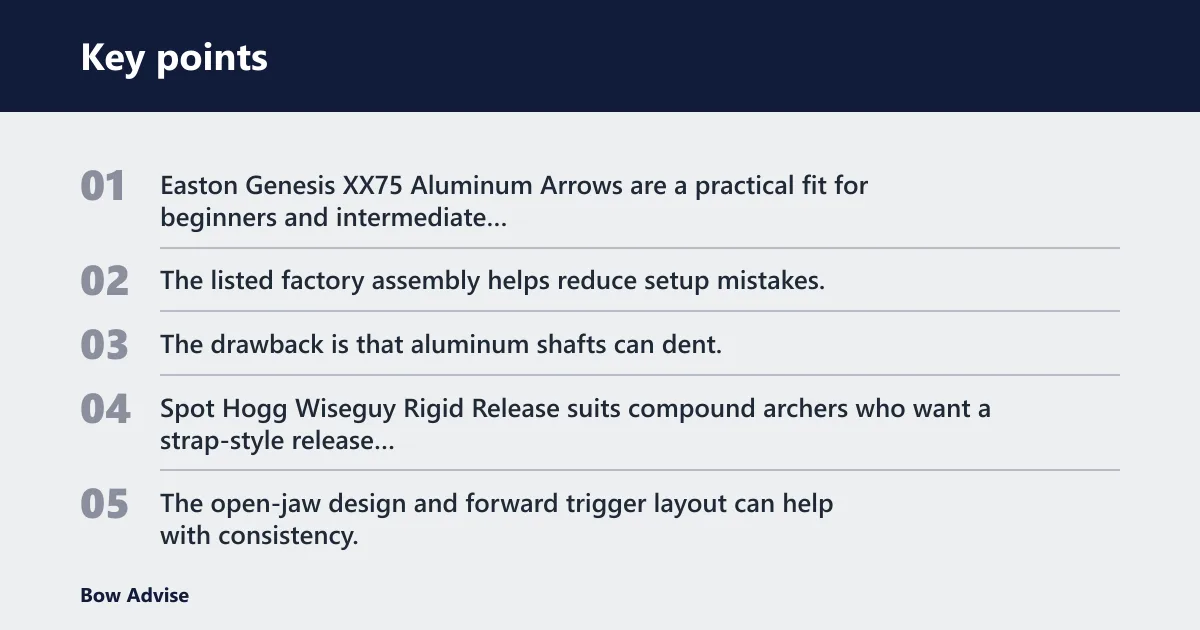
Easton Genesis XX75 Aluminum Arrows are a practical fit for beginners and intermediate archers who need matched arrows that arrive ready to shoot. The listed factory assembly helps reduce setup mistakes. The drawback is that aluminum shafts can dent, so inspect them often and retire any damaged shaft instead of patching it for continued use.
As an Amazon Associate we earn from qualifying purchases. Prices and availability are accurate as of the date shown and are subject to change

Spot Hogg Wiseguy Rigid Release suits compound archers who want a strap-style release with a light trigger and quick reset. The open-jaw design and forward trigger layout can help with consistency. The drawback is that release feel is personal, so the trigger tension and strap fit should be checked carefully before the event.
No third must-have product is listed in the supplied product set. For a 3D tournament, the third real-world must-have is still a legal bow setup matched to your division, even if it is not represented here as a product card.
Nice-to-have
As an Amazon Associate we earn from qualifying purchases. Prices and availability are accurate as of the date shown and are subject to change

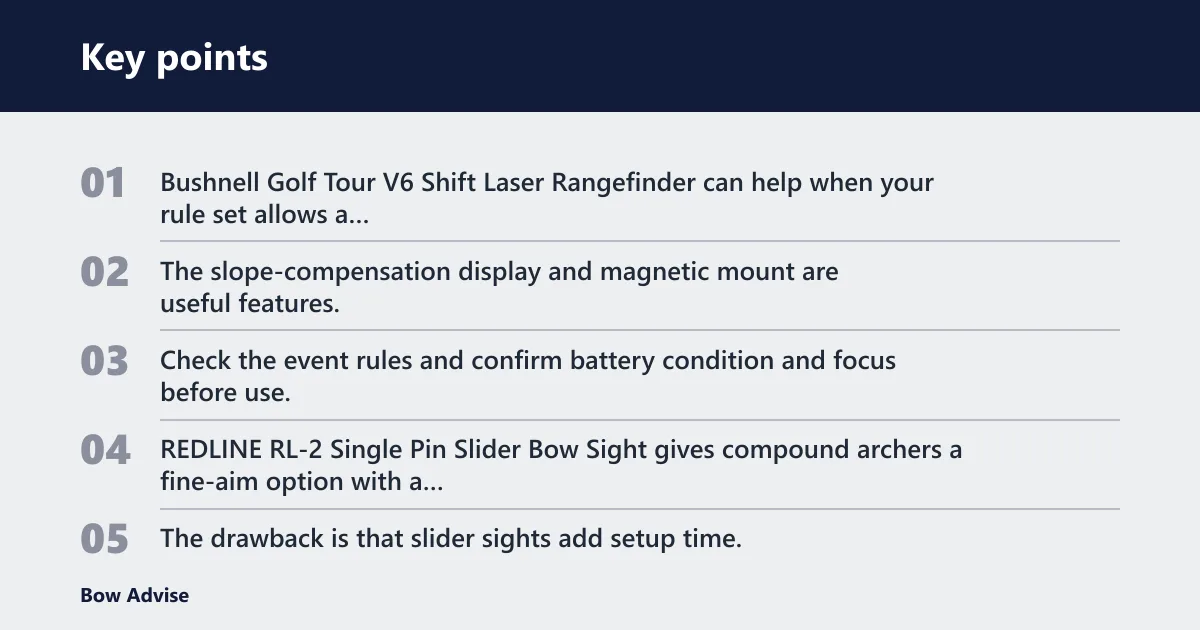
Bushnell Golf Tour V6 Shift Laser Rangefinder can help when your rule set allows a rangefinder and you need a quick read on unknown distances. The slope-compensation display and magnetic mount are useful features, but slope or angle-compensating modes may be restricted or illegal in some target divisions. Check the event rules and confirm battery condition and focus before use.
As an Amazon Associate we earn from qualifying purchases. Prices and availability are accurate as of the date shown and are subject to change

REDLINE RL-2 Single Pin Slider Bow Sight gives compound archers a fine-aim option with a .019 fiber pin, yardage tape, and axis adjustments. The drawback is that slider sights add setup time, and a single pin can be slower if you have not memorized yardage marks. Confirm sight legality in your division.
As an Amazon Associate we earn from qualifying purchases. Prices and availability are accurate as of the date shown and are subject to change

Ringsun Leather Archery Finger Tab is a simple fit for recurve archers who want finger protection and a cleaner release. The leather build and adjustable fit are useful, though fit varies by hand size and tab position. Check that the tab does not interfere with your clicker or anchor point.
As an Amazon Associate we earn from qualifying purchases. Prices and availability are accurate as of the date shown and are subject to change

BLOCK Classic Layered Foam Archery Target is useful for practice when you want easy arrow removal and a face that accepts field points cleanly. The drawback is that it is a practice target, not a tournament course target, so it should help with tune and grouping, not replace event-specific distance practice.
Consumables and spares
Consumables are the small items that keep a tournament day from falling apart. Think spare nock, extra serving thread if your club allows basic maintenance, and arrows that match your current setup. Do not bring broadheads to a 3D target event unless the rule book explicitly says they are allowed, which is uncommon.
Arrow fit matters more than brand
Use carbon or aluminum-carbon shafts, the correct spine for your draw weight and draw length, and field or target points that match the event rules. Keep arrow length and weight matched across the set. A mismatched arrow can hit different impact points even when the shot looks clean.
What to avoid
Do not carry a damaged arrow into competition and hope it holds together. If a shaft is cracked, splintered, bent, or otherwise compromised, retire it or repair it only within manufacturer guidance and event rules. A weak shaft can cost points and create a safety problem.
How does scoring work in 3D archery?
Scoring depends on the event, but the target hit always matters. Many 3D formats use zones such as vital, body, and antler. Some clubs score 11, 10, 8, 5, and 0; others use 10, 8, 5, and 0 or a similar structure. One-arrow and two-arrow formats change how much risk you should take.
Common zone examples
On many foam animal targets, the smallest vital area gets the highest value. The body ring scores less, and the outer ring or antler zone may score lower or be a tiebreak-only area depending on the rule set. A miss or a shot outside scoring rings usually counts as zero.
One-arrow versus two-arrow formats
In one-arrow formats, one committed shot matters more because there is no second attempt. In two-arrow formats, the first shot may still carry the higher value, but a second arrow can rescue a poor read. That changes shot choice: safe center-hunting makes more sense when only one arrow counts.
Pass-throughs, mishits, and ties
Pass-through rules vary by organization. If an arrow passes through the target or falls out, the event may score the visible hit or require an official call. Mishits that strike foam outside the scoring area usually count as zero. Tie-breaks often use x-counts, score totals, or a shoot-off, depending on the rule book.
Bow setup by division
The best bow setup is the one your division allows and your arrows support. Compound and recurve archers need different checks, and a legal setup in one class may be illegal in another. Read the division sheet first, then tune your bow around it.
Compound setup
For compound archers, check the sight, stabilizer, release aid, peep sight, and arrow spine tuning. A single-pin slider or multi-pin sight may be allowed depending on class. Stabilizer length and weight vary by division, so confirm the event rules. Peep alignment and arrow tune should be stable before you enter the course.
Recurve setup
For recurve archers, confirm finger tab fit, fingersling use, clicker position, brace height, and arrow tune. Some divisions allow a sight and some do not, so do not assume that a target sight is legal. Recurve arrows should leave the bow cleanly and group consistently at the distances you expect to see.
What to confirm before you arrive
Check the club sheet for sight limits, stabilizer rules, arrow tip rules, and rangefinder legality. If the event uses a class label like open, barebow, or bowhunter, read the equipment list line by line. Small rule differences can change what gear you are allowed to use on the line.
3D tournament prep sheet
Use the next seven days to remove surprises. The goal is not to overhaul your setup; it is to confirm that your bow, arrows, and rule knowledge all match the same event. If one item fails, fix it before the weekend.
| Day | Action | Pass/fail check |
|---|---|---|
| Day 7 | Read the club rules, division sheet, and scoring format. Check whether the course is unknown-distance and whether a rangefinder is legal. | Pass if you can state your class, score format, and rangefinder rule without guessing. |
| Day 6 | Inspect bow condition. Compound: verify sight marks, peep alignment, stabilizer tightness, release function, and cam timing if your manual covers it. Recurve: verify tab fit, brace height, clicker position, and nock fit. | Pass if all hardware is secure and your setup matches the division rules. |
| Day 5 | Sort arrows by shaft type, length, and point weight. Confirm spine matches your bow setup. Replace damaged shafts. | Pass if every arrow is matched and undamaged. |
| Day 4 | Practice unknown-distance judging on 3 target sizes and 3 distances. Add a simple holdover plan for close, mid, and far shots. | Pass if your estimate is within a workable bracket on most shots. |
| Day 3 | Run a scoring-mode check: know whether your event uses 11/10/8/5/0, 10/8/5/0, one-arrow, or two-arrow scoring. Practice scorecard handling or electronic scoring steps. | Pass if you can score a sample target without asking for help. |
| Day 2 | Walk through rangefinder legality prompts: slope mode off if forbidden, battery charged, display readable, focus set, and no use outside the rule set. | Pass if the device matches the event rules and is ready. |
| Day 1 | Pack clothing, water, snacks, bow case or sling, arm guard, arrows, and score gear. Shoot a few practice arrows to confirm tune and confidence. | Pass if nothing missing and your sight picture feels normal. |
How should you shoot the course?
Shoot a 3D course by estimating distance first, confirming your lane rules second, and choosing the shot that fits the scoring format. Unknown-distance targets punish rushed judgment. A disciplined process beats a hard, fast guess almost every time.
Estimate distance before you anchor
Use the target size, terrain, and sight picture to judge yardage before you settle in. If your division allows a rangefinder, verify whether angle or slope features are legal for that event. Do not treat angle-compensating readouts as a free aim correction; the rule book controls whether that display may be used.
Use terrain and wind without overreacting
Downhill shots can feel closer than they are, and uphill shots can make the target look smaller. Wind on open ridges can move arrows more than it seems at the stake. If the target sits in shade or against a dark background, spend an extra second before drawing.
Keep your shot sequence consistent
Pick a fixed order: range, spot, anchor, bubble check, release. That keeps you from changing your process from one target to the next. Bubble check means confirming your level or body alignment before the shot leaves. If the sight picture feels off, reset and start again.
Manage time and pressure
Do not rush because the group behind you is waiting. A clean shot taken in order scores better than a rushed shot taken on hope. Picture a first-timer standing on a 32-yard lane, guessing 38, then reaching for a harder holdover; the fix is to pause, confirm the sight picture, and choose the safer center hold.
Common mistakes
Most beginner mistakes come from rule confusion, not lack of effort. The biggest errors are using the wrong scoring assumption, bringing arrows that do not match the bow, and shooting a setup that is legal at home but not legal at the event. Those are avoidable.
- Assuming every club scores the same way. Read the event sheet before you pack.
- Using a rangefinder with slope or angle settings when the rule book forbids it.
- Choosing arrows by brand instead of by spine, length, and point weight.
- Ignoring target size and shooting the same hold on every lane.
- Rushing the first arrow after a bad estimate. Reset and recheck instead.
- Arriving with loose hardware, dull focus, or dead batteries.
Suppose a recurve archer shows up with arrows that are too stiff for the bow. The groups may open up at the longer stumps even if the anchor feels fine. The fix is not to force the shot; it is to correct the arrow setup before the next event.
Budget setups
Use the table below as a practical starting point. Prices are listed only where the supplied product data includes them, and the best setup still depends on your division rules.
| Setup | What it covers | Products | Price |
|---|---|---|---|
| Starter | Basic arrows and finger protection for a recurve beginner | Easton Genesis XX75 Aluminum Arrows; Ringsun Leather Archery Finger Tab | $43.99 + $12.99 |
| Mid | Compound release aid plus practice target for tune work | Spot Hogg Wiseguy Rigid Release; BLOCK Classic Layered Foam Archery Target | $126.94 + $77.50 |
| Serious | Compound aiming and distance tools for an allowed division | Bushnell Golf Tour V6 Shift Laser Rangefinder; REDLINE RL-2 Single Pin Slider Bow Sight | $399.99 + $139.99 |
Frequently asked questions
What bow setup is best for a 3D tournament?
The best setup is the one that matches your class and remains stable on the course. Compound archers should check sight, peep, stabilizer, release, and tune. Recurve archers should confirm tab fit, clicker position, brace height, and arrow tune. Always follow the division sheet first.
Do I need a rangefinder for 3D archery?
No, but it can help if the event allows it. Some events permit a rangefinder while restricting slope or angle-compensating modes. Before you use one, check the rule book, charge the battery, and make sure the display is readable in the light you expect on course.
How do 3D archery targets get scored?
Foam animal targets are scored by where the arrow lands in the target rings. The vital area scores highest, the body scores lower, and the outer or antler area may score less or count only for tie-break use depending on the rule set. A miss usually scores zero.
What mistakes do beginners make at 3D archery tournaments?
The most common mistakes are using the wrong rule set, guessing yardage too fast, and bringing arrows that do not match the bow. Beginners also forget that legal gear changes by division. Read the rules, confirm your equipment, and practice unknown-distance shots before event day.