Bow String Price: What to Expect Before You Buy
Bow string price usually runs about $25 to $150 for most bows, but total ownership often lands higher once peeps, servings, and setup are added. A replacement is often needed about every 1 to 3 years, and sooner with heavy use. Buying only the lowest sticker price can bring poor fit, more creep, bad timing, and extra shop labor. This guide compares string costs by bow type, what setup adds, and how to judge value against lifespan and performance risk.
Bow string cost table


This table turns bow string price into total cost, not just sticker price. The main differences come from bow class, whether the product is string-only or a full set, and whether installation and retiming are part of the purchase. For compound bows, setup can change the real price more than the string itself.
| Purchase path | String price | Likely installation or retiming cost | Expected replacement interval | Estimated cost per season, compound | Estimated cost per season, recurve |
|---|---|---|---|---|---|
| Budget stock string | $24.99 to $34.99 | $25 to $50 | 1 to 2 seasons for light use | $50 to $85 | $25 to $55 |
| Mid-range custom string | $45.00 | $15 to $35 | 2 seasons or more with normal care | $30 to $58 | $23 to $40 |
| Ready-to-ship set | $119.95 | $0 to $35 | 2 years is a common benchmark | $60 to $78 | N/A for most recurves |
| Premium custom set | $119.95 | $15 to $40 | 2 to 3 seasons for frequent shooters | $45 to $79 | $40 to $70 |
The table uses the price points in the market that matter most to buyers: a custom longbow and recurve bow string can cost $24.99, a two-color Dacron longbow and recurve custom bow string costs $34.99, a 60X BCY custom compound bow string costs $45.00, a 60X BCY 452Xtra custom compound bow string and cable costs $119.95, and a ready-to-ship Barnett crossbow string and cable replacement set costs $119.95. The real total depends on whether the bow needs cam timing, peep alignment, or both.
What a bow string costs by bow type
Bow string price changes by bow class, material, and whether the string is stock, custom, or ready-to-ship. Compound bows usually cost more to keep in service because the string often ties into cam timing and cable length, while recurves and longbows usually need simpler replacement parts and less setup work.
Compound bow string price range
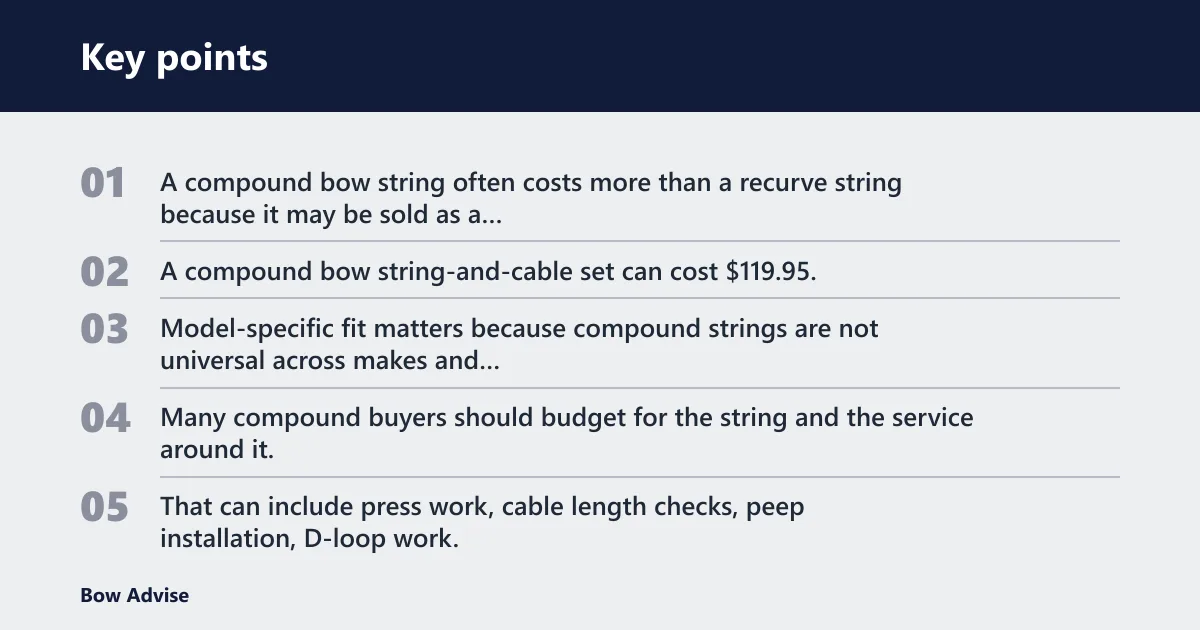
A compound bow string often costs more than a recurve string because it may be sold as a string-and-cable set, and the bow may need timing checks after installation. A compound bow string-and-cable set can cost $119.95, while a 60X BCY custom compound bow string costs $45.00. Model-specific fit matters because compound strings are not universal across makes and axle-to-axle setups.
Many compound buyers should budget for the string and the service around it. That can include press work, cable length checks, peep installation, D-loop work, and retiming after the new set settles.
Recurve bow string price range
Recurve bow strings are usually cheaper than compound sets, but material and length still change the price. A custom longbow and recurve bow string can cost $24.99, a two-color Dacron longbow and recurve custom bow string costs $34.99, and a 60X custom longbow and recurve bow string using 8125 costs $45.00. Fast Flight 652 standard longbow and recurve bow string costs $24.99.
Fit matters here too. Longbow and recurve compatibility depends on the exact bow length, brace height target, and whether the bow is rated for a faster material. Fast Flight-style materials should stay within the bow maker’s rating.
Longbow and crossbow fit differences
Longbows and recurves share some string material choices, but they do not share the same length or brace-height needs. Crossbow strings are a separate category, and a ready-to-ship Barnett crossbow string and cable replacement set costs $119.95. That price reflects the different build and fit demands of crossbow hardware.
Do not assume a bow string built for one class will fit another. Exact model compatibility matters most for compounds and crossbows, while recurve and longbow strings still need the right length, material, and loop style.
What affects bow string price most?
Material choice, strand count, model-specific fit, serving work, and pre-stretching drive most of the price difference. The cheapest string is not always the cheapest ownership choice if it stretches early, needs re-serving, or fails to hold tune through hunting season.
Material choice and strand count
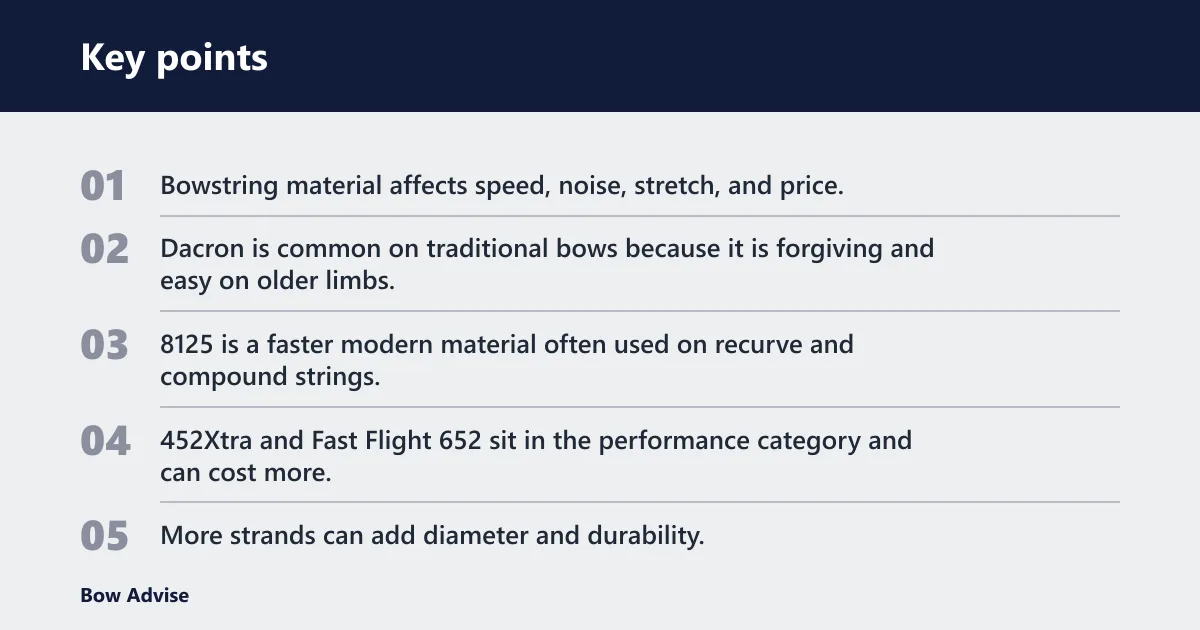
Bowstring material affects speed, noise, stretch, and price. Dacron is common on traditional bows because it is forgiving and easy on older limbs. 8125 is a faster modern material often used on recurve and compound strings. 452Xtra and Fast Flight 652 sit in the performance category and can cost more, especially when paired with custom build work.
Strand count also matters. More strands can add diameter and durability, while fewer strands can trim weight and speed. The right balance depends on the bow, arrow rest, serving size, and the maker’s recommendation.
Custom length and model-specific build
A custom string usually costs more when the bow needs exact length, color pattern, twist count, or model-specific cam and cable geometry. Compound bow string compatibility is especially tight. Some bows need a full string-and-cable set, and some need exact cam timing after installation. Recurve and longbow strings usually involve simpler sizing, but exact AMO length still matters.
Serving, loops, and end finish
String serving protects wear points at the nocking point, cams, cable slides, and center section. Serving material, serving length, and loop finish all affect price. A cheap string with weak serving can wear early where the nock or cam track contacts it, and that can force an early replacement or a re-serve job.
Watch the center serving for flattening, fraying, or separation. If the serving moves, or if the nocking point cuts into it, the string is no longer a low-cost buy.
Pre-stretching and quality control
Pre-stretching improves value by reducing creep, limiting peep rotation, shortening settling time, and helping shot-to-shot consistency. One store says all strings arrive pre-stretched using several hundred pounds of tension, and that its pre-stretch process can reduce settling to less than 10 shots. That kind of prep can matter more than a small sticker-price gap.
FieldArchery notes that a good bow string must maintain constant length under repeated stress and changing weather, and that good strings are expensive and replacement can become a major item of expense. That is why cheap strings that move a lot can end up costing more.
Compound bow string price explained
A compound bow string usually costs more than a recurve string because the purchase may include cables, and the bow often needs retiming, peep setup, and a press for installation. The finished price should include the work needed to get the bow back into a safe and accurate state.
String-only versus string-and-cable sets
Some compound setups need only a string replacement, but many require a string-and-cable set. The second price is higher because it covers more parts and usually demands a more complete setup process.
Installation, peep setup, and retiming cost
Compound installation cost can include a bow press, loop work, cam timing, and peep correction. That matters because a new set can shift timing as it settles. If a shop has to press the bow again after the first round of shots, the low sticker price can disappear fast.
Suppose a hunter buys a low-cost string that needs repeated retiming during the season. The string itself may look like a deal, but the extra labor and lost range time can make the total cost higher than a better pre-stretched build.
Ready-to-ship versus custom ordering
Ready-to-ship strings can help when the bow needs a quick turnaround and the model is common. Custom strings are the better call when the bow is unusual, the exact cam system matters, or the archer wants a specific material and color setup. Ready-to-ship is faster; custom is more exact.
A common first-timer mistake is buying a compound string by axle length alone and ignoring cam system, bow make, and cable layout. That can lead to poor fit and extra shop work.
Recurve bow string price and materials
Recurve bow string price is usually lower than compound pricing because the bow setup is simpler. Material still matters a lot. Dacron is common for a forgiving feel, while 8125 and Fast Flight 652 suit bows rated for faster string materials. Longbow and recurve compatibility should be checked before ordering.
Dacron versus Fast Flight
Dacron costs less in many traditional builds and is often chosen for older or more forgiving bows. Fast Flight 652 is a faster material and can improve performance on bows rated for it, but it should not be used on bows that are not designed for low-stretch materials. A Fast Flight 652 standard longbow and recurve bow string costs $24.99.
String length and strand count
Recurve and longbow strings are sized to the exact bow length and brace-height target. A custom longbow and recurve bow string can cost $24.99, while a two-color Dacron longbow and recurve custom bow string costs $34.99 and a 60X custom longbow and recurve bow string using 8125 costs $45.00. Strand count and material choice shift both feel and price.
When a recurve needs a custom string
A custom recurve string is worth considering when the bow uses a nonstandard length, a specific brace-height target, or a material upgrade from Dacron to 8125 or another performance material. Traditional archers often choose custom length for fit, while bowhunters may choose it for better consistency after break-in.
Are custom bow strings worth it?
Custom bow strings are worth the extra cost when fit, consistency, and bow-specific build quality matter more than the lowest sticker price. For simple setups or backup bows, a budget string can still make sense. For hunting bows, model-specific compounds, or weather-exposed gear, custom often pays back through better stability and fewer repeat adjustments.
When budget strings make sense
Budget strings work best for low-volume shooters, simple recurve setups, and bows with easy-to-find standard lengths. If the bow sees limited use, the owner stores it indoors, and the string material matches the bow’s rating, a lower-cost option can be reasonable.
When custom strings pay off
Custom strings pay off when the bow has tight tolerance needs, when peep rotation is a problem, or when repeated re-serves are likely to erase the savings from a cheap string. Pre-stretched custom strings can also reduce the settling period, which matters to bowhunters who want the bow ready without repeated tune sessions.
Buying for hunting volume and climate
Climate and shooting volume should drive the choice. Cold, wet, or highly variable weather can punish weak materials and poor serving work. Heavy practice and regular hunting use push the string toward the common two-year benchmark faster than casual shooting does.
Say your compound bow sees weekly practice and late-season hunts in damp weather. A stronger custom build with better pre-stretching may cost more up front, but it can stay in tune longer and reduce the chance of peep rotation before opening day.
How often should a bow string be replaced?
Replacement timing depends on shooting frequency, storage, weather, and how quickly the string loses length or serving integrity. A common benchmark is every two years, but that is not a guarantee. Frequent shooters may need replacement sooner, while lightly used bows may go longer if stored well and inspected regularly.
Typical replacement interval
One store says frequent shooters typically replace strings every two years. That is a useful planning point, not a fixed rule. A bow that sees many shots, a lot of weather, or frequent travel can need replacement earlier.
Wear signs to check
How do you know if a bow string is worn out? Look for fraying serving, broken strands, shiny flattened sections, dry fuzzing, peep rotation that keeps returning, and a visible change in brace height or tune. On compounds, repeated timing drift after adjustment is another warning sign.
Storage and weather effects
Heat, moisture, and long storage cycles can all affect string life. FieldArchery’s note about constant length under repeated stress and changing weather is the key point here: a string that stays stable indoors may move when it sees humidity swings, cold mornings, or long off-season storage.
- Inspect the center serving, end loops, and cam contact points before each shooting block.
- Check for creep by measuring brace height or peep position after the first few shots.
- Watch for strands that fuzz, separate, or flatten under the serving.
- Replace the string sooner if timing, peep position, or brace height keeps changing.
Frequently asked questions
How much does a bow string cost?
Bow strings are commonly priced at about $25 to $150, depending on bow type, material, and whether the purchase is string-only or a full set. Recurve and longbow strings often sit near the low end. Compound string-and-cable sets and crossbow sets usually sit much higher once setup is included.
What is the average price of a compound bow string?
A compound bow string often lands between $45 and $120 before labor, but the total can rise with installation, retiming, and peep setup. A 60X BCY custom compound bow string costs $45.00, while a compound bow string-and-cable set can cost $119.95.
How much is a recurve bow string?
A recurve bow string can cost $24.99 to $45.00 in common custom options, with Dacron and Fast Flight-style materials affecting the price. A custom longbow and recurve bow string can cost $24.99, while a 60X custom longbow and recurve bow string using 8125 costs $45.00.
Are custom bow strings worth the extra cost?
Custom bow strings are worth it when you need exact fit, better pre-stretching, or a specific material for your bow’s design. They are less compelling for a low-use backup bow. For hunting bows and compounds that are sensitive to peep rotation or creep, custom often saves trouble later.
What string material is best for my bow?
The best material depends on the bow’s rating and use. Always match material to the bow maker’s guidance.