Why Did Some Native American Bows Have No Shelf?
Many Native American bows had no shelf because they were built as natural-handheld self bows: grip, arrow spine, and release were matched so the arrow could leave cleanly without a cut-in shelf, which could disturb the bow’s intended function. Ignore that fit, and arrows kick left or right, lose speed, and become hard to tune. This guide explains why shelf-less designs worked, how the bow hand and arrow behaved together, and what modern bowyers can learn from them.
Bow hand, grip, and release style replace a shelf

Shelf-less bows were tuned as one system
Native American archery was nearly universal in the Americas by 1492, but bow design varied by region, nation, period, and material. Many bows were simple self bows, and some used sinew backing. In those builds, the bow hand, arrow shaft, string material, and release style were part of the same setup, so a shelf was not automatically useful.
A shelf is one way to support an arrow. On a shelf-less bow, the arrow can ride the hand, a rounded grip, or a small arrow pass formed by the bow’s natural shape. If the shaft, fletching, and release are matched well, the arrow clears without needing a carved ledge.
Why a shelf could be unnecessary or awkward
A true shelf is a cut or built-up support near the grip that gives the arrow a fixed rest point. That can help a modern archer center the arrow and repeat the same launch path. On a traditional self bow, though, a cut shelf can remove wood from a working area or change the bow’s feel in a way that conflicts with the original design.
That matters most on short bows and bows with narrow grips. A shelf can also change how the bow hand sits, which changes arrow clearance and the way the shaft bends around the bow at release. When the design already expects shoot-off-the-hand behavior, adding a shelf may solve a problem the bow did not have.
What is a bow shelf, and what does it do?
A bow shelf is the arrow rest area at the grip, where the shaft sits before the shot. Its main job is to give the arrow a repeatable place to start, which can improve side-to-side consistency and reduce contact at release. Many traditional bows worked well without one because the arrow and hand were already matched.
Shelf versus rounded handle or arrow pass
A cut shelf is not the same as a rounded handle. A rounded grip may still let the arrow pass over the hand, while the arrow pass is simply the path the shaft follows during release. Those details matter because a bow can be shelf-less yet still be shaped to guide the arrow in a predictable way.
Arrow clearance and launch behavior
When an arrow leaves the string, it bends around the bow before straightening in flight. If the hand position, shaft stiffness, and fletching are wrong, the arrow can strike the bow or leave at a bad angle. A shelf helps some bows with that problem, but it is not required when the rest of the setup is already matched.
No-shelf bow shooting setup by bow style
| Bow style | Arrow rest method | Likely arrow material | Typical draw weight range | Common tuning risk |
|---|---|---|---|---|
| Self bow | Shoot off the hand or a rounded grip | Wooden shaft, often with feather fletching | About 50 pounds was usually enough for most game | Poor spine match can push the arrow left or right |
| Sinew-backed bow | Hand support with careful shaft clearance | Wooden shaft, cane, or reed where local materials allowed | Often around hunting weight; some horse bows approached 80 pounds | Extra energy can punish weak shafts or sloppy release |
| Horn bow | Minimal support or hand-held launch, depending on form | Stiff wooden shaft matched to the bow’s power | Often higher power than many simple wood bows | Too-light arrows can react badly to the bow’s snap |
Quick checklist for modern replicas
- Keep the bow shelf-less if the historic form was meant for shoot-off-the-hand use.
- Use only a minimal shelf if the replica needs small clearance help and the design allows it.
- Match arrow spine to the bow’s draw weight and length.
- Keep the bow hand in the same spot for every shot.
- Check whether the arrow clears the grip without broadhead or fletching contact.
Were Native American bows shot off the hand?
Yes, many were. Shelf-less bows were often meant to be shot off the hand, with the arrow resting against the fingers or the side of a rounded grip. That method works when the shaft stiffness, bow length, and release are consistent. A shelf can help repetition, but it was not essential in many traditional systems.
Hand placement and repeatability
The hand matters because a small change in grip position changes the launch angle. A bow that is shot off the hand depends on repeatable finger pressure and the same palm placement every time. If the archer grips high one shot and low the next, the arrow path changes even when the bow itself has not changed.
Picture an approximately 48-inch replica with no shelf and a loose hand position. One shot rides the heel of the palm, the next rides a finger pad, and the arrows land in different spots even at the same distance. The bow has not become inaccurate; the launch point has shifted.
Arrow spine and release behavior
Arrow spine is the shaft’s stiffness. On a shelf-less bow, spine matters because the arrow must flex enough to clear the bow but not so much that it wanders badly in flight. If the shaft is too stiff, it can kick one way; if it is too weak, it can slap the bow and lose clean flight.
A common first-timer mistake is assuming a shelf will solve every tuning problem. It will not. A poor release, wrong shaft length, or weak fletching match can still send arrows left, right, or into the bow hand area.
How did bow shape and arrow setup work together?
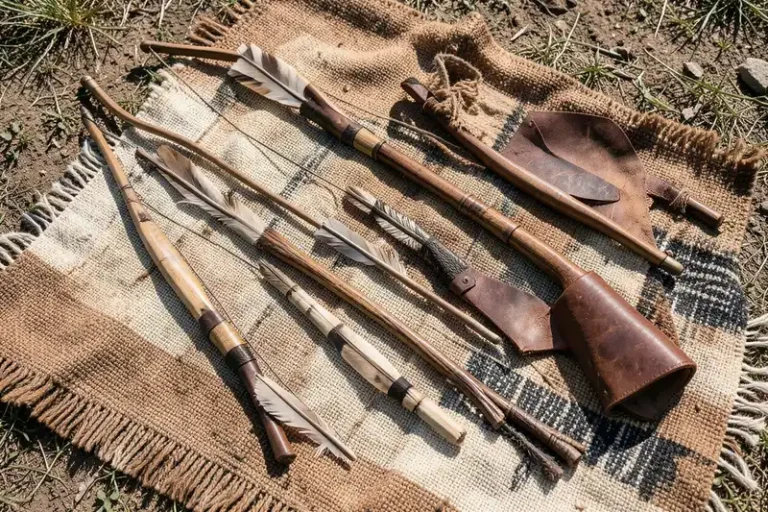
Bow shape and arrow setup were matched closely. Many arrows used wooden shafts, and feather fletching was common because it stabilizes flight and helps control trajectory. Stone, bone, and copper points were also used where local materials and hunting needs supported them. A bow did not work in isolation; the arrow completed the system.
Wooden arrow shafts and stiffness matching
Arrow shafts had to fit the bow’s strength and length. A long self bow from the eastern woodlands could favor a different shaft feel than a shorter plains bow, while the bowyer still aimed for clean flight. Cane and reed shafts were used in some places, and wood remained common where it was practical and available.
Common hunting practice favored arrows that flew straight enough for close and medium game, and approximately 50 pounds was usually enough for most game. That does not mean every bow used that draw weight. It means the bow and shaft had to be balanced for the task rather than for a shelf.
Feather fletching and flight stability
Feather fletching is commonly reported in Native American arrows, with some regional exceptions, including some polar cultures. Feathers stabilize the shaft after release, which matters even more when the arrow leaves from the hand rather than from a fixed shelf. Bad fletching setup can hide or worsen a spine problem.
Points and the last part of the tuning chain
Stone, bone, and copper points each change arrow balance and front weight. If the point is too heavy for the shaft, the arrow may behave weakly. If it is too light, the arrow may not recover its line quickly. The point, shaft, and fletching should all fit the bow, not fight it.
What materials made these bows stronger?
Strong Native American bows often came from local materials chosen for the job. Sinew backing added springiness and improved strength on wooden bows. Horn and sinew composite bows used layered construction for greater power, and they were used in some regions, including the Rocky Mountain area. Local wood and local string materials shaped the final design.
Sinew backing on wooden bows
Sinew is animal tendon backing applied to the back of a wooden bow. It helps the bow resist tension and can add lively cast when the bow is built well. Plains natives used woods reinforced with animal sinew, while eastern woodlands typically used long self bows. That difference matters because it changes how the bow stores and releases energy.
Horn and sinew composite construction
A composite bow combines horn and sinew layers, usually on a shorter form than many plain wood bows. That construction can produce greater power in a compact bow, which helped in some mounted or high-mobility settings. Some sinew-backed horse bows approached 80 pounds, but that figure belongs to specific forms, not to all Native bows.
Archaeological evidence in the American Southwest may date bows to AD 200-700, and the Basketmaker III period is when the bow and arrow replaced the atlatl. Anasazi bows were often made from gamble oak and mountain mahogany. Some Anasazi bows were very short, as little as 19 inches, while Apache bows could be 40 to 50 inches long, Comanche bows ranged from 42 to 56 inches long, and Cheyenne bows were described as 3.5 to 4.5 feet long.
Bowstrings from sinew or plant fiber
Bowstring material also followed local availability. Sinew strings were used in some places, while yucca or other plant fiber alternatives fit different regions. The string had to survive the draw and release without stretching so much that the arrow’s launch became inconsistent. That is another reason shelf-less bows depended on a carefully matched system.
Were short Native American bows used because of horseback hunting?
Sometimes, yes, but not everywhere and not for every nation. Short bows became common on the plains after horse adoption in some regions because mounted hunting favors mobility and easy handling. A shorter bow is easier to move in tight spaces, but it still has to match arrow length, release style, and the rider’s position.
Mounted shooting constraints
Horseback use changes the bowyer’s priorities. A mounted archer needs a bow that is compact, quick to nock, and less likely to snag. That creates tradeoffs in draw length and stability. A shorter bow can be practical from horseback, but it is not a universal answer for all Native nations or all hunting styles.
Suppose a plains-style replica is 44 inches long and the shooter tries to use long shafts meant for a tall longbow. The arrows may feel awkward, clear poorly, or behave inconsistently because the whole setup is mismatched. Changing only the bow length can expose every other setup error.
Frequently asked questions
Why did some Native American bows not have a shelf?
Because the bow, arrow shaft, and release were often designed to work together without one. A shelf was not always needed for clear arrow flight, and on some bows it could interfere with the original hand position or remove wood from a form meant to stay simple and flexible.
What is a shelf on a bow and why does it matter?
A shelf is the arrow rest area near the grip. It matters because it gives the arrow a repeatable launch point and can reduce contact at release. On many traditional bows, though, the same job was handled by the hand, grip shape, and careful arrow matching instead.
Were Native American bows shot off the hand or off the shelf?
Many were shot off the hand. That does not mean every bow was used the same way, but shelf-less shooting was common enough to be a core part of traditional design. The key was consistent hand placement and an arrow shaft tuned to the bow’s behavior.
Did all Native American bows use the same arrow-rest design?
No. Some bows had no shelf, some used a rounded grip, and some likely had forms that supported the arrow more than others. Regional materials, bow length, and shooting style all changed the arrow path. Treating all Native bows as one design hides those differences.
How did bow shape and arrow setup affect accuracy on traditional bows?
They affected it directly. A bow that is too short, too stiff, or paired with the wrong shaft can make arrows kick, drag, or lose consistency. Feather fletching, shaft spine, point weight, and hand position all influence whether the arrow leaves cleanly and flies predictably.
What materials made Native American bows stronger?
Sinew backing made many wooden bows stronger by adding tension resistance and springiness. Composite bows with horn and sinew layers could deliver more power in a shorter form. Local woods such as osage orange, ash, hickory, juniper, cedar, mulberry, birch, gamble oak, and mountain mahogany all played different roles depending on region and use.
How were Native American arrows matched to their bows?
By matching shaft material, stiffness, length, fletching, and point weight to the bow’s draw and shooting style. Wooden shafts were common, with cane or reed in some regions, and feathers helped stabilize the arrow. Stone, bone, or copper points changed balance, so they had to fit the rest of the setup rather than fight it.